Cold Email Copywriting: The Anatomy of a 10x Reply Rate Email
Most cold emails get ignored. Yours probably do too.
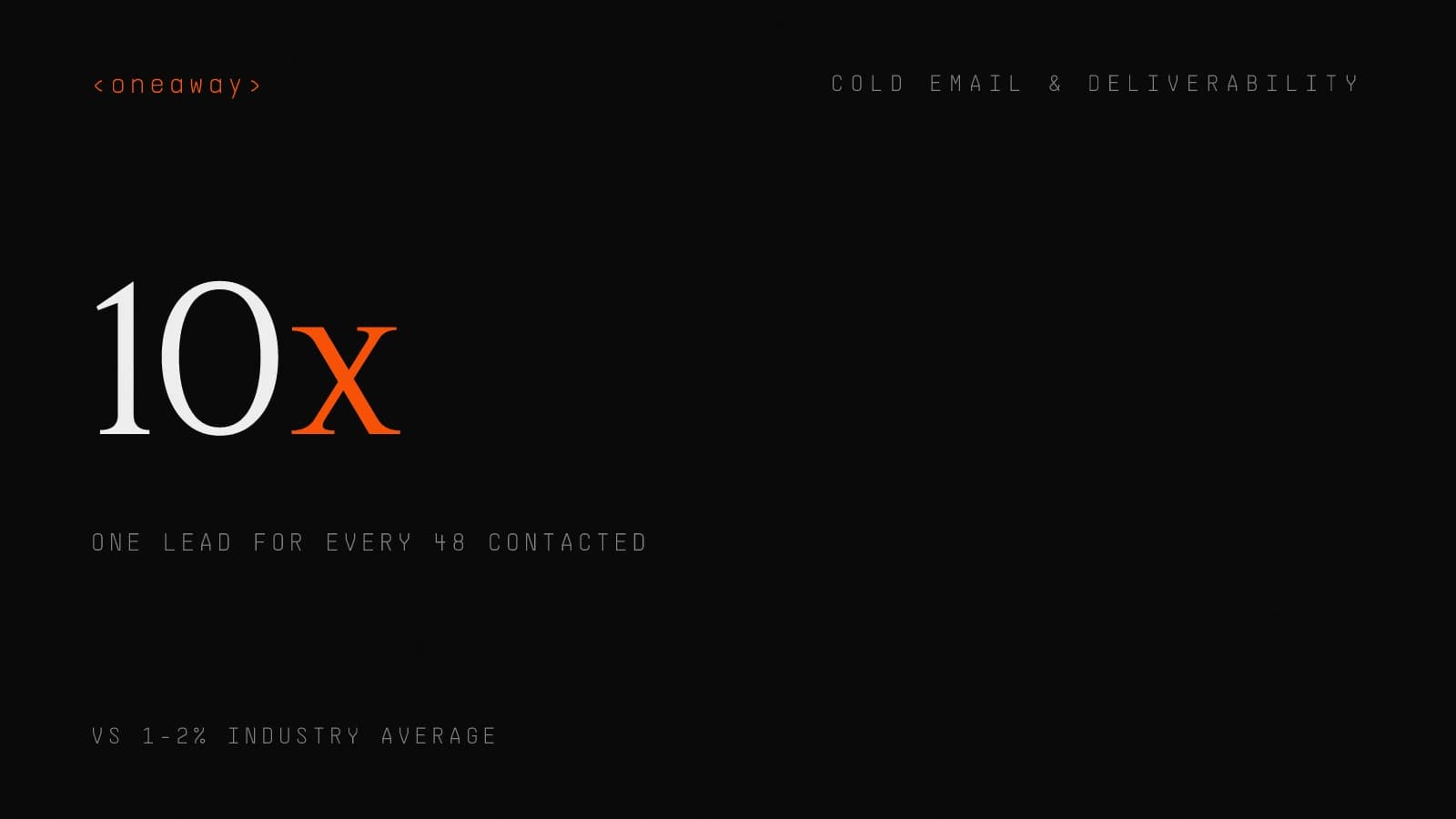
The average cold email reply rate sits around 1-2%. Most B2B companies celebrate hitting 3%. But the email I'm about to break down got our client one lead for every 48 people contacted—nearly 10x better than what most people see.
This isn't about fancy automation or expensive tools. It's about understanding why good copy works. Because without solid copywriting fundamentals, all the Clay workflows and AI scraping in the world won't save you.
Here's the exact email, the psychology behind each line, and a framework you can steal.
Quick Answer
The cold email broken down in this post generated one lead for every 48 contacts—nearly 10x the industry average of 1-2%. The keys: a 3-word subject line that creates curiosity without clickbait, a hyper-personalized opening that proves you did research, a specific case study with real numbers, and a low-friction CTA that makes saying yes feel easy.
The Email That Got 10x Results
Before we dissect it, here's the actual email:
Subject: One star review
Hey David,
I was browsing through your Google reviews, and it's tough seeing one like Joseph Manis's one star among the bunch.
Would it be helpful if you could block reviews like that from posting while every happy client left five stars without you even directly asking?
FJ Law used our product to add 27 five-star Google reviews in under a month while blocking two bad ones.
If I said I'd help you land five stars on the house, would you tell me you would try it?
That's it. No fancy formatting. No long pitch. Just strategic copy that converts.
Why Subject Lines Make or Break Everything
Three words: One star review.
That's the entire subject line. And it works for three specific reasons:
1. It's short
Long subject lines get truncated on mobile. Three words displays fully on any device.
2. It creates curiosity without being clickbait
The subject line doesn't promise or claim anything. It alludes to what's inside. There's a massive difference between "I can help you get more reviews!" and "One star review."
3. It connects to the email body
Here's where most people mess up. They write clever subject lines that have nothing to do with the email content. The prospect opens it, feels tricked, and deletes.
"One star review" delivers exactly what it promises—an email about a one-star review.
The key insight: Cold email isn't about selling. It's about curiosity. Can you get someone curious enough to click through the obstacles? The subject line and first line are your preview. Spend 80% of your time perfecting those two elements.
Subject Line Formula
| Element | What It Does | Example |
|---|---|---|
| Short (2-4 words) | Displays fully on mobile | "One star review" |
| Alludes to content | Creates curiosity | Not "I can help with reviews" |
| Connects to body | Builds trust | Delivers on the promise |
| Relevant to target | Shows you did homework | Only works if they have reviews |
The First Line Formula
"I was browsing through your Google reviews..."
This single line does more work than most entire emails. Here's why:
It's an observation about them, not a pitch about you.
Most cold emails start like this:
- "Hey David, I help companies do X..."
- "Hey David, I can help you with..."
- "Hey David, we specialize in..."
All of these are about the sender. Nobody cares about the sender.
Starting with "I was browsing through your Google reviews" immediately signals:
- I did research on your company
- This isn't a mass blast
- I have something specific to say
The observation doesn't require AI
This is important. The first line observation is pure strategy. You're thinking about what your target cares about and making a relevant comment. Nine times out of ten, you don't need fancy scraping—just clear thinking about your audience.
For this campaign, the target was local businesses with Google reviews. Saying "I was browsing through your reviews" is:
- Relevant (they all have reviews)
- Specific (it's about their business)
- Non-threatening (just browsing, not criticizing)
Advanced Personalization That Scales
"...and it's tough seeing one like Joseph Manis's one star among the bunch."
This is where the email goes from good to great. We're name-dropping an actual person who left a one-star review on this specific business.
How did we find this?
We used Clay to:
- Search the Google reviews of each lead
- Filter for one-star reviews
- Extract the name of the reviewer
This can be automated at scale. Can you argue the time to build this system equals manually checking each business? Maybe. But once built, it runs forever.
Why does this work?
When the prospect reads this line, they think: "How did they know about this?"
You're now demonstrating—without saying it—that you did real research on their company. Even though it's automated, the output feels deeply personal.
The psychological impact
This line stings a little. Seeing that specific negative review called out creates an emotional response. The prospect remembers the frustration of that review. They're now emotionally engaged with your email.
Personalization Comparison
| Approach | Example | Impact |
|---|---|---|
| No personalization | "Hey there, I help businesses..." | Deleted immediately |
| Basic personalization | "Hey David..." | Slightly better |
| Observation | "I was browsing your reviews..." | Opens curiosity |
| Specific detail | "...Joseph Manis's one star..." | Emotional engagement |
Dream Outcome Questions
"Would it be helpful if you could block reviews like that from posting while every happy client left five stars without you even directly asking?"
This is what I call a dream outcome question. You're painting a picture of their ideal scenario.
A simpler example
Let's say you're a personal trainer and your prospect wants to lose weight. You could ask:
"Would it be helpful if you could fit into that suit you want to wear to your best friend's wedding?"
The answer is obviously yes. That's the dream. That's what they're thinking about.
What makes this line work
- It frames the pain: "block reviews like that from posting"
- It offers the dream: "every happy client left five stars"
- It removes friction: "without you even directly asking"
The question format is key. You're not claiming you can do this—you're asking if it would be helpful. It's softer, less salesy, and makes them think about their situation.
Double duty
This line accomplishes two things simultaneously:
- States the dream outcome (more five-star reviews automatically)
- States the pain point (bad reviews getting posted)
Credit to my COO Balsha for this line. It's tight.
Social Proof That Actually Works
"FJ Law used our product to add 27 five-star Google reviews in under a month while blocking two bad ones."
At this point, the prospect still has no idea who you are. That's intentional. They should only learn about you toward the end.
This social proof line does several things at once:
1. It's quantified
Compare these two statements:
- "I promise I can help you get more reviews"
- "FJ Law added 27 five-star reviews in under a month"
The second one lands harder. Numbers create credibility. People resonate with specifics. You don't help "a lot of people"—you help 3,366 people. Be specific.
2. It includes a timeline
Jeff Bezos says it constantly: people want things fast. "27 reviews" is good. "27 reviews in under a month" is better.
Timeline creates urgency and believability. It's not some vague promise—it's a specific result in a specific timeframe.
3. It reinforces the offer
The social proof mirrors the dream outcome question. They asked about blocking bad reviews and getting five-star reviews. This line proves it's possible:
- 27 five-star reviews (the dream)
- While blocking two bad ones (the pain solved)
4. It's industry-relevant
"FJ Law" is clearly a law firm. For most campaigns, you'll use the same social proof. But if you have multiple case studies, match the social proof to the prospect's industry.
Social Proof Formula
| Element | Why It Works | Example |
|---|---|---|
| Company name | Specificity creates trust | "FJ Law" not "a client" |
| Quantified result | Numbers resonate | "27 five-star reviews" |
| Timeline | Speed sells | "in under a month" |
| Mirrors the pain | Reinforces relevance | "while blocking two bad ones" |
The Soft CTA
"If I said I'd help you land five stars on the house, would you tell me you would try it?"
Notice what this doesn't ask for:
- No meeting request
- No phone call
- No demo
We're asking if we could help them. For free.
Why soft CTAs work in cold email
The entire point of the first touchpoint is to draw curiosity. You're not closing a deal—you're opening a conversation.
Asking "do you have 15 minutes for a call?" is a big ask from a stranger. Asking "would you try something free that could help you?" is almost impossible to say no to.
The psychology
If you've received this email, you have a one-star review (we made sure via targeting), and someone's offering to help you get five-star reviews for free—why wouldn't you at least respond?
The reply rate proves it: one lead for every 48 contacts.
The Complete Framework
Here's how to reverse-engineer this for your own campaigns:
Step 1: Start with the email, then build the system
Write the ideal email first. Actually write it out. Then divide it up and figure out:
- What needs basic data (first name)
- What needs observation (strategy + thinking)
- What needs advanced scraping (automation)
Step 2: The skeleton
| Section | What It Does | AI/Automation Needed? |
|---|---|---|
| Subject line | Creates curiosity | No |
| First name | Basic personalization | Basic scraping |
| Observation | Shows research | Usually no—pure strategy |
| Advanced personalization | Creates "how did they know?" moment | Yes (Clay, etc.) |
| Dream outcome question | Paints the ideal scenario | No—iterate with A/B testing |
| Social proof | Builds credibility with specifics | No—same for most leads |
| Soft CTA | Opens conversation | No |
Step 3: The 80/20 rule
The biggest chunk of AI/automation effort goes into the observation and advanced personalization. If you lose them in the beginning, nothing else matters. They won't even open your email.
Spend 80% of your effort on:
- Subject line
- First line observation
- Personalized detail
The rest—dream outcome, social proof, CTA—you can iterate on with A/B testing, but they won't save a bad opening.
Working Backwards From Results
The reason this email hit 10x industry average isn't one element—it's how everything connects:
- Subject line alludes to what's inside
- First line delivers on that promise with an observation
- Personalized detail proves you did research and creates emotional engagement
- Dream outcome paints the picture of what's possible
- Social proof proves it's achievable with specifics
- Soft CTA makes responding easy
Each line flows into the next like a story. You're dancing, and the dance looks pretty.
Frequently Asked Questions
What reply rate should I expect from cold email?
Industry average sits around 1-2% for B2B cold email. A well-crafted campaign with proper targeting and personalization can hit 5-10%. The email in this breakdown achieved approximately 2% conversion to leads (1 per 48 contacts), which represented nearly 10x improvement for this specific market.
How important is the subject line versus the email body?
The subject line and first line are everything. They form the preview that determines whether someone opens and reads. Spend 80% of your effort perfecting those two elements. A brilliant email body won't help if no one opens it.
Do I need Clay or automation tools for effective cold email?
No. The observation in your first line is pure strategy—no AI required. Advanced personalization like name-dropping a specific reviewer helps, but it's not mandatory. You can write effective cold emails with just a prospect list and clear thinking about what your target cares about.
Should I ask for a meeting in my first cold email?
Generally, no. Asking for a meeting is a big ask from a stranger. A soft CTA—like offering something free or simply asking if they'd be interested—generates higher response rates. Save the meeting ask for follow-ups once you've established interest.
How long should a cold email be?
Short. The email in this breakdown is 4 sentences plus a question. Every word should earn its place. If a line doesn't create curiosity, prove credibility, or move toward a response—cut it.
Key Takeaways
- Cold email is about curiosity, not selling. Your job is to get them curious enough to respond, not to close a deal in the first message.
- Subject line + first line = 80% of success. These form the preview. Perfect them before worrying about anything else.
- Observations beat pitches. Starting with something about them ("I was browsing your reviews") always outperforms starting with something about you ("I help companies...").
- Quantify everything. "27 five-star reviews in under a month" beats "I can help you get more reviews." Numbers create credibility.
- Soft CTAs outperform hard asks. Offer to help for free. Ask if they'd try something. Don't ask for a meeting on first contact.
- The email should read like a story. Each line flows into the next. Subject line alludes, first line delivers, personalization proves research, dream outcome paints possibility, social proof builds trust, CTA makes responding easy.
- Work backwards. Write the ideal email first, then figure out what needs basic scraping, what needs advanced automation, and what's just strategy.
Want Cold Emails That Actually Convert?
If you want help building campaigns like this—with the research, personalization, and copy that gets 10x results—that's what we do at oneaway.
Check if we're a fitContinue Reading
Cold Email Agencies With a Live Client Portal in 2026
Which cold email agencies show you results, replies and meetings live, which send a weekly report or a spreadsheet, and who lets you keep your data when you leave.
Read more [ 12 MIN READ ]Cold Email Agency Pricing in 2026: 6 Agencies Compared
Agencies that publish a price charge $2,000 to $11,500 a month. Prices, setup fees and terms for OneAway, Sales.co, CIENCE, SalesHive, Belkins and Martal Group, plus what an in-house SDR costs.
Read more [ 14 MIN READ ]Best Cold Email Tools 2026, Ranked by Inbox Survival
I tested 9 cold email platforms sending 2M+ emails. Here's what actually lands in the inbox in 2026—ranked by deliverability, rotating sender capability, and real-world survival rates.
Read more