Vibe Working: Why Non-Technical Founders Are the Real Winners of the AI Era

“Vibe coding” dominated the AI conversation in 2025. Developers described intent, AI wrote the code, and suddenly anyone could ship software. It was the year's biggest buzzword.
Then Anthropic released Opus 4.6 on February 5, 2026, and their head of product, Scott White, said something that should have gotten more attention: “We are now transitioning almost into vibe working.”
Vibe working is what happens when AI stops being a coding assistant and starts running your entire business. Marketing campaigns. Sales research. Content pipelines. Client onboarding. The shift from “AI writes my code” to “AI executes my strategy across every function.”
And the people best positioned to capitalize on this shift are the ones nobody expected: non-technical founders.
Here is why.
Quick Answer
Vibe working is the evolution beyond vibe coding—instead of AI just writing code, it now executes entire business functions like sales research, content pipelines, and client onboarding. Non-technical founders are best positioned because the advantage has shifted from knowing how to code to knowing what a business needs. With 92% of US developers already using AI coding tools daily and 41% of all code now AI-generated, the barrier to entry has collapsed for anyone who can describe strategy clearly.
What Is Vibe Working?
Vibe coding meant describing what you wanted to build and letting AI generate the code. You didn't need to know Python or JavaScript. You needed to know what you wanted.
Vibe working extends that to everything else a business does.
Instead of telling AI “build me a landing page,” you tell it “research these 50 prospects, write personalized outreach for each one, schedule the emails across three time zones, and update my CRM with the results.” Instead of “write me a blog post,” you tell it “create a full content campaign: SEO article, newsletter, social posts, community engagement, all aligned to this core thesis.”
The term comes from Anthropic directly. When they released Opus 4.6, they positioned Claude Code as a tool that goes beyond writing software. Boris Cherny, the creator of Claude Code, said “coding is practically solved.” The frontier now is orchestrating AI across entire workflows.
Vibe coding vs. vibe working:
| Vibe Coding | Vibe Working |
|---|---|
| AI writes code based on natural language | AI executes entire business functions |
| Output: software features | Output: completed workflows and deliverables |
| Replaces developer labor | Replaces team labor across departments |
| Tool-specific (Cursor, Claude Code, Copilot) | Cross-functional (marketing, sales, ops, research) |
| Single-task execution | Multi-step orchestration |
The distinction matters because it changes who benefits most. When AI only wrote code, developers had the advantage. Now that AI runs workflows, the advantage goes to people who understand business strategy and can describe what needs to happen.
The Data Behind the Shift
The numbers tell a clear story: AI tools are already being used far beyond software engineering, and the adoption curve is accelerating.
AI Coding Has Gone Mainstream
- 92% of US developers use AI coding tools daily
- 41% of all code is now AI-generated
- 87% of Fortune 500 companies use at least one vibe coding platform
- 25% of Y Combinator Winter 2025 codebases are 95% AI-generated
- 60% of new software code will be AI-generated by 2026, according to Gartner
- 4% of all GitHub public commits are now authored by Claude Code, and that number doubles monthly
The Non-Developer Takeover
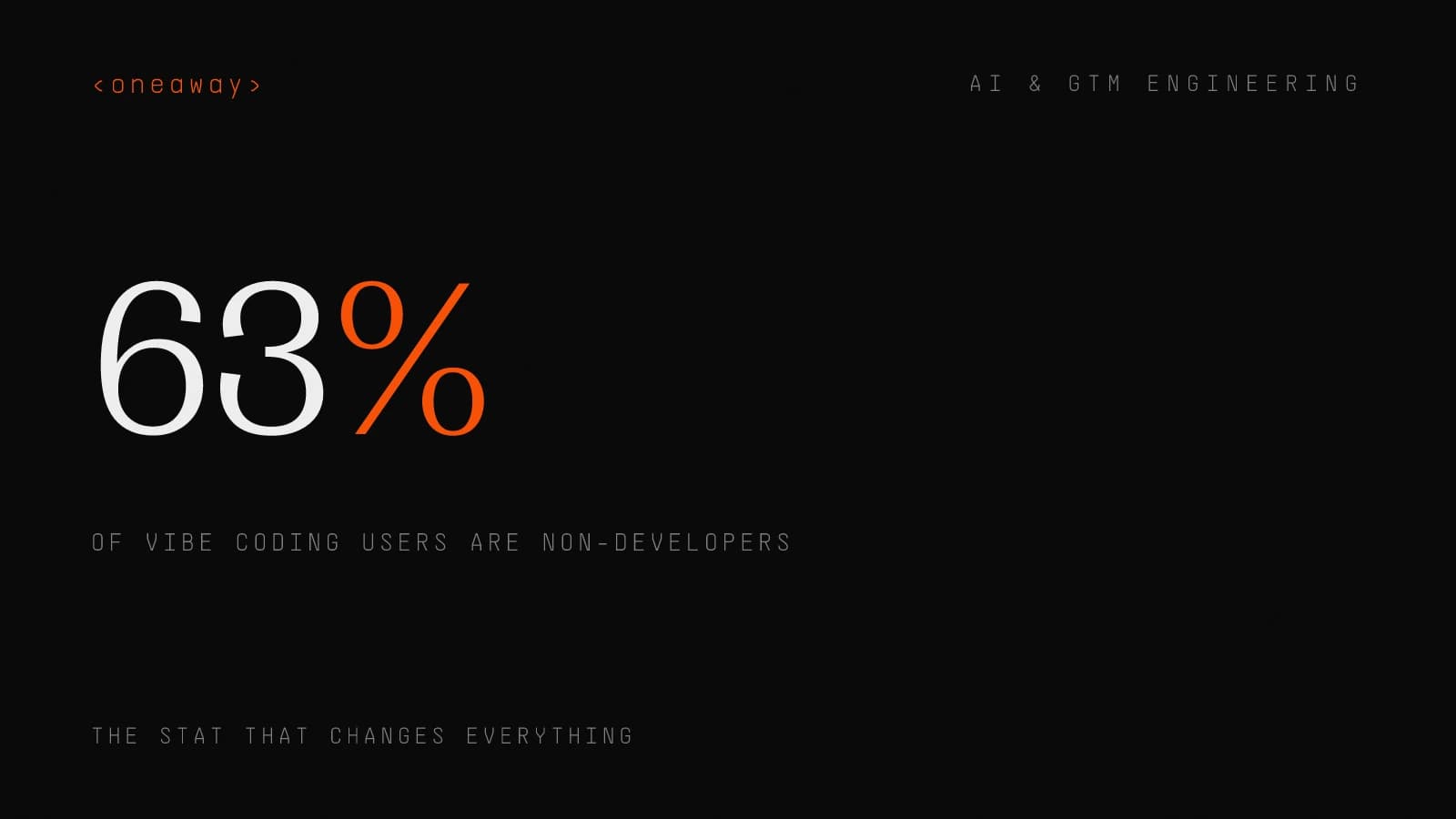
Here is the stat that changes everything: 63% of vibe coding users are already non-developers.
Read that again. The majority of people using AI to build software are not engineers. They are marketers, founders, operators, sales leaders, and consultants who figured out that describing what you want is more valuable than knowing how to code it.
This is why “vibe working” is a more accurate term. These people were never coding in the traditional sense. They were always working -building business systems, automating processes, creating content pipelines. AI just removed the bottleneck of needing a developer to translate their intent into reality.
The Marketing Industry is Already Shifting
- 60% of CMOs are spending less on content agencies because of AI
- 73% faster campaign development with AI agents
- 83% of CMOs believe full automation could eliminate the majority of agency costs
These numbers represent real budget decisions happening right now. CMOs are not speculating about what AI might do. They are already redirecting spend.
Claude Code's Growth Tells the Story
Claude Code's run-rate revenue has grown to over $2.5 billion. That growth is coming from a user base that skews heavily non-technical. When your revenue doubles while your non-developer user percentage climbs, that is the market telling you where the value is.
Why Non-Technical Founders Have the Advantage
There is a counterintuitive dynamic at play. Developers who have spent years learning to code often struggle with AI tools because they want to control the implementation details. They review every line, override AI suggestions, and micromanage the process.
Non-technical founders do the opposite. They describe the outcome they want and let the AI figure out how to get there. They are natural orchestrators because they have always relied on other people (or now, AI agents) to execute their vision.
Three Reasons Non-Technical Founders Win at Vibe Working
1. They think in outcomes, not implementation.
A developer asks: “How should this API endpoint handle authentication?” A non-technical founder asks: “When someone books a meeting, I need their company researched, a personalized brief created, and the whole thing in Notion before I walk into the call.” The second prompt produces more value because it describes a complete business outcome.
AI excels at multi-step orchestration when you give it a clear end state. The less you constrain the implementation path, the more creative and efficient the AI can be.
2. They don't have technical ego blocking them.
This sounds harsh, but it is real. Many experienced developers feel threatened by AI writing code “their way.” They hesitate to delegate because they believe they could do it better manually. Non-technical founders never had that option. Delegation is their default operating mode. AI is just the most responsive, cheapest, fastest team member they have ever hired.
3. They understand business context that AI needs.
AI can write code, but it cannot tell you which market segment to target, what messaging resonates with your buyers, or which leads are worth pursuing. Business strategy is the input that makes vibe working valuable. Without it, AI is just a fast employee with no direction.
Non-technical founders bring the strategy. AI brings the execution. That pairing produces more value than a developer who can do both at a mediocre level.
What I Did: Replacing My Head of Marketing with AI Agents
I need to tell you what happened at my company because it illustrates the shift better than any data point.
I run OneAway Growth Studio. We do outbound sales and growth systems for B2B SaaS companies. I am not a developer. I was a close-up magician, then an SDR at a startup, then a BDR at Salesforce, then a BDR at AWS. I got fired. I failed at an entertainment agency. I struggled for two years before figuring out how to scale an agency.
My background is sales and GTM strategy. I use Claude Code every day, but I have never written code from scratch in my life.
A few weeks ago, I made a decision: every LinkedIn post this week would be AI-generated. Not “AI-assisted” where I edit a draft. Fully AI-generated by my AI content team -a system of Claude Code agents that research, write, edit, and publish content autonomously.
The results:
One post hit 122 likes, 19 comments, 1 repost, and 3,600 impressions. That outperforms most human-written content on LinkedIn, including posts from people who charge $5,000/month for content strategy.
This was not a one-off. The system consistently produces content that performs at or above the level of a dedicated marketing hire. I replaced my head of marketing function with AI agents that cost a fraction of a salary, work 24/7, and improve every week as I refine the prompts and workflows.
How the System Works
The AI content team operates on a pipeline model:
- Research agent -Scans industry news, competitor content, trending topics, and my past high-performing posts to identify what to write about
- Writing agents -Multiple agents generate different content types in parallel: SEO articles, newsletters, LinkedIn posts, Twitter threads, community posts
- Quality agent -Reviews all content against brand guidelines, checks for consistency, flags anything that sounds off
- Distribution -Content gets formatted and queued for each platform
The whole pipeline runs from a single prompt. I describe the topic and core thesis. The AI team handles everything else.
The important part: I built this system with zero coding knowledge. I described what I wanted. Claude Code built it. I refined the outputs. That is vibe working.
The Orchestrator Economy
The new job title that matters is not “developer” or “marketer” or “sales rep.” It is orchestrator.
An orchestrator describes intent and AI executes. They manage a fleet of AI agents the same way a CEO manages a team of employees -setting direction, reviewing output, and making strategic decisions about resource allocation.
Non-technical founders launching paid products in 2–4 weeks with AI tools are orchestrators. A single founder acting with the speed of a 10-person team is an orchestrator. CMOs replacing agency contracts with AI workflows are orchestrators.
What Orchestrators Actually Do
- Define the outcome -What needs to happen, in specific terms
- Design the workflow -What steps need to occur in what order
- Select the tools -Which AI models and integrations handle each step
- Review and refine -Check outputs, adjust prompts, improve the system over time
- Make strategic decisions -Decide what to build next based on what produces results
None of these tasks require writing code. All of them require business judgment, domain expertise, and clear communication.
The Skill Stack That Matters Now
If you are a non-technical founder, here is what you should be developing:
- Prompt engineering -The ability to describe what you want with enough specificity that AI executes correctly on the first pass
- Workflow design -Understanding how to break complex business processes into discrete steps that AI can handle
- Quality judgment -Knowing whether AI output is good enough to ship or needs refinement
- Tool literacy -Staying current on which AI tools do what, and how to connect them
- Strategic thinking -The business context that makes AI output valuable instead of generic
Technical founders have some of these skills. But non-technical founders who have spent years managing teams, selling products, and building businesses have been developing these skills their entire career. Vibe working just made them directly applicable.
What This Means for Marketing Teams and Agencies
The data is already showing the impact. 60% of CMOs reducing agency spend. 73% faster campaign development. 83% believing full automation could eliminate most agency costs.
Agencies that sell execution -writing blog posts, designing social content, running email sequences -are the most exposed. Their value proposition was “we do the work so you don't have to.” AI does the work faster and cheaper.
Agencies that sell strategy -defining positioning, identifying market opportunities, designing go-to-market plans -still have significant value. Strategy requires the kind of contextual business understanding that AI does not have. Yet.
The Timeline
This is happening faster than most marketing leaders expect. Claude Code went from launch to $2.5 billion run-rate revenue in months. AI agent capabilities are improving weekly. Every month, the list of tasks that require a human gets shorter.
For non-technical founders running lean operations, this is the opportunity. You can now compete with companies that have 10x your headcount by deploying AI across every business function. Your marketing team is AI agents. Your research team is AI agents. Your content team is AI agents.
The constraint is no longer budget or headcount. The constraint is how clearly you can describe what you want.
How to Start Vibe Working Today
If you are a non-technical founder who wants to start operating this way, here is the practical path:
Step 1: Identify Your Highest-Value Repetitive Work
Look at what you or your team spend the most time on each week. Content creation. Lead research. Email sequences. Client reporting. Pick the one that is most time-consuming and most formulaic.
Step 2: Describe the Workflow in Plain Language
Write out every step of that process as if you were training a new employee. “First, find 10 companies that match these criteria. Then pull the CEO's LinkedIn profile. Then write a personalized email that references their most recent funding round.” The more specific you are, the better AI performs.
Step 3: Start with Claude Code
Claude Code is where vibe working started, and it remains the most capable tool for orchestrating complex workflows. You interact with it in plain English. You describe what you want. It builds the system. You do not need to know how the code works -you need to know what you want the code to accomplish.
Step 4: Build in Layers
Do not try to automate everything at once. Start with one workflow. Get it working reliably. Then add the next one. Each system you build teaches you how to describe intent more precisely, which makes every subsequent system better.
Step 5: Measure and Iterate
Track the output quality of your AI systems the same way you would track employee performance. What is the engagement rate on AI-generated content? What is the response rate on AI-written emails? Use data to refine your prompts and workflows.
Frequently Asked Questions
What is vibe working vs vibe coding?
Vibe coding is using AI to write software by describing what you want in natural language. Vibe working extends this to all business functions -AI executes marketing campaigns, sales workflows, research processes, and operational tasks based on natural language instructions. Vibe coding is a subset of vibe working.
Can non-technical founders really use AI tools like Claude Code?
Yes. 63% of vibe coding users are already non-developers. Tools like Claude Code are designed to work with plain language instructions. You describe the outcome you want and AI handles the implementation. No programming knowledge is required.
Is AI-generated content actually good enough to publish?
It depends on the system you build around it. Raw AI output from a single prompt often sounds generic. But a well-designed pipeline with research, writing, editing, and quality-check stages produces content that consistently performs at or above human-written levels. My AI-generated LinkedIn posts regularly outperform industry benchmarks.
How much does vibe working cost?
Claude Code pricing is usage-based. For most small businesses, running AI agents across multiple workflows costs a fraction of a single full-time hire. The economics get better as you scale because AI marginal costs decrease while human marginal costs increase.
Will vibe working replace marketing teams?
It is already replacing certain marketing functions. Execution-focused roles -content writing, social media management, email sequence creation -are the most affected. Strategy roles that require deep business context and creative direction remain valuable. The shift is from large teams doing execution to small teams doing strategy with AI handling the execution.
What tools do I need to start vibe working?
Claude Code is the primary tool for building and orchestrating AI workflows. Beyond that, the specific tools depend on your use case: CRMs for sales workflows, content management systems for publishing, data enrichment tools for research. The AI helps you connect them.
Key Takeaways
- Vibe working is the evolution of vibe coding -AI executing entire business functions, not just writing code
- 63% of AI coding tool users are non-developers, making this a mainstream business shift
- Non-technical founders have a structural advantage because they think in outcomes and delegate by default
- 60% of CMOs are already reducing agency spend due to AI capabilities
- The new high-value skill is orchestration -describing intent clearly enough that AI can execute
- AI-generated content, when built on proper pipelines, performs at or above human-written levels
- Non-technical founders can now operate with the speed and output of 10-person teams
- The constraint is no longer technical skill or headcount -it is how clearly you can articulate what you want
Xavier Caffrey is the founder of OneAway Growth Studio, where we build AI-powered growth systems for B2B SaaS companies. If you want to see what vibe working looks like applied to your sales and marketing pipeline, reach out here.
Continue Reading
Best AI Sales Forecasting Models in 2026, Ranked by Accuracy
I tested 11 AI sales forecasting models with real pipeline data. Here's what actually works, ranked by accuracy, cost, and whether your CRM can handle it.
Read more [ 14 MIN READ ]Best AI Sales Team Workflows in 2026, Ranked by Time Saved
I tested dozens of AI tools sales team workflows. Here's what actually saves time in 2026, ranked by hours recovered per rep per week—with real implementation data.
Read more [ 18 MIN READ ]Best AI GTM Tools for Revenue Teams in 2026, Ranked by Impact
I've tested dozens of AI GTM tools as a former AWS/Salesforce SDR turned GTM engineer. Here's what actually moves revenue in 2026, ranked by real-world impact.
Read more