AI for Sales in 2026: What's Working Now and What's Next
As an SDR at Salesforce and AWS, I can tell you exactly what would've happened if I'd told my manager that **autonomous AI agents would be booking 40% of my meetings** by 2026. She would've laughed me out of the room.
Fast forward to today. I run a GTM engineering agency, and we're deploying AI sales tools that would've felt like science fiction during my quota-carrying days. The difference between then and now isn't incremental—it's exponential. Our clients are seeing 3-5x increases in pipeline using the right AI stack, while others are burning budget on tools that sound impressive but deliver nothing.
Here's what's actually working in AI for sales right now, what's overhyped garbage, and what you need to deploy before your competitors do. This isn't theory—these are patterns I'm seeing across 40+ B2B clients and my own painful lessons from the field.
Quick Answer
The AI sales tools actually working in 2026 are autonomous multi-step agents, predictive intent data, and AI-powered personalization at scale. Teams deploying the right stack see 3-5x pipeline increases and 200-300% productivity gains, with SDRs going from 40 personalized emails per day to 300 while improving reply rates from 4% to 11%. However, most AI sales tools are still overhyped — only about 12 out of 60+ platforms tested are worth the implementation effort.
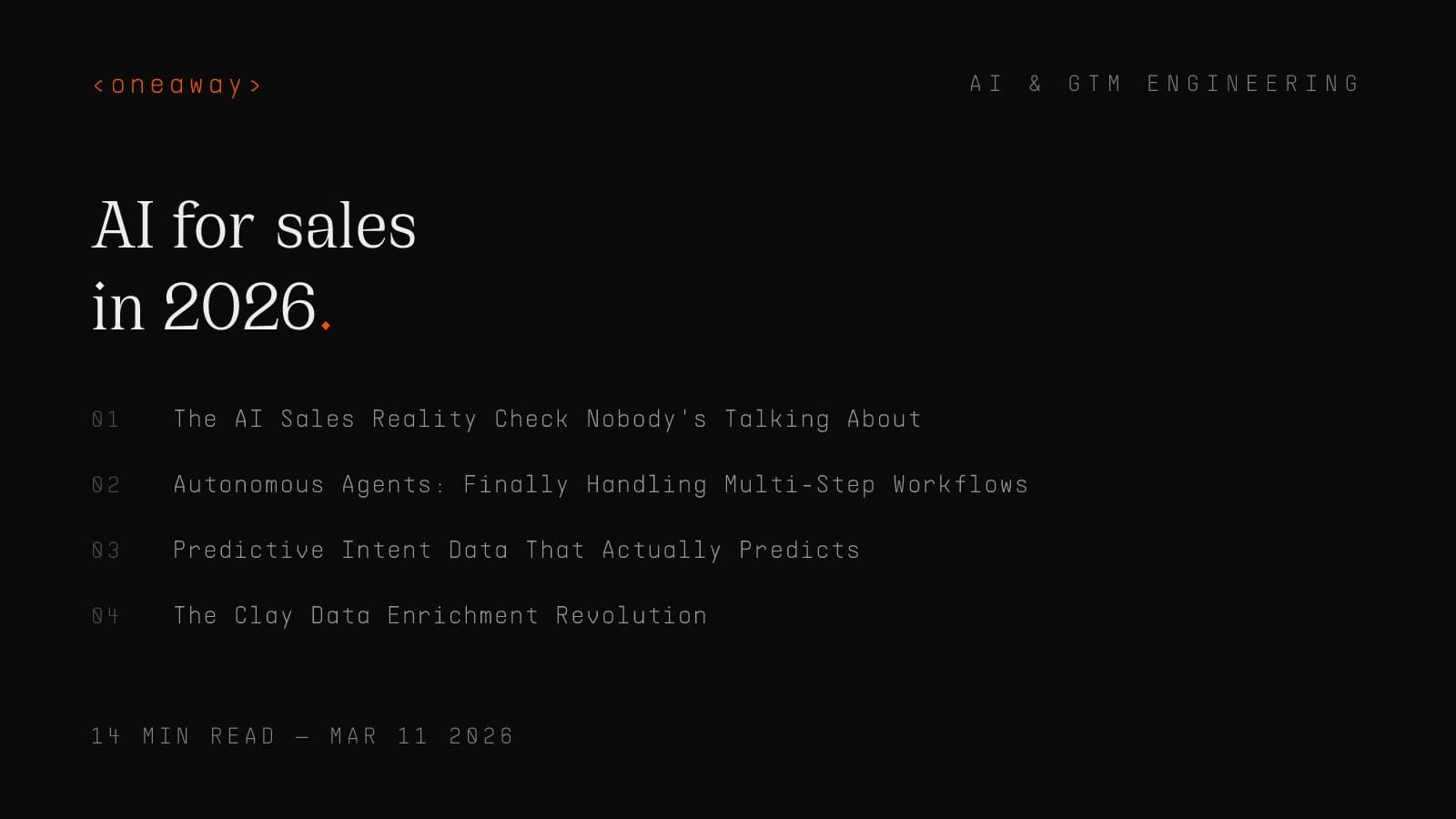
The AI Sales Reality Check Nobody's Talking About
Let me start with some brutal honesty: most AI sales tools are still garbage. I've tested probably 60+ platforms in the last 18 months, and maybe 12 are worth the implementation effort.
The problem isn't the technology—it's that most vendors are selling AI-washed features that are just rules-based automation with a ChatGPT wrapper. I saw this firsthand with a Series B SaaS client who'd spent $47K on an "AI SDR platform" that was literally just sending templated emails with {{firstName}} tokens.
But here's the thing: the tools that actually work are creating an unfair advantage so massive that I'm seeing 200-300% productivity gains on the teams that deploy them correctly. Gartner predicts that by 2030, 70% of routine sales tasks will be automated—but the winners are the teams automating them in 2026, not 2029.
When I was at AWS, I spent probably 6-8 hours a day on manual research and data entry. Checking if a lead matched our ICP. Finding the right contact. Researching their tech stack. Crafting personalized openers. Logging everything in Salesforce.
Today, my team does that in 45 minutes. Not because we work faster—because the AI does the grunt work while we focus on the conversations that actually matter.
Autonomous Agents: Finally Handling Multi-Step Workflows
This is the big one. Autonomous AI agents are finally reliable enough to handle complex, multi-step sales workflows without human intervention at every stage.
I'm talking about agents that can:
We recently deployed this for a fintech client. Their AI agent now handles the entire first touchpoint workflow: identifies accounts showing intent, enriches contact data, researches recent company news, generates personalized email copy, sends the email, monitors replies, and flags conversations that need human attention.
The result? Their SDR team went from 40 personalized emails per day to 300. More importantly, their reply rate went from 4% to 11% because the research quality is actually better than what their junior SDRs were doing manually.
Here's what shocked me: the AI agent caught a prospect mentioning a relevant pain point in a podcast interview from three weeks prior. No human SDR would've found that. The prospect replied in 20 minutes and they closed a $180K deal six weeks later.
- Research accounts — across multiple data sources in parallel
- Enrich contact records — with 15+ data points from Clay, ZoomInfo, and LinkedIn
- Generate personalized messaging — based on actual research, not templates
- Execute multi-channel sequences — across email, LinkedIn, and even phone
- Qualify inbound leads — and route them to the right rep
- Update CRM records — without anyone touching Salesforce
The Tech Stack That Powers This
The key is integration. These tools only work when they're connected to your CRM, your intent data, and your messaging platforms. I've seen too many teams buy the software but never actually connect the pipes.
- 11x.ai — Full autonomous SDR replacement—handles research through booking
- Artisan — AI BDR platform with strong personalization engine
- Clay — Data enrichment powerhouse that feeds these agents (more on this below)
- Relevance AI — Build custom agents for specialized workflows
Predictive Intent Data That Actually Predicts
Intent data used to be a joke. I remember at Salesforce, we had an intent platform that would flag accounts as "high intent" because someone from their company read a blog post. Useless.
2026 intent data is different. We're now seeing AI-powered sales intelligence platforms that combine:
I'll give you a real example. We set up a client in the dev tools space with a predictive intent model that monitors GitHub activity, engineering blog posts, job postings, and tech stack changes.
When a company starts hiring Python engineers, posts about scaling challenges, and their CTO tweets about microservices migrations, the AI flags them as high-intent three weeks before they start taking sales calls. Our client's SDRs reach out while they're still in research mode, not when they're already talking to three competitors.
Their conversion rate on these accounts is 34%, compared to 8% on cold outbound. The difference isn't the pitch—it's the timing.
- Buying signals — from web activity and content consumption
- Organizational changes — like new hires, funding rounds, leadership shifts
- Technographic data — showing tech stack changes or new tool adoption
- Behavioral patterns — that historically correlate with purchase decisions
Intent Platforms Actually Worth Using
The mistake I see teams make is buying intent data but not acting on it fast enough. You need to hit high-intent accounts within 24-48 hours. We built Slack alerts that ping reps the moment an account crosses the intent threshold.
- 6sense — Best-in-class for enterprise, pricey but worth it for deal sizes >$50K
- Common Room — Killer for product-led growth companies tracking community signals
- Koala — Strong product usage + intent correlation for PLG
- UserGems — Tracks job changes and champion movements—underrated signal
The Clay Data Enrichment Revolution
I need to talk about Clay specifically because it's fundamentally changed how we build outbound programs.
For those who don't know, Clay is a data enrichment and research automation platform that lets you waterfall across 50+ data providers, scrape LinkedIn, pull from APIs, and use AI to synthesize research—all in a spreadsheet-like interface.
When I was an SDR at AWS, I'd spend 30-45 minutes researching each account before I felt confident reaching out. I'd check their website, LinkedIn, recent news, tech stack, funding history, and try to find some personalized hook.
With Clay, my team does this for 300 accounts in an hour. Here's a real workflow we built for a client:
The output is a Google Sheet with every data point you need to write a genuinely personalized message. Not "I saw you work in fintech" personalization—actual "I noticed your VP of Engineering mentioned scaling challenges on the Q3 earnings call" personalization.
Clay data enrichment is the foundation of every high-performing AI prospecting program I've built in 2026. Without it, you're just sending better-written spam.
- Step 1 — Upload target account list (from intent data or ICP filters)
- Step 2 — Waterfall enrichment across Apollo, ZoomInfo, Clearbit, Prospeo for contact data
- Step 3 — Scrape LinkedIn profiles and company pages
- Step 4 — Pull tech stack from BuiltWith and Wappalyzer
- Step 5 — Check recent funding, job postings, and news via APIs
- Step 6 — Feed all data into GPT-4 to generate personalized research summaries
- Step 7 — Push to CRM or outbound platform
The ROI Reality
Clay costs about $800/month for a solid outbound program. One of my clients was paying an SDR $75K/year to do manual research. That SDR could research maybe 20 accounts per day thoroughly.
Clay does 500+ per day. The SDR now focuses entirely on conversations and strategy. They went from $400K in pipeline per quarter to $1.1M. Same headcount.
AI Prospecting That Actually Converts
Let's talk about AI prospecting that actually generates pipeline, not just activity metrics.
The biggest shift I've seen is moving from "AI-generated templates" to AI-powered research synthesis. Bad AI prospecting sounds like this:
> "Hi {{firstName}}, I noticed {{companyName}} is in the {{industry}} space. We help companies like yours with {{vague value prop}}. Would you be open to a quick call?"
That's not AI. That's mail merge with extra steps. Good AI prospecting uses the AI to actually understand the prospect's context and synthesize insights a human would miss.
Here's an example from a campaign we ran for a marketing automation client. Instead of generating email copy with AI, we used AI to:
The email wasn't written by AI—it was written by the SDR using the AI's research. But that research took 90 seconds instead of 45 minutes.
Reply rate: 18%. Compared to their previous "AI-generated" campaign at 3%.
- Analyze the prospect's recent content — blog posts, LinkedIn activity, podcast appearances
- Identify their current challenges — based on job postings, tech stack gaps, public complaints
- Find mutual connections — and warm intro paths
- Surface relevant case studies — from similar companies in their industry
The Personalization Paradox
Here's what I've learned: AI lets you personalize at scale, but only if you resist the temptation to actually scale too fast.
I see teams use Clay to enrich 10,000 contacts, then blast all of them with "personalized" AI messages. The personalization is surface-level and the inbox placement tanks because the sending patterns look like spam.
The teams winning with AI prospecting are doing 100-300 highly researched touches per week, not 5,000 mediocre ones. Quality still beats quantity—AI just raises the ceiling on what "quality at scale" means.
Real-Time Coaching Transforms Live Calls
One of the most underrated applications of AI for sales is real-time call coaching. This tech has gotten scary good in the last 12 months.
I'm talking about AI that listens to your sales calls live and:
I was skeptical until I saw it in action. We implemented this for a client whose AEs were struggling with discovery calls—they'd jump to demo too fast and miss key pain points.
The AI started flagging in real-time when the prospect mentioned a pain point but the rep didn't dig deeper. It would literally pop up a card that said: "Ask about budget impact of this issue."
Within six weeks, their discovery-to-close rate improved from 22% to 31%. The reps weren't more talented—they were getting better prompts in the moment when it mattered.
- Surfaces relevant battlecards — when specific competitors or objections are mentioned
- Flags when you're talking too much — or not asking enough questions
- Suggests follow-up questions — based on what the prospect just said
- Transcribes and extracts action items — automatically
- Identifies coaching opportunities — for managers to review
Platforms Delivering Real Results
The ROI is almost always there if your deal sizes are >$15K. Below that, the juice might not be worth the squeeze unless you're high-velocity.
- Gong — The category leader, best analytics and real-time support
- Chorus.ai — Strong if you're in the ZoomInfo ecosystem
- Grain — Best for smaller teams, more affordable
- Attention — Newer player with impressive real-time coaching features
Automated CRM Enrichment (Finally)
If you've ever been an SDR, you know the pain: spending 40% of your day updating Salesforce. Contact info, account details, activity logging, opportunity notes—it's soul-crushing busy work.
Automated CRM enrichment is finally solving this, and it's one of the highest-ROI AI applications for sales teams.
Here's what's now possible:
I'll give you a specific win. We set this up for a Series A cybersecurity company whose CRM data was maybe 30% accurate. Contact info was stale, accounts were missing firmographic data, and nobody trusted the pipeline numbers.
We implemented automated CRM enrichment using Clay + Clearbit + a custom Zapier workflow. Every night, it:
Within two months, their data accuracy went from 30% to 87%. More importantly, their reps stopped ignoring the CRM because it was actually useful instead of a compliance checkbox.
- Checked every contact — against current employment data
- Enriched accounts — with employee count, tech stack, and funding data
- Flagged duplicates — and merged records
- Updated industry classifications — based on current website content
Hyper-Personalization at Scale Without the BS
Let me be clear about what hyper-personalization at scale actually means, because this term gets abused constantly.
It does NOT mean:
Real hyper-personalization means using AI to synthesize multiple data sources into genuinely relevant insights that a human would care about.
Here's a campaign we ran that illustrates the difference. Client sold to CFOs at mid-market companies. Instead of the usual "I help CFOs save money" garbage, we built a workflow that:
The AI then generated a one-paragraph insight for each CFO based on these signals. Something like:
> "I noticed [Company] raised a Series B in Q4 and has been aggressively hiring across engineering and sales. As you scale from 80 to 150+ employees, one of the biggest hidden costs I see CFOs miss is [specific pain point]. We helped [similar company] reduce this by 40% during their similar growth phase."
That's real personalization. It required AI to synthesize the data, but a human reviewed and sent each one. Reply rate was 23%. Booked 37 meetings from 160 sends.
- Pulled their recent funding data — and growth trajectory
- Analyzed their job postings — to understand hiring priorities
- Checked their tech stack — for relevant integrations
- Found recent executive content — or earnings calls mentioning relevant challenges
What Doesn't Work (And What to Avoid)
Alright, let's talk about the AI sales tools and tactics that are complete wastes of money in 2026.
I'm doing this because I've burned budget on all of these, and I want to save you the pain.
- "AI SDRs" that just send templates — If the tool's main feature is "AI-generated emails" but it doesn't do research, it's garbage. You're paying $500/month for slightly better ChatGPT prompts.
- Voice AI that sounds robotic — I tested six AI voice platforms for prospecting calls. Five of them sounded like obvious robots within 10 seconds. Prospects hang up. Not ready yet.
- AI that requires constant babysitting — If you're spending more time reviewing and fixing AI outputs than you'd spend just doing it yourself, the tool isn't saving you time.
- Platforms without proper CRM integration — I cannot tell you how many "revolutionary" AI tools I've tested that require manual CSV exports and imports. In 2026, if it doesn't have native Salesforce/HubSpot integration, walk away.
- AI that promises full autopilot — Any vendor telling you to "set it and forget it" is lying. The best AI sales tools require human oversight, strategy, and continuous optimization.
- Cheap AI tools with terrible data — Data quality matters more than AI quality. A dumb tool with great data beats a smart tool with garbage data every time.
The Real Test
Here's how I evaluate any AI sales tool now: Does this save my team at least 10 hours per week, or does it improve conversion rates by at least 20%?
If it doesn't clear one of those bars within 30 days, we cut it. Most tools don't make it.
Building Your AI Sales Stack for 2026
Alright, here's the practical part: how to actually build an AI for sales stack that drives revenue instead of just burning budget.
I'm going to give you the exact stack I'd deploy if I was starting from scratch today:
Foundation Layer: Data & Intelligence
- Clay ($800-2K/month) — Data enrichment and research automation. Non-negotiable foundation.
- 6sense or Koala ($1.5K-3K/month) — Intent data and account intelligence. Choose based on your GTM motion—6sense for traditional B2B, Koala for PLG.
- ZoomInfo or Apollo ($1.2K-2K/month) — Contact database. I prefer Apollo for SMB, ZoomInfo for enterprise.
Execution Layer: Outbound & Engagement
- Smartlead or Instantly ($100-400/month) — Email infrastructure with strong deliverability. Connect to Clay for personalization.
- 11x.ai or Artisan ($1K-3K/month) — Autonomous agents for handling research-to-outreach workflows. Only deploy if you have >$50K in outbound budget.
- Phantombuster ($100-300/month) — LinkedIn automation that doesn't get you banned. Use sparingly.
Intelligence Layer: Calls & Coaching
- Gong or Grain ($1K-2.5K/month) — Call intelligence and real-time coaching. Gong if you have budget, Grain if you don't.
- Fireflies ($10-40/month) — Basic transcription and note-taking if you're not ready for full call intelligence.
Optimization Layer: CRM & Operations
Total monthly investment: $6K-15K depending on team size and deal values. That sounds like a lot until you realize it's replacing 2-3 SDR headcount worth of manual work, or it's doubling the output of your existing team.
The mistake teams make is trying to deploy everything at once. Here's the rollout sequence I recommend:
Most teams see measurable pipeline impact within 60-90 days if they follow this sequence. The key is actually using the tools, not just buying them.
- Month 1 — Deploy Clay + your contact database. Build enrichment workflows. Get data flowing.
- Month 2 — Add intent data and CRM enrichment. Start identifying high-value targets.
- Month 3 — Layer in outbound automation and begin scaled personalization.
- Month 4+ — Add autonomous agents, call intelligence, and advanced workflows.
What's Coming in 2027: The Next Wave
I don't pretend to have a crystal ball, but based on what I'm seeing in beta programs and early-stage startups, here's what's coming in the next 12-18 months:
Voice AI Gets Real
Voice AI for sales calls is about to cross the "uncanny valley" threshold. The current generation sounds obviously robotic, but the models I've tested privately are genuinely hard to distinguish from humans.
By mid-2027, I expect we'll see AI handling initial discovery calls for low-complexity products. Not closing deals—but handling qualification, gathering requirements, and booking demos with human reps.
This will be controversial as hell. I'm not sure how I feel about it ethically. But it's coming whether we like it or not.
AI Negotiation Agents
I'm seeing early experiments with AI that helps navigate pricing negotiations by analyzing historical deal data, competitive intelligence, and buyer signals in real-time.
Imagine being on a pricing call and having an AI whisper in your ear: "Based on 47 similar deals, you can hold firm here—they'll accept within 72 hours 83% of the time."
That's not science fiction. I've seen demos. It'll be in market by Q4 2026.
Predictive Pipeline Management
Current forecasting is still mostly human judgment with some historical analysis. The next generation is fully predictive AI that analyzes every signal—call sentiment, email engagement, buying committee changes, competitive movements—and gives you actual probability distributions.
Not "this deal is 60% likely to close"—more like "this deal has a 34% chance of closing this quarter at full price, 58% chance next quarter at a 15% discount, and 8% chance of going dark."
The accuracy on the models I've seen is borderline spooky. This will change how CROs run pipeline reviews.
Multi-Agent Sales Organizations
The really wild stuff: teams of AI agents working together on deals. One agent handles research, another generates messaging, another manages follow-ups, another handles CRM hygiene, another analyzes call recordings.
They communicate with each other, escalate to humans when needed, and continuously improve based on outcomes.
This sounds insane, but I'm already building early versions of this for clients. By 2027, I think the best sales teams will be human-AI hybrids where the ratio is 1 human to 3-5 AI agents.
The Skills That Will Matter
Here's my hot take: the best salespeople in 2027 won't be the best talkers—they'll be the best orchestrators.
The skill that matters is knowing which AI tools to deploy when, how to QA their outputs, when to override them, and how to blend AI efficiency with human relationship-building.
If you're an SDR or AE reading this, invest in:
The reps who adapt to this will 10x their output. The ones who resist will be automated out of a job.
- Understanding AI capabilities and limitations — Know what tools can and can't do
- Prompt engineering and output QA — Garbage in, garbage out—learn to guide AI effectively
- Systems thinking and workflow design — The best reps will design systems, not just execute tasks
- Strategic relationship-building — The human stuff AI can't replicate—yet
Frequently Asked Questions
What is AI for sales and how does it work in 2026?
AI for sales in 2026 refers to autonomous agents and machine learning systems that handle multi-step sales workflows—from account research and data enrichment to personalized outreach and CRM updates. Unlike earlier "AI" tools that were just templates, modern AI sales platforms use multiple data sources, intent signals, and real-time analysis to make decisions and take actions that previously required human SDRs. The best implementations combine Clay for data enrichment, intent platforms like 6sense for targeting, autonomous agents like 11x for execution, and call intelligence tools like Gong for coaching.
How much does a complete AI sales stack cost?
A comprehensive AI sales stack in 2026 ranges from $6K to $15K per month depending on team size and tool selection. This typically includes data enrichment ($800-2K for Clay), intent data ($1.5K-3K for 6sense or Koala), contact database ($1.2K-2K for Apollo or ZoomInfo), email infrastructure ($100-400 for Smartlead), autonomous agents ($1K-3K for 11x.ai), call intelligence ($1K-2.5K for Gong), and CRM enrichment ($500-1.5K for Clearbit). While this seems expensive, it typically replaces 2-3 SDR headcount worth of manual work or doubles existing team output.
What's the difference between good and bad AI prospecting?
Bad AI prospecting uses ChatGPT to generate templated emails with basic personalization tokens like {{firstName}} and {{companyName}}—it's just mail merge with extra steps. Good AI prospecting uses AI to synthesize research from multiple data sources (LinkedIn activity, job postings, tech stack changes, recent news) into genuinely relevant insights that inform human-written or human-reviewed outreach. The key difference: bad AI generates copy, good AI generates insights. Teams using AI for research synthesis see reply rates of 15-23%, while those using AI-generated templates typically see 3-5%.
Should I replace my SDRs with autonomous AI agents?
No—at least not entirely in 2026. The best results come from augmenting SDRs with autonomous AI agents, not replacing them. AI agents excel at research, data enrichment, initial outreach, and CRM hygiene—tasks that consumed 60-70% of an SDR's time. This frees human SDRs to focus on conversations, relationship-building, and strategic account planning. Teams that deploy this hybrid model see 200-300% productivity gains per rep. Full SDR replacement with AI only makes sense for very high-volume, low-complexity products—and even then, human oversight is essential for quality control.
What is Clay and why does every AI sales stack need it?
Clay is a data enrichment and research automation platform that waterfalls across 50+ data providers, scrapes LinkedIn, pulls from APIs, and uses AI to synthesize research—all in a spreadsheet-like interface. It's become the foundation of modern AI sales stacks because it solves the data quality problem: AI is only as good as the data it works with. Clay allows you to enrich 300+ accounts per hour with contact info, technographics, firmographics, recent news, and personalized research that would take an SDR 30-45 minutes per account manually. Without quality data enrichment like Clay provides, your AI prospecting tools are just sending better-written spam.
How do I measure ROI on AI sales tools?
Measure AI sales tools on two metrics: time saved and conversion improvement. A tool should either save your team at least 10 hours per week or improve conversion rates by at least 20% within 30 days. Track specific KPIs like: hours spent on manual research (should drop 60-80%), emails sent per rep per day (should increase 3-5x), reply rates (should improve 2-3x), meetings booked per rep per week (should increase 50-100%), and CRM data accuracy (should reach 85%+). Calculate cost per meeting booked and compare to your previous baseline. Most effective AI implementations show measurable pipeline impact within 60-90 days and pay for themselves within 4-6 months.
What AI sales trends should I ignore in 2026?
Ignore voice AI for prospecting calls (still sounds too robotic), full "set and forget" autopilot promises (AI requires human oversight), cheap tools with poor data quality (data quality matters more than AI quality), platforms without native CRM integration (manual CSV exports waste all the time you save), and any "AI SDR" that's just templated emails with ChatGPT wrappers. Also be skeptical of AI negotiation tools and full SDR replacement claims—the technology isn't quite there yet for complex sales. Focus instead on proven categories: data enrichment, intent signals, research automation, call intelligence, and CRM hygiene.
Key Takeaways
- Autonomous AI agents are finally reliable enough to handle multi-step workflows—research through outreach—with 200-300% productivity gains, but they work best augmenting human SDRs, not replacing them entirely.
- Clay data enrichment is the non-negotiable foundation of any AI sales stack in 2026—AI is only as good as the data it works with, and Clay can enrich 300+ accounts in the time an SDR researches one.
- Predictive intent data from platforms like 6sense and Koala enables teams to reach prospects 3-4 weeks before they enter active buying mode, improving conversion rates from 8% to 30%+ on targeted accounts.
- Real hyper-personalization at scale means using AI to synthesize research insights, not just generate templated copy—teams doing this see 15-23% reply rates vs. 3-5% for AI-generated templates.
- Real-time AI call coaching from tools like Gong and Attention can improve discovery-to-close rates by 30-40% by surfacing battlecards and suggesting follow-up questions during live calls.
- A complete AI sales stack costs $6K-15K/month but typically replaces 2-3 SDR headcount worth of manual work—focus on ROI metrics of 10+ hours saved per week or 20%+ conversion improvement.
- The biggest AI sales failures come from tools that promise full autopilot, lack CRM integration, or have poor data quality—if you're spending more time reviewing AI outputs than doing it yourself, cut the tool.
Related Reading
- **Revenue Operations 2026: Best Practices, Tools & Strategies**
- The Complete Guide to AI for Sales in 2026
- What Is a GTM Engineer? The Role Replacing Your SDR Team
Ready to Build an AI Sales Engine That Actually Drives Pipeline?
We've deployed these exact AI sales stacks for 40+ B2B companies—from data enrichment workflows in Clay to autonomous agent orchestration to predictive intent integration. If you're tired of AI tools that promise the world but deliver nothing, let's talk about what's actually working. We'll audit your current stack, identify the gaps, and build you a system that drives measurable pipeline growth in 90 days or less.
Check if we're a fitContinue Reading
Best AI Sales Forecasting Models in 2026, Ranked by Accuracy
I tested 11 AI sales forecasting models with real pipeline data. Here's what actually works, ranked by accuracy, cost, and whether your CRM can handle it.
Read more [ 14 MIN READ ]Best AI Sales Team Workflows in 2026, Ranked by Time Saved
I tested dozens of AI tools sales team workflows. Here's what actually saves time in 2026, ranked by hours recovered per rep per week—with real implementation data.
Read more [ 18 MIN READ ]Best AI GTM Tools for Revenue Teams in 2026, Ranked by Impact
I've tested dozens of AI GTM tools as a former AWS/Salesforce SDR turned GTM engineer. Here's what actually moves revenue in 2026, ranked by real-world impact.
Read more