The Complete Guide to AI for Sales in 2026

I spent two years as an SDR at Salesforce and AWS, manually researching prospects, writing sequences, and updating Salesforce records. If I had the AI stack available today back then, I would've been 10x more productive. Not because AI would've done my job—but because it would've eliminated the 70% of my time spent on research, data entry, and administrative tasks that had nothing to do with actually selling.
Fast forward to 2026, and AI for sales isn't a future concept anymore. According to Gartner, 60% of B2B sales organizations will transition from experience- and intuition-based selling to data-driven selling by 2026. At oneaway.io, we're building these systems for our clients every week—connecting outbound sales AI tools, enrichment platforms like Clay, and sales intelligence platforms into cohesive GTM engines.
This isn't a guide about theory. This is what's actually working right now—the tools, the workflows, the integration patterns, and the results we're seeing from teams that have moved beyond pilot projects into production AI systems. Whether you're a sales leader evaluating your 2026 stack or a GTM engineer building these systems, here's everything you need to know about AI for sales in 2026.
Quick Answer
AI for sales in 2026 centers on automating research, data enrichment, and personalization — not replacing reps. High-performing teams are 2.3x more likely to use AI, seeing 40-60% less research time and 25-35% better response rates.
The State of AI in Sales: 2026 Reality Check
Let's cut through the hype. AI hasn't replaced sales reps—and it won't in 2026. What it has done is fundamentally changed what top performers spend their time on.
According to Salesforce's 2026 State of Sales report, high-performing sales teams are 2.3x more likely to be using AI compared to underperformers. But here's what matters: they're not using AI to automate selling—they're using it to automate everything that isn't selling.
The data from our client deployments at oneaway.io shows similar patterns. Teams using integrated AI systems are seeing:
The shift isn't about technology replacement—it's about time reallocation. The best reps are spending more time on calls, demos, and relationship building because AI is handling research, enrichment, personalization, and follow-up.
BCG's recent research on AI sales agents highlights that the most successful implementations combine autonomous AI agents (handling repetitive tasks) with assistive AI (augmenting rep capabilities). This hybrid model is what we're seeing work in practice.
- 40-60% reduction in research time — using AI prospecting and enrichment
- 3-5x increase in personalization scale — without adding headcount
- 25-35% improvement in response rates — from AI-optimized messaging
- 20-30 hours per rep per month — saved on administrative tasks
The Modern AI Sales Stack Architecture
Here's the architecture we're deploying for mid-market and enterprise GTM teams in 2026. This isn't theoretical—this is the actual stack that's producing results:
Layer 1: Data Foundation & Enrichment
Your AI is only as good as your data. This layer feeds everything else:
Layer 2: Intelligence & Activation
This is where AI processes data and generates insights:
Layer 3: Execution & Engagement
Where AI-powered outreach and engagement happens:
Layer 4: Analysis & Optimization
The feedback loop that makes everything smarter:
The key difference between 2024 and 2026? These systems now talk to each other. We're building bi-directional data flows between every layer using tools like Make, Zapier, and custom APIs. Clay triggers Smartlead sequences. Gong insights update Clay enrichment criteria. HubSpot data trains custom AI models.
- Clay — for waterfall enrichment (Apollo → ZoomInfo → Clearbit → LinkedIn)
- Apollo.io or ZoomInfo — as primary B2B database
- Clearbit or 6sense — for firmographic enrichment
- LinkedIn Sales Navigator — for social data and org charts
- Custom web scraping — for unique data sources (we build these in Python)
AI Prospecting: From ICP to Qualified Meetings
AI prospecting in 2026 means building workflows that go from 'who fits our ICP' to 'here's a booked meeting' with minimal human intervention. Here's the exact workflow we deploy:
Step 1: ICP Definition & Signal Monitoring
We start by training AI models on your existing customer data. Using Clay or custom Python scripts, we:
Step 2: AI-Powered Research & Enrichment
For each prospect that matches criteria, Clay orchestrates a waterfall enrichment:
This entire process takes 15-30 seconds per prospect vs. the 10-15 minutes it took me manually at Salesforce.
Step 3: AI Personalization at Scale
Here's where 2026 AI outperforms 2024. We're using:
The result? Personalized emails that reference specific initiatives, recent hires, tech stack changes, or competitive intel—at a scale of thousands per day.
Step 4: Autonomous Outreach & Follow-up
AI agents (built on platforms like Smartlead or Apollo) handle:
One client—a Series B SaaS company—is running this workflow at 2,000 new prospects per week with two SDRs focusing exclusively on booked meetings and high-intent replies. Their meeting rate increased from 1.2% to 3.8% after implementation.
- Analyze top 20% of customers — to identify common attributes
- Monitor intent signals — using 6sense, Bombora, or Common Room
- Track trigger events — like funding rounds, leadership changes, tech stack changes
- Build scored lists — that prioritize prospects with multiple positive signals
Clay and Data Enrichment: Building Your Intelligence Layer
Clay has become the de facto standard for data enrichment in modern GTM stacks. Here's why we use it in nearly every client deployment:
The Clay Advantage: Waterfall Enrichment
Instead of relying on a single data source (which might have 40-60% coverage), Clay lets you set up waterfalls:
This typically gets us 85-95% coverage on key fields vs. 40-60% from a single source.
Real Clay Workflow Example
Here's a Clay table we built for a fintech client targeting CFOs:
Cost Optimization with Clay
Clay's credit system means you only pay when you successfully find data. Compare this to traditional licenses:
For a team running 10K prospects/month, Clay typically saves $2-4K monthly compared to traditional data provider combinations.
Advanced Clay Techniques We Use
Beyond basic enrichment, we're building sophisticated workflows:
The learning curve is real—it took our team about 2 weeks to become proficient with Clay's more advanced features. But the ROI is immediate once you're past that initial learning phase.
- Column 1 — Input LinkedIn URL
- Column 2 — Find company using Clearbit
- Column 3 — Get technographics from BuiltWith
- Column 4 — Check for recent funding (Crunchbase → PitchBook → News scraping)
- Column 5 — Find work email (Apollo → Hunter → Dropcontact)
- Column 6 — Get company financial data (ZoomInfo → Custom scraping)
- Column 7 — AI analysis: 'Does this company show signs of financial transformation projects?'
- Column 8 — Generate personalized first line referencing specific findings
Outbound Sales AI Tools That Actually Work
I've tested 40+ outbound sales AI tools in the past 18 months. Most are garbage. Here are the ones we actually deploy for clients:
Email Infrastructure & Deliverability
AI SDR & Engagement Platforms
Conversational AI & Meeting Tools
What We Avoid
Tools that promise to 'automate your entire sales process' or 'replace your SDR team' are usually overhyped and underdeliver. We've tested platforms like Artisan, Regie.ai, and others that sound amazing in demos but produce generic, low-quality output in production.
The best approach? Compose best-of-breed tools rather than betting on all-in-one platforms that do everything poorly.
- Instantly.ai or Smartlead — for sending infrastructure (we typically provision 15-20 domains per client)
- Warmup Inbox or Mailreach — for domain warming
- Postmark or SendGrid — for transactional email monitoring
| Tool | Best For | Pricing | Our Take |
|---|---|---|---|
| Smartlead | High-volume outbound (10K+/mo) | $94-468/mo | Best deliverability, best API |
| Apollo.io | Integrated prospecting + outreach | $49-149/user/mo | Great for teams under 10K/mo |
| Instantly.ai | Cost-effective sending | $37-279/mo | Good for startups, limited enrichment |
| Clay | Data enrichment | Credit-based (~$149-500/mo) | Essential for any serious stack |
| 11x.ai | AI SDR agent | Custom pricing | Promising but still early, test carefully |
AI Agents: When to Use Autonomous vs. Assistive AI
The biggest shift in 2026 is the emergence of AI sales agents—systems that can execute multi-step workflows autonomously. But understanding when to deploy autonomous vs. assistive AI is critical.
Autonomous AI Agents: Set It and Monitor It
These handle repeatable workflows end-to-end with minimal human oversight:
We're building autonomous agents using platforms like n8n, Make, or custom Python with LangChain. The key is extensive testing and clear guardrails.
Example Autonomous Agent Workflow
Here's an AI agent we built for a client that books meetings autonomously:
This agent books 15-25 qualified meetings per month with zero human intervention beyond initial setup and weekly monitoring.
Assistive AI: Augmenting Rep Capabilities
These tools make reps better at their jobs:
When to Use Each Approach
Autonomous agents: Repetitive, high-volume, low-risk tasks (research, enrichment, first touch outreach, scheduling)
Assistive AI: High-stakes conversations, complex deals, relationship building, negotiation
The best teams use both. Agents handle the grunt work; assistive AI makes reps superhuman at the high-value activities.
- Lead qualification & scoring — analyzing incoming leads against ICP criteria
- Research & enrichment — gathering intel on prospects before outreach
- First-touch outreach — initial emails and LinkedIn messages
- Meeting scheduling — back-and-forth coordination via email or chat
- Data entry & CRM updates — keeping Salesforce/HubSpot current
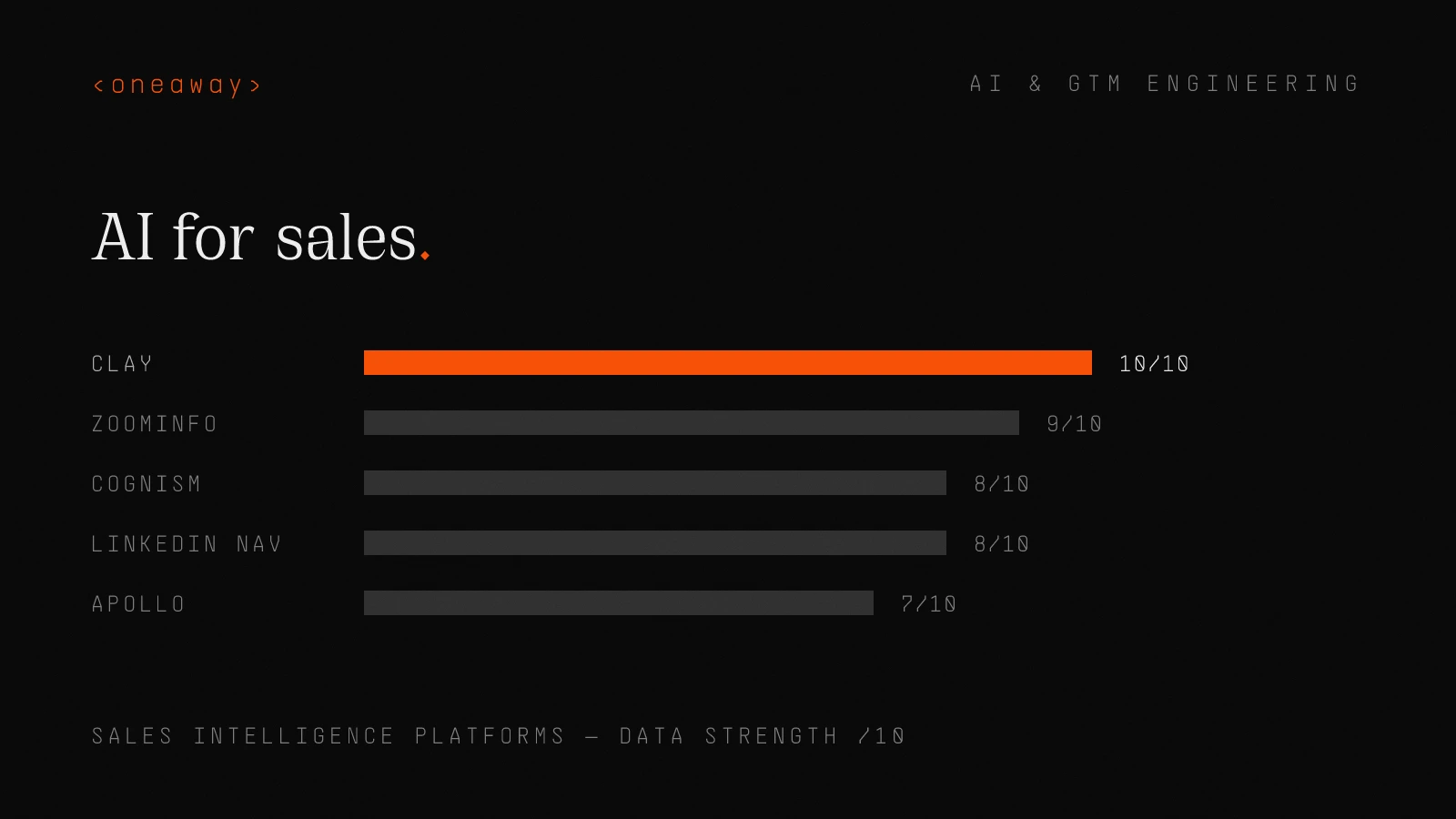
Sales Intelligence Platforms: Competitive Analysis
Our Stack Recommendation by Company Size
Startup (0-20 people): Apollo + Clay + LinkedIn Sales Nav = ~$500-800/month total
Mid-market (20-200 people): ZoomInfo or Cognism + Clay + 6sense (if doing ABM) + LinkedIn = ~$4K-8K/month
Enterprise (200+ people): ZoomInfo + 6sense + Clay + Gong + LinkedIn = ~$15K-25K/month
The key insight? No single platform has everything. Clay's superpower is aggregating data from multiple sources, which is why it appears in every tier.
| Platform | Best Use Case | Data Strength | AI Features | Pricing |
|---|---|---|---|---|
| ZoomInfo | Enterprise sales, comprehensive data | 9/10 - Best B2B coverage | Intent signals, conversation AI | $15K-50K+/year |
| Apollo.io | Startup to mid-market, integrated workflow | 7/10 - Good coverage, improving | AI writing, scoring, sequencing | $4K-12K/year |
| 6sense | ABM & predictive analytics | 7/10 - Strong intent data | Predictive scoring, best intent platform | $30K-100K+/year |
| Cognism | International/EMEA coverage | 8/10 - Best for Europe | Cell phone data, compliance-first | $12K-40K/year |
| Clay | Data enrichment & orchestration | 10/10 - Aggregates all sources | Custom AI prompts, research agents | Credit-based, ~$2K-8K/year |
| LinkedIn Sales Nav | Social selling, org charts | 8/10 - Best for people data | Limited AI, strong for research | $1.4K-2K/year |
90-Day AI Sales Implementation Roadmap
Based on dozens of implementations at oneaway.io, here's the proven playbook for going from zero to fully operational AI sales system:
Days 1-30: Foundation & Quick Wins
Days 31-60: Integration & Automation
Days 61-90: Optimization & Scale
Common Pitfalls to Avoid
I've seen implementations fail because teams:
Start small, prove ROI, then scale. That's the formula that works.
- Week 1 — Audit current data quality in CRM; identify gaps
- Week 2 — Set up Clay account; build first enrichment table with top 100 target accounts
- Week 3 — Implement email infrastructure (domains, warmup, sending platform)
- Week 4 — Launch first AI-personalized campaign to 500 prospects; measure baseline
Measuring ROI: What Good Looks Like
Every client asks: 'How do we know this is working?' Here are the metrics we track and the benchmarks you should expect:
Leading Indicators (Measure Weekly)
Lagging Indicators (Measure Monthly)
Real Results from Client Deployments
Client A (Series B SaaS, 8-person sales team):
Client B (Enterprise software, 40-person SDR team):
Client C (Services company, 3-person BDR team):
The pattern? Time savings compound into more selling activity, which drives more pipeline. It's not magic—it's leverage.
- Email deliverability rate — Target: >95% inbox placement
- Response rate — Good: 2-4% | Great: 4-8% | Exceptional: 8%+
- Positive reply rate — Good: 1-2% | Great: 2-4%
- Meeting booking rate — Good: 0.5-1.5% | Great: 1.5-3%
- Time saved per rep — Target: 15-25 hours/month
What's Next: 2026 and Beyond
Based on what we're seeing in early deployments and testing, here's what's coming:
1. AI Buyers Talking to AI Sellers
We're already seeing procurement teams deploy AI agents to evaluate vendors. This means your AI outreach will soon be evaluated by AI buyers. The game becomes: which AI is better at pattern matching and persuasion?
2. Real-Time Adaptive Campaigns
Instead of static sequences, we're building campaigns that adapt in real-time based on:
Think: Netflix-style recommendation engines for B2B sales.
3. Voice AI for Sales Calls
Platforms like Bland.ai and Air.ai are getting scary good at phone conversations. We're testing voice AI that:
Still early, but improving rapidly. Expect voice AI SDRs to handle discovery calls by late 2026.
4. Vertical-Specific AI Models
Generic LLMs are being replaced by fine-tuned models trained on industry-specific data. We're training custom models for clients that:
The ROI on custom models is 3-5x better personalization compared to generic GPT-4 prompts.
5. Integrated GTM Intelligence Platforms
The future isn't 15 different tools—it's unified platforms that combine data, intelligence, engagement, and analytics. We're seeing early versions from companies like Salesforce (Einstein AI), HubSpot (Breeze), and new entrants building the 'operating system for GTM'.
My Prediction
By late 2026, top-performing sales teams will have:50% of their pipeline generated by AI-autonomous systems with reps focusing exclusively on mid-funnel acceleration and closing. The SDR role as we know it will evolve into 'AI orchestrator'—someone who builds, monitors, and optimizes AI agents rather than manually prospecting.
This isn't science fiction. We're building these systems right now.
- Prospect engagement patterns — adjusting send times and channels
- Competitive intel — changing messaging when competitor activity is detected
- Intent signals — prioritizing high-intent accounts automatically
- A/B test results — promoting winning variants automatically
Frequently Asked Questions
Will AI replace sales reps in 2026?
No. AI is replacing the administrative and research work that takes up 60-70% of a sales rep's time. The best reps in 2026 are using AI to handle prospecting, enrichment, and follow-up so they can spend more time on high-value activities like discovery calls, demos, and relationship building. Think of AI as an assistant that handles grunt work, not a replacement for human selling skills.
What's the best AI tool for outbound sales?
There's no single 'best' tool—you need a stack. For most teams, we recommend: Clay for data enrichment, Smartlead or Apollo for sending infrastructure, and a CRM like HubSpot or Salesforce as the system of record. The magic happens when these tools are integrated via automation platforms like Make or Zapier. Budget $500-2000/month for a starter stack depending on volume.
How much does it cost to implement AI for sales?
For a small team (5-10 reps), expect $500-1500/month in tools plus 40-80 hours of implementation time. Mid-market teams (20-50 reps) typically invest $3K-8K/month in tools plus a dedicated GTM engineer or agency partner. Enterprise implementations can run $15K-50K/month. The ROI typically shows up within 60-90 days through increased meetings booked and time saved.
What is Clay and why do I need it?
Clay is a data enrichment platform that lets you aggregate data from 50+ sources (Apollo, ZoomInfo, Clearbit, LinkedIn, etc.) in waterfall sequences. Instead of being limited by one provider's data coverage (typically 40-60%), Clay gets you to 85-95% coverage by checking multiple sources automatically. It's become essential because no single data provider has complete, accurate information on every prospect.
How do I measure ROI on AI sales tools?
Track these metrics: time saved per rep (target: 15-25 hours/month), email response rate (good: 2-4%, great: 4-8%), meeting booking rate (good: 1-2%, great: 2-4%), and cost per meeting booked. Compare these to your baseline before AI implementation. Most teams see positive ROI within 60-90 days through increased pipeline and reduced time-to-productivity for new reps.
What's the difference between AI sales assistants and AI sales agents?
AI assistants augment what reps do—tools like Gong analyze calls, ChatGPT helps write emails, etc. AI agents work autonomously with minimal human oversight—they can research prospects, send sequences, book meetings, and update CRM without human intervention. Use assistants for high-stakes activities (demos, negotiations); use agents for repetitive, high-volume tasks (prospecting, enrichment, follow-up).
Should I build custom AI solutions or use off-the-shelf tools?
Start with off-the-shelf tools for 80% of use cases—they're faster to implement and cheaper to maintain. Build custom solutions when: you have unique data sources competitors don't have, your ICP is highly specific, or you're at scale (100K+ prospects/month) where custom builds become cost-effective. Most teams benefit from a hybrid: off-the-shelf tools connected via custom automation workflows.
Key Takeaways
- AI isn't replacing sales reps—it's eliminating 60-70% of administrative work so reps can focus on high-value selling activities. Top performers are 2.3x more likely to use AI than underperformers.
- The modern AI sales stack has four layers: data foundation (Clay, Apollo, ZoomInfo), intelligence (AI models, scoring), execution (Smartlead, outreach platforms), and analysis (Gong, analytics). Integration between layers is what creates leverage.
- Clay has become essential for data enrichment by aggregating 50+ data sources in waterfall sequences, achieving 85-95% data coverage vs. 40-60% from single providers. It typically saves $2-4K monthly compared to traditional data provider combinations.
- AI agents should handle autonomous, repetitive tasks (research, enrichment, first-touch outreach, scheduling) while assistive AI augments reps during high-stakes activities (demos, negotiations, complex deals).
- Start small with quick wins in the first 30 days: Set up Clay enrichment, implement email infrastructure, launch one AI-personalized campaign. Prove ROI before scaling to full automation.
- Measure leading indicators weekly (deliverability, response rate, time saved) and lagging indicators monthly (meetings booked, pipeline generated, cost per meeting). Expect positive ROI within 60-90 days.
- The future is adaptive, real-time campaigns powered by AI that adjusts based on engagement patterns, intent signals, and competitive intelligence—plus voice AI handling discovery calls and vertical-specific models trained on industry data.
Ready to Build Your AI Sales Engine?
At oneaway.io, we build production-ready AI systems for GTM teams—from Clay enrichment workflows to fully autonomous AI SDR agents. We've deployed these systems for Series A startups through public companies, typically delivering 3-5x ROI within 90 days. If you're serious about scaling pipeline with AI (not just experimenting), let's talk. Book a free GTM systems audit at oneaway.io/inquire and we'll show you exactly what's possible for your team.
Check if we're a fitContinue Reading
Best AI Sales Forecasting Models in 2026, Ranked by Accuracy
I tested 11 AI sales forecasting models with real pipeline data. Here's what actually works, ranked by accuracy, cost, and whether your CRM can handle it.
Read more [ 14 MIN READ ]Best AI Sales Team Workflows in 2026, Ranked by Time Saved
I tested dozens of AI tools sales team workflows. Here's what actually saves time in 2026, ranked by hours recovered per rep per week—with real implementation data.
Read more [ 18 MIN READ ]Best AI GTM Tools for Revenue Teams in 2026, Ranked by Impact
I've tested dozens of AI GTM tools as a former AWS/Salesforce SDR turned GTM engineer. Here's what actually moves revenue in 2026, ranked by real-world impact.
Read more