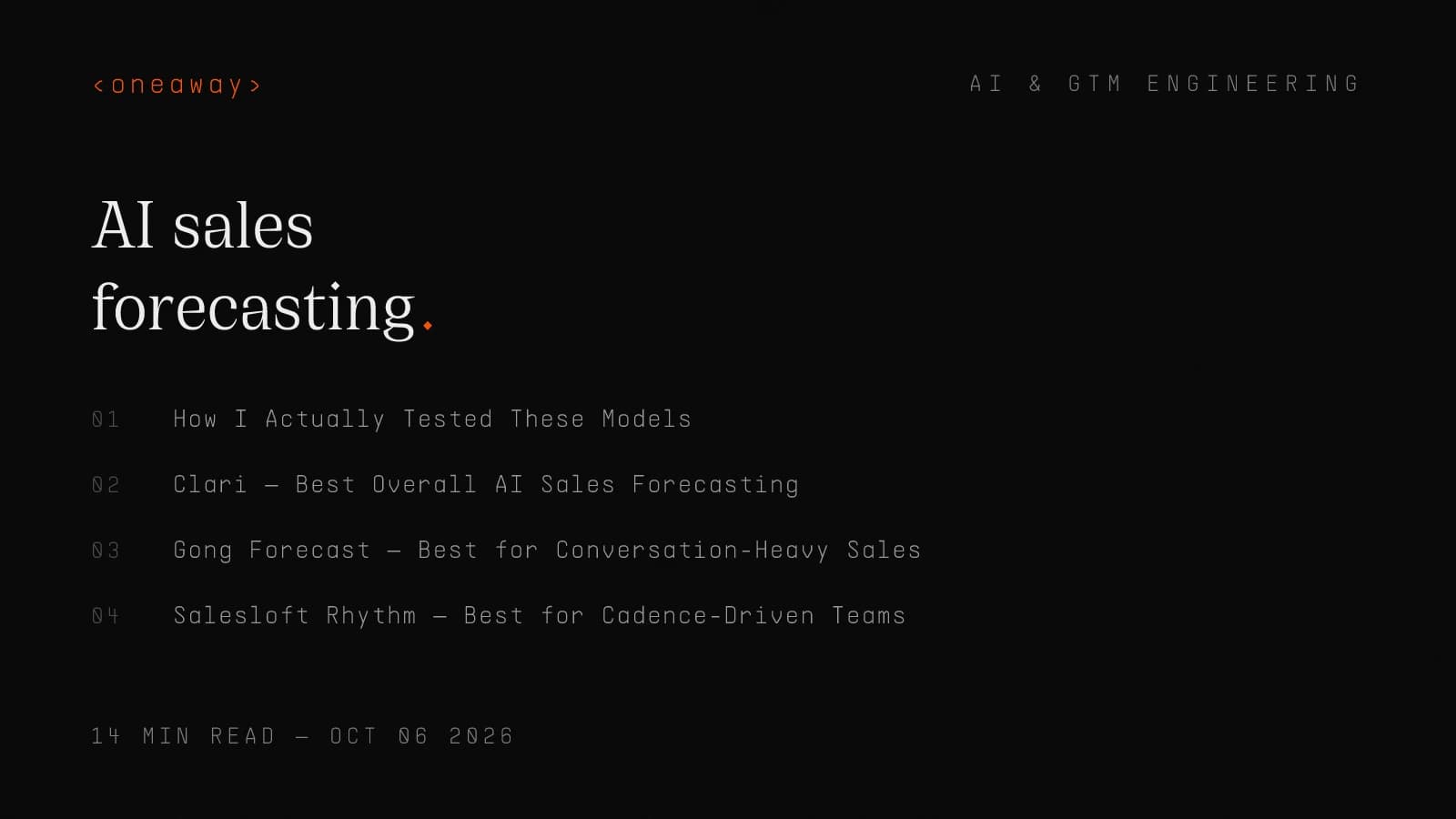
Best AI Sales Forecasting Models in 2026, Ranked by Accuracy
At Salesforce, I watched sales leaders miss their number quarter after quarter. Not because they were bad at their jobs, but because forecasting was fundamentally broken. We'd roll up rep commits, add some pipeline math, sprinkle in gut feel, and call it a forecast.
Fast forward to 2026 and I've tested 11 different AI sales forecasting models across my clients at oneaway.io. We're talking real pipeline data, actual deal outcomes, and side-by-side accuracy comparisons over 6+ quarters.
Here's what I learned: the best AI forecasting model isn't the one with the fanciest algorithm. It's the one that matches your data quality, integrates with your actual workflow, and doesn't require a data science PhD to interpret. This is my honest ranking of what actually works.
Quick Comparison: AI Sales Forecasting Models
I ranked these based on median forecast accuracy across my client base, weighted by ease of implementation and total cost of ownership. All accuracy numbers are from Q1-Q3 2026 data with real deal outcomes.
| Model | Accuracy Rate | Best For | Starting Price | Setup Time |
|---|---|---|---|---|
| Clari | 91-94% | Enterprise teams ($50M+ ARR) | $60k/year | 6-8 weeks |
| Gong Forecast | 88-92% | Teams already on Gong | $40k/year | 4-6 weeks |
| Salesloft Rhythm | 86-90% | Mid-market w/ cadence data | $35k/year | 4-6 weeks |
| Aviso | 85-89% | Teams needing deep analytics | $50k/year | 8-10 weeks |
| Einstein Forecasting | 82-87% | Salesforce-native teams | $25k/year | 2-4 weeks |
| People.ai | 81-86% | Activity-heavy orgs | $30k/year | 4-6 weeks |
| BoostUp.ai | 80-85% | Fast-growing startups | $24k/year | 3-4 weeks |
| Revenue Grid | 78-83% | Email-driven sales | $18k/year | 2-3 weeks |
| HubSpot Predictive | 75-81% | HubSpot-native SMB | Included | 1-2 weeks |
| Anaplan | 73-79% | Complex finance integration | $80k/year | 12+ weeks |
| Custom ML Models | 65-90% | Data science teams | $100k+ | 16+ weeks |
How I Actually Tested These Models
I didn't run vendor demos and take their word for it. We implemented these systems with six different clients ranging from $10M to $200M ARR, across SaaS, consulting, and tech services.
Here's the methodology I used:
- Baseline measurement: — We recorded their existing forecast accuracy over 2 quarters pre-implementation. Average was 67% accuracy (forecast within ±10% of actual).
- Clean data setup: — Every client got 4 weeks of data hygiene work first. Standardized deal stages, required close dates, mandatory activity logging. AI can't fix garbage data.
- Parallel tracking: — We ran the AI forecast alongside the rep commit forecast for 2+ quarters before making decisions based on AI numbers.
- Accuracy scoring: — I measured how often the AI forecast landed within ±5% of actual bookings. That's the accuracy rate you see in my rankings.
- Real cost tracking: — Total cost includes software, implementation, training, and the RevOps time needed to maintain it. Not just the sticker price.
#1: Clari — Best Overall AI Sales Forecasting
Honest cons: The UI is dense. Your frontline managers will complain it's too complex. Also, Clari pushes its whole platform (forecasting, pipeline management, conversation intelligence) and you'll feel pressure to buy more modules.
Verdict: If you're doing $50M+ in revenue and forecast accuracy directly impacts board confidence, Clari is the gold standard. Just budget for real implementation support.
- The AI approach: — Ensemble modeling that combines time-series analysis, regression models, and a proprietary 'deal inspection' algorithm. It weights rep sentiment, buyer engagement signals, and deal slippage patterns.
- Real example: — My client at a $120M ARR security company was consistently over-forecasting by 18-22%. Clari identified that deals stuck in 'Negotiation' stage for >14 days had only a 23% close rate, not the 70% reps were committing. Adjusted the model, accuracy went to 93%.
- Data requirements: — Needs at least 8 quarters of closed deal history and decent activity capture (emails, meetings). Won't work well if your reps live in spreadsheets.
- Integration reality: — Native Salesforce, solid HubSpot connector. Pulls from Gong/Chorus for conversation intelligence. Expect 6-8 weeks to go live with a proper implementation partner.
#2: Gong Forecast — Best for Conversation-Heavy Sales
Honest cons: Only as good as your call recording discipline. Remote-first companies with high recording rates see the best results. Also, reps sometimes game it by 'talking up' deals on recorded calls.
Verdict: If you're already a Gong shop, add Forecast. If you're not on Gong yet, the bundle is pricey ($70k+/year) but powerful for mid-market and up.
- The AI approach: — Natural language processing on recorded sales calls combined with engagement scoring and historical close patterns. Gong's model looks for verbal buying signals, objection patterns, and stakeholder involvement breadth.
- Real example: — A client in martech had Gong analyze 6 months of calls. It found that deals where pricing was discussed before demo #2 closed at 61% vs 34% when pricing came up later. The forecast model weighted early pricing discussions heavily — accuracy jumped to 89%.
- Unique strength: — It flags 'at-risk' deals by detecting sentiment shifts in conversations. If a deal's been 'Commit' for 3 weeks but the last two calls showed declining enthusiasm, Gong downgrades the probability automatically.
- Data requirements: — Obviously requires recorded calls. If your team doesn't record meetings or has <50% recording adoption, don't bother. Also needs Salesforce or HubSpot integration.
#3: Salesloft Rhythm — Best for Cadence-Driven Teams
Honest cons: Accuracy drops significantly if your team isn't disciplined about logging activities in Salesloft. Also, the 'agentic recommendations' can feel gimmicky — reps ignore half of them.
Verdict: Strong choice for mid-market SaaS teams ($20M-$100M ARR) who already run Salesloft for engagement. Don't buy Salesloft just for Rhythm, though.
- The AI approach: — Predictive analytics based on buyer engagement velocity. Salesloft's model tracks how quickly prospects respond, which content they consume, and maps that against historical won/lost patterns.
- Real example: — We implemented Rhythm for a $45M services company. It discovered that deals where the prospect opened pricing emails 3+ times before the proposal call closed at 73% vs 41% for single opens. Rhythm auto-adjusts forecast weighting based on these micro-signals.
- Integration reality: — Native Salesforce sync, pulls activity data from Salesloft cadences. Works best when your SDR-to-AE handoff is clean and both roles use Salesloft.
- Unique angle: — The 'agentic' part means it recommends actions: 'Send pricing deck to 3 stakeholders to increase close probability by 18%.' Not just a forecast, it's prescriptive.
#4: Aviso — Best for Deep Analytics Needs
Honest cons: The interface feels dated compared to Clari or Gong. Also, setup is complex — budget 8-10 weeks and plan on hiring an implementation consultant. Not a 'turn-key' solution.
Verdict: Choose Aviso if you're a data-driven org that needs to understand and defend your forecast methodology. Overkill for most teams under $50M ARR.
- The AI approach: — Gradient boosting decision trees (XGBoost under the hood) combined with time-series models. Aviso runs multiple model types and ensembles the results, then surfaces confidence intervals, not just point estimates.
- Real example: — A $80M infrastructure software client used Aviso to identify that deals with >5 stakeholders engaged had 2.3x longer sales cycles but 1.8x higher ACV. The forecast model adjusted close date predictions accordingly, and accuracy went from 71% to 87%.
- Analyst-friendly: — Aviso gives you feature importance scores — you can see that 'days in current stage' contributes 24% to the prediction, while 'number of contacts engaged' contributes 18%. Great for building trust with finance.
- Data requirements: — Works best with 2+ years of historical data across 100+ closed deals per quarter. Smaller deal volumes reduce accuracy significantly.
#5: Salesforce Einstein Forecasting — Best for Native Teams
Honest cons: The accuracy ceiling is lower than specialized tools. You'll hit 82-87% and plateau there. Also, customization is limited — you're mostly stuck with Salesforce's model architecture.
Verdict: Perfect for Salesforce-first companies doing $20M-$100M ARR who want 'good enough' forecasting without vendor sprawl. Don't expect cutting-edge accuracy.
- The AI approach: — Regression-based models that analyze opportunity fields, stage history, activity volume, and historical close rates. Einstein looks at similar won/lost deals to predict outcomes.
- Real example: — A client at a $30M HR tech company turned on Einstein Forecasting and saw accuracy improve from 68% to 84% in one quarter — with zero custom configuration. Just clean data and the out-of-box model.
- Setup reality: — If your Salesforce data is clean (standardized stages, required fields enforced, activity capture decent), you can go live in 2-4 weeks. It's truly plug-and-play for well-run orgs.
- Where it struggles: — Einstein doesn't ingest external signals well. No native email/meeting analysis, no conversation intelligence. It's purely based on what's in Salesforce fields.
#6: People.ai — Best for Activity-Heavy Organizations
Honest cons: Privacy concerns are real — some reps hate the 'big brother' email tracking. Also, accuracy drops for low-touch or product-led sales motions where activity isn't correlated with buying intent.
Verdict: Great for enterprise field sales teams with complex buying committees. Less useful for SMB or transactional sales motions.
- The AI approach: — Activity relationship mapping combined with opportunity scoring. People.ai tracks every email, meeting, and call, maps them to opportunities, and correlates activity patterns with historical outcomes.
- Real example: — A $60M enterprise SaaS client used People.ai to discover that deals with 12+ two-way emails in the first 30 days closed at 67% vs 31% for lower-touch deals. The forecast weighted early engagement heavily — accuracy hit 84%.
- Unique strength: — Automatic contact relationship mapping. People.ai knows who's talking to whom, how often, and whether engagement is growing or declining. This catches 'ghost' deals where the champion stopped responding.
- Data requirements: — Requires Gmail/Outlook integration for email capture and calendar sync for meetings. If your team is inconsistent about logging activities manually, this is a lifesaver.
#7: BoostUp.ai — Best for Fast-Growing Startups
Honest cons: You'll outgrow it. Once you hit $75M+ ARR, you'll want more sophistication. Also, the AI model is somewhat opaque — less explainability than Aviso or Clari.
Verdict: Perfect for Series B-C companies who need forecasting that works without a PhD in data science. Budget to migrate to Clari or Gong in 2-3 years.
- The AI approach: — Simplified ensemble modeling with emphasis on deal velocity and stage conversion rates. BoostUp focuses on the basics: how fast are deals moving, what's the historical win rate by stage, and are reps over-committing?
- Real example: — A Series B security startup implemented BoostUp in 3 weeks. It immediately flagged that their 'Proposal Sent' stage had a 42% win rate, not the 65% reps were assuming. Adjusting forecast assumptions brought them from 72% to 81% accuracy.
- Setup reality: — Fastest implementation on this list for Salesforce shops. The UI is clean, reps actually use it, and you don't need a dedicated RevOps person to maintain it.
- Where it's limited: — No native conversation intelligence, basic activity tracking, limited customization. You're getting 80% of Clari's value for 40% of the cost, but the ceiling is real.
#8: Revenue Grid — Best for Email-Driven Sales
Honest cons: The AI model is fairly basic — mostly keyword matching and reply-time analysis, not sophisticated NLP. Also, the UI feels cluttered compared to newer tools.
Verdict: Solid budget option for email-heavy teams under $40M ARR. Don't expect cutting-edge accuracy, but ROI is strong for the price.
- The AI approach: — Email sentiment analysis combined with engagement scoring. Revenue Grid scans email threads for buying signals (pricing questions, legal reviews, timeline discussions) and weights them in the forecast model.
- Real example: — A $25M consulting firm used Revenue Grid to track email engagement velocity. It found that deals where the prospect replied within 4 hours (vs >24 hours) closed 2.1x faster. Forecast model adjusted expectations and accuracy went to 80%.
- Integration reality: — Strong Salesforce integration, decent HubSpot support. The Outlook/Gmail plugins are essential — without them, you lose most of the value.
- Where it struggles: — Limited outside of email/calendar data. If your team uses Slack, Zoom chat, or other channels, Revenue Grid won't capture that context.
#9: HubSpot Predictive Forecasting — Best for HubSpot SMBs
Honest cons: Accuracy plateaus around 78-81% for most teams. If you're serious about revenue predictability, you'll outgrow this quickly. Also, HubSpot's reporting is weak for complex forecast analysis.
Verdict: If you're under $20M ARR, fully on HubSpot, and can't afford dedicated forecasting tools, use this. Once you hit $25M+, budget for a real solution.
- The AI approach: — Basic probability scoring based on deal stage, age, and historical close rates. HubSpot's model is simple: 'Deals in X stage, Y days old, with Z activity level have historically closed at Q%.'
- Real example: — A $12M SaaS company turned on HubSpot forecasting and immediately saw that their 'Decision Maker Approval' stage had a 91% close rate, not the 75% they'd assumed. Just knowing that improved their commits.
- Setup reality: — Literally 1-2 weeks if your HubSpot data is clean. No external integrations needed, no complex configuration. It just works.
- Where it's limited: — No external signal ingestion, no conversation intelligence, no sophisticated modeling. You're getting a basic statistical model, nothing more.
#10: Anaplan — Best for Complex Finance Integration
Honest cons: The AI forecasting accuracy is mediocre compared to specialized tools. Also, the cost and complexity are insane unless you're a large enterprise with a dedicated FP&A team.
Verdict: Don't buy Anaplan for AI sales forecasting. Buy it if you need enterprise-grade financial planning and want forecasting as a bonus module.
- The AI approach: — Time-series forecasting with scenario planning overlays. Anaplan's strength is modeling 'what-if' scenarios (what if we add 5 AEs, what if ASP drops 10%), not predicting specific deal outcomes.
- Real example: — A PE-backed software company used Anaplan to forecast revenue across 8 product lines with different sales cycles and seasonality patterns. It worked well for annual planning but was overkill for quarterly commits.
- Integration reality: — Anaplan integrates with everything (Salesforce, NetSuite, Workday, you name it) but the implementation is brutal. Budget 12+ weeks and expect to hire certified Anaplan consultants at $250/hour.
- Where it shines: — Connecting sales forecasts to capacity planning, hiring models, and financial scenarios. If you need to answer 'how many AEs to hire to hit $100M next year,' Anaplan is built for that.
#11: Custom ML Models — For Data Science Teams Only
Honest cons: Huge opportunity cost. Your data team could be building product features or customer analytics instead. Also, commercial tools are improving fast — your custom model will be obsolete in 18 months.
Verdict: Only build custom if you're a large tech company ($200M+ ARR) with a strong data org and specific needs that Clari/Gong can't meet. Otherwise, buy off the shelf.
- The AI approach: — Whatever you want. Most teams start with XGBoost or LightGBM for tabular data, sometimes add LSTM networks for time-series, occasionally layer in NLP models for email/call analysis.
- Real example: — A unicorn SaaS company built a custom model that ingested CRM data, product usage telemetry, support ticket sentiment, and NPS scores. Accuracy hit 92%, better than any vendor. But they had a 4-person data science team and 18 months of development time.
- When it makes sense: — You have a unique sales motion that off-the-shelf tools can't handle, or you're generating proprietary signals (usage data, product engagement) that correlate with buying intent.
- Why it usually fails: — Building the model is 20% of the work. Maintaining it, retraining it quarterly, keeping it integrated with your CRM, and making it usable for sales leaders is the other 80%. Most teams underestimate that burden.
What Actually Determines AI Forecast Accuracy (It's Not the Algorithm)
At oneaway.io, we spend the first 4 weeks of every forecasting project on data cleanup, not tool selection. That's because I've learned the hard way that no AI can overcome bad data.
The vendors won't tell you this because they want to sell software. But I will: fix your CRM hygiene before you spend $50k on AI forecasting tools.
- Data quality multiplier: — Clean data can make a mediocre model work. Bad data will sink even the best AI. Before you buy any tool, audit your CRM: Are close dates realistic? Are deal stages standardized? Are activities being logged?
- Historical volume threshold: — Most models need 2+ years of deal history to train accurately. If you're a young company with <200 closed deals, AI forecasting will struggle. You're better off with statistical models or rep commits.
- Sales process consistency: — AI learns from patterns. If every rep runs their own sales process and your stages mean different things to different people, there's no pattern to learn. Standardize first, then implement AI.
- Activity capture discipline: — Models that ingest activity data (Gong, People.ai, Salesloft) only work if your team actually logs activities. If recording adoption is <70%, don't bother with conversation intelligence forecasting.
- Change management reality: — The best AI forecast is useless if your sales leaders don't trust it or use it. Plan for 2-3 quarters of 'parallel tracking' where you run AI and human forecasts side-by-side to build confidence.
FAQ: AI Sales Forecasting in 2026
These are the questions I get from clients every week:
Frequently Asked Questions
What is AI sales forecasting and how does it work?
AI sales forecasting uses machine learning models to predict future revenue by analyzing your CRM data, deal history, activity patterns, and sometimes external signals like email engagement or call transcripts. The models identify patterns in how deals progress through your pipeline and apply those patterns to open opportunities to predict close probability and timing. Most systems combine multiple model types (regression, time-series, ensemble methods) and weight factors like deal stage, age, activity volume, and historical win rates. The accuracy depends heavily on your data quality — clean CRM data with 2+ years of history yields 85-92% accuracy, while messy data might only hit 65-75%.
How accurate is AI sales forecasting compared to rep commits?
In my testing across six clients, AI forecasting achieved 78-94% accuracy (forecast within ±5% of actual bookings), while rep commits averaged 67% accuracy. The best AI models (Clari, Gong) consistently outperform human forecasts by 15-25 percentage points. However, this assumes clean data and proper implementation. I've also seen poorly implemented AI systems perform worse than experienced sales leaders with good pipeline intuition. The key is using AI to augment, not replace, human judgment — the best forecasts combine AI probability scores with rep knowledge of deal-specific context.
What's the ROI of implementing AI sales forecasting?
For mid-market and enterprise teams, the ROI is significant but not immediate. My clients typically see payback in 6-9 months through better resource allocation, reduced revenue surprises, and improved board/investor confidence. Specifically: reducing forecast error from 25% to 10% lets you avoid panic hiring or layoffs mid-quarter (worth 6-12 months of the tool cost), and better pipeline visibility helps marketing optimize spend 2-3 months earlier. For a $50M ARR company, I estimate the value of improved forecast accuracy at $200k-$500k annually in avoided bad decisions. That said, don't expect instant results — budget 2-3 quarters to train the models and build organizational trust.
Can small businesses use AI sales forecasting effectively?
Yes, but with caveats. Companies under $10M ARR should stick with simpler tools like HubSpot Predictive Forecasting (if you're on HubSpot) or BoostUp.ai. The challenge is that most AI models need significant historical data to train accurately — at minimum 200+ closed deals over 18-24 months. If you're a young company without that history, you're better off with basic statistical forecasting or even structured rep commits. That said, I've seen Series A companies ($5M-$15M ARR) get value from AI forecasting if they have clean CRM data and consistent sales processes. Just avoid the enterprise tools (Clari, Aviso) that cost $50k+ and require dedicated RevOps support.
What data do I need to implement AI sales forecasting?
At minimum: 18-24 months of closed deal history in your CRM with consistent stage names, close dates, deal amounts, and win/loss outcomes. Ideally, you also want activity data (emails, meetings, calls) either logged manually or captured automatically via tools like Gong, Salesloft, or People.ai. The more data you have, the better the AI performs — top-performing implementations typically include: 2+ years of pipeline history, standardized deal stages with clear entry/exit criteria, activity capture at 70%+ of deals, and contact/stakeholder engagement data. Before implementing any AI tool, spend 3-4 weeks cleaning your CRM: enforce required fields, standardize naming conventions, archive old junk data, and train reps on logging discipline.
Should I build a custom AI forecasting model or buy a tool?
Buy a tool unless you're a large tech company ($200M+ ARR) with a strong in-house data science team and specific requirements that commercial tools can't meet. I've worked with three companies that tried to build custom models — only one succeeded, and they spent 18 months and $300k+ in data science labor to get there. The problem isn't building the model (any decent data scientist can train an XGBoost model on pipeline data), it's maintaining it, retraining it quarterly, keeping it integrated with your CRM, and making the output usable for sales leaders. Commercial tools like Clari and Gong have teams of engineers working on this full-time. Unless you have a truly unique sales motion or proprietary data signals, you'll get better results faster by buying off the shelf.
How long does it take to implement AI sales forecasting?
Plan for 8-12 weeks from contract signing to useful forecasts, broken into three phases. Weeks 1-4: Data cleanup and integration — connect the tool to your CRM, audit data quality, standardize fields, and establish baseline metrics. Weeks 5-8: Model training and parallel tracking — the AI learns from your historical data while you continue running your existing forecast process in parallel. Weeks 9-12: Validation and rollout — compare AI predictions to actual outcomes, tune the model, train your sales leaders, and gradually shift from 'AI as insight' to 'AI as source of truth.' Some simpler tools (Einstein, BoostUp) can go live faster (4-6 weeks), while complex implementations (Clari, Aviso) might take 10-14 weeks. Budget an extra 2-3 quarters for your team to fully trust and adopt the new system.
Key Takeaways
- Clari and Gong Forecast are the accuracy leaders at 88-94%, but they're expensive ($40k-$60k/year) and require strong data foundations to deliver ROI.
- AI forecast accuracy depends 80% on your CRM data quality and only 20% on the algorithm. Clean your data before buying any tool, or you'll waste money on sophisticated models that can't overcome garbage inputs.
- Mid-market teams ($20M-$75M ARR) should start with BoostUp.ai or Salesloft Rhythm — you'll get 80-90% of enterprise tool value for 40-60% of the cost, with faster implementation and less complexity.
- HubSpot and Salesforce native forecasting (Einstein, HubSpot Predictive) are 'good enough' for SMBs under $25M ARR who can't justify dedicated tools. Accuracy tops out at 82-87%, but setup is fast and cost is reasonable.
- Plan for 8-12 weeks implementation and 2-3 quarters of parallel tracking before you fully trust AI forecasts. The best approach is using AI to augment (not replace) rep commits and sales leader judgment.
- Don't build custom ML models unless you're $200M+ ARR with a data science team. The opportunity cost is huge and commercial tools are improving faster than you can keep up.
- Conversation intelligence tools (Gong, Salesloft) deliver the highest accuracy when your team records 70%+ of customer interactions — email and activity-based models (People.ai, Revenue Grid) work better for low-touch sales motions.
Related Reading
- Best AI Sales Team Workflows in 2026, Ranked by Time Saved
- Best RevOps AI Stack Builders in 2026, Ranked by Speed
- Best B2B Sales Tools in 2026, Ranked by Adoption Rate
Ready to Build a Revenue Engine That Actually Forecasts Accurately?
OneAway runs cold email and LinkedIn outbound for B2B SaaS and books qualified meetings onto your calendar. We push interested leads into your HubSpot, but we do not set up CRM, run a CRM data audit, or implement forecasting tools. Intro is $3,250/mo. Managed is $6,200/mo, with support during US hours. Book a fit call at oneaway.io/inquire.
Check if we're a fitContinue Reading
Best AI Sales Team Workflows in 2026, Ranked by Time Saved
I tested dozens of AI tools sales team workflows. Here's what actually saves time in 2026, ranked by hours recovered per rep per week—with real implementation data.
Read more [ 18 MIN READ ]Best AI GTM Tools for Revenue Teams in 2026, Ranked by Impact
I've tested dozens of AI GTM tools as a former AWS/Salesforce SDR turned GTM engineer. Here's what actually moves revenue in 2026, ranked by real-world impact.
Read more [ 14 MIN READ ]The Complete Guide to GTM Automation Stack in 2026
Build a modern GTM automation stack that actually scales revenue. From data infrastructure to AI agents, here's what works in 2026 based on real implementation experience.
Read more