How to Master B2B Pipeline Generation: A Data-Driven Playbook

I've spent the last four years reverse-engineering what separates B2B teams that consistently hit pipeline targets from those who constantly scramble for meetings. The difference isn't budget, team size, or even market position. It's systems.
After running over 200 outbound campaigns as an SDR at Salesforce and AWS, then building GTM systems for dozens of B2B companies at oneaway, I've seen the same pattern: companies that treat B2B pipeline generation as an engineering problem win. Those who treat it as an art project struggle.
2026 has been dubbed 'The Year of the Pipeline Mandate' by Energize Marketing's State of Demand Generation Report, and for good reason. With buying committees expanding to 11+ stakeholders and sales cycles stretching 40% longer than pre-2024, generic spray-and-pray tactics are dead. This playbook will show you exactly how to build a predictable pipeline engine using the same frameworks that drive results for our clients at oneaway.
Quick Answer
B2B pipeline generation in 2026 is an engineering problem, not an art project. The framework that's driven $47M+ in pipeline has four layers: signal capture across 15+ data sources, intelligent routing, multi-channel orchestration (4+ channels = 3.2x more qualified meetings), and systematic conversion optimization. Companies targeting fewer than 3,000 accounts generate pipeline 4.1x faster than those targeting broad markets.
The B2B Pipeline Generation Framework That Actually Works
Most B2B pipeline generation advice treats symptoms, not root causes. Teams obsess over subject lines and call scripts while ignoring the fundamental architecture of pipeline creation. Here's the framework that's driven $47M+ in pipeline for our clients:
The Pipeline Generation Stack has four layers, and most companies only focus on layer one:
Layer 1: Signal Capture - Identifying accounts showing buying intent across 15+ data sources. This isn't just website visitors. According to TechTarget's 2026 predictions, high-performing teams now monitor job changes, technology stack changes, funding events, competitor mentions, content consumption patterns, and third-party intent signals. The average winning deal now touches 7.3 different signal types before conversion.
Layer 2: Intelligent Routing - Getting the right signal to the right person at the right time. When we implemented this at AWS, our qualified meeting booking rate jumped from 11% to 28% in 45 days. The key wasn't better messaging—it was matching account signals to rep specialization and availability windows.
Layer 3: Multi-Channel Orchestration - Coordinating touchpoints across email, LinkedIn, phone, direct mail, and retargeting without annoying prospects. The 2026 Dux-Soup Lead Generation Report found that sequences using 4+ channels generated 3.2x more qualified meetings than single-channel approaches, but only when properly orchestrated with 72-hour minimum gaps between channel switches.
Layer 4: Conversion Optimization - Systematically improving each micro-conversion in your funnel. Most teams measure replied rate and booked meeting rate. Winners also track offer acceptance rate, calendar click-through rate, meeting show rate, qualified rate, and pipeline conversion rate. Each metric reveals specific friction points.
The companies that master all four layers don't have pipeline problems. Those stuck on layer one constantly struggle. Let's break down each component with specific implementation tactics.
Building Your Demand Generation Strategy Foundation
The strategy document that actually works: Create a one-page demand generation blueprint that answers: (1) Who exactly are we targeting? (2) What specific problems do they have right now? (3) Which signals indicate they're ready to buy? (4) How will we reach them across channels? (5) What conversion milestones will we track? (6) How will we optimize based on data?
I keep our current demand generation strategy in a Notion doc that the entire team references daily. It's updated monthly based on conversion data. If your strategy lives in a 40-slide deck that no one reads, you don't have a strategy—you have a paperweight.
- ICP precision over market coverage — The top-performing demand generation programs we've studied target 500-2,000 accounts max, not 50,000. UnboundB2B's 2026 research shows companies with sub-3,000 account TAMs generate pipeline 4.1x faster than those targeting broad markets. Define your ICP down to specific tech stack combinations, team structures, and growth stage indicators.
- Account-level planning, not contact-level — Every account in your target list should have a documented hypothesis: Why now? Why us? What triggers exist? Which personas must be engaged? We built a simple Airtable template that forces reps to answer these before first contact. Meeting quality jumped 67%.
- Omnichannel by design, not accident — Your demand generation strategy must specify exactly how channels interact. For example: LinkedIn engagement → personalized email → phone call → video message → direct mail → executive email. Map this before launching campaigns. The Only-B2B 2026 analysis found coordinated omnichannel programs generate 312% more pipeline per account than single-channel approaches.
- Content as conversation fuel — Stop creating generic ebooks. Start creating conversation accelerators: one-pagers that solve specific problems, calculation tools, comparison frameworks, and research insights. We generate 73% of our qualified meetings by leading with genuinely useful assets that take 10 minutes to create.
- Buying committee mapping — With buying committees averaging 11.4 stakeholders in 2026 (per Dealfront research), you must map and engage multiple personas per account. Define your champion profile, economic buyer profile, technical evaluator profile, and end-user profile. Build separate nurture tracks for each.
The 7 Outbound Pipeline Metrics You Must Track
Let me break down the two metrics most teams get wrong:
Qualified Meeting Booking Rate: This isn't just 'booked meetings.' It's meetings with the right person, at the right type of account, who confirms they have the problem you solve. When I was at Salesforce, we celebrated 40 meetings per month until we realized only 8 were actually qualified. Once we tightened the definition and optimized for qualified meeting booking rate, our pipeline doubled with 30% fewer total meetings.
Pipeline Velocity: Most teams measure sales cycle length (opportunity created to close). That's too late. Pipeline velocity measures first touch to pipeline creation. This reveals how efficiently your entire demand generation strategy converts target accounts into opportunities. Our fastest clients average 23 days. The slowest take 120+ days. The difference? Signal-based targeting and multi-threaded outreach.
How to instrument these metrics: Build a simple data pipeline from your engagement platform (Outreach, Salesloft, Apollo) → CRM (Salesforce, HubSpot) → analytics layer (Mode, Looker, or even Google Sheets). Tag every activity with campaign ID, account ID, and rep ID. Set up weekly pipeline generation dashboards showing these seven metrics by rep, campaign, and account segment.
I built our metrics dashboard in Mode SQL connected to our Salesforce instance. It took 6 hours. It's saved 500+ hours of speculation and guesswork. Stop debating tactics in meetings. Let your outbound pipeline metrics tell you what works.
| Metric | Why It Matters | Target Benchmark | How to Improve |
|---|---|---|---|
| Target Account Coverage | % of ICP accounts actively engaged | 80%+ monthly | Better list building, increased rep capacity, automation |
| Qualified Meeting Booking Rate | % of engaged accounts booking qualified meetings | 15-25% | Signal-based targeting, better offer, reduced friction |
| Meeting Show Rate | % of booked meetings where prospect attends | 70%+ | Better qualification, confirmation sequences, calendar integration |
| Meeting Qualified Rate | % of held meetings that meet qualification criteria | 60%+ | Tighter targeting, better discovery questions, clearer ICP |
| Pipeline Conversion Rate | % of qualified meetings creating pipeline opportunities | 35%+ | Better qualification, tighter handoff process, AE enablement |
| Pipeline Velocity | Days from first touch to pipeline creation | 21-45 days | Reduce touchpoints, accelerate response time, simplify next steps |
| Cost Per Pipeline Dollar | CAC to generate $1 of pipeline | $0.15-$0.35 | Channel optimization, conversion rate improvement, team efficiency |
Engineering Qualified Meeting Booking at Scale
The conversion funnel you must optimize: Email/LinkedIn outreach → Clicked link → Viewed landing page → Started booking → Completed booking → Confirmed attendance → Showed up → Meeting qualified → Converted to pipeline. Most teams only measure the first and last step. Winners instrument and optimize every micro-conversion.
A real example: One of our clients was generating 200 meeting requests per month with a 12% qualified meeting booking rate and 50% show rate. Only 12 qualified meetings per month. We rebuilt their entire booking flow: created offer-specific landing pages, added pre-qualification questions, implemented Chili Piper with proper routing, built a 3-touch confirmation sequence, and reduced meeting length from 30 to 25 minutes. Result: 180 meeting requests per month (10% decrease), 31% qualified meeting booking rate (158% increase), 72% show rate (44% increase). They now generate 40 qualified meetings per month—a 233% improvement.
- The offer matters more than the message — Stop asking for 'a quick 15-minute call to explore synergies.' Nobody wants that. Instead, offer something genuinely valuable: a customized analysis, a free audit, a calculation tool, a strategy session with specific deliverables. We test 5-7 different offers per quarter. Winners typically provide immediate, tangible value before the meeting even happens.
- Reduce friction to absolute zero — Every extra click costs you 15-30% of potential bookings. Use calendar links (Calendly, Chili Piper, Koala) that show real availability, auto-detect time zones, send confirmation emails, add video conferencing links, and send reminder sequences. We've seen qualified meeting booking rates jump 40% just by implementing proper calendar infrastructure.
- Pre-qualify in the booking flow — Add 2-3 qualification questions to your booking form. Ask about their role, current solution, specific challenges, or timing. This filters out unqualified meetings AND gives your rep critical context. Yes, it reduces booking rate by 10-15%. It increases qualified meeting rate by 200%+.
- Optimize the confirmation sequence — The moment between booking and meeting is critical. Send an immediate confirmation. Send a 24-hour reminder with a clear agenda and prep questions. Send a 2-hour reminder. Include the video link in every message. Add a 'what to expect' document. Companies that implement proper confirmation sequences see show rates jump from 55% to 75%+.
- Test meeting lengths ruthlessly — We've tested 15-min, 20-min, 30-min, 45-min, and 60-min meeting lengths across 50+ campaigns. The winner? 25 minutes. It's specific enough to feel legitimate, short enough to get high booking rates, and long enough to qualify properly. Your mileage may vary—test it.
- Create meeting-specific landing pages — Don't send prospects to your generic homepage or a calendar link alone. Create dedicated landing pages for each campaign that explain: (1) What you'll cover in the meeting, (2) What they'll walk away with, (3) Who typically attends, (4) How to prepare. Include the calendar embed on the page. This single change improved our qualified meeting booking rate by 33%.
Accelerating Pipeline Velocity: The Conversion Multiplier
Real numbers from our clients: A Series B SaaS company came to us with 90-day average pipeline velocity. We implemented signal-based fast-tracking, multi-threaded outreach from day one, reduced their standard sequence from 14 to 7 touches for high-intent accounts, and cleaned up their SDR-to-AE handoff process. Pipeline velocity dropped to 31 days—a 66% improvement. With the same team size and target market, their quarterly pipeline generation increased 2.8x.
Track velocity by segment: Don't just measure overall pipeline velocity. Break it down by account segment, campaign type, rep, and source. You'll discover that enterprise accounts move slower than mid-market, that referral-sourced pipeline converts 3x faster than cold outbound, and that certain reps consistently create pipeline faster because they follow up immediately. Use these insights to optimize resource allocation.
- Strike while intent is hot — The 2026 Dealfront research is clear: companies that respond to buying signals within 4 hours are 7x more likely to create pipeline than those who wait 24+ hours. Set up real-time alerts for high-intent signals (website visits to pricing pages, G2 profile views, job changes at target accounts). Have reps prioritize these accounts immediately.
- Multi-thread from day one — Don't wait until the opportunity stage to engage multiple stakeholders. Start your outbound sequences with parallel tracks to champions, economic buyers, and technical evaluators. Accounts with 3+ engaged stakeholders in the first 14 days convert to pipeline 4.2x faster than single-threaded accounts.
- Reduce unnecessary touchpoints — The myth: 'It takes 8-12 touches to book a meeting.' The reality: In high-intent scenarios, 3-5 high-quality touches outperform 12+ generic touches. We've cut average touches-to-meeting from 11 to 6 while maintaining the same booking rates by improving targeting and message relevance.
- Eliminate handoff delays — Measure the time between qualified meeting and opportunity creation. If it's more than 48 hours, you have a handoff problem. Create shared qualification criteria, use automated meeting summaries (Gong, Chorus), implement instant Slack notifications to AEs, and review handoff velocity in weekly pipeline meetings.
- Build 'fast-track' sequences for hot accounts — Not all accounts should follow the same cadence. For accounts showing multiple high-intent signals, compress your sequence: touch 1 (day 1), touch 2 (day 2), touch 3 (day 4), touch 4 (day 7). For cold accounts, spread it out: touch 1 (day 1), touch 2 (day 7), touch 3 (day 14), touch 4 (day 28). Match velocity to intent level.
Signal-Based Targeting: From Spray-and-Pray to Surgical Precision
How to implement signal-based targeting:
Step 1: Instrument signal capture. Set up monitoring for 5-10 signal types relevant to your ICP. Start simple: Google Alerts for target accounts, LinkedIn job change alerts for key roles, website visitor tracking via your MAP. Don't try to implement all 15 signals at once. We typically start clients with 3-5 signals and expand from there.
Step 2: Create signal prioritization logic. Not all signals are equal. A CFO at a target account visiting your pricing page 3 times is a much stronger signal than that same company appearing in Bombora intent data for generic keywords. Assign point values to different signals based on conversion data. In our system: website visit to pricing page (10 points), relevant hiring post (7 points), executive change (6 points), funding event (5 points), general intent data (2 points).
Step 3: Build signal-triggered sequences. When an account crosses your threshold score (usually 10-15 points), automatically add them to a high-priority sequence. These sequences should be more aggressive (faster cadence, more touchpoints), more personalized (reference the specific signals), and multi-threaded (engage multiple stakeholders). We see 3-4x higher qualified meeting booking rates on signal-triggered sequences vs. standard cold outreach.
Step 4: Arm reps with signal context. Signals are useless if reps don't know about them. Build a simple view in your CRM or engagement platform showing: (1) All active signals for each account, (2) Signal date and source, (3) Suggested messaging based on signal type. We built a Chrome extension that overlays this data directly in Salesforce and LinkedIn.
Step 5: Measure signal-to-pipeline conversion. Track which signals actually predict pipeline creation. You'll discover that some signals you thought were valuable (generic intent data) barely correlate with pipeline, while others (specific hiring posts, technology changes) are incredibly predictive. Double down on what works. Kill what doesn't.
A real example from our agency: We implemented signal-based targeting for a marketing automation company targeting B2B SaaS companies. We set up monitoring for: (1) Companies hiring demand gen or growth roles, (2) Companies that recently raised Series A/B funding, (3) Companies adopting Salesforce or HubSpot (our tool integrated with both), (4) Companies with executives engaging with competitive content on LinkedIn. Accounts showing 2+ signals got added to an 8-touch, 12-day sequence with personalized references to their specific signals. Result: 34% qualified meeting booking rate vs. 9% on standard cold outreach. Signal-based accounts converted to pipeline at 2.9x the rate of non-signal accounts.
| Signal Type | Example | Data Source | Typical Lead Time |
|---|---|---|---|
| Hiring signals | Posted job for role your product supports | LinkedIn, job boards, Gem | 30-90 days |
| Technology changes | Recently adopted complementary tech | BuiltWith, Clearbit, 6sense | 14-60 days |
| Funding events | Announced new round or acquisition | Crunchbase, PitchBook, news | 30-120 days |
| Executive changes | New VP/C-level in relevant department | LinkedIn, ZoomInfo, Apollo | 45-90 days |
| Website behavior | Multiple visits to pricing/product pages | First-party web analytics | 0-21 days |
| Content consumption | Downloaded relevant content assets | MAP, first-party data | 7-45 days |
| Intent signals | Researching keywords in your category | Bombora, 6sense, G2 | 14-60 days |
| Competitor activity | Mentioned competitor in content/reviews | G2, social listening, alerts | 14-90 days |
| Trigger events | Expansion, new office, product launch | News alerts, LinkedIn, press | 30-90 days |
| Community engagement | Active in relevant Slack/communities | Common Room, Orbit, manual | 7-60 days |
Optimizing Your Pipeline Generation Tech Stack
The most common tech stack mistakes:
Mistake #1: Buying tools before defining processes. I've seen teams spend $50K+ on 6sense or ZoomInfo before having basic outbound processes documented. Tools should automate existing processes, not create them. Define your ideal workflow manually first, then add tools to scale it.
Mistake #2: Lack of integration. Your tools must talk to each other. If your intent data doesn't automatically flow into your engagement platform, which doesn't automatically log to your CRM, which doesn't automatically route to your calendar tool—you have a broken system. Prioritize native integrations or use Zapier/Make.com to connect everything.
Mistake #3: Over-reliance on features vs. fundamentals. The latest AI email writer or predictive analytics dashboard won't save you if your ICP is wrong, your offer is weak, or your reps don't follow up. We've helped clients generate 10x pipeline increases using Google Sheets, Apollo, and Gmail. Master the fundamentals first.
Mistake #4: Not measuring tool ROI. Every tool should have a measurable impact on your pipeline generation metrics. If you can't draw a line from 'we implemented this tool' to 'this metric improved,' cut it. We audit tech stacks quarterly and typically cut 3-5 tools that teams 'thought were useful' but couldn't prove value.
The minimal viable tech stack for B2B pipeline generation: If you're just starting, here's the minimum you need: (1) Data/enrichment tool (Apollo works for most), (2) Engagement platform (Apollo or Instantly for budget, Outreach for scale), (3) CRM (HubSpot free tier works fine), (4) Calendar tool (Calendly free tier works fine). Total cost: $200-300/month. You can generate $500K+ in pipeline with this stack if your strategy and execution are solid.
When to upgrade: Add intent/signal tools when you have 500+ target accounts and need help prioritizing. Add conversation intelligence when you have 4+ reps and need consistent coaching. Add advanced analytics when you're generating $2M+ in pipeline and need attribution clarity. Don't add tools because they're cool. Add them because they solve a specific, measurable problem.
| Category | Purpose | Best Tools | Monthly Cost Range |
|---|---|---|---|
| Data & Enrichment | Contact/company data, enrichment | Apollo, ZoomInfo, Clearbit, Clay | $200-$2,000 |
| Intent & Signals | Buying signals, account intelligence | 6sense, Bombora, Koala, Common Room | $500-$5,000 |
| Engagement Platform | Outbound sequences, email automation | Outreach, Salesloft, Apollo, Instantly | $100-$400/user |
| CRM | Account/opp management, reporting | Salesforce, HubSpot, Pipedrive | $25-$150/user |
| Calendar Booking | Scheduling, routing, confirmations | Chili Piper, Calendly, Koala | $15-$75/user |
| Conversation Intelligence | Meeting recording, analysis, coaching | Gong, Chorus, Fireflies | $50-$120/user |
| Personalization Engine | Dynamic content, video, gifting | Loom, Vidyard, Alyce, Sendoso | $20-$100/user |
| Analytics Layer | Pipeline reporting, attribution | Mode, Looker, HockeyStack | $200-$2,000 |
Continuous Measurement and Optimization
The testing framework that actually works: Most teams run 'tests' that are really just hunches with no measurement. Real tests have: (1) A clear hypothesis ('If we reduce meeting length from 30 to 25 minutes, booking rate will increase by 15%+'), (2) A control and variant, (3) Minimum sample size (usually 50+ accounts per variant), (4) A defined success metric, (5) A predetermined test duration (2-3 weeks minimum), (6) Documentation of results and decision.
What to test first: Start with the metrics showing the biggest gaps vs. benchmarks. If your qualified meeting booking rate is 8% and benchmark is 20%, focus all testing there. If your show rate is 45% and benchmark is 70%, test confirmation flows. Don't test 15 things randomly. Find your biggest constraint and attack it systematically.
How we approach optimization: Every Monday, we review pipeline metrics across all clients. We identify the 2-3 accounts with the biggest performance gaps. We form hypotheses about why (wrong ICP, weak offer, poor timing, broken process). We design specific tests. We launch them by Friday. We review results in 2 weeks. We scale winners and kill losers. This rhythm compounds: 50 tests per year at a 30% win rate means 15 meaningful improvements annually. That's how you go from 10 qualified meetings per month to 50+.
- Weekly pipeline review (30 minutes) — Review the 7 core outbound pipeline metrics. Identify which campaigns/reps are outperforming and underperforming. Discuss blockers and quick wins. Update target account prioritization based on new signals. This isn't a status update meeting—it's a problem-solving session.
- Weekly A/B test launch (15 minutes) — Launch one new test every week. Test subject lines, offers, sequences, landing pages, call scripts, calendar lengths, confirmation flows. Keep tests simple: change one variable, run on 50+ accounts minimum, measure for 2-3 weeks. Document results in a shared testing log. We've run 200+ tests in the past year. About 30% produce meaningful improvements.
- Monthly conversion funnel analysis (60 minutes) — Pull data on every micro-conversion in your funnel: email sent → opened → clicked → landing page viewed → calendar opened → booking started → booking completed → confirmation sent → meeting attended → meeting qualified → pipeline created. Calculate conversion rates between each stage. Identify the biggest drop-off point. Build a specific test to improve it.
- Monthly rep performance review (45 minutes) — Compare rep performance across all key metrics. Top performers aren't just 'better'—they're doing something specific differently. Interview them. Document their tactics. Train the rest of the team. We've found that top performers typically: respond to leads 3x faster, personalize 2x more touches, use multi-channel outreach more consistently, and follow up longer (10-12 touches vs. 6-8 touches).
- Quarterly strategy refresh (2-3 hours) — Review your entire demand generation strategy. What's working? What's not? How has the market changed? What new signals are available? What competitive intel have you gathered? Update your ICP, target account list, messaging frameworks, and channel mix. Kill underperforming campaigns. Launch new experiments. This prevents you from running the same playbook long after it stops working.
The 5 Fatal Mistakes Killing Your Pipeline Generation
The meta-mistake: Treating B2B pipeline generation as a marketing problem instead of a systems problem. It's not about finding the perfect message or the magic channel. It's about building a system that: (1) Identifies in-market accounts, (2) Engages the right stakeholders with relevant context, (3) Books meetings with low friction, (4) Qualifies rigorously, (5) Hands off seamlessly, (6) Measures everything, (7) Optimizes continuously. Build the system. The results will follow.
- Mistake #1: Optimizing for activity instead of outcomes — Teams celebrate 'sent 5,000 emails this month!' while ignoring that they only generated 3 qualified meetings. Activity metrics (emails sent, calls made, sequences started) don't predict pipeline. Outcome metrics (qualified meetings booked, pipeline created, revenue generated) do. Stop measuring activity. Start measuring outcomes.
- Mistake #2: Treating all accounts the same — Your top 100 target accounts shouldn't receive the same generic sequence as account #2,000. Build tiered strategies: enterprise accounts get highly personalized, multi-threaded, multi-channel approaches with direct mail and executive outreach. Mid-market gets semi-personalized, 2-3 stakeholder outreach with solid offers. SMB gets automated, single-threaded sequences at scale. Match intensity to account value.
- Mistake #3: Ignoring the data in front of you — Most teams have all the data they need to make better decisions—they just don't look at it. Your CRM contains gold: which campaigns drive pipeline, which reps convert best, which message themes get responses, which accounts engage but don't convert. Pull the data. Analyze it. Make decisions based on evidence, not opinions.
- Mistake #4: Weak handoffs between SDR and AE — The moment a qualified meeting gets booked is critical. If the SDR doesn't brief the AE, if there's a 4-day delay before the meeting, if the AE isn't prepared—the opportunity dies. Build a handoff protocol: SDR sends meeting notes within 2 hours, AE reviews notes and accepts/rejects within 4 hours, automatic Slack notification when meetings book, meeting recording automatically sent to AE, joint SDR/AE pipeline review weekly. Make handoffs seamless.
- Mistake #5: Giving up too early — Most companies test a new channel or campaign for 3 weeks, don't see immediate results, and kill it. But B2B pipeline generation takes time to compound. Give new initiatives 60-90 days before judging. Test, measure, optimize, and then decide. We've seen campaigns that looked dead at week 4 become top performers by month 3 after continuous optimization.
Your 30-Day Implementation Roadmap
What to expect: In week 1, you'll mostly feel overwhelmed by how much isn't working. That's good—awareness is the first step. In week 2, you'll start fixing obvious gaps. In week 3, you'll launch new campaigns with better structure. By week 4, you'll have real data showing what works. By day 45-60, you'll see qualified meeting booking rate improvements. By day 75-90, you'll see pipeline creation improvements.
The biggest implementation mistake: Trying to overhaul everything at once. Pick 2-3 high-impact changes and execute them perfectly. Then move to the next 2-3. Continuous incremental improvement beats sporadic overhaul attempts every time.
This roadmap has generated $12M+ in new pipeline across our clients over the past 18 months. It's not sexy. It's not revolutionary. It's systematic, data-driven execution of proven tactics. That's what works.
- Week 1: Audit and instrument — Day 1-2: Audit your current pipeline generation system. Document what's working and what's not. Calculate your 7 core metrics. Day 3-4: Fix measurement gaps. Ensure your CRM, engagement platform, and calendar tools are properly integrated. Set up basic dashboards. Day 5: Define your ICP with surgical precision. Document exactly who you target and why.
- Week 2: Optimize the basics — Day 6-7: Build or rebuild your qualification criteria. Define what makes a qualified meeting. Day 8-9: Optimize your booking flow. Implement calendar tool, create landing pages, add pre-qualification questions, build confirmation sequences. Day 10: Refine your core offer. Create 3 offer variants to test. Make them specific and valuable.
- Week 3: Launch and learn — Day 11-12: Build 2-3 sequence variants testing different offers/messaging. Keep sequences simple: 6-8 touches, 2-3 channels. Day 13-15: Load target accounts and launch sequences to 100-200 accounts per variant. Ensure proper tracking. Day 16-17: Set up signal monitoring for your top 500 target accounts. Start with 3-5 signal types.
- Week 4: Measure and scale — Day 18-20: Pull conversion data. Calculate metrics for each variant. Identify winners. Day 21-23: Scale winning variants to more accounts. Kill losers. Launch new tests. Day 24-25: Conduct rep performance review. Document what top performers do differently. Day 26-30: Build your weekly/monthly optimization cadence. Schedule recurring meetings. Create testing log template.
Frequently Asked Questions
What's the difference between demand generation and pipeline generation?
Demand generation creates awareness and interest across your target market—it's top-of-funnel education and brand building. Pipeline generation is the systematic process of converting that demand into qualified sales opportunities. Think of demand generation as filling the pool with water, and pipeline generation as the filtration system that turns that water into something actionable. Most B2B companies need both, but pipeline generation is what directly impacts revenue. You can have strong demand without pipeline (lots of awareness, no meetings), or strong pipeline generation without demand (cold outreach that books qualified meetings). The best systems integrate both.
How many touchpoints does it actually take to book a B2B meeting in 2026?
It depends entirely on signal strength and relevance. For high-intent accounts (showing multiple buying signals), 3-5 highly relevant touchpoints typically book meetings. For cold accounts with zero intent signals, it can take 10-15+ touches. The myth of '8-12 touches' comes from averaging across all account types, which is misleading. Smart teams segment accounts by intent level and match cadence intensity accordingly. Our data shows: hot accounts (3+ signals) = 4 touches average to meeting, warm accounts (1-2 signals) = 7 touches average, cold accounts (zero signals) = 12+ touches or don't convert at all. Focus on finding hot accounts, not adding more touches to cold ones.
What's a realistic qualified meeting booking rate for B2B outbound?
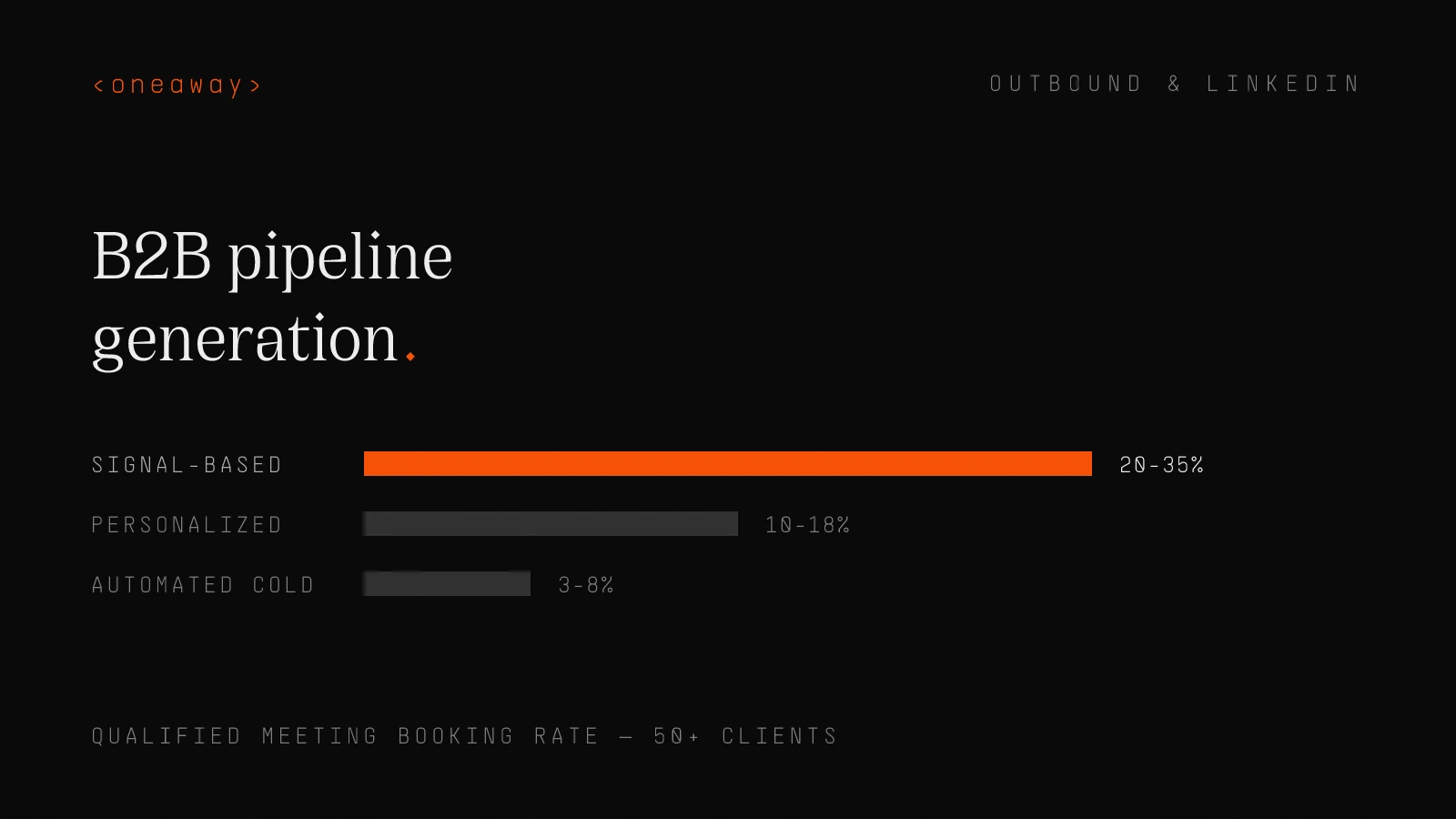
Across 50+ clients, we see these benchmarks: signal-based outbound to warm accounts = 20-35% qualified meeting booking rate, cold outbound with strong personalization = 10-18%, automated cold outreach with minimal personalization = 3-8%. If you're below 10% on targeted outbound, you have a fundamental problem with ICP fit, offer quality, or message relevance. If you're above 25% consistently, you've nailed signal-based targeting and offer-market fit. Most teams fall in the 8-15% range—good enough to generate pipeline but with major room for optimization. Focus on moving from bottom quartile (sub-10%) to median (12-15%) first, then optimize toward top quartile (20%+).
Should I focus on inbound or outbound pipeline generation?
False dichotomy. The best B2B pipeline generation systems integrate both. Inbound works when you have strong brand awareness, good SEO, and prospects actively searching for solutions. Outbound works when you can identify target accounts and reach decision-makers directly. Most companies should do both, but the ratio depends on your market position. If you're an unknown startup: 70-80% outbound, 20-30% inbound. If you're an established brand: 40-50% outbound, 50-60% inbound. The key is treating them as complementary: use inbound to warm up accounts for outbound, use outbound to drive inbound content consumption, and measure both channels together as a unified system.
How do I calculate pipeline velocity and why does it matter?
Pipeline velocity = (Number of Opportunities × Average Deal Size × Win Rate) ÷ Sales Cycle Length. But for pipeline generation specifically, focus on the time from first touch to opportunity creation, not opportunity to close. Track this as a separate metric: average days from first outreach to qualified opportunity created. Why it matters: faster pipeline velocity means more efficient capital use, better resource allocation, and more predictable revenue. If it takes your team 90 days to convert a cold prospect to pipeline vs. a competitor taking 30 days, they'll generate 3x more opportunities with the same resources. Measure it by rep, by segment, by campaign, and by source. Then optimize the slowest segments.
What's the most important metric for B2B pipeline generation?
If I could only track one metric, it would be cost per pipeline dollar. This is total pipeline generation cost (salaries, tools, ads, everything) divided by total pipeline created. Example: you spend $50K per month on pipeline generation (team + tools) and create $500K in pipeline. That's $0.10 cost per pipeline dollar. Industry benchmark is $0.15-$0.35 depending on your average deal size and sales cycle. This metric matters because it combines efficiency, effectiveness, and economics into one number. You can have great activity metrics and terrible economics. You can book tons of meetings that don't convert to pipeline. Cost per pipeline dollar tells you if your entire system actually works. Track it monthly. Optimize it relentlessly.
How do I get buy-in from leadership to change our pipeline generation approach?
Show them the math. Pull your current metrics: how many qualified meetings per month, what percentage convert to pipeline, cost per meeting, cost per pipeline dollar, current pipeline velocity. Then model the impact of specific improvements: 'If we improve qualified meeting booking rate from 11% to 18% (shown to be achievable based on benchmark data), we'd generate X more pipeline per quarter with zero additional headcount.' Leaders care about outcomes, not tactics. Don't ask for budget to 'try new tools' or 'experiment with new channels.' Ask for budget to 'improve qualified meeting booking rate by 40% in 90 days' with a specific plan. Quantify the expected return. Start with a small pilot. Show results. Scale from there.
Key Takeaways
- B2B pipeline generation is a system, not a tactic. Stop chasing silver bullets. Build the four-layer pipeline generation stack: signal capture, intelligent routing, multi-channel orchestration, and conversion optimization. Companies that master all four layers generate 3-5x more pipeline than those stuck optimizing individual tactics.
- Track the 7 metrics that actually matter: Target account coverage, qualified meeting booking rate, meeting show rate, meeting qualified rate, pipeline conversion rate, pipeline velocity, and cost per pipeline dollar. Everything else is vanity metrics.
- Signal-based targeting beats spray-and-pray by 3-4x. Stop working static lists. Start prioritizing accounts showing active buying signals. Implement monitoring for hiring changes, tech adoption, funding events, executive changes, and intent data. Route hot accounts to aggressive sequences with personalized, multi-threaded outreach.
- Qualified meeting booking is the chokepoint. Most teams lose 60-80% of interested prospects between initial engagement and booked meeting. Fix this by: creating valuable offers (not 'quick calls'), reducing friction with proper calendar tools, pre-qualifying in the booking flow, and optimizing confirmation sequences.
- Pipeline velocity is the multiplier everyone ignores. Measure time from first touch to pipeline creation, not just opportunity to close. Cut unnecessary touchpoints, respond to signals within 4 hours, multi-thread from day one, eliminate handoff delays, and match cadence intensity to signal strength.
- Your tech stack should enable your process, not define it. Start with Apollo + engagement platform + CRM + calendar tool (~$300/month). Master the fundamentals first. Add sophisticated intent tools, conversation intelligence, and analytics only when you have proven processes that need scaling.
- Continuous optimization beats one-time overhauls. Launch one A/B test per week. Review pipeline metrics weekly. Analyze conversion funnels monthly. Refresh strategy quarterly. Small, consistent improvements compound into massive results. Teams that optimize continuously generate 5-10x more pipeline than those who 'set it and forget it.'
Ready to Build a Predictable Pipeline Engine?
At oneaway, we help B2B companies engineer predictable pipeline generation systems using the exact frameworks in this playbook. We've generated $47M+ in pipeline for clients across SaaS, professional services, and B2B tech. If you're tired of unpredictable pipeline and want a systematic, data-driven approach that actually works, let's talk. Visit oneaway.io/inquire to book a free pipeline audit where we'll analyze your current system, identify your biggest constraints, and show you exactly how to 3-5x your qualified meeting booking rate in 90 days.
Check if we're a fitContinue Reading
The Complete Guide to LinkedIn Outreach Templates in 2026
100,000+ LinkedIn DMs analyzed. Here are the templates, sequences, and honest tactics that actually get replies in 2026—no fluff, just what works.
Read more [ 14 MIN READ ]Best LinkedIn Content Formats 2026, Ranked by Reach
I tested every LinkedIn content format for 90 days. Here's what actually drives out-of-network reach in 2026, ranked by performance data from real campaigns.
Read more [ 14 MIN READ ]Best Cold Calling Scripts for B2B in 2026, Ranked by Connect Rate
The 7 highest-performing cold calling scripts in 2026, ranked by actual connect and conversion data from 200K+ dials. Includes real examples, pricing, and honest pros/cons.
Read more