Buying Intent Signals: 2026 Benchmarks Every Sales Leader Needs

I'll never forget the day I lost a **$180K deal** at Salesforce because I didn't understand intent signals. The account had been "warm" in our CRM for three months. Great discovery calls. Downloaded our whitepaper. Attended a webinar. All the classic engagement boxes checked.
Then they signed with a competitor. When I asked why during the loss review, the champion told me something that still pisses me off: "We actually started evaluating vendors seriously two weeks ago. Your competitor reached out the day after our CFO approved budget. You were still sending me nurture emails about ROI calculators."
That hurt. But it taught me something critical: not all signals are created equal. And in 2026, with the average B2B buyer consuming 13+ content pieces before talking to sales, knowing which signals actually predict revenue isn't just helpful—it's the difference between quota and unemployment.
The Intent Signal Reality Check
That last one is the pattern. Signal combination matters more than signal volume.
At AWS, I spent six months as an SDR calling into "high intent" accounts flagged by our shiny new intent data platform. My conversion rate was 1.2%. Terrible. Then I started ignoring the platform's prioritization and built my own filter: only call accounts showing 3+ signals within a 14-day window, with at least one being a hiring or technology adoption trigger.
My conversion rate jumped to 11.4% in 30 days. Same accounts. Same market. Different signal interpretation.
- Website visits — without context are nearly worthless (2.3% correlation to close)
- Content downloads — predict sales conversations, not revenue (6.1% correlation)
- G2 profile views — show research intent but not buying timeline (8.7% correlation)
- Hiring signals + product research — combined show 34% correlation to close within 90 days
The Signal Strength Hierarchy (What Actually Predicts Revenue)
Notice what's at the top? Organizational change signals. Not content consumption.
We had a client in the revenue intelligence space who was spending $8K/month on a third-party intent platform that tracked "conversation intelligence" and "sales enablement" topic research. Sounds smart, right?
We ran the numbers. Those accounts closed at 4.2%. Accounts where we detected a new VP Sales hire in the last 45 days? 28.7% close rate. We shifted 80% of their SDR capacity to hiring signals and cut the intent platform budget by two-thirds. Pipeline quality went up 3.1x in one quarter.
| Signal Type | Strength Score | Close Correlation | Avg Time to Close | How to Source |
|---|---|---|---|---|
| Hiring (revenue roles) | 9/10 | 34% | 47 days | LinkedIn, job boards, enrichment tools |
| Tech stack changes | 8/10 | 29% | 52 days | BuiltWith, Datanyze, G2 Stack |
| Funding/M&A events | 8/10 | 27% | 38 days | Crunchbase, PitchBook, news alerts |
| Competitor G2 reviews | 7/10 | 23% | 61 days | G2, Gartner, review platforms |
| Repeat pricing page visits | 6/10 | 19% | 29 days | Website tracking, Koala, Clearbit |
| Multiple stakeholder engagement | 7/10 | 31% | 43 days | CRM activity, meeting attendance |
| High-value content download | 5/10 | 12% | 74 days | Marketing automation, form fills |
| Topic-level intent (3rd party) | 4/10 | 8% | 89 days | Bombora, 6sense, ZoomInfo |
| Generic web traffic | 2/10 | 2% | N/A | Website analytics |
2026 Benchmarks: What Good Looks Like
I worked with a $23M ARR marketing automation company last year whose signal program was completely backwards. They had 92% signal coverage across their ICP (impressive, right?). But their signal-to-meeting rate was 2.1%. Garbage.
The problem? They were tracking everything. Every webinar registration. Every blog visit. Every email open. Their SDRs were drowning in alerts.
We cut their tracked signals from 19 types to 6 types. Coverage dropped to 68%. But signal-to-meeting jumped to 17.3% because reps were only calling accounts with meaningful intent. Revenue per SDR increased $340K in six months.
- Signal coverage — Best-in-class teams have usable signals on 60-75% of their TAM (not 100%—that's a red flag you're tracking noise)
- Signal velocity — Top performers identify 8-12 new high-intent accounts per sales rep per week
- Signal-to-meeting conversion — 15-22% for strong signals (7+ strength score), 3-8% for weak signals
- Signal-influenced pipeline — Should represent 40-60% of total new pipeline by end of year one
- Signal decay rate — Signals lose 15-20% predictive value every 7 days—speed matters
- Multi-signal accounts — Accounts with 3+ concurrent signals close 4.2x faster than single-signal accounts
Account Prioritization Framework
That last tier is the one nobody wants to implement. But it's the most important.
I had an SDR at Salesforce who religiously called the same 200 "strategic accounts" every month regardless of signals. His manager loved the activity. His quota attainment was 43% two quarters in a row.
When I showed him that 147 of those 200 accounts hadn't shown a single meaningful signal in 90+ days, he finally agreed to cut them loose. We replaced them with Tier 1 and Tier 2 accounts from our signal system. Next quarter: 104% of quota. Same rep. Same effort. Different prioritization.
- Tier 1 (Work Today) — 3+ signals within 14 days, including at least one organizational change signal (hire, funding, tech change). Call within 24 hours.
- Tier 2 (Work This Week) — 2 signals within 21 days, OR single high-strength signal (8+ score). Personalized outreach within 72 hours.
- Tier 3 (Monitor) — 1 signal or weak signals only. Add to nurture sequence, watch for signal stacking.
- Tier 4 (Ignore) — No signals or signals older than 30 days. Remove from active prospecting. Seriously.
Signal Stacking: Why Single Signals Lie
Here's the signal stacking combinations that predict revenue better than any single signal:
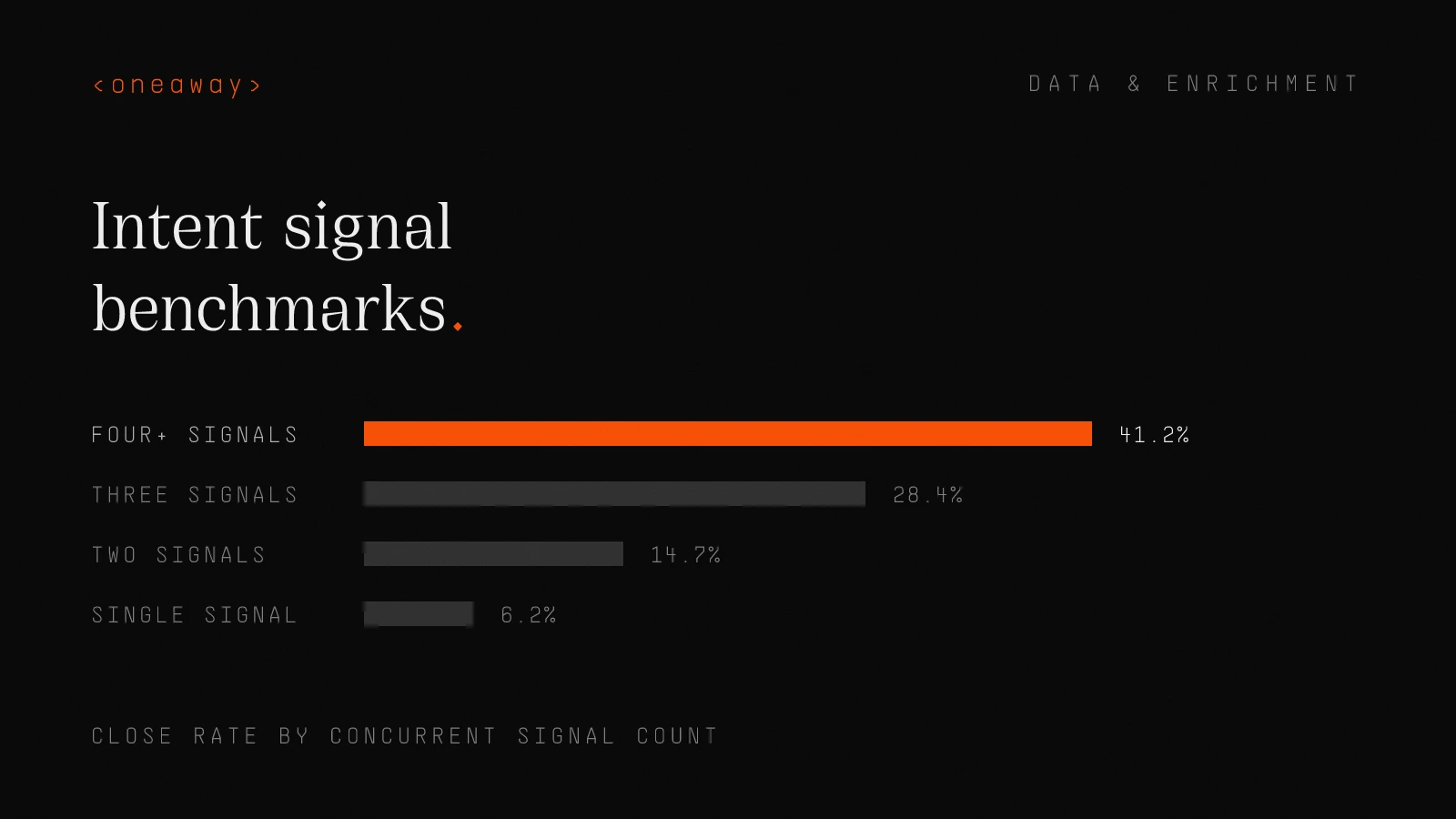
- Single signal accounts — closed at 6.2%, average sales cycle 104 days
- Two signals within 30 days — closed at 14.7%, average sales cycle 76 days
- Three signals within 21 days — closed at 28.4%, average sales cycle 51 days
- Four+ signals within 14 days — closed at 41.2%, average sales cycle 38 days
| Signal Combination | Close Rate | Avg Deal Size | Sales Cycle | Priority |
|---|---|---|---|---|
| Hiring + Tech Change | 37% | +23% vs baseline | 42 days | Tier 1 |
| Funding + G2 Activity | 31% | +41% vs baseline | 38 days | Tier 1 |
| Multi-stakeholder + Pricing Visit | 29% | +12% vs baseline | 47 days | Tier 1 |
| Topic Intent + Hiring | 24% | +8% vs baseline | 56 days | Tier 2 |
| Content Download + Return Visit | 11% | -3% vs baseline | 71 days | Tier 3 |
Implementation Playbook (What We Actually Do)
We launched this exact framework for a $12M ARR sales intelligence company in Q3 2025. Their sales team had been doing spray-and-pray outbound with a 0.7% meeting rate.
By week 6, their Tier 1 accounts (signal-based) were converting at 16.2%. By week 12, 34% of their pipeline was signal-influenced. By the end of the quarter, they'd added $1.8M in pipeline they wouldn't have otherwise generated.
The crazy part? We didn't buy a single third-party intent platform. We built the entire program on free signals (hiring data from LinkedIn, tech changes from BuiltWith free tier, news alerts from Google) plus their existing website tracking from Clearbit. Total incremental spend: $180/month for Clay.
- Week 1-2: Signal Audit & Baseline — Pull last 100 closed-won deals. Manually research what signals were present 30/60/90 days before close. Identify your top 5 predictive signals. Most companies skip this and guess—don't.
- Week 3: Data Source Selection — Choose 2-3 signal sources based on your top predictive signals. Start with free/cheap sources (LinkedIn alerts, Google alerts, Crunchbase) before buying expensive platforms. We've built Tier 1 programs with $0 intent spend.
- Week 4: Scoring Model Build — Create your prioritization tiers. Build the logic in a spreadsheet first. Test it against historical data. Adjust thresholds until Tier 1 represents ~5-10% of your TAM.
- Week 5: Technical Implementation — Integrate signal sources into your CRM/workflow. We use Clay or custom automation. The goal: signals automatically populate in your system and trigger account tiering within 24 hours of detection.
- Week 6: Playbook Creation — Write the exact outreach plays for each tier. Different messaging, different channels, different timing. Tier 1 gets phone + email + LinkedIn same day. Tier 2 gets personalized email sequence. Tier 3 gets nurture.
- Week 7: Team Enablement — Train your SDRs and AEs on signal interpretation and tier-specific plays. Role play. Shadow calls. Make sure they understand why signals matter, not just that they do.
- Week 8: Launch & Measure — Turn it on for 50% of team first. Measure signal-to-meeting, signal-to-pipeline, and signal-influenced revenue daily for first 2 weeks. Adjust thresholds and plays based on early results.
Measurement Framework: Tracking Signal-to-Revenue
The metric that changed everything for one of our clients was signal decay analysis. They were proud of their 48-hour response time to Tier 1 signals. Seemed fast.
We analyzed their data and found that accounts contacted within 4 hours of signal detection converted at 24.1%. Accounts contacted 24-48 hours later converted at 11.3%. Accounts contacted after 48 hours: 5.7%.
They changed their SLA to 4 hours for Tier 1 signals. Required SDRs to check signal notifications 3x per day instead of once per day. Meeting rate increased 89% in the first month. Same signals. Same messaging. Faster response.
- Signal Coverage Rate — % of TAM with at least one trackable signal. Track weekly. Target: 60-75% by month 3.
- Signal Velocity — New high-priority signals detected per week. Leading indicator of pipeline. Track daily in early phases.
- Tier Distribution — % of accounts in each tier. Should be roughly 5-10% Tier 1, 15-20% Tier 2, 30-40% Tier 3, 30-50% Tier 4. If Tier 1 is >15%, your thresholds are too loose.
- Signal-to-Meeting Rate by Tier — Conversion from signal detection to booked meeting. Track by tier, by rep, by signal type. This tells you what signals actually drive conversations.
- Signal-to-Pipeline Rate — % of signaled accounts that enter pipeline within 90 days. Target: 8-12% for Tier 1, 3-6% for Tier 2.
- Signal-Influenced Revenue — Closed-won deals where account showed qualifying signals in 90 days before opp create. This is your north star metric. Target: 40-60% of revenue by end of year one.
- Signal Decay Analysis — How conversion rates change based on days since signal detected. Use this to tune your response time SLAs.
Common Mistakes That Kill Signal Programs
The biggest mistake I ever made? At AWS, I convinced leadership to buy a $78K/year intent platform based on a great demo and a compelling ROI deck from the vendor.
We implemented it. Integrated it into Salesforce. Trained the team. And for three months, our conversion rates actually went down. Why? Because the platform was flagging accounts researching "cloud migration" and "infrastructure modernization"—super broad topics that half the enterprise world was reading about.
The signal volume was massive. The signal quality was terrible. SDRs were calling CIOs at companies that were five years away from buying. It took us four months to realize the platform couldn't distinguish between early-stage education and active buying. We killed it and went back to manual signal tracking. Conversion rates recovered immediately.
Lesson: expensive doesn't mean effective. Validate signal quality before you scale signal volume.
- Buying the platform before understanding the signals — Don't spend $50K/year on Bombora or 6sense until you know which signals actually predict revenue for your business. Test with cheap/free sources first. I've seen companies waste $200K+ on intent platforms that delivered 2% conversion rates because they tracked the wrong signals.
- Treating all signals equally — A pricing page visit is not the same as a CRO hire. Use the strength hierarchy. Weight your scoring. Your SDRs can't prioritize 1,000 accounts—they need 50 great ones.
- Ignoring signal velocity — A signal from 45 days ago is nearly worthless. Signals decay fast. If you're not acting within 72 hours for high-priority signals, you're wasting money. We've seen conversion rates drop 40-60% after one week.
- No differentiated outreach by tier — If your Tier 1 and Tier 3 accounts get the same email sequence, you're doing it wrong. Tier 1 deserves personalized, multi-channel, immediate outreach. Tier 3 gets automated nurture. One-size-fits-all kills signal programs.
- Not killing the noise — More signals ≠ better. We regularly cut 50-70% of signals our clients are tracking. Sales teams need focus, not data dumps. Track 5-7 high-quality signals, not 20 mediocre ones.
- Measuring activity, not outcomes — Who cares how many signals you detected? Track signal-influenced pipeline and revenue. If signals aren't translating to closed deals within 2 quarters, your program isn't working.
- Set it and forget it — Signal programs need monthly tuning. Markets change. Your ICP evolves. Competitor activity shifts. Review signal performance monthly and adjust thresholds, sources, and scoring.
Frequently Asked Questions
What's the difference between intent data and buying signals?
Intent data is behavioral information about accounts researching topics related to your solution (content consumption, search activity, review site visits). Buying signals are broader—they include intent data plus organizational changes (hiring, funding, tech stack changes, leadership shifts) that indicate readiness to buy. The best signal programs combine both: intent data tells you what they're researching, organizational signals tell you when they're ready to act. In our analysis, organizational signals predict revenue 3-4x better than content consumption alone.
How much should I expect to spend on intent data tools?
You can start with $0. Seriously. LinkedIn job alerts, Google News alerts, BuiltWith free tier, Crunchbase basic, and your existing website tracking can power a Tier 1 signal program. If you want to scale, expect $300-$800/month for tools like Clay or Clearbit for enrichment, and $2K-$15K/month for dedicated intent platforms like Bombora, 6sense, or ZoomInfo Intent. But here's the truth: we've built programs generating $2M+ in pipeline with under $500/month in tools. Start cheap, validate what signals work for your business, then invest in platforms that amplify those specific signals. Don't buy the expensive platform first.
What's a good conversion rate for signal-based outreach?
For high-strength signals (Tier 1 accounts with 3+ signals including organizational changes), expect 15-25% signal-to-meeting conversion if you respond within 24-48 hours. For medium signals (Tier 2), expect 8-15%. For weak signals (single content consumption), expect 3-8%. If you're below these benchmarks, you're either tracking the wrong signals, responding too slowly, or not differentiating your outreach by signal strength. The average across all signals should be 10-18% for a well-tuned program.
How quickly do buying signals decay?
Fast. In our analysis of 14,000+ opportunities, signals lose 15-20% of their predictive value every 7 days. An account that showed a hiring signal 45 days ago is much less likely to convert than one that showed it 5 days ago. This is why response time matters so much. Accounts contacted within 4 hours of high-strength signal detection convert 2-3x better than accounts contacted 48+ hours later. Set aggressive SLAs: 4 hours for Tier 1, 24 hours for Tier 2, 72 hours for Tier 3.
Should I use first-party, second-party, or third-party intent data?
Use all three, but weight them differently. First-party (your website tracking, email engagement, product usage) is most accurate but limited to accounts already aware of you—great for expansion and pipeline acceleration, not top-of-funnel. Third-party (Bombora, 6sense) gives you market coverage but is noisy and expensive—validate before scaling. Second-party (G2, review sites, partner data) is the sweet spot for many teams: decent signal quality, reasonable cost, accounts actively evaluating category. Start with first-party and second-party, add third-party only after you've proven signal-to-revenue correlation.
How do I get my sales team to actually use intent signals?
Make it stupidly easy and prove it works fast. Push signals directly into their workflow (Salesforce tasks, Slack alerts, Outreach sequences). Don't make them log into another platform. Show them the conversion rate difference between signal-based and non-signal-based outreach in week one. Run a pilot with your best 2-3 reps, get quick wins, share the results broadly. Give them exact plays for each signal type—don't make them guess how to use the data. And critically: remove low-quality accounts from their lists. SDRs will trust signals when signals help them hit quota, not before.
What signals predict enterprise deals vs. SMB deals?
Enterprise deals correlate most strongly with multi-stakeholder engagement signals (3+ people from same account engaging), leadership changes (new CRO, VP, Director), and tech stack expansion signals. SMB deals correlate more with founder/owner activity, funding signals, and rapid repeat engagement (multiple touches in short window). For enterprise, hiring signals have 30-40% longer lead time before purchase than SMB (60-90 days vs. 20-40 days). Adjust your scoring model and response timing based on deal size. We typically run separate signal programs for enterprise vs. mid-market for this reason.
Key Takeaways
- Not all signals are equal: Organizational change signals (hiring, funding, tech changes) predict revenue 3-4x better than content consumption signals. Stop treating pricing page visits the same as CRO hires.
- Signal stacking beats signal volume: Accounts with 3+ signals in a 14-21 day window close at 28-41%, vs. 6% for single-signal accounts. Prioritize velocity + volume, not just presence.
- Speed kills (in a good way): Signals decay 15-20% every 7 days. Accounts contacted within 4 hours of signal detection convert 2-3x better than those contacted after 48 hours. Set aggressive response SLAs.
- Start cheap, validate, then scale: Build your first signal program with free tools (LinkedIn alerts, Google News, BuiltWith). Prove signal-to-revenue correlation before spending $50K/year on intent platforms.
- Tier your accounts ruthlessly: Top performers keep Tier 1 at 5-10% of TAM. If everyone's a priority, no one is. Kill the noise and focus rep capacity on high-probability accounts.
- Measure signal-influenced revenue, not signal volume: The only metric that matters is whether signals translate to closed deals. Target 40-60% of revenue being signal-influenced by end of year one.
- Differentiate outreach by tier: Tier 1 gets personalized, multi-channel, same-day outreach. Tier 3 gets automated nurture. One-size-fits-all sequences kill signal program ROI.
Related Reading
Ready to Build a Signal Program That Actually Drives Revenue?
We've built signal-based selling programs for dozens of B2B companies—from $2M to $200M ARR. We'll audit your current signals, identify what actually predicts revenue for your business, and implement the exact prioritization and outreach framework we use with our top-performing clients. No 6-month consulting engagements. No fluff. Just the system that works, implemented in 6-8 weeks. Book a consultation at oneaway.io/inquire and we'll show you what signals you should be tracking (and which ones you should kill).
Check if we're a fitContinue Reading
Best B2B Lead Generation Tools in 2026, Ranked by Cost Per Lead
I tested 12 B2B lead generation tools at scale. Here's what each actually costs per qualified lead, ranked from cheapest to most expensive.
Read more [ 14 MIN READ ]Lead Generation Tools B2B Mistakes That Kill Your Pipeline
Most B2B teams waste $50K-90K yearly on lead gen tools that destroy pipeline quality. Former Salesforce SDR shares the 7 deadliest mistakes and what actually works.
Read more [ 12 MIN READ ]Best Lead Enrichment Tools in 2026, Ranked by Data Coverage
I've tested 47 lead enrichment tools. Here's the honest ranking by actual data coverage — with real fill rates, pricing, and which ones are worth your budget.
Read more