Clay Alternative: How I Replaced a $990/mo Stack With Claude Code

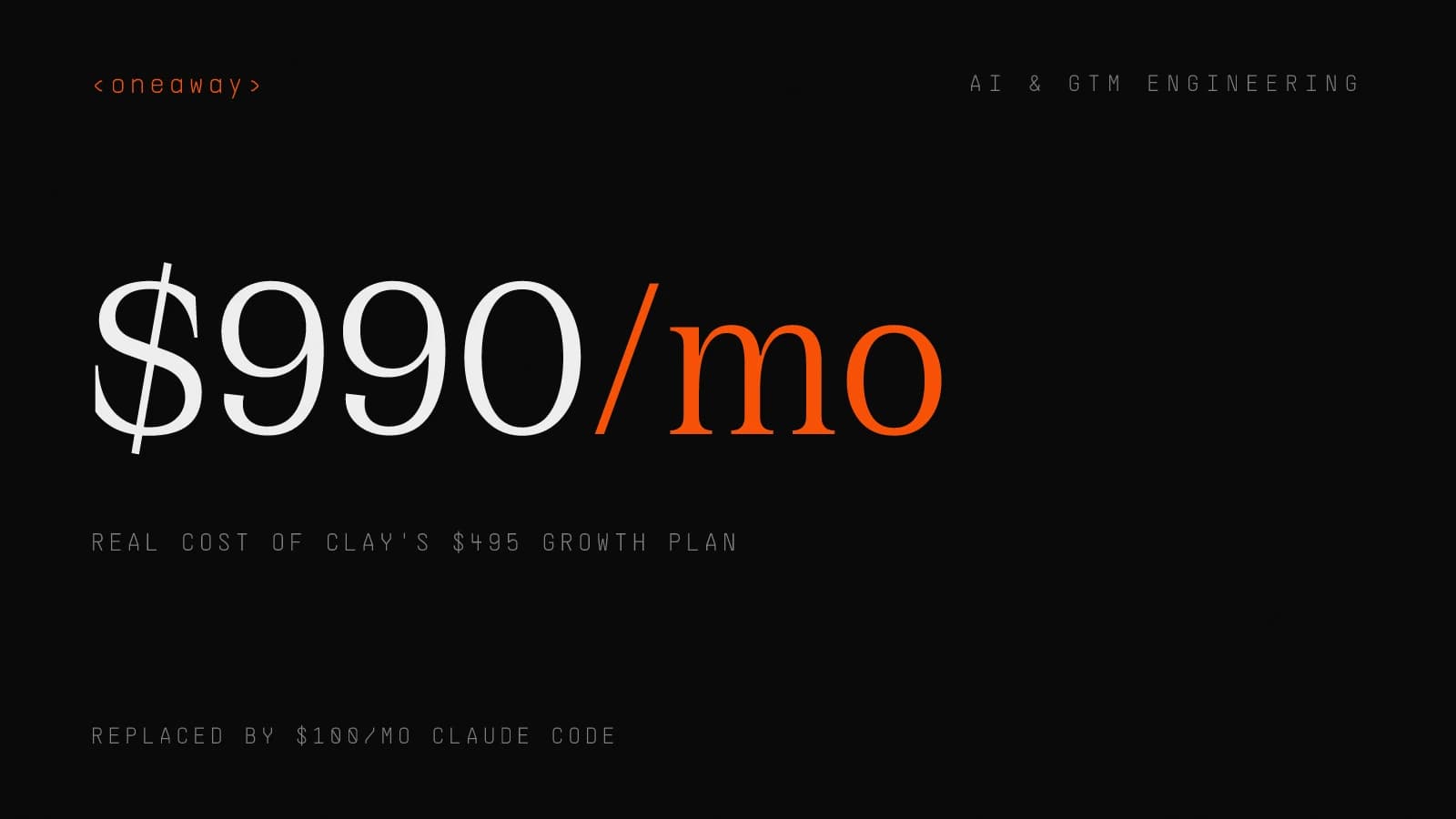
Clay's Growth plan says "$495/mo" on their website. I checked what it actually costs on monthly billing. It's $990/mo. $495 is just the platform fee. You also need Actions ($205/mo) and Data Credits ($290/mo) to actually do anything. Those are separate charges.
I run a GTM agency. I've helped clients generate over $100 million in pipeline through cold email. I'm not a developer. I don't write code. But I replaced Clay entirely with a $100/mo Claude Code subscription that does more than Clay ever did for me.
This isn't a listicle of 14 SaaS products you've never heard of. This is a real story about what happens when you stop renting someone else's enrichment spreadsheet and start building a system you actually own.
Quick Answer
Clay's Growth plan costs $990/mo in practice (platform + Actions + Data Credits). I replaced it with a $100/mo Claude Code subscription that handles enrichment, cleaning, scoring, research, and campaign launch—with no credit limits, no row caps, and no code required. Annual savings: $13,000-$15,000.
Why I Left Clay
I want to be clear about something: Clay is a great product. I genuinely think most people should try it. I used it for almost two years to run my agency. We enriched thousands of leads through it. It works.
But once you start scaling, the walls close in fast. And those walls aren't bugs or missing features. They're business model decisions. Credit caps. Row limits. Pricing tiers designed to push you toward enterprise contracts.
I didn't leave Clay because it was bad. I left because I hit a ceiling that I could only raise by spending more money on someone else's infrastructure. And once I realized I could build something better for a tenth of the cost, there was no going back.
Clay's Real Pricing: The $990/mo Breakdown
Clay restructured their pricing in March 2026. They merged their old Starter, Explorer, and Pro plans into two tiers: Launch ($185/mo) and Growth ($495/mo). On the surface, it looks simpler. In practice, the Growth plan still doesn't include everything you need.
Here's what the Growth plan actually costs when you're using it for real enrichment work:
| Line Item | Monthly Cost |
|---|---|
| Growth plan (platform fee) | $495 |
| Actions (orchestration credits) | $205 |
| Data Credits (enrichment data) | $290 |
| Total | $990/mo |
That's the advertised $495 plan doubling the moment you try to actually use it.
And that doesn't include failed lookups. Clay charges credits for every enrichment attempt, regardless of whether data is found. Independent analyses show 20-30% of credits go to failed queries. So that $990/mo is really buying you about $700 worth of usable data.
Add LinkedIn Sales Navigator ($100/mo), an email sequencing tool ($50-100/mo), and a CRM, and you're easily above $1,200/mo before you've sent a single email.
My replacement cost: $100/mo for Claude Code. Plus whatever API costs I choose to pay directly, at cost, with no markup.
The 7 Limitations That Pushed Me Out
These aren't edge cases. These are daily pain points for anyone running outbound at scale.
1. The 50,000 Row Cap
Every Clay table maxes out at 50,000 rows. If you're running campaigns across multiple clients and verticals, you hit this fast. When you do, your options are: start a new table and lose the context, or upgrade to Enterprise and negotiate a contract.
2. Performance Degradation at Scale
Once a table hits 30-40 columns, Clay's UI starts to lag. Scrolling stutters. Enrichments slow down. The 400 records/hour API throttle on the Explorer plan (now part of Growth) caps daily processing at 3,200 records. Time-sensitive campaigns become impossible without upgrading.
3. Credits That Expire Every Month
Unused credits disappear at the end of each billing cycle, with a rollover cap at 2x your monthly allocation. If you run campaigns quarterly, you lose 30-40% of your subscription value during low-activity months.
4. Mid-Cycle Top-Up Premium
Run out of credits before the month ends? Clay charges a 50% markup on top-up credits. A mid-month campaign needing 3,000 extra credits costs $159 on top of your subscription. 60% of Growth plan users purchase top-ups at least quarterly.
5. Custom API Calls Require the Growth Plan
Want to call your own APIs? You need the Growth plan minimum. This is a dealbreaker for agencies and power users who need to connect niche data providers that Clay doesn't natively support.
6. Real Support Is Enterprise Only
Growth plan customers get a "priority queue." Slack access—the kind of direct support you need when a workflow breaks mid-campaign—is reserved for Enterprise. If something goes wrong at 11pm before a launch, you're on your own.
7. Bring Your Own Key, Still Pay Per Action
Even if you provide your own API keys to data providers, Clay still charges you per Action for the orchestration. You're paying twice: once for the data at source, and again for Clay to run it.
What I Built Instead (With Zero Code)
I built a complete lead enrichment and campaign system using Claude Code. I didn't write a single line of code myself. I described what I needed in plain English, and Claude built it.
Here's everything it does:
CSV Upload and Auto-Detection
It uploads CSVs from any lead source—Apollo, Prospeo, Store Leads, you name it—auto-detects where the data came from based on column headers, and normalizes everything into a Postgres database I own.
Not a spreadsheet. Not someone else's platform. A real database that I can query across every client, every campaign, every enrichment I've ever run.
Company Name Cleaning
It auto-cleans company names—strips taglines, fixes ALL CAPS, removes "Powered by X" garbage, drops the "Inc." and "LLC" suffixes that break email personalization. Every company name comes out clean and ready for first-line personalization.
Contact Data Cleaning
It cleans contact names, standardizes job titles, detects junk leads (generic emails, test accounts, duplicates), and automatically flags contacts with non-Latin characters that would break English outreach. This alone saved me hours of manual CSV cleanup every week.
MX Lookup Classification
It runs MX lookups on every email domain to classify the provider: Google Workspace, Microsoft 365, or other. This tells me which inboxes I'm landing in before I send a single email. If a prospect is on Google, I know what kind of deliverability challenges to expect. If they're on Microsoft, different playbook entirely.
Website Scraping + LLM Analysis
It scrapes company websites and runs them through an LLM to extract:
- Competitors—who they compete against
- ICP signals—what kind of customers they serve
- Pricing models—how they charge
- Product categories—what they actually do
Cost: about a penny per company. Clay charges credits for similar enrichment through Claygent, and those credits add up fast.
Deep Research Mode
For high-priority prospects, it has a deep research mode that hits Google three different ways, runs semantic search across review sites, aggregates the results, and synthesizes everything through Llama 70B. Full company intel—funding, headcount, tech stack, recent news—for about a cent per company.
In Clay, this level of research would burn through your monthly credits in a single campaign.
Cold Email Detection
It detects whether a company is already running cold email by analyzing their domain DNS records and redirect patterns. This tells me who's inbox-aware before I reach out. If a prospect is already running outbound, they understand the game. That changes how I write the first line.
Sales Rep Discovery
It finds sales reps and decision-makers at each company, verifies their emails through multiple providers, and adds them directly to the database. No need for a separate tool.
ICP Scoring
It scores every contact against a custom ICP rubric that I build conversationally. I describe my ideal customer in plain English, and Claude creates a deterministic scoring system. Need to change the criteria? I change it in one sentence. Scores update instantly. Cost: $0.
In Clay, you'd build a formula column or use Claygent for this. Both consume credits. Both require you to understand Clay's formula syntax.
Any API Integration
It connects to any API I want. Not just the ones Clay decided to support. I point Claude at the API docs and the integration exists in minutes. No marketplace. No waiting for Clay to add a provider. No per-Action charge for using my own keys.
End-to-End Campaign Launch
When I'm done enriching, another agent takes the scored leads, writes the email sequences, creates the campaign in my sending tool, imports the contacts, attaches senders, sets the schedule, and launches. Same chat window. Same $100/mo subscription.
In Clay, enrichment ends at the export button. Everything after that is another tool, another tab, another subscription.
Clay vs Claude Code: Feature-by-Feature Comparison
| Capability | Clay (Growth Plan) | Claude Code |
|---|---|---|
| Monthly cost | $990+ (real cost) | $100 |
| Data enrichment | 75+ providers via credits | Any API, at cost, no markup |
| Row/record limit | 50,000 per table | Unlimited (Postgres) |
| Company name cleaning | Manual or formula column | Automatic, AI-powered |
| Contact data cleaning | Manual | Automatic, flags junk leads |
| MX lookup classification | Not built-in | Built-in, auto-classifies |
| Website scraping + analysis | Claygent (credits) | ~$0.01/company |
| Deep research | Claygent (heavy credit usage) | ~$0.01/company |
| Cold email detection | Not available | Built-in |
| ICP scoring | Formula columns (credits) | Conversational, $0 |
| Custom API integrations | Growth plan minimum, per-Action fee | Any API, minutes to connect |
| Campaign launch | Export to separate tool | End-to-end, same interface |
| Data ownership | Clay's platform | Your Postgres database |
| Credit expiration | Monthly | None |
| Support | Priority queue | Direct (it's your system) |
The Real Cost Comparison
Let's compare what it actually costs to run a 5,000-contact enrichment campaign.
Clay's Cost
| Item | Cost |
|---|---|
| Growth plan | $495/mo |
| Actions | $205/mo |
| Data Credits | $290/mo |
| 25% failed lookup waste | ~$72 wasted |
| Mid-cycle top-up (likely) | ~$159 |
| Email sequencing tool | ~$79/mo |
| LinkedIn Sales Navigator | ~$100/mo |
| Monthly total | $1,400+ |
Claude Code's Cost
| Item | Cost |
|---|---|
| Claude Code subscription | $100/mo |
| API calls at cost (enrichment, scraping) | ~$50-80/mo |
| Neon Postgres (database) | $0-19/mo |
| Email sequencing tool | ~$79/mo |
| Monthly total | $250-280 |
Annual savings: $13,000-$15,000.
And that's before you factor in the compounding value. Every enrichment I run, every campaign I launch, every piece of data I collect lives in a database I own. I can query across all of it. Build reports. Find patterns. That data compounds. Clay's data lives in Clay's spreadsheet with a 50,000 row cap and credits that reset every month.
Who This Is For (and Who Should Stay on Clay)
This Approach Is For You If:
- You're spending $500+/mo on Clay and hitting credit limits, row caps, or performance issues
- You run an agency managing multiple clients and need cross-client data infrastructure
- You want data ownership—a real database you control, not a platform you rent
- You need custom API integrations that Clay doesn't natively support
- You're comfortable describing what you want in plain English (no code required, but you need to be specific about what you need)
- You value capability over features—you want a system that grows with you, not one with a pricing page that gates each tier
Stay on Clay If:
- You're enriching fewer than 500 contacts/month—Clay's Launch plan ($185/mo) is sufficient and simpler to set up
- You need a visual workflow builder—Clay's drag-and-drop interface is genuinely good for teams who think in spreadsheets
- You have a RevOps team that already knows Clay—switching costs are real, and if Clay works for your volume, don't fix what isn't broken
- You need to be operational today—building a custom system takes a week of focused effort upfront, while Clay works out of the box
The Bigger Picture: Product vs. Capability
I didn't plan to build all of this. I started by uploading a CSV and cleaning some company names. But once you start, you can't stop. Because every new capability costs almost nothing to add.
That's the fundamental difference between a product and a capability.
Clay is a product with a pricing page. Every new feature they add is another tier on that page. Every API you want to call is another credit charge. Every row you add is one step closer to a cap.
What I built is a capability with no ceiling. Need a new enrichment source? Point Claude at the API docs. Need a new scoring model? Describe it in one sentence. Need to cross-reference data across three campaigns from six months ago? Run a SQL query on your own database.
My data lives in Postgres. Not in someone else's spreadsheet. I can query across every client, every campaign, every enrichment I've ever run. That's not a workflow. That's a data asset that compounds.
Frequently Asked Questions
Do I need to know how to code to replace Clay with Claude Code?
No. I don't write code. I describe what I need in plain English, and Claude Code builds it. "Upload this CSV, clean the company names, run MX lookups on every domain, and score each contact against this ICP." That's the level of instruction required. Claude handles the implementation.
How long does it take to set up?
The initial system took about a week of focused sessions to build. But it's not a one-time build—it grows with every conversation. Each new capability (a new API integration, a new scoring model, a new enrichment step) takes minutes to add, not days.
How much does Clay actually cost per month?
Clay's Growth plan advertises $495/mo, but the real cost is $990/mo when you add required Actions ($205/mo) and Data Credits ($290/mo). With additional tools like LinkedIn Sales Navigator and email sequencing, total cost exceeds $1,200/mo.
What data providers work with Claude Code?
Any data provider with an API—Apollo, Prospeo, Hunter, Clearbit, and more. You pay providers directly at their published rates with no middleman markup.
Is a Claude Code enrichment system reliable for production campaigns?
Yes. The data lives in Postgres, the same database technology that runs Instagram, Spotify, and most of the internet. It's production infrastructure, not a prototype.
Can I still use Clay alongside this system?
Yes. Some teams use Clay for specific waterfall enrichment workflows and push the enriched data into their Postgres database for everything else. It's not all-or-nothing. But most people who try the Claude Code approach find they don't go back.
Key Takeaways
- Clay's Growth plan costs $990/mo in practice, not the $495 advertised—once you add Actions and Data Credits
- Every "Clay alternative" listicle recommends other SaaS products. The real alternative is building a system you own.
- Claude Code costs $100/mo and replaces enrichment, cleaning, scoring, research, and campaign launch—with no credit limits, no row caps, and no expiring credits
- You don't need to code. You need to describe what you want in plain English.
- Data ownership matters. Your enrichments should live in a database you control, not a platform you rent.
- Annual savings: $13,000-$15,000 compared to a full Clay stack—and the gap widens as you scale.
Get the Full System Blueprint
I put together the complete blueprint for this system—every tool, the workflow, the integrations, a detailed Clay vs custom cost comparison, and a step-by-step walkthrough of how each piece works.
If you want to see exactly how a non-technical agency owner replaced a $990/mo enrichment stack with something better for $100/mo, the blueprint covers everything you need to get started.
Continue Reading
Best AI Sales Forecasting Models in 2026, Ranked by Accuracy
I tested 11 AI sales forecasting models with real pipeline data. Here's what actually works, ranked by accuracy, cost, and whether your CRM can handle it.
Read more [ 14 MIN READ ]Best AI Sales Team Workflows in 2026, Ranked by Time Saved
I tested dozens of AI tools sales team workflows. Here's what actually saves time in 2026, ranked by hours recovered per rep per week—with real implementation data.
Read more [ 18 MIN READ ]Best AI GTM Tools for Revenue Teams in 2026, Ranked by Impact
I've tested dozens of AI GTM tools as a former AWS/Salesforce SDR turned GTM engineer. Here's what actually moves revenue in 2026, ranked by real-world impact.
Read more