We Analyzed 1,533,399 Cold Emails. Here's What Actually Gets a Reply in 2026.

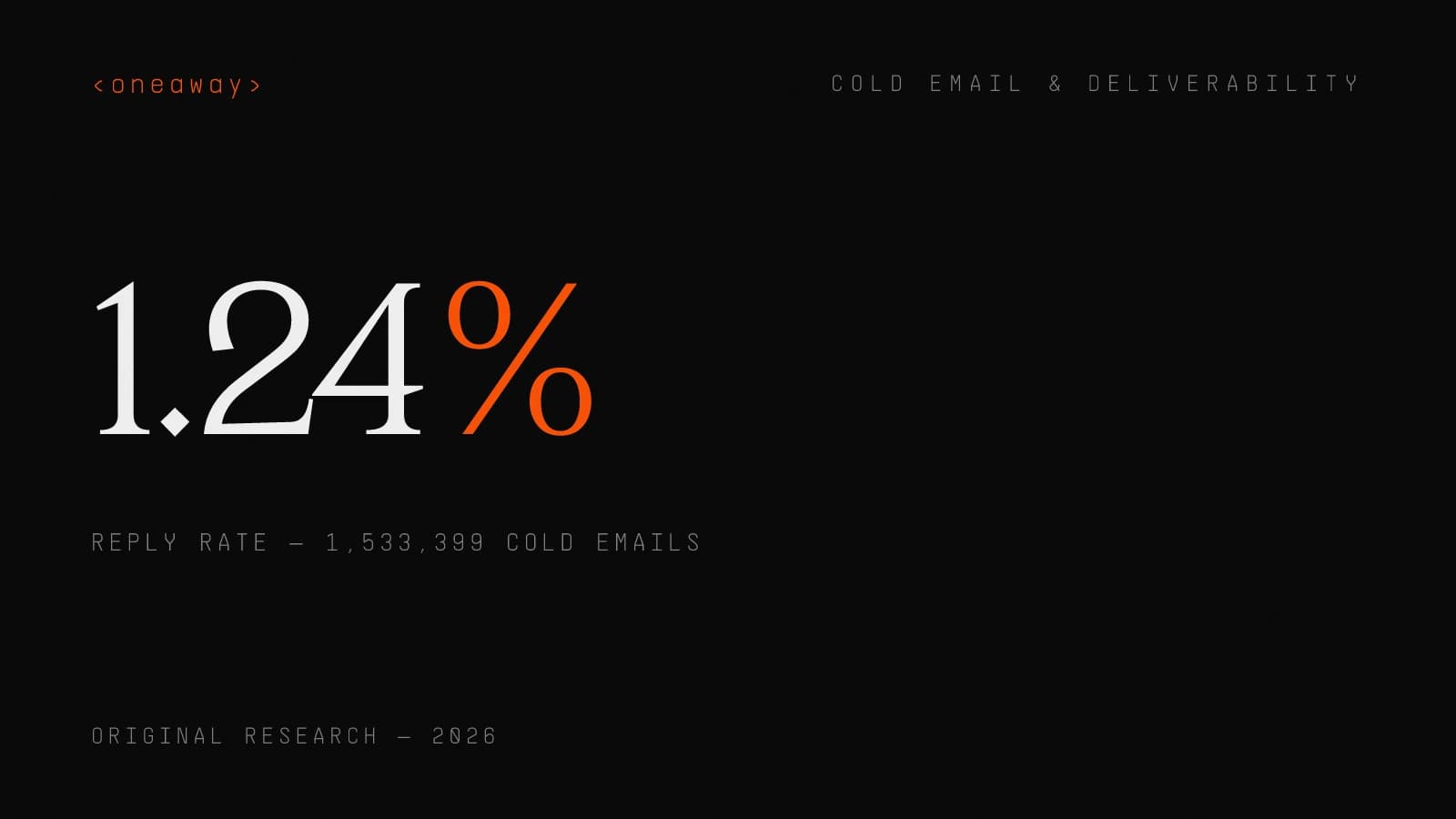
We pulled every cold email we've sent across our campaigns and counted them: 1,533,399 emails to 640,246 prospects, across 707 campaigns and 17 B2B companies. Then we looked at what actually happened. The most important finding isn't the reply rate — it's that reply rate is a vanity metric, and chasing it is why most cold email looks busy and books nothing.
I've been sending cold email since I was an SDR at Salesforce, then AWS. Now we run outbound for B2B companies for a living. So instead of quoting someone else's “industry average,” here are our own numbers — 1.5 million cold emails worth — with nothing rounded and no client named.
Two definitions first, because the whole story lives in the gap between them. A reply is any human response. An interested reply is one where the prospect actually wants to talk. Those two numbers are nowhere near each other.
The dataset: 1,533,399 cold emails
This isn't a survey or a scrape of other people's blogs. It's every cold email sent through our campaigns, pulled straight from our system of record as of June 2026, aggregated and fully anonymized.
| Metric | Number |
|---|---|
| Cold emails sent | 1,533,399 |
| Prospects contacted | 640,246 |
| Emails per prospect | 2.4 |
| Campaigns | 707 |
| B2B companies | 17 |
| Total replies | 19,042 |
| Interested replies | 2,556 |
One thing we don't measure: open rates. We turn open tracking off on every campaign, on purpose — more on why below. For cold email in 2026, the reply is the only signal worth trusting, so that's what we built this analysis around.
Cold email reply rates in 2026: 1.24%
Across 1,533,399 emails, we got 19,042 replies. That's a 1.24% reply rate — a bit more than double the ~0.5% figure that gets thrown around as the industry average, and a long way from the 8–12% I used to see at Salesforce in 2019.
That number is real, but on its own it's almost useless. Reply rate is where most analyses stop, and stopping there is the mistake. Because a reply isn't a buyer. A reply is just a human typing something back — and most of what they type is some version of “no.”
Reply rate is a vanity metric
Of those 19,042 replies, only 2,556 were actually interested. That's 13.4% of all replies, and just 0.17% of emails sent — roughly one interested reply for every 600 cold emails.
The cleanest proof that reply rate lies is what happens when you put two of the companies in this dataset side by side:
| Company | Reply rate | Interested rate |
|---|---|---|
| Company A | 3.04% (highest in the dataset) | 0.011% |
| Company B | 1.84% | 0.459% (~40× higher) |
Company A had the highest reply rate in the entire dataset — 3.04%. On a leaderboard, they win. But their interested rate was 0.011%. Nearly every reply was a rejection, an unsubscribe, or an annoyed “take me off this list.” A lot of replies, almost no pipeline.
Company B got a lower reply rate — 1.84% — but a 0.459% interested rate, about 40 times more genuine interest per email. Fewer replies, dramatically more pipeline.
Here's the uncomfortable conclusion: if you optimize for reply rate, you're often just optimizing for people telling you no faster. Aggressive subject lines, guilt-trip follow-ups, and “just bumping this” emails all lift reply rate. They also fill your inbox with people who were never going to buy.
Most replies are rejections, not opportunities
When we sentiment-tagged the replies, the split was sobering:
- 47% negative — not interested, unsubscribe, or hostile.
- 39% positive — some level of genuine interest.
- 14% neutral — questions, “who is this,” or “not now.”
So when a founder tells me “we're getting tons of replies,” my first question is always: how many of them wanted to talk? Across 1.5 million emails, the honest answer is that the plurality of replies are people telling you to go away. That's not a reason to quit cold email — it's a reason to stop celebrating the wrong number.
Reply rates varied 9× by company. Interest varied 40×.
Across the 17 companies, reply rates ranged from 0.35% to 3.22% — a 9× spread. Interested rates ranged from 0.011% to 0.459% — a 40× spread. Same operators, same infrastructure, same year. The variable that moved the needle wasn't volume or send tech. It was who they targeted and what they offered.
This tracks with everything I've seen since Salesforce: the list and the offer are 90% of the result. You can't out-send a bad target. If your reply rates are low and your interested rate is near zero, the answer is almost never “send more.” It's a tighter ICP and a sharper reason to care.
The deliverability numbers (and the metric we refuse to track)
Across 1,533,399 sends, our bounce rate was 0.98% — just under 1%. That's the floor you need to even play in 2026; once bounce rates climb, your domain reputation tanks and the rest of your sends quietly stop reaching the inbox. If you want the full picture on that, we wrote a deeper guide on deliverability.
And the number we deliberately don't track: opens. Zero open tracking, across every campaign. Open-tracking pixels add a tracking link to every email, which is one of the fastest ways to get filtered into spam in 2026. The “open rate” you'd gain is mostly noise anyway — inflated by security scanners and Apple Mail Privacy Protection auto-opening everything. We'd rather protect deliverability and judge campaigns on the only thing that correlates with revenue: replies, and specifically interested replies.
The Outlook problem nobody accounts for
Here's a finding that changed how we run campaigns. We checked the inbox provider on 3,435 B2B buyers we'd enriched. 37% were on Microsoft / Outlook.
That matters because cold email to Microsoft-hosted inboxes underperforms badly — Microsoft's filtering is more aggressive, and a clean message that lands fine in Gmail can vanish into an Outlook quarantine. If more than a third of your market is on Outlook and you're treating every inbox the same, you're structurally invisible to a huge slice of your buyers.
It's exactly why OneAway checks the inbox provider on every lead and routes accordingly: Google Workspace buyers get email, where it performs; Outlook-heavy buyers get LinkedIn outreach instead, where you can actually reach them. The channel should be decided by the data, not by habit.
What this means for your outbound in 2026
- Track interested-reply rate, not reply rate. If your tool only shows replies, you're flying blind. Tag every reply as interested / not, and watch the interested number.
- Expect ~1 interested reply per 600 emails at a healthy 0.17% interested rate. Reverse-engineer your volume from how many conversations you actually need.
- Fix the list before the volume. A 40× swing in interest came from targeting and offer, not send count.
- Route by inbox provider. If a third of your TAM is on Outlook, email-only outbound leaves a third of your pipeline on the table.
- Keep bounce under 1% and kill open tracking. Both protect the deliverability that everything else depends on.
Frequently asked questions
What is a good cold email reply rate in 2026?
Across 1,533,399 cold emails we sent, the average reply rate was 1.24%. But reply rate alone is misleading — only 13.4% of those replies were actually interested. A more useful target is the interested-reply rate, which averaged 0.17% (about one interested reply per 600 emails).
What is an interested-reply rate?
It's the share of emails that generate a reply from a prospect who actually wants to talk — not an unsubscribe, rejection, or auto-response. In our data it was 0.17% of emails sent and 13.4% of all replies. It's the metric that correlates with pipeline; raw reply rate does not.
Why is reply rate a vanity metric?
Because a high reply rate often means more people are saying no, faster. In our dataset, the company with the highest reply rate (3.04%) had one of the lowest interested rates (0.011%), while a company with a lower 1.84% reply rate had ~40× more genuine interest. Replies are easy to generate; interest is not.
Should you track email open rates for cold email?
No. We disable open tracking on every campaign. Open-tracking pixels hurt deliverability, and open data is heavily inflated by security scanners and Apple Mail Privacy Protection. Reply rate — specifically interested-reply rate — is the only metric worth optimizing.
Does inbox provider affect cold email performance?
Significantly. 37% of the B2B inboxes we checked were on Microsoft / Outlook, where cold email is filtered far more aggressively than Gmail. If a third of your market is on Outlook, treating every inbox the same makes you invisible to a large share of buyers.
Key takeaways
- We analyzed 1,533,399 cold emails sent to 640,246 prospects across 17 B2B companies.
- Average reply rate: 1.24%. But only 13.4% of replies were interested.
- Interested-reply rate averaged 0.17% — about 1 interested reply per 600 emails.
- The highest reply rate in the data (3.04%) had a near-zero interested rate (0.011%).
- 47% of replies were negative; reply rate is a vanity metric.
- Interest varied 40× across companies — targeting and offer beat volume.
- 0.98% bounce, zero open tracking, and 37% of buyers on Outlook.
If you'd rather have someone run outbound that's measured on interested replies and meetings — not vanity metrics — book a call with OneAway and we'll map your TAM and show you what the numbers should look like.
Continue Reading
Best Email Outreach Tools for Small Teams (2026), by Setup Speed
I tested 10 email outreach tools and ranked them by how fast you can actually send your first campaign. Real setup times, honest pricing, and which platforms work for teams under 10.
Read more [ 12 MIN READ ]The 30/30/50 Budget Rule for B2B Founders, Ranked by Survival
Most B2B founders waste their GTM budget on the wrong channels. Here's the allocation framework that actually keeps companies alive, tested across 50+ early-stage startups.
Read more [ 14 MIN READ ]Best Email Warm-Up Tools 2026: Safety vs Fake Engagement
I ranked the best email warmup tools by what actually matters in 2026: real deliverability improvement vs fake engagement that gets you flagged. Here's what works.
Read more