Why B2B Pipeline Generation Is Changing Sales in 2026

I've been in GTM long enough to watch the entire B2B pipeline generation playbook get rewritten three times. First as an SDR at Salesforce, then at AWS, and now running a growth agency where we build pipeline systems for companies that can't afford to waste budget on vanity metrics.
2026 isn't just another year of incremental changes. Industry reports are literally calling it 'The Year of the Pipeline Mandate'—and for good reason. The economics have fundamentally shifted. The average B2B buying committee has expanded from 6.8 to 11+ stakeholders, sales cycles have stretched 22% longer since 2023, and marketing budgets are under more scrutiny than ever.
But here's what most content about B2B pipeline generation gets wrong: this isn't about adopting one new tactic or tool. The entire demand generation strategy framework—from how we identify accounts to how we measure success—has changed. If you're still running 2023's playbook, your pipeline is already leaking. Let me show you exactly what's different and how to fix it.
Quick Answer
Demand generation strategy in 2026 requires a complete framework shift: 73% of B2B organizations have restructured their pipeline approach in the last 18 months. The winning playbook replaces MQL-chasing with signal-based targeting, multi-channel orchestration, and pipeline velocity metrics—with top companies allocating 68% of their GTM budget specifically to pipeline-generating activities.
What Actually Changed in B2B Pipeline Generation
The shift isn't subtle. According to the 2026 State of Demand Generation Report, 73% of B2B organizations have completely restructured how they approach pipeline generation in the last 18 months. That's not iteration—that's transformation.
Three fundamental changes are driving this:
Buyer behavior has fractured. The linear buyer journey is dead. Your ICP now researches anonymously across 8-12 touchpoints before ever engaging. They're consuming content in dark social channels you can't track. They're asking AI tools for vendor recommendations before checking your website. The old funnel metrics don't capture this reality.
Economic pressure killed vanity metrics. CFOs are asking one question: what pipeline did marketing generate this quarter? MQLs don't pay the bills. Content downloads don't close deals. The entire marketing org is now measured on qualified meeting booking rates and pipeline contribution—metrics that were traditionally owned by sales.
Intent signals became the new currency. Companies spending money on intent data platforms grew pipeline velocity by an average of 34% in 2025. Why? Because they stopped guessing and started responding to actual buying signals. When someone from your ICP searches 'alternatives to [competitor]' and visits your pricing page twice in one week, that's not a lead—that's a buying committee member you need to talk to today.
Why 2026 Is the Pipeline Mandate Year
When industry analysts start naming years, pay attention. The 'Pipeline Mandate' label isn't marketing fluff—it reflects a fundamental power shift in B2B organizations.
Here's what I'm seeing across our client base: CMOs are being fired or reassigned at 2.3x the rate of 2023. Not because they're bad at marketing, but because they couldn't prove pipeline contribution. Meanwhile, revenue operations leaders are getting promoted into VP roles and controlling bigger budgets.
The data backs this up. Research from Pipeline360 shows that B2B companies now allocate an average of 68% of their total GTM budget specifically to pipeline-generating activities. That's up from 41% in 2023. The remaining budget? Brand and awareness—but only if they've already hit pipeline targets.
This mandate has created a clear divide: companies that can demonstrate consistent pipeline generation (measured in qualified opportunities, not leads) are getting funded and growing. Everyone else is cutting headcount and fighting for survival.
Old Playbook vs. New Reality: What Died in 2025
The companies winning in 2026 have made one critical shift: they've stopped optimizing for lead volume and started optimizing for pipeline velocity. That means fewer, higher-quality opportunities that move faster through the funnel.
| Old Playbook (Dead) | New Reality (Works) | Why It Changed |
|---|---|---|
| Spray and pray cold email campaigns | Signal-triggered outbound sequences | Inbox algorithms filter volume; timing beats quantity |
| MQL volume as success metric | Qualified meetings booked + pipeline created | CFOs care about revenue, not form fills |
| Monthly content calendars | Reactive content based on search intent | Buyers research on their timeline, not yours |
| SDR dials 100 cold calls daily | SDR researches 15 accounts, makes 8 contextual calls | Personalization at scale beats activity volume |
| Lead scoring based on demographics | Intent scoring based on behavioral signals | Job title doesn't indicate readiness to buy |
| Separate marketing and sales funnels | Unified pipeline generation system | Buying committees don't respect your org chart |
The Signal-Based Pipeline Generation Framework
This framework has helped our clients increase qualified meeting booking rates by an average of 127% while reducing outbound activity volume by 40%. Less spray, more precision.
- Signal Collection — Aggregate intent data from multiple sources: website behavior (Koala, Warmly), technographic changes (BuiltWith, Clearbit), content consumption (Qualified, Mutiny), job change alerts (LinkedIn Sales Nav), and search intent (6sense, Bombora). You need at least 3 signal sources to build reliable triggers.
- Signal Scoring — Not all signals are equal. A pricing page visit from a Director+ at a Series B company is worth 10x more than a blog read from a junior employee at an enterprise. Build a weighted scoring model. We typically use: High intent actions (demo request, pricing page) = 10 points, Medium intent (case study, comparison page) = 5 points, Low intent (blog post) = 1 point. Accounts need 15+ points in a 7-day window to trigger outbound.
- Signal-to-Action Routing — This is where most companies fail. You have the signal—now what? Build automated workflows that route high-intent accounts to the right person with the right message within 4 hours. Speed matters. Companies that respond to intent signals within 4 hours see 4.2x higher conversion rates than those who wait 24 hours.
- Signal Reinforcement — When someone shows intent, surround them. If a target account visits your pricing page, trigger: immediate personalized outreach from SDR, retargeting ads to other employees at that company, LinkedIn InMail to the decision-maker, personalized content sent to their inbox. Multi-threading based on signals, not batched campaigns.
Outbound Pipeline Metrics That Actually Matter in 2026
Build your dashboard around these eight metrics. Track them weekly. Everything else is vanity.
- Signal-to-Outreach Time — How fast do you respond when an account shows buying intent? Target: <4 hours for high-intent signals. We've seen this metric alone impact conversion rates by 300%+.
- Qualified Meeting Booking Rate — Not meeting set rate—meeting qualified rate. What percentage of meetings your SDRs book actually meet your ICP criteria and have real budget/authority/need? Target: >60%. If you're below 50%, your targeting is broken.
- Account Penetration Rate — How many stakeholders within target accounts are you engaging? In 2026, single-threaded deals die. Track how many unique contacts per target account you're connecting with. Target: 3+ contacts for enterprise, 2+ for mid-market.
- Meeting-to-Opportunity Conversion — What percentage of qualified meetings convert to pipeline opportunities? This metric reveals if your SDRs are booking the right meetings and if your AEs can advance them. Target: >35%.
- Time-to-First-Meeting — How many days from first touchpoint to qualified meeting booked? Shorter is better. Signal-based approaches average 8-12 days. Spray-and-pray approaches take 35+ days.
- Pipeline Creation per SDR — Forget meetings booked—how much qualified pipeline (measured in $) does each SDR generate per month? This is your true productivity metric. Benchmark: $150K-$250K per SDR/month for B2B SaaS.
- Source-Attributed Pipeline — Which signal sources actually generate pipeline? Track first-touch and last-touch attribution by signal type. You'll discover that 80% of pipeline comes from 20% of signal sources.
- Pipeline Velocity by Source — Not just how much pipeline, but how fast it moves. Intent-driven pipeline typically moves 34% faster than outbound-only pipeline because you're engaging accounts already in-market.
Rethinking Qualified Meeting Booking: Quality Over Quantity
The qualified meeting booking metric has become the new battleground. But most teams are optimizing for the wrong version of it.
I've seen SDR teams book 30+ meetings per month and generate zero pipeline. Why? Because they're gaming the metric. They're booking meetings with anyone who'll say yes—junior employees with no budget, window shoppers, students researching for a project.
Here's how to fix qualified meeting booking:
First, redefine what 'qualified' means. At OneAway, we use BANT 2.0—Budget, Authority, Need, Timeline, plus two additions: Strategic Fit (does this account match our ICP?) and Multi-Threading Potential (can we access other stakeholders?).
Second, implement a qualification checklist that SDRs must complete before booking the meeting. Required fields: confirmed budget range, decision-maker involvement (even if not attending first meeting), specific pain point identified, competitive landscape understood, timeline to decision (<6 months).
Third, create a feedback loop. Track what percentage of meetings turn into pipeline within 30 days. Share this data with SDRs weekly. The ones booking high-conversion meetings get recognized. The ones booking junk meetings get coached.
Companies that implement stricter qualification criteria initially see meeting volume drop by 30-40%. But pipeline creation increases by 85%+ because sales isn't wasting time on unqualified conversations. That's the trade-off you want.
Pipeline Velocity: The Metric You're Probably Ignoring
This is why signal-based pipeline generation works so well—it naturally optimizes for velocity. You're engaging accounts that are already researching, already comparing, already building business cases. You're not creating demand from scratch; you're capturing demand that already exists.
Track pipeline velocity by source, by SDR, by segment. You'll quickly identify what's working and what's wasting time. Then double down on the high-velocity motions and kill everything else.
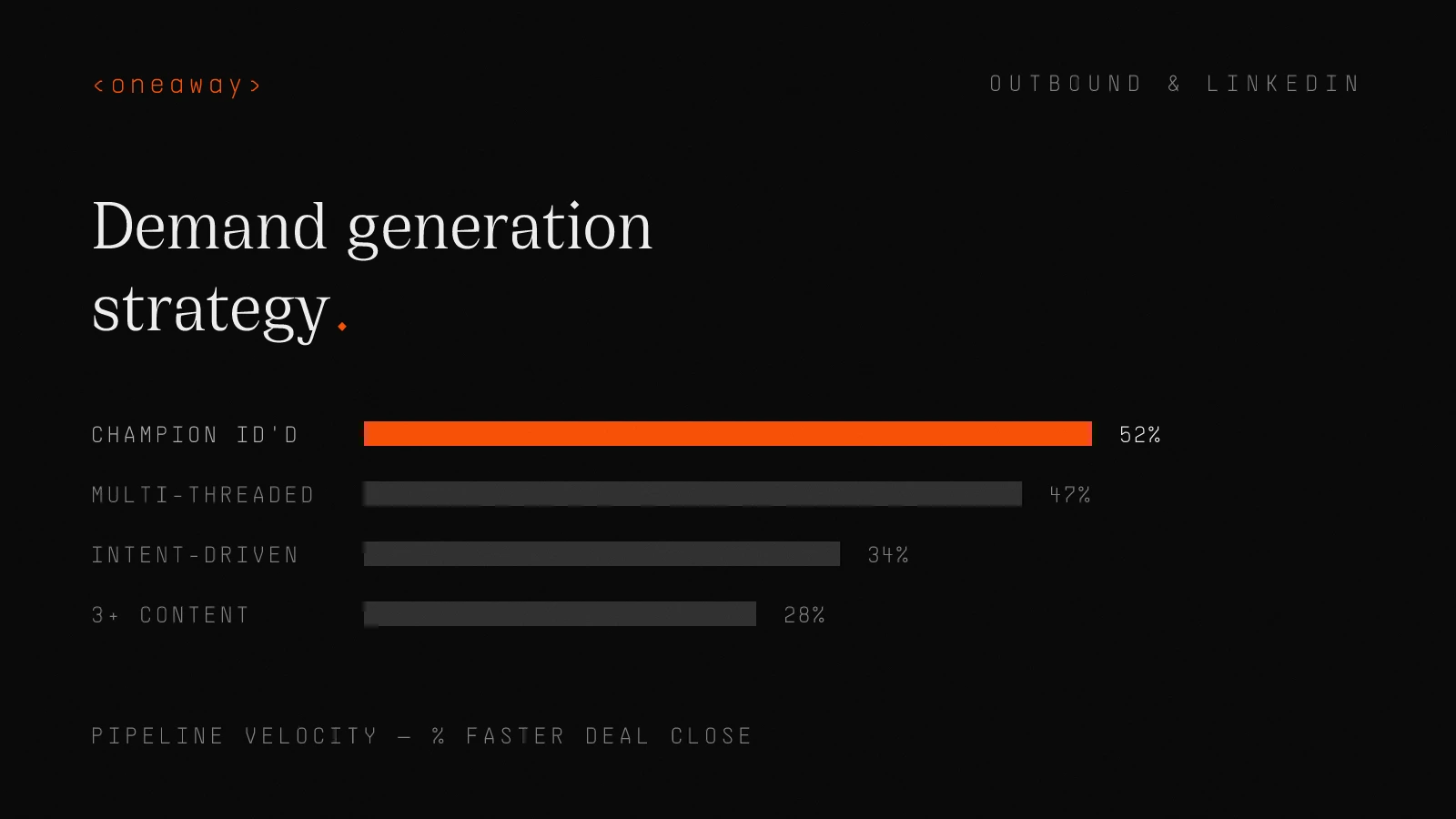
- Intent-driven opportunities — close 34% faster than cold outbound opportunities
- Multi-threaded deals — (3+ stakeholders engaged) close 47% faster than single-threaded deals
- Opportunities with champion identified in first meeting — close 52% faster than those without
- Accounts that consume 3+ pieces of content before first meeting — close 28% faster than those with zero content engagement
Building Your 2026 Demand Generation Strategy
Your demand generation strategy needs to change from broadcast to precision. Here's the framework that's working:
Layer 1: Account Selection (Not Lead Generation)
Stop generating leads. Start selecting accounts. Build your Total Addressable Market (TAM) list—every company that fits your ICP. For most B2B companies, this is 500-5,000 accounts, not 50,000. Use firmographic data (revenue, employee count, industry) plus technographic data (what tools they use) plus intent data (what they're researching).
Segment this TAM into tiers: Tier 1 (dream accounts, highest fit) = 20% of TAM, Tier 2 (strong fit) = 30% of TAM, Tier 3 (good fit) = 50% of TAM. Allocate resources accordingly.
Layer 2: Signal Monitoring
Monitor your TAM continuously for buying signals. You need both first-party signals (website visits, content downloads, email engagement) and third-party signals (intent topics, technographic changes, hiring patterns, funding announcements).
Set up alerts for high-intent signals: pricing page visit + demo request = instant SDR notification, 3+ content downloads in 7 days = trigger nurture sequence, competitor mention + hiring for related role = trigger executive outreach.
Layer 3: Orchestrated Outreach
When signals fire, execute coordinated outreach across multiple channels. Not random touches—orchestrated campaigns where each touchpoint builds on the last.
Example signal-based sequence: Day 1 - High-intent signal detected (pricing page visit), SDR researches account and stakeholders, within 4 hours. Day 1 (continued) - Personalized email sent to specific visitor if identified, LinkedIn connection request to decision-maker with personalized note, Retargeting ads activated for entire company domain. Day 2 - Follow-up email with relevant case study for their industry, SDR call to main line, ask for decision-maker. Day 3 - Video message via LinkedIn to decision-maker showing their website + specific pain point. Day 5 - Multi-channel touchpoint: email + call + LinkedIn message, reference their specific intent signal. Day 7 - Executive send: have AE or founder send personalized note to VP/C-level.
Layer 4: Content as Proof, Not Fluff
Content in 2026 serves one purpose: proving you understand their specific problem better than alternatives. Generic thought leadership is dead.
Create content that maps to intent signals: If they're researching 'alternatives to [competitor]', have a comparison guide ready. If they're searching 'how to calculate ROI for [solution category]', have an ROI calculator built. If they're evaluating your category, have customer proof for their specific use case.
Layer 5: Continuous Optimization
Review pipeline metrics weekly. Which signal sources produce the highest-velocity pipeline? Which outreach sequences have the best meeting-to-opportunity conversion? Which content assets appear most frequently in closed deals?
Kill what doesn't work. Double down on what does. This isn't set-it-and-forget-it—it's continuous refinement.
The Minimum Viable Tech Stack for Pipeline Generation
Total investment: $60K-180K annually depending on team size and tier of tools. That might sound expensive, but it's 3-5x cheaper than hiring additional SDRs to make up for inefficiency.
The key isn't having all these tools—it's having them properly integrated. Your intent data should flow into your CRM. Your CRM should trigger your outbound automation. Your website identification should alert your SDRs in real-time. If your tools don't talk to each other, you're just creating more manual work.
| Category | Tool Options | What It Does | Price Range |
|---|---|---|---|
| CRM | Salesforce, HubSpot | Single source of truth for all account and contact data | $50-150/user/mo |
| Intent Data | 6sense, Bombora, Qualified | Identifies accounts researching your category | $20K-60K/year |
| Website Identification | Koala, Clearbit Reveal, Warmly | Reveals which companies visit your website | $500-2K/month |
| Outbound Automation | Outreach, SalesLoft, Apollo | Sequences, email tracking, call logging | $100-150/user/mo |
| Data Enrichment | Clearbit, ZoomInfo, Apollo | Enriches contact and company data | $10K-50K/year |
| LinkedIn Automation | LinkedIn Sales Navigator + manual or Phantombuster | Research and outreach on LinkedIn | $80-200/user/mo |
| Sales Engagement | Gong, Chorus | Call recording, deal intelligence | $1200-1800/user/year |
| RevOps Platform | Clari, Salesloft Analytics | Pipeline tracking and forecasting | $5K-20K/month |
30-Day Implementation Roadmap
This roadmap assumes you have basic sales infrastructure (CRM, email tool). If you're starting from zero, add 2 weeks for tool selection and setup.
- Week 1: Audit and Baseline — Pull your pipeline data for the last 90 days. Calculate your current metrics: meeting booking rate, meeting-to-opportunity conversion, pipeline velocity, cost per qualified opportunity. Document your current process: how do leads enter the system? What qualification criteria exist? What happens after a meeting is booked? Interview 3 SDRs, 3 AEs, and your ops person. Ask: what's broken?
- Week 2: Signal Infrastructure — If you don't have intent data, start a trial with 6sense or Bombora (most offer 30-day trials). Install website identification tool (Koala has a free tier to start). Set up basic alerts: Slack notification when target account visits pricing page, email alert when target account downloads high-value content, CRM task created when intent score exceeds threshold. Document your signal scoring model.
- Week 3: Process Redesign — Rewrite your qualification criteria (use BANT 2.0 framework above). Build 3 signal-based outbound sequences (one for high-intent signals, one for medium-intent, one for cold targeted outreach). Create templates that reference specific signals ('I noticed your team was researching…'). Train SDRs on new qualification and new sequences. Role-play the new discovery questions.
- Week 4: Launch and Monitor — Launch new process with one segment or one SDR as pilot. Track daily: signal-to-outreach time, meeting booking rate, meeting qualification rate, pipeline created. Hold daily 15-minute standups to troubleshoot issues. Collect feedback from SDRs and AEs. By day 30, you should have enough data to see if the new approach is working. Typical results: 30-50% improvement in meeting qualification rate, 15-25% improvement in pipeline creation, 40-60% reduction in wasted outreach.
5 Mistakes Killing Your Pipeline Generation
I've seen these mistakes dozens of times. They're silent killers—easy to miss, expensive to fix:
Mistake #1: Prioritizing Activity Over Outcomes
Your SDRs are making 80 calls per day and sending 200 emails per week. Sounds productive, right? Wrong. If those activities aren't generating qualified pipeline, they're just noise. I've seen teams cut activity volume by 60% and increase pipeline by 90% by focusing on quality targeting and research. Stop measuring dials and emails. Start measuring pipeline created per SDR.
Mistake #2: Single-Threading Enterprise Accounts
You book a meeting with a Director at a 5,000-person company. Your AE runs the demo. It goes great. Then… nothing. Why? Because that Director can't buy alone. They need buy-in from procurement, security, their VP, probably a C-level executive. If you're not multi-threading from day one—engaging multiple stakeholders across the buying committee—you're building a house of cards. Track this metric: average number of contacts engaged per opportunity. Enterprise deals need 4+, mid-market needs 2-3.
Mistake #3: Ignoring the Speed-to-Lead Problem
An account visits your pricing page at 2pm on Tuesday. Your SDR sees it Wednesday morning. By then, they've already talked to two of your competitors. Speed kills in B2B sales—but most teams have no infrastructure for real-time response. If you can't respond to high-intent signals within 4 hours, you're losing deals before the race even starts. Set up real-time alerts. Have SDRs monitoring Slack channels. Build SLAs around signal response time.
Mistake #4: Treating All Signals Equally
Your marketing automation sends the same follow-up whether someone downloaded an ebook or requested a demo. That's insane. A demo request is 50x more valuable than an ebook download. Build a weighted scoring system. High-intent actions get immediate, personalized, multi-channel outreach. Low-intent actions get automated nurture. Stop wasting human time on low-intent signals.
Mistake #5: Optimizing for Vanity Metrics
Your demand gen report shows 5,000 MQLs this quarter. Your CEO is happy. Your CRO is furious because only 12 turned into opportunities. MQLs don't pay the bills. Neither do content downloads, webinar registrations, or email opens. The only metrics that matter: qualified meetings booked, pipeline created, revenue influenced. If your dashboard doesn't show those three metrics prominently, rebuild it.
Frequently Asked Questions
What is B2B pipeline generation and how is it different from lead generation?
B2B pipeline generation is the process of creating qualified sales opportunities that enter your pipeline, measured in dollar value and probability to close. Lead generation focuses on collecting contact information (leads). The key difference: pipeline generation tracks revenue potential and sales readiness, while lead generation tracks volume. In 2026, successful companies have shifted from measuring leads to measuring pipeline dollars created, pipeline velocity, and conversion rates through the full funnel.
What are the most important outbound pipeline metrics to track?
The eight critical outbound pipeline metrics are: signal-to-outreach time (target <4 hours), qualified meeting booking rate (target >60%), account penetration rate (3+ contacts for enterprise), meeting-to-opportunity conversion (target >35%), time-to-first-meeting (8-12 days for signal-based), pipeline creation per SDR ($150K-$250K/month), source-attributed pipeline, and pipeline velocity by source. These metrics predict revenue better than activity metrics like calls made or emails sent.
How has qualified meeting booking changed in 2026?
Qualified meeting booking has shifted from quantity to quality. In 2026, 'qualified' means meetings that meet BANT 2.0 criteria: Budget, Authority, Need, Timeline, plus Strategic Fit (matches ICP) and Multi-Threading Potential (access to other stakeholders). Companies now track meeting-to-pipeline conversion rates and have implemented stricter qualification checklists. The result: 30-40% fewer meetings booked, but 85%+ more pipeline created because sales teams aren't wasting time on unqualified conversations.
What is pipeline velocity and why does it matter?
Pipeline velocity measures how quickly opportunities move through your pipeline and is calculated as: (Number of Opportunities × Average Deal Value × Win Rate) / Sales Cycle Length. It matters because it's the best predictor of future revenue. You can increase velocity by generating more opportunities, increasing deal size, improving win rate, or shortening sales cycles. Signal-based approaches increase velocity by 34% on average because they engage accounts already in-market, naturally shortening sales cycles.
What's the difference between intent data and website visitor tracking?
Website visitor tracking (tools like Koala, Clearbit Reveal) shows you which companies visit your website and what pages they view—this is first-party intent data. Intent data platforms (like 6sense, Bombora) track research behavior across thousands of websites to show you which companies are researching topics related to your solution, even if they've never visited your site—this is third-party intent data. You need both: website tracking shows high-intent signals from people already aware of you, while intent data helps you identify in-market accounts before competitors reach them.
How quickly should I respond to high-intent buying signals?
For high-intent signals (pricing page visits, demo requests, competitor comparison searches), respond within 4 hours. Data shows companies that respond within 4 hours see 4.2x higher conversion rates than those who wait 24 hours. Set up real-time alerts via Slack or SMS when target accounts show high-intent behavior. For medium-intent signals (case study downloads, repeat website visits), respond within 24 hours. For low-intent signals, automated nurture sequences are sufficient.
What should my demand generation strategy focus on in 2026?
Your 2026 demand generation strategy should prioritize signal-based account selection over mass lead generation, multi-channel orchestrated outreach triggered by buying signals, content that serves as proof (comparison guides, ROI calculators, use-case specific case studies) rather than generic thought leadership, and continuous optimization based on pipeline metrics. The shift is from broadcast campaigns to precision targeting of in-market accounts. Companies should monitor their Total Addressable Market continuously for signals and respond with coordinated, personalized outreach across email, LinkedIn, phone, and ads.
Key Takeaways
- B2B pipeline generation has fundamentally shifted from volume-based lead generation to signal-driven precision targeting, with 2026 being labeled 'The Year of the Pipeline Mandate' as companies demand measurable pipeline contribution over vanity metrics.
- Signal-based approaches outperform spray-and-pray tactics by 127% in qualified meeting booking rates while reducing outbound activity volume by 40%, because they focus on engaging accounts already showing buying intent.
- Pipeline velocity is the most important metric most teams ignore—it measures how quickly opportunities move through your funnel and can be increased 34% by engaging accounts with intent signals rather than cold outbound alone.
- Speed-to-lead determines conversion rates—companies that respond to high-intent signals within 4 hours see 4.2x higher conversion rates than those who wait 24 hours, making real-time alert systems critical infrastructure.
- Qualified meeting booking quality matters more than quantity—implementing stricter BANT 2.0 qualification criteria may reduce meeting volume by 30-40% but increases pipeline creation by 85%+ by eliminating wasted sales time.
- Multi-threading is non-negotiable for enterprise deals—tracking account penetration rate (engaging 3+ stakeholders per target account) is essential as buying committees have expanded to 11+ members in 2026.
- The minimum viable tech stack requires 8-10 properly integrated tools including CRM, intent data platform, website identification, outbound automation, and data enrichment—total investment of $60K-180K annually is cheaper than hiring additional SDRs to compensate for inefficiency.
Related Reading
Ready to Build a Pipeline Generation System That Actually Performs?
Most B2B companies are still running 2023's pipeline generation playbook and wondering why their results are declining. At OneAway, we build signal-based pipeline systems that increase qualified meeting booking rates by 127% while reducing wasted outreach. If you're tired of vanity metrics and ready to build predictable pipeline, let's talk. We'll audit your current approach, identify the gaps, and show you exactly what needs to change.
Check if we're a fitContinue Reading
The Complete Guide to LinkedIn Outreach Templates in 2026
100,000+ LinkedIn DMs analyzed. Here are the templates, sequences, and honest tactics that actually get replies in 2026—no fluff, just what works.
Read more [ 14 MIN READ ]Best LinkedIn Content Formats 2026, Ranked by Reach
I tested every LinkedIn content format for 90 days. Here's what actually drives out-of-network reach in 2026, ranked by performance data from real campaigns.
Read more [ 14 MIN READ ]Best Cold Calling Scripts for B2B in 2026, Ranked by Connect Rate
The 7 highest-performing cold calling scripts in 2026, ranked by actual connect and conversion data from 200K+ dials. Includes real examples, pricing, and honest pros/cons.
Read more