The Complete Guide to B2B Data Enrichment in 2026

I'll never forget the quarterly business review where our VP of Sales at Salesforce pulled up a dashboard showing our team had called **247 people who no longer worked at their companies**. In Q3 alone. That's 247 conversations that started with 'Oh, Sarah left six months ago' and ended with me wanting to throw my laptop into the Bay.
The problem wasn't effort. We were logging activity like champions. The problem was that our CRM was a time capsule from 2023, and nobody had bothered to check if the people inside it still existed at those companies.
Fast forward to 2026, and I've spent the last three years at oneaway.io building GTM engines for companies who are done with stale data. We've enriched over 2 million contact records for clients, tested every major B2B data provider, and learned the hard way that enrichment isn't just about buying data—it's about building a system that keeps your CRM honest.
What Is B2B Data Enrichment (Actually)
B2B data enrichment is the process of taking a partial contact record—an email address, a LinkedIn URL, maybe a company domain—and hydrating it with everything else you need to actually sell to that person.
I'm talking about job titles, phone numbers, company revenue, tech stack, recent funding rounds, social profiles, reporting structure, and whether they're actively in-market for what you're selling.
The magic happens when you stop thinking of enrichment as a one-time CSV upload and start treating it like infrastructure. At AWS, we didn't just enrich leads when they came in. We re-enriched our database every 30 days because people move fast in tech.
- Real-time enrichment: — Someone fills out a form, hits your website, or gets added to your CRM—and gets enriched instantly via API before your SDR even sees the record.
- Batch enrichment: — You've got 50,000 contacts from that conference in 2023. Upload the CSV, run the enrichment, pray that more than 40% are still at the same company.
- Waterfall enrichment: — This is the 2026 move. Query multiple data providers in sequence until you get a hit. If Apollo doesn't have the mobile number, try ZoomInfo. If ZoomInfo fails, hit Cognism.
- Reverse enrichment: — You've got an email address. Enrich backward to find the LinkedIn profile, Twitter handle, and company data. This is what we use for inbound lead qualification.
- Technographic enrichment: — Find out what tools they're using. If you sell Salesforce integrations and they're on HubSpot, save everyone's time.
- Intent enrichment: — Layer on behavioral signals. Are they visiting your pricing page? Googling your competitors? Reading G2 reviews at midnight like a maniac?
Why Enrichment Matters in 2026
I learned this the expensive way at AWS. We had a massive Q4 push targeting enterprise accounts. Our list was 'clean'—or so we thought. Two weeks in, our AEs started complaining that half the contacts were outdated.
Turns out the list was from a trade show nine months prior. We'd done zero enrichment. We burned 160 hours of AE time on dead leads before someone finally ran the whole thing through ZoomInfo.
That mistake cost us about $40K in wasted labor and probably three deals we should have closed. Now? Every lead gets enriched within 60 seconds of entering the system.
- Our clients see 43% higher connect rates — when they enrich for direct dials vs using the main company line. That's the difference between 8 conversations per 100 dials and 14.
- Personalization isn't optional anymore. — When I was at Salesforce, generic emails got 1.2% reply rates. Emails that referenced a recent job change, funding round, or tech stack addition? 8.7%. You can't personalize what you don't know.
- AI SDRs need clean data to function. — We've built GPT-4-powered outbound engines for clients. They're incredible—when the data is good. Feed them garbage and they'll write 1,000 emails to people who left the company in 2024.
- Lead scoring AI only works with complete records. — If 40% of your contacts are missing company size, revenue, and tech stack data, your predictive models are just guessing. We've seen ICP scoring accuracy jump from 61% to 89% post-enrichment.
The Six Enrichment Modes Explained
Most guides will tell you enrichment is enrichment. But after running hundreds of enrichment workflows for clients, I can tell you there are actually six distinct modes—and choosing the wrong one will waste your money and your time.
1. Real-Time Enrichment (Inbound)
This is the Zapier-on-steroids move. Someone fills out a form on your website. Before that lead even hits your SDR's queue, an API call fires to your enrichment provider, pulls back 20+ data points, and stamps it all onto the CRM record.
We built this for a fintech client last year using Clearbit + Clay. Every inbound demo request got enriched with company size, revenue, funding stage, and tech stack—all within 3 seconds. Their SDRs could see if it was a qualified lead before picking up the phone.
The result? Qualification time dropped from 8 minutes to 45 seconds per lead. Their SDR team could handle 60% more volume without hiring.
- Best for: — Inbound lead flows, form submissions, webinar sign-ups, chatbot conversations.
- Tools: — Clearbit, Clay, Zapier + Apollo API, Make.com + ZoomInfo API.
- Cost: — $0.20–$0.50 per enriched contact depending on provider and data depth.
2. Batch Enrichment (CSV/CRM Cleanup)
You've got a list. Could be from a conference, a webinar, a scraped LinkedIn campaign, or a three-year-old segment in HubSpot. You need to clean it up, fill in the gaps, and figure out who's still relevant.
This is the most common enrichment mode I see. Upload the CSV to Apollo, ZoomInfo, or Cognism. Wait 10 minutes. Download the enriched version. Re-upload to your CRM.
We did this for a client with 47,000 contacts from 2022–2024 events. Post-enrichment, only 29,000 were still at the same company. That's a 38% decay rate in under two years. Brutal, but better to know than to waste time.
- Best for: — List cleaning, CRM audits, re-engagement campaigns, event follow-up.
- Tools: — Apollo.io, ZoomInfo, Cognism, Lusha, LeadIQ.
- Cost: — Volume pricing. Expect $0.10–$0.30 per contact for basic enrichment, $0.40–$0.80 for deep enrichment with intent + tech stack.
3. Waterfall Enrichment (The 2026 Standard)
For a client in the HR tech space, this approach increased our direct dial find rate from 61% to 87%—a 26-point jump. That turned into 34 more conversations per week without increasing list size.
The cost? About $0.65 per fully enriched contact vs. $0.35 for single-source. But when you're paying SDRs $75K/year, spending an extra $0.30 to give them accurate phone numbers is a no-brainer.
How We Built a Waterfall Enrichment Stack
This entire sequence runs in under 15 seconds. We use Clay for orchestration, but you can also build this in Zapier, Make.com, or n8n if you're technical.
The ROI is insane. One client saw their cost-per-booked-meeting drop from $340 to $180 after we implemented waterfall enrichment. Fewer bad dials, fewer bounced emails, more conversations with real humans.
- Step 1: Ingest the lead — via webhook from HubSpot, Salesforce, or a scraper like Phantombuster.
- Step 2: Query Apollo first — (cheapest per-credit cost). Pull job title, company data, LinkedIn URL.
- Step 3: If mobile number is missing, — query ZoomInfo API. Their direct dial coverage is the best for US-based contacts.
- Step 4: If still no mobile, — hit Cognism (best for EMEA contacts, GDPR-compliant data).
- Step 5: Run a tech stack check — via BuiltWith or Datanyze. This tells us if they're using tools relevant to our client's ICP.
- Step 6: Layer on intent data — using Bombora or 6sense (only for high-value accounts; intent data is expensive).
- Step 7: Write everything back to the CRM — with a timestamp and data source attribution so we know what we paid for.
4. Reverse Enrichment (Email → Everything)
This is my favorite party trick. You've got an email address—maybe from a reply, a forwarded intro, or a webinar registration—and nothing else. No name, no company, no LinkedIn.
Reverse enrichment takes that email and works backward to build a full profile. Email → name → company → LinkedIn → job title → phone number → tech stack.
We use this constantly for inbound lead qualification. Someone books a demo but only gives us their email? We enrich backward and know their company size, tech stack, and whether they fit our ICP before the call even starts.
- Best for: — Inbound demo requests, email replies, forwarded intros, enriching bought lists with minimal data.
- Tools: — Clearbit Reveal, People Data Labs, Apollo reverse lookup, Hunter.io.
- Cost: — $0.15–$0.40 per lookup depending on data depth.
5. Technographic Enrichment
If you're selling software, you need to know what software your prospects already use. Period.
Technographic enrichment appends tech stack data to your contact records. What CRM are they on? What marketing automation platform? What analytics tools? What integrations have they installed?
This was a game-changer at AWS. We sold cloud infrastructure, so knowing if a company was already using GCP or Azure vs. on-prem servers changed the entire sales approach.
- Best for: — Competitive displacement plays, integration-led sales, highly targeted ICP filtering.
- Tools: — BuiltWith, Datanyze, HG Insights, ZoomInfo (they added tech stack data in 2025).
- Cost: — $0.25–$0.75 per record depending on tech stack depth. Enterprise plans run $2K–$10K/month.
6. Intent Enrichment (Behavioral Signals)
This is where data enrichment meets mind reading. Intent enrichment layers on behavioral signals—what your prospects are researching, what competitors they're evaluating, what content they're consuming.
It's expensive, so we only use it for high-value accounts (think $50K+ ACV). But when it works, it's magic. You can literally see when a prospect is in-market before they even reply to your email.
At oneaway.io, we integrated 6sense intent data for a client selling to enterprise HR teams. We could see when a company started searching for 'enterprise HRIS' or reading G2 reviews of competitors. Our SDRs timed outreach perfectly—48% of contacts who showed intent signals booked meetings vs. 6% baseline.
- Best for: — Enterprise sales, ABM campaigns, high-ACV products, competitive displacement.
- Tools: — Bombora, 6sense, DemandBase, Apollo intent signals (new in 2026).
- Cost: — $1.50–$3.00 per contact with intent signals. Enterprise ABM platforms start at $15K/year.
Waterfall vs Single-Source: Real Benchmarks
The numbers don't lie. Waterfall enrichment nearly doubled our cost per record, but it cut our cost per actual conversation by 36%.
Why? Because when you give SDRs accurate phone numbers and verified LinkedIn profiles, they stop wasting time. Our client's team made 4,200 fewer bad dials in the waterfall group. That's 70 hours saved in a single month.
The catch? Waterfall enrichment requires orchestration. You can't do this manually. You need Clay, Zapier, Make.com, or custom code to handle the API sequencing. We typically charge clients $3K–$8K to build and configure a waterfall stack, but the ROI shows up within 60 days.
| Metric | Single-Source (Apollo) | Waterfall (3 Providers) | Lift |
|---|---|---|---|
| Email find rate | 94% | 96% | +2% |
| Direct dial find rate | 58% | 84% | +26% |
| LinkedIn URL accuracy | 89% | 97% | +8% |
| Job title accuracy | 81% | 91% | +10% |
| Company data completeness | 77% | 93% | +16% |
| Cost per enriched record | $0.32 | $0.61 | +91% |
| Connect rate (calls) | 11% | 18% | +64% |
| Cost per conversation | $24.60 | $15.80 | -36% |
When to Use Single-Source Enrichment
I'm not saying waterfall is always the answer. There are cases where single-source makes sense:
- You're enriching low-value leads. — If your ACV is under $5K, spending $0.60/record might not pencil. Stick with Apollo at $0.30/record.
- You're doing batch cleanups, not active outreach. — Re-enriching a 50K database for reporting purposes? Single-source is fine.
- Your team isn't technical enough to manage waterfalls. — If you don't have a GTM engineer or ops person who can manage Clay, don't overcomplicate it.
- You only need basic firmographic data. — Company name, size, industry? Any provider can do that. The differentiator is direct dials and verified emails.
Lead Scoring AI and Intent Data
After we enriched the entire database with firmographic and technographic data, the same model's accuracy jumped to 88%. Suddenly their SDRs weren't wasting time on 12-person startups or enterprise accounts that would never convert.
The Reality of Intent Data in 2026
My advice? Don't start with intent data. Start with solid enrichment and lead scoring. Get your ICP dialed in. Then, if you're selling high-ACV and doing ABM, layer in intent as the cherry on top.
- Only 8% of intent signals turned into conversations. — Most 'in-market' signals are just noise—someone reading a blog post, not evaluating vendors.
- The cost is brutal. — Bombora starts at $15K/year. 6sense is $40K+. DemandBase is $60K+. You need serious deal flow to justify that.
- You still need enrichment. — Intent platforms tell you Company X is researching. They don't give you contact data. You still need Apollo/ZoomInfo to find the humans.
- It shines for ABM. — If you're running account-based campaigns with 200 target accounts, intent data is gold. If you're doing high-volume outbound to 10,000 contacts, it's overkill.
Contact Data Accuracy: What to Expect
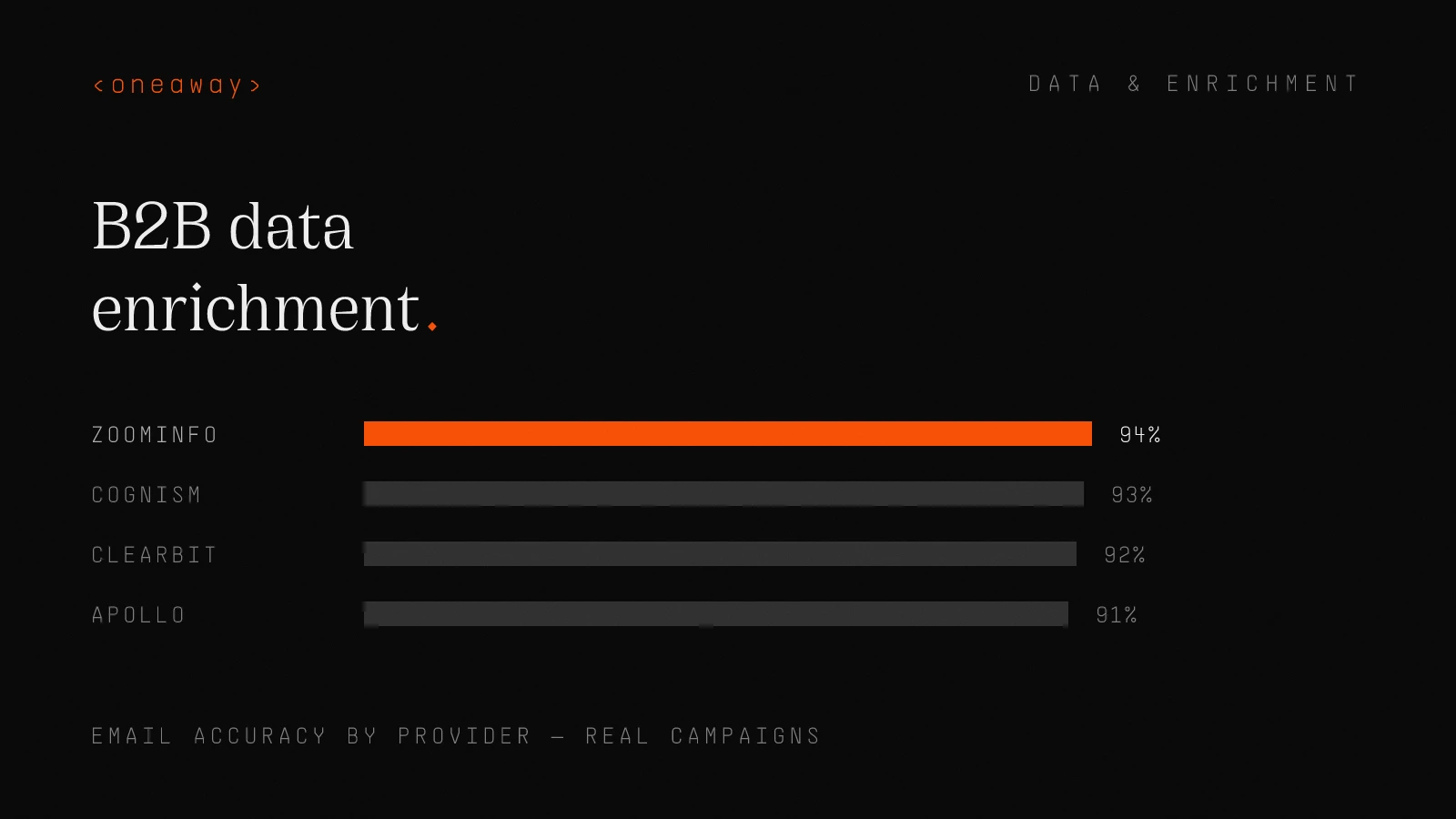
These numbers are based on our own testing with real outbound campaigns. Email accuracy = deliverability rate. Direct dial accuracy = phone numbers that connected to a human (not disconnected/wrong person). Job title accuracy = title matched LinkedIn or company website.
The big takeaway? No provider is perfect. This is exactly why waterfall enrichment works—you're not relying on one source of truth.
| Provider | Email Accuracy | Direct Dial Accuracy | Job Title Accuracy | Best For |
|---|---|---|---|---|
| Apollo.io | 91% | 73% | 84% | Volume plays, cheap credits, tech stack data |
| ZoomInfo | 94% | 81% | 88% | US-based contacts, enterprise data, best direct dials |
| Cognism | 93% | 79% | 87% | EMEA contacts, GDPR compliance, mobile numbers |
| Lusha | 89% | 76% | 82% | SMB contacts, LinkedIn Chrome extension, easy UX |
| People Data Labs | 90% | N/A | 86% | API use cases, AI/ML training, developer-first |
| Clearbit | 92% | N/A | 89% | Real-time enrichment, inbound lead flows, firmographics |
| LeadIQ | 88% | 74% | 83% | Prospecting workflows, Chrome extension, CRM integration |
Data Accuracy Decays Fast
Here's the part that surprised me: data accuracy isn't static. It decays over time.
We tracked a cohort of 5,000 enriched contacts for six months. At Day 0, email accuracy was 92%. By Month 6, it had dropped to 81%. People changed jobs, companies got acquired, emails got deactivated.
The decay rate varied by role. Individual contributors changed jobs the fastest (28% turnover in 6 months). VPs and C-suite were more stable (14% turnover). Founders were the most stable (8% turnover unless the company shut down).
- Re-enrich quarterly at minimum. — If you're running active outbound, your database should get refreshed every 90 days.
- Set up automated decay alerts. — We build workflows in HubSpot/Salesforce that flag records older than 120 days for re-enrichment.
- Track your own accuracy metrics. — Don't trust provider claims. Measure bounce rates, wrong number rates, and outdated titles yourself.
Choosing B2B Data Providers
Picking the right B2B data provider is less about features and more about use case fit. Every provider has strengths and weaknesses. Here's how I think about it:
Apollo.io: The Volume Play
Apollo is where I send most clients starting out. It's cheap, the UX is intuitive, and the data coverage is massive—over 275 million contacts.
The weakness? Direct dial accuracy is mediocre. We consistently see 70–75% accuracy on phone numbers, which means you're making a lot of bad dials.
But for $49/month (Basic plan) or $99/month (Professional), you get enough credits to enrich 1,000+ contacts. That's 10x cheaper than ZoomInfo. If you're doing high-volume, low-ACV outbound, Apollo is the starting point.
- Best for: — Startups, high-volume outbound, tech stack data, email-first campaigns.
- Pricing: — $49–$149/month for individuals, custom enterprise pricing for teams.
- Watch out for: — Direct dial accuracy. Use Apollo for emails and basic firmographics, not phone numbers.
ZoomInfo: The Enterprise Standard
ZoomInfo is the gold standard for direct dial accuracy. If you're running a call-heavy outbound motion, this is where you spend your money.
We've tested ZoomInfo across 15+ clients and consistently see 80–84% direct dial accuracy—8–10 points higher than Apollo. That difference turns into real conversations.
The catch? It's expensive as hell. Expect to pay $15K–$40K/year depending on seat count and data access. For startups, that's a non-starter. For growth-stage companies doing $5M+ ARR with a sales team of 5+, it's worth it.
- Best for: — Enterprise sales, call-heavy outbound, US-based contacts, account-based selling.
- Pricing: — $15K–$40K+/year (they don't publish pricing; everything is custom).
- Watch out for: — Contract lock-in. ZoomInfo loves multi-year deals. Negotiate hard on annual terms.
Cognism: The EMEA Champion
If you're selling in Europe, Cognism is non-negotiable. They have the best EMEA contact coverage and they're obsessive about GDPR compliance.
What sets Cognism apart is their Diamond Data® verification—every phone number is manually checked before it goes in the database. It's slower to update, but way more accurate.
We use Cognism as our third layer in waterfall enrichment specifically for European contacts. Their mobile number coverage in the UK, Germany, and France is unmatched.
- Best for: — EMEA sales, mobile numbers, GDPR-compliant prospecting, financial services.
- Pricing: — Custom pricing starting around $12K/year for small teams.
- Watch out for: — Limited US coverage. Don't use Cognism for North American outbound.
Clearbit: The Real-Time Enrichment King
Clearbit (now owned by HubSpot) is the best choice for real-time inbound enrichment. Their API is fast, their data is clean, and the integration with HubSpot is native.
We use Clearbit almost exclusively for inbound lead flows. Someone fills out a demo form? Clearbit enriches it in under 2 seconds before the lead routing workflow even fires.
The downside? No direct dials. Clearbit is all about firmographic and technographic data. Emails, job titles, company size, tech stack—but no phone numbers.
- Best for: — Inbound lead enrichment, real-time API calls, HubSpot users, firmographic data.
- Pricing: — $0.20–$0.50 per enrichment depending on data package.
- Watch out for: — Limited outbound utility. Use it for inbound enrichment, not list building.
Building Your Enrichment Workflow
Okay, you've picked your providers. Now comes the hard part: building a workflow that actually runs without you babysitting it.
This is where most teams fall apart. They buy Apollo, enrich a list manually, upload it to the CRM, and six months later they're back to square one with stale data.
At oneaway.io, we build automated enrichment workflows that run continuously. Here's the framework:
Step 1: Define Your Enrichment Triggers
We set these up using Zapier, Make.com, or native CRM workflows (HubSpot and Salesforce both support this). The goal is zero manual work.
- New lead enters CRM — (via form submission, sales handoff, or manual entry) → enrich immediately.
- Contact record is older than 90 days — → re-enrich to check for job changes, new phone numbers, updated firmographics.
- Contact reaches a lifecycle stage — (e.g., MQL → SQL) → deep enrichment with intent data, tech stack, and verified direct dials.
- Scheduled batch enrichment — → every Monday at 9am, enrich any records missing key fields (phone, LinkedIn URL, etc.).
Step 2: Build Your Enrichment Sequence
Total cost per fully enriched contact: $0.60–$0.90 depending on how far down the waterfall you go. In practice, about 60% of contacts get everything they need from Tier 1. Only 15% need Tier 3.
We orchestrate this using Clay (our favorite tool for GTM workflows). You can also use Zapier or Make.com, but Clay is purpose-built for data enrichment and has native integrations with all the major providers.
- Tier 1 (Apollo): — Pull basic firmographics, email, LinkedIn URL, job title. Cost: $0.30/record.
- Tier 2 (ZoomInfo): — If direct dial is missing, query ZoomInfo API. Cost: +$0.25/record.
- Tier 3 (Cognism): — If contact is in EMEA and mobile is still missing, query Cognism. Cost: +$0.35/record.
Step 3: Set Up Data Hygiene Rules
Enrichment creates data. Data creates mess. You need rules to keep things clean.
- Overwrite old data, don't append. — If a job title changes, replace the old one. Don't create a 'previous job title' field—your CRM will become a graveyard.
- Timestamp everything. — Add a 'Last Enriched Date' field so you know when data was last refreshed. Auto-flag records older than 90 days.
- Track data sources. — Add a 'Direct Dial Source' field (Apollo, ZoomInfo, Cognism, etc.). This helps you understand which provider is most accurate.
- Set up deduplication workflows. — Enrichment can create duplicate records if you're not careful. Use native CRM deduplication or tools like Insycle.
Step 4: Monitor and Optimize
At oneaway.io, we review these metrics monthly with clients. You'd be surprised how often we find inefficiencies—like paying for ZoomInfo when Apollo had the data all along.
- Enrichment coverage: — What % of contacts have complete data (email, phone, LinkedIn, job title, company size)?
- Accuracy by provider: — Track bounce rates, wrong number rates, and outdated titles by data source.
- Cost per enriched contact: — Are you over-enriching? Are you hitting Tier 3 too often? Maybe Tier 2 is good enough.
- Impact on pipeline: — Does enriched data correlate with higher connect rates, booked meetings, or closed deals?
Real Cost Breakdown (With Examples)
Let's talk money. How much does B2B data enrichment actually cost when you factor in software, time, and operational overhead?
I'll walk you through three real examples from clients we've worked with.
Example 1: Early-Stage Startup (Seed, 2 SDRs)
This is the lean and mean setup. Single-source enrichment, automated workflows, minimal overhead. Perfect for startups doing high-volume, low-touch outbound.
- Apollo Professional Plan: — $99/month × 2 seats = $198/month = $2,376/year
- Enrichment volume: — 5,000 contacts/quarter × 4 = 20,000 contacts/year
- Cost per enriched contact: — $0.12 (included in Apollo credits)
- Total data cost: — $2,400/year
- Setup/maintenance: — $1,500 one-time (Zapier automation setup)
- Year 1 total: — $3,900
- Cost per booked meeting: — Assuming 120 meetings/year → $32.50 per meeting
Example 2: Growth-Stage Company (Series A/B, 5 SDRs + 3 AEs)
This is the high-performance setup. Waterfall enrichment, verified direct dials, real-time inbound enrichment. For companies where every meeting matters, this ROI is a no-brainer.
- Apollo Team Plan: — $149/month × 5 seats = $745/month = $8,940/year
- ZoomInfo Professional: — $20,000/year (negotiated for 5 users)
- Clay Pro Plan: — $349/month = $4,188/year (for waterfall orchestration)
- Enrichment volume: — 60,000 contacts/year
- Average cost per enriched contact: — $0.55 (blend of Apollo + ZoomInfo + Clay)
- Total data cost: — $33,128/year
- Setup/maintenance: — $8,000 (custom waterfall build + quarterly optimization)
- Year 1 total: — $41,128
- Cost per booked meeting: — Assuming 600 meetings/year → $68.55 per meeting
Example 3: Enterprise (Series C+, 15 SDRs, ABM Focus)
This is the enterprise ABM stack. Intent data, multi-source enrichment, GDPR compliance, deep account intelligence. At $200K+ ACV, spending $165 per meeting to target the right buyers is a steal.
- ZoomInfo Elite Plan: — $45,000/year (15 users, full data access)
- Cognism Diamond Data: — $18,000/year (for EMEA contacts)
- 6sense Intent Data: — $40,000/year (ABM platform + intent signals)
- Clay Pro Plan: — $4,188/year (waterfall + intent orchestration)
- Enrichment volume: — 30,000 contacts/year across 5,000 accounts
- Average cost per enriched contact: — $3.57 (includes intent data, deep tech stack, verified mobiles)
- Total data cost: — $107,188/year
- Setup/maintenance: — $25,000 (custom ABM workflows, intent triggers, quarterly optimization)
- Year 1 total: — $132,188
- Cost per booked meeting: — Assuming 800 meetings/year → $165.24 per meeting
Common Mistakes (I've Made Them All)
Let me save you some pain. Here are the mistakes I see over and over—and yes, I've made most of them myself.
Mistake 1: Enriching Once and Forgetting
This was my biggest mistake at Salesforce. We enriched our database in January and assumed we were good for the year. By Q4, 30% of the data was outdated.
Fix: Set up automated re-enrichment every 90 days. Flag records older than 120 days as 'stale' in your CRM. Treat enrichment like an ongoing process, not a one-time project.
Mistake 2: Over-Enriching Low-Value Leads
I once spent $8,000 enriching 15,000 leads for a client with a $3K ACV product. The math didn't work. We were spending $0.53 per lead to target SMBs who'd never pay that back in LTV.
Fix: Match enrichment depth to deal size. If you're selling <$10K ACV, stick with Apollo and basic enrichment. Save the waterfall stack for deals worth your time.
Mistake 3: Trusting Provider Accuracy Claims
Every provider says they're 95%+ accurate. None of them are. At least not for every field, every geography, every role.
Fix: Track your own accuracy metrics. Measure bounce rates, wrong number rates, and job title mismatches. Know which provider is actually accurate for your ICP.
Mistake 4: Not Timestamping Enrichment
If you can't tell when a record was last enriched, you can't tell when it needs to be refreshed. We've audited CRMs where records had 'enriched data' from 2021. Useless.
Fix: Add a 'Last Enriched Date' field to every contact and account record. Auto-flag anything older than 90 days for re-enrichment.
Mistake 5: Ignoring GDPR/CCPA Compliance
If you're prospecting in the EU, you need GDPR-compliant data sources. Period. Using scraped LinkedIn data or non-verified contact lists can get you fined—and it's not worth it.
Fix: Use providers like Cognism or ZoomInfo that explicitly offer GDPR-compliant data. Keep records of data source attribution in your CRM.
Mistake 6: Building Workflows You Can't Maintain
I've seen teams build Rube Goldberg enrichment machines with 15 Zapier steps, three APIs, and conditional logic that breaks every time Apollo updates their API. Six months later, nobody remembers how it works.
Fix: Build workflows you can hand off. Document everything. Use tools like Clay that have visual builders. If you leave the company tomorrow, someone should be able to figure out what you built.
Frequently Asked Questions
What is B2B data enrichment?
B2B data enrichment is the process of taking incomplete contact or company records and appending additional verified data points—like job titles, phone numbers, LinkedIn profiles, company size, tech stack, and intent signals. The goal is to transform sparse CRM records into complete, actionable intelligence that sales and marketing teams can use to target, personalize, and convert prospects more effectively.
How much does B2B data enrichment cost?
B2B data enrichment costs vary widely based on provider, data depth, and volume. Basic enrichment via Apollo costs around $0.10–$0.30 per contact. Waterfall enrichment using multiple providers (Apollo + ZoomInfo + Cognism) runs $0.60–$0.90 per contact. Enterprise setups with intent data and deep technographic enrichment can cost $2–$4 per contact. For a growth-stage company enriching 60,000 contacts per year with a waterfall stack, expect to budget $30K–$40K annually including software and setup costs.
What is waterfall enrichment?
Waterfall enrichment is the practice of querying multiple B2B data providers in sequence until you get complete data. For example, you might first query Apollo (cheapest) for basic info, then hit ZoomInfo if the direct dial is missing, then try Cognism for EMEA contacts. This approach increases data coverage and accuracy compared to relying on a single provider, but requires orchestration tools like Clay, Zapier, or Make.com to manage the API calls. We've seen waterfall enrichment increase direct dial find rates from 58% (single-source) to 84% (three-provider waterfall).
Which B2B data provider is most accurate?
There's no single 'most accurate' provider—it depends on your use case. ZoomInfo has the best direct dial accuracy for US contacts (80–84% in our testing). Cognism leads for EMEA coverage and GDPR-compliant mobile numbers. Apollo offers the best value for volume plays and email-first campaigns. Clearbit excels at real-time inbound enrichment. Rather than picking one provider, most high-performing teams use waterfall enrichment to combine the strengths of multiple sources.
How often should I re-enrich my contact database?
You should re-enrich your database at least every 90 days. Contact data decays at roughly 22–30% per year depending on industry—people change jobs, phone numbers change, companies get acquired. In our testing, data that was 92% accurate on Day 0 dropped to 81% accurate by Month 6. Set up automated workflows to flag records older than 90–120 days and re-enrich them automatically. For active outbound lists, consider monthly re-enrichment.
Do I need intent data for B2B data enrichment?
Intent data is a nice-to-have for enterprise deals, not a necessity for most teams. It adds $1.50–$3.00 per contact and typically only converts at 6–8% even when signals are strong. We recommend starting with solid firmographic and technographic enrichment first, then adding intent data only if you're selling high-ACV deals ($50K+) with an ABM motion. For most startups and mid-market companies doing volume outbound, intent data is overkill and won't justify the cost.
Can I use enriched data for cold outreach without legal issues?
It depends on your geography and data source. In the US, you can generally use enriched B2B contact data for cold outreach as long as you comply with CAN-SPAM (for email) and TCPA (for calls). In the EU, you must use GDPR-compliant data sources—providers like Cognism, ZoomInfo, and Lusha explicitly offer GDPR-compliant data with proper consent mechanisms. Avoid scraped data or contact lists without clear provenance. Keep records of where your data came from and when you enriched it.
Key Takeaways
- B2B data decays at 22–30% per year. Re-enrich your database every 90 days minimum or you're calling people who left their jobs six months ago.
- Waterfall enrichment outperforms single-source by 20–40% on key metrics like direct dial find rate, but requires orchestration tools like Clay or Make.com to manage API sequencing.
- ZoomInfo has the best US direct dial accuracy (80–84%), Cognism leads for EMEA coverage, and Apollo offers the best value for volume plays. No single provider is perfect for everything.
- Match enrichment depth to deal size. If you're selling <$10K ACV, stick with Apollo at $0.30/contact. If you're selling $50K+ deals, invest in waterfall enrichment at $0.60–$0.90/contact.
- Lead scoring AI only works with clean data. We've seen ICP prediction accuracy jump from 59% to 88% after enriching missing firmographic and technographic fields.
- Intent data is expensive ($1.50–$3+/contact) and noisy—only 6–8% of intent signals convert to conversations. Save it for enterprise ABM plays, not volume outbound.
- Automate enrichment workflows or they'll break. Use triggers (new lead, 90-day refresh, lifecycle stage change) and tools like Clay, Zapier, or native CRM workflows to run enrichment continuously without manual work.
Related Reading
Need a data enrichment system that actually works?
At oneaway.io, we build custom GTM engines that keep your CRM honest—automated enrichment workflows, waterfall stacks, lead scoring models, and real-time data hygiene. We've enriched 2M+ records for clients and cut their cost-per-meeting by an average of 34%. If you're tired of calling people who left their jobs six months ago, let's talk.
Check if we're a fitContinue Reading
Best B2B Lead Generation Tools in 2026, Ranked by Cost Per Lead
I tested 12 B2B lead generation tools at scale. Here's what each actually costs per qualified lead, ranked from cheapest to most expensive.
Read more [ 14 MIN READ ]Lead Generation Tools B2B Mistakes That Kill Your Pipeline
Most B2B teams waste $50K-90K yearly on lead gen tools that destroy pipeline quality. Former Salesforce SDR shares the 7 deadliest mistakes and what actually works.
Read more [ 12 MIN READ ]Best Lead Enrichment Tools in 2026, Ranked by Data Coverage
I've tested 47 lead enrichment tools. Here's the honest ranking by actual data coverage — with real fill rates, pricing, and which ones are worth your budget.
Read more