Buying Intent Signals Mistakes That Kill Your Pipeline

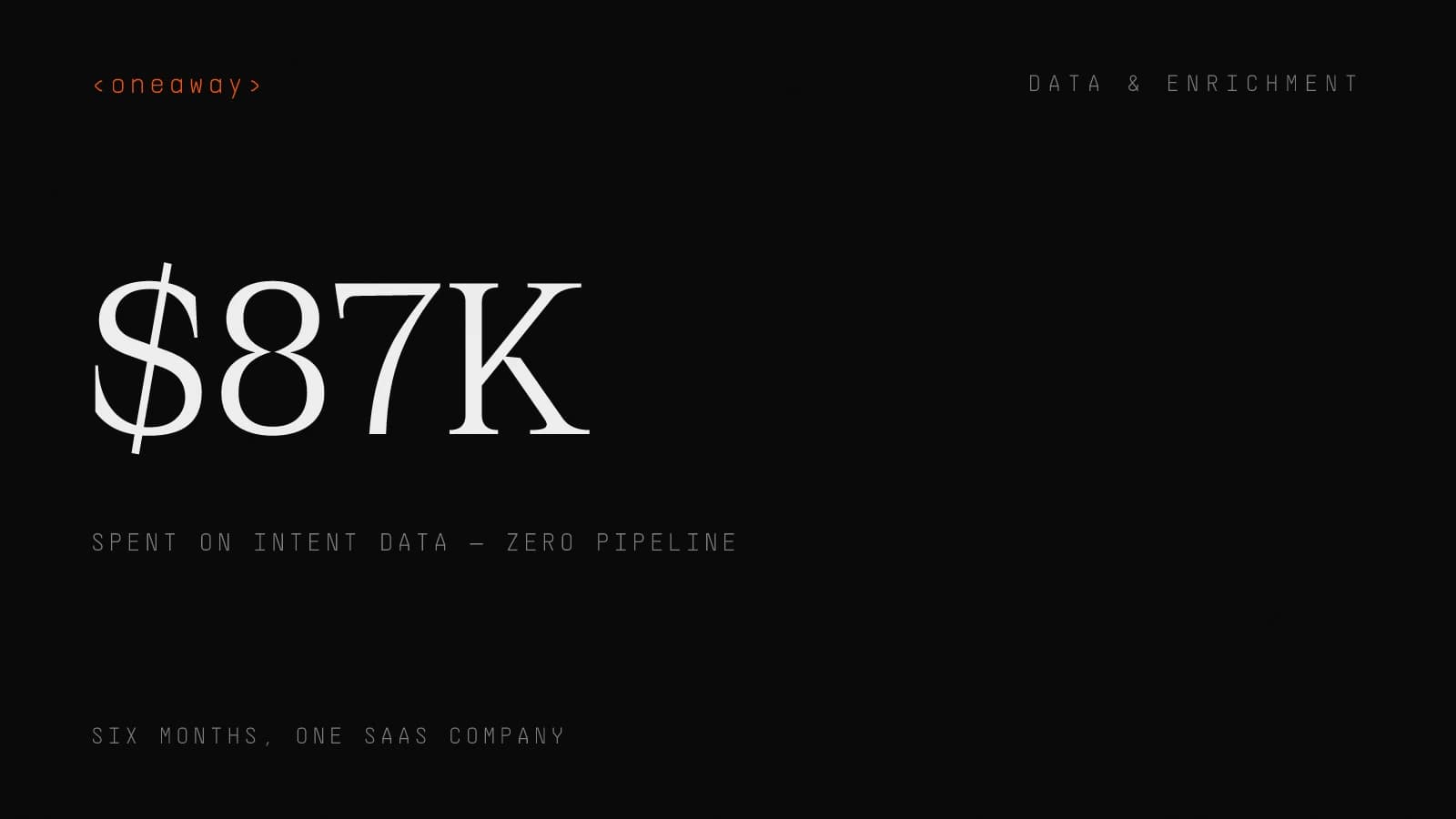
I watched a SaaS company spend **$87K on intent data** in six months and generate exactly **zero pipeline** from it. Not low ROI. Not disappointing conversion rates. Actual zero.
The problem wasn't the data. They had Bombora, ZoomInfo intent, G2 buyer intent—the whole stack. The problem was what they did with it. Or more accurately, what they didn't do with it.
During my time as an SDR at Salesforce and later at AWS, I saw this pattern repeat endlessly. Teams would get excited about buying intent signals, implement some expensive tool, blast the accounts with generic sequences, and then wonder why their pipeline didn't move. The data became shelfware with a subscription fee.
The Intent Data Illusion Most Teams Fall For
Here's the fundamental lie that intent data vendors won't tell you: buying intent signals don't create pipeline on their own. They create opportunity. There's a massive difference.
When I started building GTM systems at oneaway, I inherited a client who had been paying for Bombora for 18 months. They had beautiful dashboards showing thousands of accounts "surging" on their keywords. Their SDR team was hitting activity metrics. And their pipeline was declining.
The breakdown happened at every step after the data arrived. Wrong signals prioritized. No speed requirements. Generic messaging. No integration between tools. The intent data was technically "being used," but it wasn't driving behavior change.
Most companies treat intent data B2B like a magic input—put data in one end, get meetings out the other. In reality, it's more like getting access to a gold mine. The gold is there, but you still have to dig, refine, and sell it. Most teams skip straight from "we have a mine" to "where's my money?"
Mistake #1: Treating All Signals Equally (When They're Not Even Close)
Not all buying intent signals are created equal. A pricing page visit from a VP is worth 50x more than an anonymous company showing search intent for your category. But I've seen countless teams treat them identically.
At AWS, we had a simple internal rule: first-party signals always beat third-party intent. Someone from an account visiting your site, downloading your content, or attending your webinar is infinitely more valuable than that same account appearing in a Bombora topic cluster.
Yet teams constantly prioritize the reverse. They chase the shiny third-party intent dashboard while ignoring the person who literally visited their pricing page twice yesterday.
- First-party signals (Tier 1) — Website visits, content downloads, demo requests, pricing page views, tool usage if you have a freemium product. These are 21x more likely to convert than cold outbound because they've already raised their hand.
- Second-party signals (Tier 2) — G2 profile views, review site comparisons, community engagement, partner ecosystem activity. They're researching actively but haven't come directly to you yet.
- Third-party intent (Tier 3) — Bombora topic surges, keyword research patterns, content consumption across the web. Valuable for account prioritization but weakest for immediate outreach.
- Company trigger events (Tier 1.5) — Funding rounds, leadership changes, tech stack additions, headcount growth. These create buying windows but don't indicate active research without other signals.
Signal Type Comparison
| Signal Type | Conversion Likelihood | Speed Required | Best For |
|---|---|---|---|
| Pricing page visit | Very High (8-12%) | < 5 minutes | Direct sales outreach |
| Product page visit | High (4-6%) | < 1 hour | Nurture sequence entry |
| Content download | Medium (2-4%) | < 24 hours | SDR personalized outreach |
| G2 comparison | Medium-High (3-5%) | < 2 hours | Competitive positioning |
| Bombora surge | Low (0.5-1%) | < 1 week | Account prioritization only |
| Funding announcement | Medium (1-3%) | < 48 hours | Strategic AE outreach |
| Job posting | Low-Medium (1-2%) | < 1 week | Problem-based messaging |
What to Do Instead
Build a signal scoring matrix that weights signals by quality and recency. I use a simple 0-100 point system:
A pricing page visit from a target account gets 40 points. If it's from a buying committee member (VP+), add 20. If it's a repeat visit within 7 days, add 15. If there are multiple people from the same company, add 10 per person. If they also have third-party intent, add 5.
Suddenly you're not treating all intent equally. You're prioritizing the 90-point opportunities (someone hot and ready) over the 15-point accounts (Bombora says they're thinking about your category).
Mistake #2: Having No Signal Threshold Strategy
One of my clients was drowning in sales triggers. Their Slack channel got 400+ intent alerts per week. Every Bombora surge, every job posting, every funding round—all flooding in with equal urgency.
Their SDRs learned to ignore the channel completely. Alert fatigue killed the whole program before it started.
This is the dirty secret of intent data B2B: most of it is noise. Bombora will tell you an account is "surging" because someone there read two blog posts about your category. That's not buying intent. That's Tuesday.
The Signal Threshold Framework
I learned this the hard way at Salesforce. We had access to incredible intent data, but the top performers weren't the ones working the most signals. They were the ones working the right signals.
Your team needs clear thresholds for what triggers action:
- Immediate action (< 5 min response) — Pricing page visit, demo request, competitor comparison page, ROI calculator usage, high-intent content (case studies, implementation guides)
- Same-day action (< 4 hours) — Multiple page visits in one session, return visitor from target account, G2 profile view, trial signup or product interaction
- Weekly prioritization — Bombora surge above 70 score, funding announcement over $10M, new C-level hire in your function, tech stack addition that signals need
- Ignore/automate — Bombora surge below 60, general content consumption, low-level job postings, conferences attended
What to Do Instead
Filter ruthlessly before signals reach your team. I built a client a simple Clay workflow that only passed signals to Slack if they met multiple criteria: target account + high-value signal + contact-level identification.
Their alert volume dropped from 400 to 12 per week. Their response rate went from 2% to 34%. Turns out when you only alert people about things that actually matter, they pay attention.
The key insight: signal-based selling isn't about responding to everything. It's about responding to the right things fast.
Mistake #3: Speed-to-Lead Failure (The 5-Minute Rule Nobody Follows)
Everyone knows the stat: leads contacted within 5 minutes are 21x more likely to convert than those contacted after 30 minutes. I've quoted it a hundred times. Yet almost nobody actually operates this way.
I ran an audit for a Series B SaaS company last quarter. They had beautiful intent data. Their average time from pricing page visit to SDR outreach? 4.3 days. Not hours. Days.
By the time they reached out, the prospect had already talked to two competitors, formed opinions, maybe even moved forward with someone else. The signal was ice cold.
The Speed Reality Check
At AWS, we had a dedicated intent response pod—three SDRs whose only job was responding to high-intent signals within 5 minutes. Not following up on cold outbound. Not working through a list. Just sitting ready to pounce on hot signals.
Sounds crazy until you see the numbers. Those three SDRs generated more pipeline than the other 15 combined. The conversion rate difference wasn't incremental. It was 10x.
Because here's what happens in those first five minutes: the prospect is still in the buying mindset. They just looked at your pricing. They're thinking about the problem. They're comparing you to competitors. They're available and engaged.
Wait even an hour, and they're in a meeting, dealing with something else, the moment has passed. Wait a day and they've completely context-switched. Your message becomes just another cold email in a crowded inbox.
What to Do Instead
You have two options:
- Option 1: Build a dedicated signal response function — This is what top teams do. Have someone (or an on-call rotation) whose job is real-time response to high-intent signals. They don't do anything else during their shift.
- Option 2: Automate the immediate response — Use Instant.dev, Qualified, or Koala to trigger immediate Slack notifications to on-call reps the second a high-intent action happens. We build these workflows constantly at oneaway.
The Workflow We Actually Use
For most clients, I set up a three-tier response system:
Tier 1 signals (pricing page, demo request) → Instant Slack ping to on-call SDR + auto-generated personalized email if no response in 3 minutes.
Tier 2 signals (high-value content download, return visit) → Instant Slack ping, 1-hour response SLA.
Tier 3 signals (Bombora surge, job posting) → Added to prioritized outbound list, no immediate response required.
The result? We're hitting sub-5-minute response times on 73% of Tier 1 signals. The conversion difference is insane.
Mistake #4: Context-Free Outreach (The Intent Data Waste)
This one drives me crazy. You spend thousands on buying intent signals. You get beautiful data telling you exactly what someone looked at. And then you send them… a generic cold email template.
I saw this constantly at Salesforce. The system would flag that someone from a target account visited our pricing page, looked at our enterprise features, and downloaded a specific use case guide. The SDR would get the alert and send: "Hey, I noticed you work in [industry]. We help companies like yours with [generic value prop]. Got 15 minutes?"
Zero mention of what they actually looked at. Zero acknowledgment that they're clearly already interested. Zero context that might separate this message from the 47 other cold emails in their inbox.
Why Context Is Everything
When you have real buying intent signals, you have context. You know:
- What they're interested in (pricing = budget conversation, case studies = validation stage)
- How interested they are (one visit vs. five visits)
- What their potential use case is (which pages, which content)
- Where they are in the buying journey (early research vs. vendor evaluation)
Using that context isn't creepy. It's helpful. It shows you're paying attention and can actually address what they care about right now.
What to Do Instead
Build signal-specific templates that reference the actual behavior. Here's the structure I use:
- Lead with the context — "Saw you were looking at our enterprise pricing" or "Noticed you downloaded our [specific guide]" - acknowledge the signal without being creepy.
- Match the stage — Pricing page visit? Talk ROI and implementation. Early content consumption? Offer more educational resources. G2 comparison? Address competitive differentiation.
- Lower the friction — Don't ask for 30 minutes when they just looked at your pricing. Offer a specific quick answer: "Happy to walk you through how [specific feature they looked at] works in 10 minutes."
Real Example: Before and After
Before (generic): "Hi Sarah, I help marketing teams improve their lead conversion rates. Would you be open to a quick call to discuss how we might help [Company]?"
After (context-aware): "Hi Sarah - saw you were checking out our Salesforce integration page yesterday. We just shipped a new bi-directional sync feature that a few marketing ops folks have said solves the [specific pain point]. Happy to show you how it works if you're evaluating options - takes about 10 min."
The second message gets 3-4x the response rate. Because it's not cold. You're continuing a conversation they already started.
Mistake #5: Ignoring First-Party Signals While Chasing Third-Party Intent
I mentioned this earlier but it deserves its own section because it's the most common mistake I see. Teams drop $50K on Bombora or 6sense while completely ignoring the gold mine of first-party data they already have.
Your website traffic. Your content downloads. Your product usage data if you have a freemium or trial. Your email engagement. Your past lost opportunities who are coming back. Your event attendees.
This is the highest-quality intent data B2B you can get. Because it's your data. Someone came to you. They're researching your solution specifically, not just the category.
The First-Party Data Reality
When I started at oneaway, we built our entire outbound motion on first-party signals before we even considered third-party intent. Here's what we tracked:
Website deanonymization via Koala - who's visiting, what they're looking at, how many times they come back.
Content engagement - who downloads what, especially high-intent assets like case studies and implementation guides.
Email behavior - who opens, who clicks, especially on follow-ups to past conversations.
LinkedIn profile views after we engage - if someone researches you after you reach out, that's a signal.
Old opportunities re-engaging - closed-lost from six months ago suddenly checking out new content.
This data is free (or close to it) and converts at 5-10x the rate of third-party intent. Yet most teams ignore it because it requires actually building tracking and workflows.
What to Do Instead
Build your first-party signal stack first before you spend a dollar on third-party intent:
- Website identification — Use Koala, RB2B, or Warmly to deanonymize website traffic and see which target accounts are visiting. Start here - it's cheap and high-impact.
- Form tracking beyond the submission — Track who starts forms but doesn't finish. Track who visits pricing but doesn't request a demo. These are signals too.
- Product usage data (if applicable) — Free trial activity, feature usage, frequency of logins. Some of your best prospects are already using your product - are you tracking and reaching out?
- Re-engagement signals — Build a workflow that flags when closed-lost opportunities or old marketing leads come back to your site. They're 8x easier to close than net-new.
Signal Stack Priority Order
| Priority | Signal Type | Tool Examples | Monthly Cost | Setup Effort |
|---|---|---|---|---|
| 1 | Website identification | Koala, RB2B, Warmly | $200-500 | Low - 2 hours |
| 2 | First-party enrichment | Clearbit, Clay | $300-800 | Low - 3 hours |
| 3 | G2/review intent | G2 Buyer Intent | $500-1000 | Medium - 1 day |
| 4 | Email engagement tracking | HubSpot, Instantly | Included usually | Low - built in |
| 5 | Third-party intent | Bombora, 6sense | $2000-5000+ | High - 2 weeks |
| 6 | Technographic data | BuiltWith, Datanyze | $300-1000 | Medium - 1 day |
Mistake #6: No Signal Decay Model (Treating Old Data Like Fresh Data)
Here's a painful truth about buying intent signals: they expire. Fast.
A pricing page visit from yesterday? Hot. A pricing page visit from three weeks ago? Meaningless—they've already made a decision.
Yet I constantly see teams treating all intent data as equally fresh. Bombora surge from last month showing up in a list next to a demo request from this morning. An SDR working through "intent accounts" with no idea that half the data is stale.
Signal Decay Curves
Different signals have different decay rates:
- Fast decay (hours to 2 days) — Pricing page visits, demo requests, product trial signups, competitive comparison pages. Act immediately or lose them.
- Medium decay (3-7 days) — Content downloads, webinar attendance, multiple page visits. You have a short window but not instant.
- Slow decay (1-4 weeks) — Bombora intent surges, job postings, funding announcements. These indicate a longer buying window.
- Very slow decay (1-3 months) — Tech stack changes, major leadership shifts, company growth milestones. These create sustained opportunity windows.
What to Do Instead
Build signal age into your scoring. That pricing page visit loses 10 points per day. After 5 days, it's worth basically nothing and shouldn't be in your active list anymore.
I use a simple decay multiplier in Clay:
- Day 0-1: 100% of signal value
- Day 2-3: 60% of signal value
- Day 4-7: 30% of signal value
- Day 8+: Archive unless new signal appears
This keeps your account prioritization list fresh and prevents SDRs from wasting time on cold signals just because they were hot two weeks ago.
Mistake #7: Wrong Signal-to-Team Ownership (Or No Ownership at All)
Not every buying intent signal should go to the same person. Yet most teams dump everything into one bucket—usually overworked SDRs—and wonder why response quality is terrible.
An enterprise account showing Bombora intent plus a funding announcement? That should go to a senior AE, not a junior SDR. A SMB account visiting your pricing page for the first time? Perfect for SDR outreach. A current customer exploring new product pages? That's your customer success team's expansion signal.
The Signal Routing Framework
At AWS, we had clear ownership rules:
- SDR-owned signals — New account first-party signals (website visits, content downloads), G2 comparisons, low-to-mid-intensity third-party intent, SMB segment trigger events
- AE-owned signals — Enterprise account trigger events (funding, leadership changes), high-intensity multi-signal accounts, strategic account re-engagement, competitive displacement opportunities
- CS/AM-owned signals — Existing customer product expansion signals, usage pattern changes, customer research on advanced features, customer attending competitor events
- Marketing-owned signals — Early-stage content consumption, broad category research, accounts below ICP threshold, educational webinar attendance with low buyer intent
What to Do Instead
Build signal routing logic into your workflows. I do this in Clay for almost every client:
High-intent signal + enterprise segment + strategic account = Slack notification to account owner AE.
High-intent signal + mid-market segment + new account = SDR queue with 5-minute SLA.
Expansion signal + existing customer = CS team notification with context on what they viewed.
The routing happens automatically. No one has to think about it. Signals go to the right person based on account segment, signal type, and current relationship status.
This simple change typically doubles signal conversion rates because the right person with the right context is reaching out.
What Signal-Based Selling Actually Looks Like (The Full System)
Okay, I've spent 2,000 words telling you what not to do. Let me show you what actually works. This is the signal-based selling system we build for clients at oneaway.
It's not rocket science. It's just disciplined execution of the right workflows.
The Full Signal-to-Outreach System
- Step 1: Aggregate signals in one place — Use Clay or Hatch to pull signals from all sources - your CRM, website identification tool, intent data provider, G2, LinkedIn. Everything flows into one table.
- Step 2: Score and filter — Apply your scoring matrix. Filter out anything below your threshold. Add decay calculations. Enrich with contact data. Now you have a clean list of hot accounts with scores.
- Step 3: Route based on rules — Automatically route to the right team based on segment, signal type, and intensity. Enterprise + high intent = AE. SMB + medium intent = SDR. Customer + expansion signal = CS.
- Step 4: Generate context-aware messaging — Use the signal data to populate dynamic templates. "Saw you were looking at [specific feature]" or "Noticed [company] just raised [amount]." The AI helps but the template structure is human-designed.
- Step 5: Send via the right channel — Highest intent = immediate call + LinkedIn message + email. Medium intent = email sequence. Lower intent = added to nurture. Match urgency to signal strength.
- Step 6: Track and optimize — Measure conversion by signal type. Which signals actually convert? Which thresholds work? Adjust your scoring and routing based on real data.
Real Client Example: Before and After
Client: Series B marketing automation platform, $15M ARR
Before: Had Bombora and ZoomInfo intent, sending generic sequences to intent accounts, 0.8% meeting booking rate, $87K annual spend on intent data, 4.3-day average response time
After: Built signal aggregation in Clay, implemented scoring and routing, added first-party website identification, reduced alerts by 85%, improved response time to sub-1-hour average
Results: 4.7% meeting booking rate (6x improvement), $12K monthly spend on signal stack (cheaper), $340K in pipeline attributed to signal-based outreach in first quarter, SDRs actually use the system instead of ignoring alerts
The difference? They stopped treating intent data as a magic bullet and started treating it as one input in a disciplined system.
Building Your Signal Stack (Without Wasting Money)
Let me end with practical advice: you don't need to buy everything day one. In fact, you shouldn't.
Start with first-party signals. Add enrichment and basic scoring. Get that working. Then layer in third-party intent if you need it.
The Starter Stack (Under $1K/month)
- Website identification: Koala or RB2B — $200-400/mo. Shows you which companies visit your site and what they look at. This alone will generate pipeline.
- Data enrichment: Clay — $300-600/mo depending on volume. Pulls in everything—contact data, company data, enrichment, and workflow automation.
- CRM: HubSpot or Salesforce — You already have this. Make sure it's properly configured to receive signal data.
- Messaging tool: Instantly or Smartlead — $100-200/mo. Sends the actual outreach once signals are identified and scored.
The Scale Stack (When You're Ready)
Once your first-party system is humming, add:
- Third-party intent: Bombora via ZoomInfo or standalone — $2K-5K/mo. Adds category-level buying signals across the web.
- Review intent: G2 Buyer Intent — $500-1K/mo. Shows you which accounts are actively researching on G2.
- Conversation intelligence: Gong or Chorus — $1K-3K/mo. Helps you understand which signals actually predict close.
The Real Problem Isn't the Data
I started this post talking about a company that spent $87K on intent data and got zero pipeline. The problem was never the data quality. It was everything that happened (or didn't happen) after the data arrived.
Most teams buy buying intent signals expecting them to work like magic. They don't. They work like ingredients. You still need a recipe, a chef, and a kitchen.
The recipe is your signal scoring system. The chef is your process for routing and responding. The kitchen is your tech stack and workflows.
Get those right, and intent data becomes the highest-ROI investment in your GTM stack. Get them wrong, and it's just expensive shelfware.
I've built these systems dozens of times now at oneaway. The pattern is always the same: start simple, focus on first-party signals, build disciplined workflows, measure what converts, scale what works.
If you're making any of these seven mistakes, you're not alone. Most teams are. But now you know exactly what to fix.
Frequently Asked Questions
What are buying intent signals in B2B sales?
Buying intent signals are observable behaviors that indicate a company or individual is actively researching or evaluating solutions in your category. These include first-party signals (website visits, content downloads), third-party intent data (keyword research across the web), trigger events (funding, hiring), and engagement signals (G2 profile views, webinar attendance). The key is that they show when someone might be ready to buy, not just who fits your ICP.
How much should I expect to spend on intent data tools?
Start with $500-1,000/month for first-party signal tools (website identification like Koala, enrichment via Clay). This will generate more pipeline than jumping straight to expensive third-party intent. Once that's working, you can add third-party intent data from Bombora or 6sense at $2,000-5,000/month. Most teams overspend on intent data before they have workflows to actually use it effectively.
What's the difference between first-party and third-party intent data?
First-party intent is behavior on your properties—your website, your content, your product, your events. Third-party intent is behavior tracked across the broader web—content consumption on other sites, keyword research, topic engagement. First-party intent converts 5-10x better because it shows direct interest in your solution specifically, not just the category. Always prioritize first-party signals before investing in third-party intent.
How fast do I really need to respond to buying intent signals?
For high-intent signals (pricing page visits, demo requests, product trials), you need sub-5-minute response time. The data shows leads contacted within 5 minutes are 21x more likely to convert than those contacted after 30 minutes. For medium-intent signals (content downloads, return visits), respond within 4 hours. For lower-intent signals (Bombora surges, job postings), weekly prioritization is fine. The hotter the signal, the faster it decays.
Should SDRs or AEs own intent-based outreach?
It depends on the signal type and account segment. SDRs should own new account first-party signals, content downloads, and mid-market/SMB intent. AEs should own enterprise account trigger events, high-intensity multi-signal accounts, and strategic re-engagement. Customer success should own expansion signals from existing customers. The mistake is routing everything to one team regardless of signal quality or account value.
What's a good conversion rate for intent-based outreach?
First-party high-intent signals (pricing page visits, demo requests) should convert at 8-12% to meetings. Medium-intent signals (content downloads, multiple page visits) should convert at 3-5%. Third-party intent alone typically converts at 0.5-1%. If you're below these benchmarks, you likely have a speed, routing, or messaging problem—not a data quality problem.
Do I need expensive intent data platforms to do signal-based selling?
No. Start with free or cheap tools: website identification ($200-400/mo), enrichment via Clay ($300-600/mo), and your existing CRM. This stack will generate significant pipeline from first-party signals alone. Only add expensive third-party intent ($2K-5K/mo) once you've built working workflows around the cheaper, higher-converting first-party data. Most teams buy expensive platforms before they're ready to use them effectively.
Key Takeaways
- Not all buying intent signals are equal—first-party signals (pricing page visits, content downloads) convert at 5-10x the rate of third-party intent data. Prioritize accordingly.
- Speed kills or converts: Leads contacted within 5 minutes are 21x more likely to convert than those contacted after 30 minutes. Build workflows that enable sub-5-minute response to high-intent signals.
- Signal decay is real—a pricing page visit loses most of its value after 48 hours. Build time-based scoring that deprioritizes stale signals automatically.
- Context is the difference between 2% and 8% reply rates. Reference the actual signal in your outreach: "Saw you were looking at [specific feature]" beats generic cold email every time.
- Start with first-party signals (website visits, product usage, content engagement) before spending thousands on third-party intent. The conversion rate difference will surprise you.
- Wrong signal routing kills conversion—enterprise accounts with trigger events should go to senior AEs, not junior SDRs. Build automated routing based on signal type, account segment, and intensity.
- Most teams fail not because they lack intent data, but because they lack signal-to-outreach workflows. The data is the easy part; scoring, routing, speed, and context are what actually drive pipeline.
Related Reading
Turn Your Intent Data Into Actual Pipeline
We've built signal-based outreach systems for dozens of B2B companies—from signal aggregation and scoring to automated routing and context-aware messaging. If you're sitting on intent data that isn't generating pipeline, or if you're ready to build a proper signal stack from scratch, let's talk. We'll audit your current setup and show you exactly where the breakdowns are happening.
Check if we're a fitContinue Reading
Best B2B Lead Generation Tools in 2026, Ranked by Cost Per Lead
I tested 12 B2B lead generation tools at scale. Here's what each actually costs per qualified lead, ranked from cheapest to most expensive.
Read more [ 14 MIN READ ]Lead Generation Tools B2B Mistakes That Kill Your Pipeline
Most B2B teams waste $50K-90K yearly on lead gen tools that destroy pipeline quality. Former Salesforce SDR shares the 7 deadliest mistakes and what actually works.
Read more [ 12 MIN READ ]Best Lead Enrichment Tools in 2026, Ranked by Data Coverage
I've tested 47 lead enrichment tools. Here's the honest ranking by actual data coverage — with real fill rates, pricing, and which ones are worth your budget.
Read more