The Complete Guide to Buying Intent Signals in 2026

I spent three years at Salesforce cold calling accounts that weren't ready to buy. My manager would hand me a list of 200 companies every Monday, and I'd dial through them like a robot — no idea if they were in-market, actively evaluating competitors, or perfectly happy with their current solution.
The hit rate was brutal. Maybe 2-3% of accounts actually engaged. The rest were either annoyed I called or politely told me to "check back in Q3." I was working hard, but I was essentially flying blind.
Fast forward to 2026, and I watch clients make the same mistake — except now they're spending $3K-15K per month on intent data platforms and still treating every account the same. They have the signals. They just don't know how to use them. This guide is everything I've learned building signal-based workflows for 40+ B2B companies at oneaway.io.
What Are Buying Intent Signals? (And Why Most Teams Get This Wrong)
Buying intent signals are observable behaviors or events that indicate an account is actively researching, evaluating, or preparing to purchase a solution in your category.
Here's what most guides won't tell you: not all signals are created equal. A company downloading your white paper is a signal. A company posting a job for a "Salesforce Administrator" when you sell Salesforce alternatives is a much stronger signal.
When I was at AWS, we tracked which accounts were searching for "AWS migration" versus "cloud computing basics." The migration searches converted at 6x the rate — same intent platform, completely different signal quality.
The problem in 2026 isn't access to signals. Every vendor claims they have intent data. The problem is signal pollution — too much noise, not enough context, and no framework for what to do when a signal fires.
The Four Types of Intent Signals (and Which Ones Actually Matter)
I organize all buying intent signals into four categories. Most teams only track one or two. The best teams layer all four to build a complete picture of account readiness.
- First-party signals — Actions taken directly on your website, product, or owned channels. These are the highest-intent signals because they show direct interest in YOUR solution, not just the category.
- Third-party intent data — Research behavior tracked across external publisher networks, review sites, and content syndication platforms. This tells you who's actively searching for solutions like yours.
- Behavioral & engagement signals — Email opens, reply sentiment, meeting no-shows, content consumption patterns. These tell you how engaged an account is with your outreach.
- Organizational change signals — Funding rounds, leadership hires, tech stack changes, office expansions, M&A activity. These create buying windows even before active research begins.
First-Party Signals: Your Most Valuable (and Most Ignored) Data
Most teams obsess over buying third-party intent data before they've even instrumented their own website properly. This is backwards.
I had a client spending $8K/month on Bombora intent data while their pricing page had no tracking, their demo requests weren't routed to Slack, and their SDRs had no idea which accounts were on the site.
We implemented Koala for first-party intent tracking in week one. Within 30 days, they had identified 73 in-market accounts from website activity alone — accounts that were visiting pricing, case studies, and competitor comparison pages multiple times per week.
| Signal Type | What It Tells You | Response Time | Conversion Lift |
|---|---|---|---|
| Pricing page visit (3+ times) | Serious evaluation mode | < 2 hours | 8-12x |
| Case study download | Looking for proof points | Same day | 4-6x |
| Competitor comparison view | Active consideration | < 4 hours | 10-15x |
| Documentation browsing | Technical validation | 24 hours | 6-8x |
| Careers page visit | Researching company stability | 48 hours | 2-3x |
How We Actually Implement First-Party Tracking
Here's the exact stack we use for clients who don't have product-led growth:
We send high-intent signals (pricing page visits, demo requests, case study downloads) directly to Slack with account context pulled from your CRM. The AE gets pinged in real-time with the account name, signal type, and suggested talking points.
For one client in the marketing automation space, this workflow alone generated 22 meetings in the first month — all from website traffic they were previously ignoring.
- Koala or Keyplay — for deanonymizing website visitors and tracking account-level activity
- Segment or RudderStack — for event tracking if you have a product (track feature usage, activation milestones, expansion signals)
- Clay — for enriching the visitor data with technographics, hiring signals, and news mentions
- Slack + Make.com or n8n — for real-time alerts to the right rep based on account ownership
Third-Party Intent Data: What Actually Works in 2026
I've tested Bombora, 6sense, ZoomInfo Intent, G2 Buyer Intent, and Demandbase with clients over the last two years. Here's what I've learned: the data is only as good as your keyword selection and filtering strategy.
Most teams buy intent data, connect it to their CRM, and then treat every "surge" account the same. This is how you end up with 800 accounts showing intent and no idea which 20 to actually call.
At Salesforce, we initially tracked 47 intent topics related to CRM, sales automation, and customer success. The problem? We were drowning in signals. Accounts researching "what is a CRM" converted at 0.8%. Accounts researching "Salesforce alternatives" or "migrate from HubSpot" converted at 11.4%.
Our Intent Data Selection Framework
When we set up intent tracking for clients, we separate keywords into three tiers:
- Tier 1: High-Intent (Bottom of Funnel) — Competitor names, "alternative to [competitor]", specific use cases your product solves, migration/implementation keywords. These get immediate SDR outreach.
- Tier 2: Mid-Intent (Problem Aware) — Category terms, problem-related searches, comparison keywords. These go into nurture sequences or get BDR touches if combined with other signals.
- Tier 3: Low-Intent (Educational) — Broad industry topics, general education content. These go into long-term nurture only — we don't waste SDR time on these.
| Provider | Best For | Pricing Range | Data Quality | Our Take |
|---|---|---|---|---|
| Bombora | Category research, broad intent | $2K-8K/mo | Wide coverage, noisy | Good for top-of-funnel awareness, not for precision targeting |
| 6sense | ABM + intent combined | $30K-100K+/yr | High, but black box | Best for enterprise teams with dedicated ops resources |
| ZoomInfo Intent | Sales-led orgs, familiar UI | $15K-40K/yr | Improving, still building | Convenient if you already use ZoomInfo, not best-in-class |
| G2 Buyer Intent | Software buyers on G2 | $500-3K/mo | High precision, narrow | Excellent signal quality, limited to G2 researchers |
| Keyplay | Signals + ICP scoring | $500-2K/mo | Very high for SMB/MM | Our go-to for startups and growth-stage companies |
Behavioral & Engagement Signals: The Signals Inside Your Sequences
86% of outbound emails sent by B2B sales teams are never opened. Of the 14% that are opened, only about 2-4% get a reply. But buried in those metrics are signals most teams completely ignore.
We had a client who was sending the same 7-touch sequence to everyone. Opens were tracked in Outreach, but no one looked at who was opening emails multiple times without replying.
We built a workflow that flagged any contact who opened 3+ emails in a sequence but never replied. Those contacts got moved to a different sequence with a pattern interrupt ("Noticed you've been keeping an eye on our emails — what's holding you back?"). Reply rate jumped from 2.1% to 8.7% on that segment.
The Engagement Signals We Track in Every Client Account
- Multiple email opens with no reply — Interested but hesitant, needs a different angle or permission to engage
- Link clicks without conversion — High interest, but the offer/content didn't match their intent level
- Calendar page visits with no booking — Ready to talk but facing a friction point (too many questions, wrong time slots, need manager approval)
- Reply sentiment analysis — Using tools like Lavender or GPT-4 to categorize replies as 'interested,' 'not now,' or 'hard no' — changes routing logic
- Meeting reschedules or no-shows — Often an early signal of deprioritization; we trigger a re-engagement sequence with case studies or ROI calculators
- Forwarded emails — If your email gets forwarded internally, that's a buying committee forming — time to multi-thread
Organizational Change Signals: The Most Underrated Category
When I was at AWS, the best leads I ever worked came from a simple signal: new VP of Engineering hires at Series B companies. These people had 90-day mandates to "modernize the infrastructure," and AWS was almost always in the conversation.
I didn't wait for them to research cloud platforms. I reached out in week 2 of their new role with a message like: "Congrats on the new role at [Company]. Most VPs of Eng we work with spend their first 90 days dealing with [specific pain point]. Here's how we helped [similar company] solve it in 60 days."
Response rate was 34%. Meetings booked from that sequence had a 52% show rate and a 19% close rate. These weren't random cold calls — they were perfectly timed outreach based on a life-event signal.
The Organizational Change Signals We Monitor for Clients
We use Clay to monitor these signals across our target account lists and trigger outreach automatically when they fire:
- Executive hires (especially revenue, ops, or product leaders) — New leaders have mandates and budgets to deploy in their first 90-120 days
- Funding announcements — Series A-C rounds usually unlock budget for tools that were 'nice to have' before
- Office expansions or new market entries — Signals scaling challenges that create demand for infrastructure, HR, sales, or ops tools
- Technology adoption signals — If a company just adopted Salesforce and you sell a Salesforce app, that's your window
- Job postings — Hiring for roles that indicate a need for your category (e.g., "Sales Ops Manager" posting = potential RevOps tool buyer)
- Layoffs or restructuring — Often signals a need to 'do more with less' — automation and efficiency tools sell well here
- M&A activity — Acquisitions create integration challenges and often open budget for tools that unify systems
How to Score Signals That Actually Predict Revenue
Most signal scoring models are too complicated to maintain and too vague to be useful. I've seen teams build 15-variable scoring models in HubSpot that no one understands and everyone ignores.
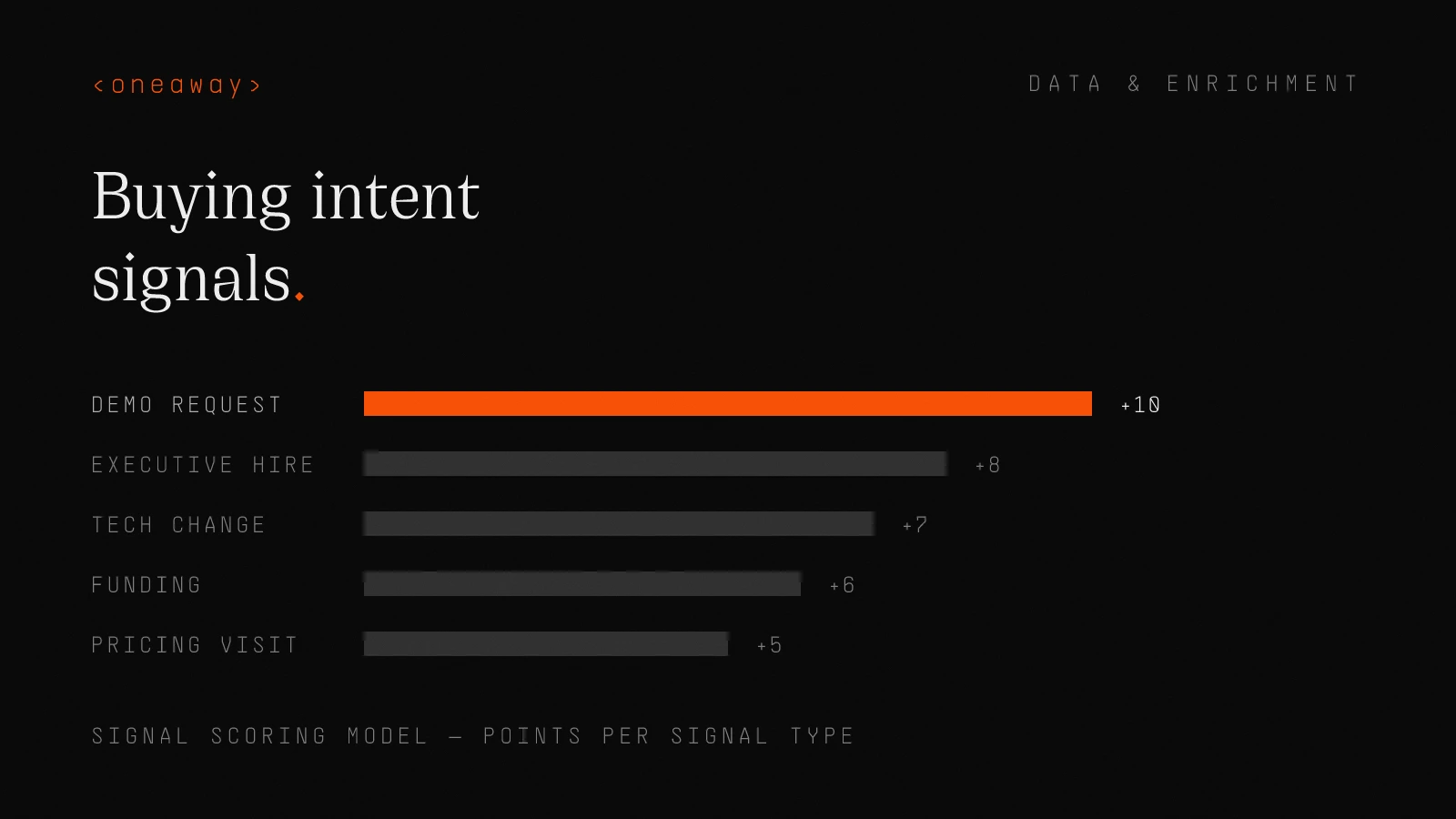
Here's the framework we use: every signal gets a point value, and accounts above a threshold get routed to sales. Simple, transparent, and actually used.
We worked with a Series B marketing platform that had a problem: their SDRs were calling 200 accounts a week with a 1.2% meeting-set rate. We implemented signal-based scoring and routing. Accounts with 15+ points went to SDRs immediately. Accounts with 8-14 points went into high-touch nurture. Everything else stayed in long-term drip.
| Signal Type | Point Value | Decay Period | Why This Matters |
|---|---|---|---|
| Pricing page visit | +5 | 7 days | Direct buying intent |
| Case study download | +4 | 14 days | Seeking validation |
| Competitor comparison view | +6 | 7 days | Active evaluation |
| Demo request | +10 | Immediate action | Hand-raise signal |
| Email open (3+ times) | +3 | 14 days | Engaged but hesitant |
| Executive hire (relevant role) | +8 | 90 days | New mandate window |
| Funding announcement | +6 | 120 days | Budget unlock |
| Third-party intent surge (Tier 1 keywords) | +5 | 30 days | Active research |
| Job posting (relevant role) | +4 | 60 days | Team building = buying |
| Tech stack change (relevant) | +7 | 90 days | Integration opportunity |
How We Actually Implement Signal Scoring
We don't use native CRM scoring — it's too rigid. Instead, we build scoring models in Clay and sync the score + triggering signals back to the CRM as a field.
This gives reps context on WHY an account scored high, not just a number. A score of "18" with signals "Pricing page visit (3x), New VP Sales hired, G2 intent spike" tells the rep exactly how to approach the conversation.
Accounts that hit the threshold trigger a workflow in Make.com or Zapier that creates a task in the CRM, posts to Slack, and (for Tier 1 signals) sends an immediate email or LinkedIn message.
Building Workflows That Act on Signals (Not Just Track Them)
This is where 90% of intent data implementations fail. Teams buy the data, connect it to their CRM, and then… nothing. The data sits there. Reps ignore it because they don't have time to check a dashboard every day.
You need automated workflows that route accounts to the right action based on the signal. Not manual. Not "check this report every Monday." Automated.
Here's a real example: we built a workflow for a client selling to ecommerce brands. When an account hit 12+ points (typically a combo of website visit + hiring signal + third-party intent), the workflow:
- Step 1 — Enriched the account in Clay with technographics, recent news, and LinkedIn profiles of key contacts
- Step 2 — Generated a personalized email using GPT-4 referencing the specific signals that triggered the workflow
- Step 3 — Sent the email from the assigned AE's Smartlead account
- Step 4 — Posted a Slack alert to the AE with talking points and signal context
- Step 5 — If no reply in 3 days, triggered a LinkedIn connection request and InMail with a different angle
The Results
Meeting-set rate went from 1.8% to 7.3% in the first 45 days. The average deal size was $31K ARR, and the workflow generated $680K in pipeline in Q1.
The key wasn't the signals themselves — it was the immediate, personalized action triggered by the signals. That's the difference between intent data as a dashboard and intent data as a revenue engine.
The 5 Biggest Mistakes Teams Make with Intent Signals
I've audited intent data setups for 40+ companies in the last 18 months. These are the mistakes I see over and over:
- Mistake #1: Buying third-party intent before instrumenting first-party signals — Your website traffic is free and higher-intent than any third-party data. Start there. If you don't have Koala, Keyplay, or Clearbit Reveal running, don't buy Bombora yet.
- Mistake #2: Tracking too many intent topics — More is not better. If you're tracking 50+ keywords, you're tracking noise. We limit clients to 8-15 high-intent keywords and ignore the rest.
- Mistake #3: Treating all signals equally — A pricing page visit is not the same as a blog read. A new CRO hire is not the same as a Marketing Coordinator hire. Build a scoring model that reflects reality.
- Mistake #4: No decay logic on signals — A funding announcement from 9 months ago is not a current signal. Every signal should have a shelf life — after that, it expires and the points come off.
- Mistake #5: Dashboards instead of workflows — If your reps have to log into a dashboard to see intent data, they won't. Signals need to trigger automatic actions or ping reps in tools they already use (Slack, CRM, email).
The 2026 Intent Signal Tech Stack We Use for Clients
Here's the exact stack we recommend (and implement) for signal-based selling in 2026. This is not theoretical — this is what we're running for clients right now.
| Category | Tool | Use Case | Pricing |
|---|---|---|---|
| First-party intent | Koala or Keyplay | Website visitor tracking, account identification | $500-2K/mo |
| Third-party intent | G2 Buyer Intent or Keyplay Signals | Research behavior, category intent | $500-3K/mo |
| Org change signals | Clay | Hiring, funding, tech adoption, news monitoring | $500-1.5K/mo |
| Enrichment | Clay + Apify | Firmographics, technographics, contact data | Included in Clay |
| Scoring & routing | Clay or custom webhook | Signal scoring, threshold triggers | Included |
| Workflow automation | Make.com or n8n | If/then logic, multi-step workflows | $29-300/mo |
| Outreach execution | Smartlead or Instantly | Email sending, deliverability, A/B testing | $200-600/mo |
| CRM | HubSpot or Attio | System of record, task management | $500-2K/mo |
| Notifications | Slack | Real-time alerts to reps | Free-$15/user/mo |
A Few Notes on This Stack
We don't use Outreach or Salesloft anymore for most clients. They're expensive, over-engineered, and slow. Smartlead + Clay gives us more control, better deliverability, and costs 70% less.
We build everything in Clay first and sync to the CRM second. Clay is the orchestration layer — the CRM is just the system of record.
We avoid all-in-one platforms like 6sense or Demandbase unless the client is enterprise ($50M+ ARR) with a dedicated RevOps team. For everyone else, they're overkill and underutilized.
Measuring ROI on Intent Data (The Metrics That Actually Matter)
Most intent data vendors sell you on "engagement lift" and "account coverage." These are vanity metrics. They don't tell you if the data is making you money.
Here are the metrics we track for every client to prove intent data ROI:
- Meeting-set rate (signal-triggered vs. cold) — If your signal-triggered outreach isn't converting at 3-5x your baseline cold rate, your signals are bad or your workflow is broken
- Show rate for booked meetings — Signal-based meetings should have higher show rates (50%+) because the timing is better
- Pipeline generated from signal-triggered accounts — Track this as a distinct source in your CRM. We tag it as 'Intent-Sourced' to isolate the impact
- Time to close (signal-triggered vs. cold) — Accounts you reach at the right time should close faster — often 20-30% shorter sales cycles
- Cost per meeting (with vs. without intent data) — If you're spending $5K/mo on intent data and generating 20 extra meetings, that's $250/meeting. Compare that to your cold outbound cost per meeting
Real ROI Example from a Client
We implemented signal-based workflows for a B2B SaaS company selling marketing automation to ecommerce brands. Here's what changed in 90 days:
| Metric | Before Intent Signals | After Intent Signals | Change |
|---|---|---|---|
| Outbound meeting-set rate | 1.4% | 6.8% | +386% |
| Meeting show rate | 42% | 61% | +45% |
| Pipeline generated (90 days) | $340K | $1.1M | +224% |
| Average time to close | 87 days | 63 days | -28% |
| Cost per meeting | $340 | $127 | -63% |
| Monthly intent stack cost | $0 | $2,400 | — |
They spent $7,200 on intent tools in 90 days and generated $760K in net-new pipeline directly attributed to signal-triggered workflows. That's a 105x ROI in the first quarter.
Even if only 25% of that pipeline closes (conservative for this client), that's $190K in revenue from a $7,200 investment. The math works.
Final Thoughts: Signals Are Only as Good as Your Response
I've watched too many teams buy intent data, get excited about the dashboard, and then do nothing with it. The data doesn't close deals. Your response to the data closes deals.
If you take one thing from this guide, let it be this: start with first-party signals, build workflows that act automatically, and measure everything against revenue, not engagement.
The best signal in the world is worthless if it takes your rep 4 days to notice it. Speed matters. Personalization matters. Automation matters.
This is what we build at oneaway.io — not just the data layer, but the entire workflow layer that turns signals into pipeline.
Frequently Asked Questions
What's the difference between intent data and buying signals?
Intent data is a type of buying signal — specifically, it tracks research behavior across third-party publisher networks. Buying signals is the broader category that includes intent data, first-party website activity, organizational changes (like hiring or funding), and engagement behaviors (like email opens or content downloads). Think of intent data as one input in a larger signal-based selling strategy.
How much does intent data cost in 2026?
Pricing varies widely. First-party intent tools like Koala or Keyplay cost $500-2K/month. Third-party intent providers like Bombora or ZoomInfo Intent range from $2K-8K/month for mid-market and $30K-100K+/year for enterprise platforms like 6sense. G2 Buyer Intent is one of the most affordable at $500-3K/month. Most companies should expect to spend $2K-5K/month total on a signal stack (first-party + third-party + enrichment).
What are the best intent data providers for startups?
For startups and early-stage companies, we recommend Keyplay (combines ICP scoring with intent signals), G2 Buyer Intent (if your category is active on G2), and Koala (for first-party website intent). Avoid enterprise platforms like 6sense or Demandbase — they're too expensive and require dedicated ops resources. You can build a highly effective signal stack for under $2K/month using Keyplay + Koala + Clay.
How do I know if intent data is actually working?
Track meeting-set rate, pipeline generated, and cost per meeting for signal-triggered outreach vs. cold outreach. If your signal-based workflows aren't converting at 3-5x your baseline cold rate, either your signals are low-quality, your scoring model is off, or your outreach messaging isn't leveraging the signals. Intent data should also reduce time to close by 20-30% because you're reaching accounts at the right time.
What are first-party intent signals?
First-party intent signals are actions taken directly on your owned channels — your website, product, email, or events. Examples include pricing page visits, demo requests, case study downloads, feature usage spikes, trial sign-ups, and documentation browsing. These are the highest-quality signals because they show direct interest in your solution, not just the category. Tools like Koala, Keyplay, Clearbit Reveal, and Segment help you track and act on first-party signals.
Should I use intent data if I have a small TAM?
Yes, but focus on first-party and organizational change signals, not broad third-party intent. If your TAM is only 500-2,000 companies, you don't need a $6K/month Bombora subscription. Instead, use Clay to monitor job changes, funding, tech adoption, and news across your entire TAM, and use Koala or Keyplay to track who's on your website. This gives you high-precision signals without paying for broad intent data you can't use.
How do I get my sales team to actually use intent data?
Don't make them log into a dashboard. Push signals to them in Slack or as tasks in the CRM, and include context on why the signal matters and what to say. Even better, automate the first touch — when a signal fires, the workflow sends a personalized email automatically and alerts the rep only if there's a reply or booking. Reps adopt intent data when it makes their job easier, not when it adds another tool to check.
Key Takeaways
- Start with first-party signals before buying third-party intent data. Your website traffic is free, higher-intent, and more actionable than any third-party signal. Implement Koala or Keyplay first.
- Not all intent signals are equal. Separate signals into tiers based on buying proximity — competitor research and pricing page visits are Tier 1, category education is Tier 3. Focus SDR effort on Tier 1 only.
- Build a point-based scoring model with signal decay. Every signal gets a point value and an expiration period. Accounts above a threshold trigger automated workflows. Accounts below stay in nurture.
- Organizational change signals (hiring, funding, tech adoption) are the most underrated signal type. These create buying windows before active research even begins — and they're trackable for free in Clay.
- Automate your response to signals, don't rely on reps to check dashboards. Use Make.com, Zapier, or n8n to trigger workflows when signals fire — enrich the account, send a personalized email, post to Slack, and create a CRM task.
- Measure ROI against revenue metrics, not engagement metrics. Track meeting-set rate, pipeline generated, time to close, and cost per meeting for signal-triggered accounts vs. cold accounts. Intent data should deliver 3-5x lift.
- The best signal in the world is worthless if your response is slow or generic. Speed and personalization matter more than signal volume. Reach out within hours, not days, and reference the specific signal in your messaging.
Related Reading
Ready to Build a Signal-Based Revenue Engine?
We've built intent signal workflows for 40+ B2B companies — from first-party tracking setup to third-party integration to fully automated outreach triggered by buying signals. If you're sitting on intent data you're not using (or considering buying it and don't know where to start), let's talk. We'll audit your current setup, map your signal sources, and build workflows that turn intent into meetings.
Check if we're a fitContinue Reading
Best B2B Lead Generation Tools in 2026, Ranked by Cost Per Lead
I tested 12 B2B lead generation tools at scale. Here's what each actually costs per qualified lead, ranked from cheapest to most expensive.
Read more [ 14 MIN READ ]Lead Generation Tools B2B Mistakes That Kill Your Pipeline
Most B2B teams waste $50K-90K yearly on lead gen tools that destroy pipeline quality. Former Salesforce SDR shares the 7 deadliest mistakes and what actually works.
Read more [ 12 MIN READ ]Best Lead Enrichment Tools in 2026, Ranked by Data Coverage
I've tested 47 lead enrichment tools. Here's the honest ranking by actual data coverage — with real fill rates, pricing, and which ones are worth your budget.
Read more