How Top Teams Use Cold Email Deliverability to Close More Deals

I'll never forget the day our entire cold email program died. March 2024, I'm running outbound for a Series A client, and our reply rates dropped from 11% to 2.3% in six weeks. Not gradually—it was like falling off a cliff.
At first, I blamed the copy. Then the list. Then Mercury must be in retrograde or something. But when I dug into the cold email deliverability numbers, I found the real problem: 68% of our emails weren't even reaching the inbox. Our prospects weren't ignoring us. They literally never saw our messages.
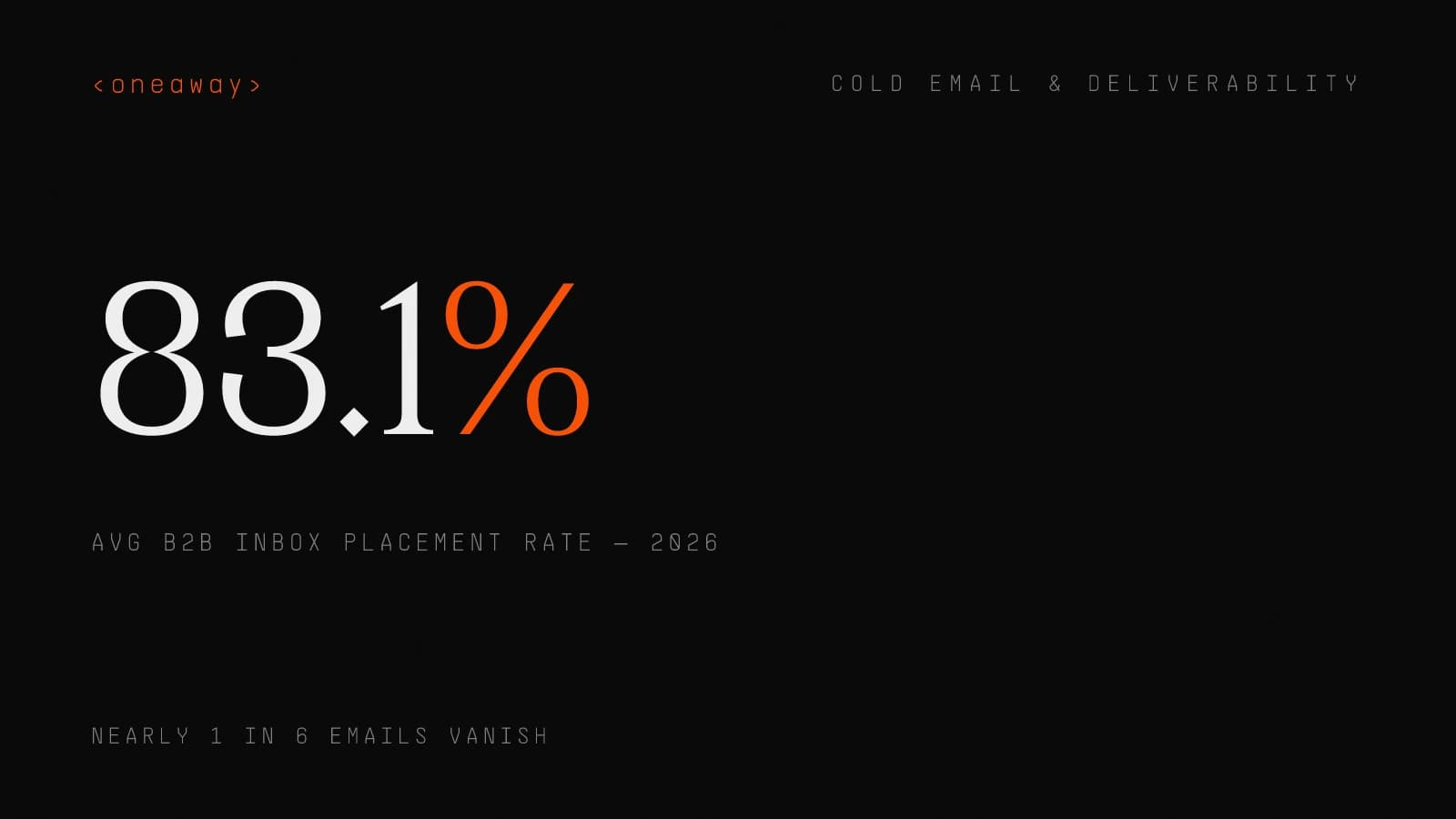
Fast forward to 2026, and the deliverability crisis has only gotten worse. The average B2B inbox placement rate is 83.1%—meaning nearly 1 in 6 emails vanishes before anyone reads it. Reply rates on generic sequences collapsed from 8-12% in 2022 to 1-3% today. But here's what nobody talks about: a small group of teams are still closing deals at scale with cold email. They're just playing a completely different game.
What Actually Killed Traditional Cold Email
Let me take you back to my Salesforce SDR days in 2019. We'd spin up a new domain, import 50,000 contacts, blast sequences with 15% personalization, and book 40-50 meetings a month per SDR. It was a numbers game, and the numbers worked.
That playbook is completely dead. Here's what happened:
DMARC enforcement went from optional to mandatory. In February 2024, Google and Yahoo implemented strict sender authentication requirements. If you're missing SPF, DKIM, or DMARC records, your emails don't just go to spam—they bounce entirely. We saw clients lose 30-40% of their send volume overnight because their technical setup was stuck in 2021.
LLM-generated spam flooded every inbox. ChatGPT democratized cold email, and not in a good way. The volume of automated outreach tripled between 2023 and 2025. Inbox providers responded by getting ruthless with filtering. Gmail's AI now detects patterns that look like bulk sending, even if you're only sending 50 emails a day.
B2B buyers developed email blindness. The average VP of Sales receives 127 cold emails per week in 2026, up from 68 in 2022. Even emails that reach the inbox get 3 seconds of attention max. Generic openers like 'I saw you're hiring' or 'Quick question about [Company]' get deleted by muscle memory.
| Metric | 2022 Baseline | 2026 Current | Change |
|---|---|---|---|
| Average inbox placement | 91-94% | 83.1% | -9% absolute |
| Cold email open rates | 35-45% | 12-18% | -60% |
| Generic sequence reply rates | 8-12% | 1-3% | -75% |
| Emails per prospect/week | 68 | 127 | +87% |
| Top-performer reply rates | 15-18% | 15-25% | Stable/improved |
What Top Performers Do Differently
I work with about 30 B2B companies running outbound at scale. Five of them consistently hit 15-25% reply rates with cold email. The rest are stuck at 2-4%.
The difference isn't copy. It's not list quality. It's not even deliverability in the traditional sense.
Top performers treat deliverability as a technical discipline, not a checkbox. They've moved from 'set it and forget it' to active reputation management. One client—series B SaaS selling to finance teams—rotates sending domains every 6 months, monitors bounce rates daily, and pulls the plug on any domain that dips below 90% inbox placement. Sounds paranoid until you realize they're booking 3x more meetings than their competitors with half the send volume.
They replaced list size with signal quality. The best team I work with sends 12 emails per day per SDR. Twelve. But every single email is triggered by a genuine buying signal: funding announcement, job posting, tech stack change, competitor mentioned in earnings call. Their reply rate is 23% because recipients actually want to hear from them.
They've rebuilt their entire tech stack around deliverability. This means dedicated IP addresses for every 3-5 sending domains, separate infrastructure for transactional vs. marketing vs. cold email, and real-time monitoring that catches deliverability issues before they tank a campaign.
- Infrastructure-first mindset: — Technical setup isn't a one-time task. It's ongoing reputation management with dedicated resources.
- Signal-based targeting: — Volume dropped 70-80%, but reply rates increased 4-6x by only reaching out when prospects show buying intent.
- Radical personalization: — Not 'Hi {{FirstName}}, I noticed {{Company}}' templates. Real research that takes 8-12 minutes per prospect.
- Multi-channel orchestration: — Cold email is one touchpoint in a 7-11 touch sequence including LinkedIn, phone, and warm intro requests.
- Ruthless list hygiene: — Scrubbing bounces immediately, removing non-responders after 2 sequences, never re-uploading old lists.
The Technical Foundation Nobody Skips Anymore
When I was at AWS, we had an IT team handling email infrastructure. Now I'm working with startups where the founder is also the sys admin, and the technical requirements for cold email deliverability are genuinely complex.
Here's what changed: you can't fake your way through technical setup anymore. Inbox providers verify every single authentication record, and one misconfiguration kills your entire domain reputation.
I recently audited a client sending 500 cold emails per day with a 1.2% reply rate. Their DKIM signature was broken (wrong DNS record format), their DMARC policy was set to 'none' instead of 'quarantine,' and they were sending from a shared IP pool with 40 other companies. We rebuilt their infrastructure from scratch, and reply rates jumped to 9.4% in three weeks—same copy, same list, just proper technical setup.
- SPF (Sender Policy Framework): — Whitelist which IP addresses can send email from your domain. Set 'v=spf1 include:youresp.com ~all' in DNS. The ~all (soft fail) is critical—'–all' (hard fail) causes legitimate bounces.
- DKIM (DomainKeys Identified Mail): — Cryptographic signature proving emails weren't tampered with in transit. Generate keys through your ESP, add TXT record to DNS. Test with mail-tester.com—you should see green checkmarks.
- DMARC (Domain-based Message Authentication): — Policy telling inbox providers what to do with failed authentication. Start with 'p=none' for monitoring, move to 'p=quarantine' after 2 weeks clean data. 'p=reject' is overkill for most B2B senders.
- Custom tracking domain: — Don't use youresp.trackingdomain.com for link tracking. Set up track.yourdomain.com with proper SSL certificate. Shared tracking domains are deliverability killers.
- Dedicated sending domains: — Never send cold email from your primary company domain. Use variations: outreach.company.com, hello.company.com. If a domain gets burned, your main domain stays clean.
- Separate IP addresses: — Shared IPs mean your reputation depends on everyone else in the pool. Dedicated IPs cost $15-30/month and give you full control. Warm them up slowly over 4-6 weeks.
Email Warm-Up Strategy That Actually Works
We use Instantly and Smartlead for automated warm-up, but I'll be honest: the automated tools only handle 60% of what you need. The other 40% is manual reputation building—joining email conversations, getting added to recipient whitelists, establishing consistent sending patterns.
One more thing: rotate domains every 9-12 months even if nothing breaks. Domains accumulate reputation baggage over time. Starting fresh with a new subdomain keeps you ahead of deliverability decay.
- Week 1-2: Internal emails only. — Send 10-15 emails per day to addresses you control (team members, test accounts). Gmail, Outlook, and your own domain. Include replies, forwards, the full interaction pattern.
- Week 3-4: Warm intro pool. — Reach out to 15-20 real contacts who know you. Customers, partners, former colleagues. Not cold prospects. You want genuine positive engagement—opens, replies, emails moved to primary tab.
- Week 5-6: Low-volume cold outreach. — Start with 20-30 cold emails per day. Hyper-targeted list, high personalization. Monitor bounce rate (should be under 3%), spam complaint rate (under 0.1%), and reply rate (should be 8%+ if targeting is good).
- Week 7-8: Scale to operational volume. — Gradually increase to 50-80 emails per day. This is the safe maximum for most B2B senders in 2026. Yes, you used to send 300/day. Those days are over.
- Ongoing: Reputation maintenance. — Send at consistent volume daily (no 500 Monday, 0 Tuesday pattern). Maintain 2:1 ratio of warm/internal email to cold outreach. Remove hard bounces immediately. Respond to every reply within 2 hours.
Signal-Based Targeting Replaces Spray-and-Pray
Send volume dropped to 80 emails per day. Reply rate jumped to 19.3%. Same team, same domains, radically different targeting approach.
This is the single biggest shift in B2B email outreach between 2023 and 2026. Top performers don't build lists—they build signal monitoring systems. They're not asking 'who fits our ICP?' They're asking 'who just entered a buying window?'
The tools we use: Clay for signal aggregation, Common Room for intent monitoring, Clearbit and ZoomInfo for firmographic enrichment, and custom Python scripts for niche signals (regulatory filings, tech stack changes, hiring patterns). It's more complex than the old Apollo export → Outreach upload workflow. It also works 6x better.
- Raised funding — (tracked via Crunchbase API and press release monitoring)
- Posted a relevant job opening — (finance, operations, or revenue roles—scraped from company career pages)
- Changed tech stack — (identified through BuiltWith and Datanyze monitoring)
- Mentioned competitors or category terms — (G2 reviews, LinkedIn posts, podcast appearances)
- Attended relevant events — (conference attendee lists, webinar participants)
- Published content about related problems — (blog posts, LinkedIn articles, podcast episodes)
Email Personalization at Scale (Without AI Slop)
This takes 7-8 minutes per prospect. An SDR can research and personalize 25-30 emails in a full day of prospecting. That's your send volume: 25-30 highly relevant, genuinely personalized emails per day.
I know this feels impossibly low if you came up during the 2019-2022 era of 300 sends per day. But look at the math: 30 emails at 18% reply rate = 5-6 conversations per day. 300 emails at 2% reply rate = 6 conversations per day. Same output, 10x less inbox pollution, and you don't burn your domain reputation.
One more thing: AI is useful for research acceleration, not writing. I use ChatGPT to summarize podcast transcripts and extract key points from earnings calls. I never use it to write the actual email. The best cold emails in 2026 sound like text messages from smart people, not marketing copy.
- Trigger signal (30 seconds): — What buying signal prompted this outreach? Be specific. 'Raised Series B' is lazy. 'Raised $23M Series B led by Accel to expand from PLG to enterprise sales' is actionable.
- Company context (2 minutes): — Read the About page and latest blog post. What are they building? Who do they serve? What's their GTM motion? Find one non-obvious detail that shows you actually looked.
- Personal context (2 minutes): — LinkedIn profile, recent posts, podcast appearances, previous companies. Look for career trajectory, not hobbies. 'I saw you just moved from Salesforce' beats 'I see you're a dog person.'
- Problem hypothesis (2 minutes): — Based on their stage, signal, and context, what problem do they likely have that you solve? Be specific and contrarian. Everyone knows Series B companies need to scale. What's the non-obvious bottleneck?
- Credibility anchor (1 minute): — Find a company you've worked with that's similar—same stage, same GTM motion, same geography. Ideally someone they'd recognize or respect. This turns cold email into warm-ish email.
Monitoring and Recovery Playbook
When deliverability drops, here's the recovery protocol:
Stop sending from affected domains immediately. I've seen clients try to 'send through' deliverability problems. It never works. You just dig the hole deeper. If inbox placement drops below 75%, pause all campaigns on that domain.
Audit technical setup. Verify SPF, DKIM, and DMARC records haven't changed. Check for blacklist placement (use MXToolbox). Review recent bounces for patterns—bouncing on a specific domain or ESP suggests infrastructure issues.
Run a re-warm campaign. Back to 10-15 internal emails per day, then gradual ramp over 3-4 weeks. Yes, this means that domain is effectively offline for a month. That's the cost of recovery.
Switch to backup domains. This is why you need 3-5 sending domains in rotation. If domain A tanks, you move volume to domains B and C while A recovers. Single-domain outbound programs are fragile.
Review list and copy. Deliverability problems are often symptoms of poor targeting or aggressive copy. If you're hitting spam traps or getting high complaint rates, the problem isn't technical—it's strategic.
- Inbox placement rate: — Use GlockApps or MailReach to test where emails land (inbox vs spam vs promotions). Run tests weekly. Target: 85%+ inbox placement across Gmail, Outlook, and corporate domains.
- Bounce rate: — Should be under 3% per campaign. Above 5% indicates list quality issues or domain reputation problems. Above 8% means stop sending immediately and investigate.
- Spam complaint rate: — Target: under 0.1% (1 complaint per 1,000 emails). Above 0.3% triggers ESP warnings. Above 0.5% gets you suspended. You can see this in your ESP dashboard—actually check it.
- Reply rate and sentiment: — Not just reply rate—positive vs negative sentiment. If you're getting 8% replies but half are 'unsubscribe' or 'not interested,' something's wrong with targeting or messaging.
- Engagement velocity: — Time from send to open, open to reply. Fast engagement (opens within 2 hours, replies within 24 hours) signals strong deliverability and relevance. Slow engagement suggests promotions tab or low priority.
What Replaces Volume: The New Cold Email Stack
Here's what top-performing teams are running in 2026. This isn't theoretical—this is the actual tech stack we've implemented with clients booking 40-60 qualified meetings per month from cold outbound:
Infrastructure layer: 5-7 sending domains (rotated quarterly), dedicated IPs for each domain, separate domains for cold email vs newsletters vs transactional. Cost: $200-400/month for domains, IPs, and DNS management.
Deliverability monitoring: GlockApps for inbox placement testing (weekly), Postmaster Tools for Gmail reputation monitoring, Instantly or Smartlead for automated warm-up. Cost: $150-300/month.
Signal and data layer: Clay for signal aggregation and enrichment, Apollo or ZoomInfo for contact data, Clearbit for firmographic enrichment, Common Room or Koala for intent monitoring. Cost: $800-1,500/month depending on volume.
Sending and personalization: Instantly, Smartlead, or Lemlist for campaign execution. ChatGPT Plus for research acceleration (not writing). Lavender or Instantly's deliverability analysis for pre-send quality checks. Cost: $300-600/month.
CRM and orchestration: HubSpot or Salesforce for pipeline tracking, Zapier or Make for connecting tools, Slack for real-time reply notifications. Cost: $500-2,000/month depending on company size.
Total stack cost: $2,000-5,000/month. Five years ago, you could run effective cold email for $300/month (Apollo + Outreach + domains). The complexity and cost went up because the deliverability bar went up. Top performers treat this as infrastructure investment, not marketing expense.
| Component | Old Approach (2019-2022) | New Approach (2026) | Why It Changed |
|---|---|---|---|
| Domains | 1-2 domains, send from main domain | 5-7 dedicated cold email domains | Domain reputation is fragile, need rotation and backups |
| Volume per sender | 200-400 emails/day | 30-80 emails/day | Deliverability penalties for high volume, quality over quantity |
| Targeting | Firmographic filters (industry, size, title) | Signal-based (funding, hiring, tech changes) | Generic outreach gets filtered, need genuine buying intent |
| Personalization | {{FirstName}} and {{Company}} tokens | 6-8 min research per prospect | AI-generated personalization is detectable and ignored |
| Tech stack cost | $300-600/month | $2,000-5,000/month | Deliverability requires dedicated infrastructure and monitoring |
| Success metric | Emails sent | Qualified meetings booked | Volume became inversely correlated with results |
Real-World Results: What This Actually Looks Like
Let me close with three actual client examples showing how this plays out in practice.
Series B DevTools Company (35 employees): They were sending 1,200 cold emails per week with a 2.1% reply rate. We rebuilt their program around GitHub activity signals—companies that recently adopted complementary tools, switched version control systems, or posted DevOps job openings. Volume dropped to 280 emails per week, reply rate jumped to 16.8%, and they booked 31 qualified demos in Q4 2025 vs 14 in Q3.
Revenue Operations Consultancy (12 employees): Founder was spending 3 hours a day sending cold emails with minimal response. We set up proper technical infrastructure (they were missing DMARC entirely), trained their SDR on signal-based targeting using LinkedIn job posts and G2 reviews, and built a 6-email sequence triggered by specific buying signals. They now send 40-50 emails per week and book 6-8 intro calls per month—and the founder got 3 hours back to actually run the business.
Enterprise SaaS (250 employees, selling to Fortune 500): Their massive 10-person SDR team was grinding through Apollo lists with 1.4% reply rates. We didn't just fix deliverability—we rebuilt their entire ICP around accounts with active budget cycle signals (leadership changes, analyst mentions, tech stack expansions visible in job descriptions). Volume per SDR dropped from 100 to 35 emails per day, but qualified pipeline from cold outbound increased 240% because they were reaching the right people at the right time.
The pattern across all three: lower volume, higher relevance, dramatically better results. That's the 2026 playbook.
Frequently Asked Questions
What is a good cold email deliverability rate in 2026?
The average inbox placement rate in 2026 is 83.1%, but top performers maintain 85-92% by using dedicated sending domains, proper technical authentication (SPF, DKIM, DMARC), and consistent warm-up protocols. If you're below 80%, you have a technical or reputation problem that needs immediate attention.
How long does email warm-up take?
Proper email warm-up takes 6-8 weeks minimum. Week 1-2 should be internal emails only, weeks 3-4 should involve warm contacts, weeks 5-6 can include low-volume cold outreach (20-30 emails/day), and weeks 7-8 scale to operational volume (50-80 emails/day). Rushing this process is the #1 cause of burned domains.
What's a realistic cold email reply rate in 2026?
Generic sequences get 1-3% reply rates in 2026, down from 8-12% in 2022. However, signal-based targeting with genuine personalization can achieve 15-25% reply rates. The key difference is reaching prospects who have active buying intent rather than blasting large lists of cold contacts.
How many cold emails should an SDR send per day?
In 2026, top-performing SDRs send 30-80 highly personalized emails per day, down from 200-400 in previous years. The focus has shifted from volume to relevance. Spending 6-8 minutes researching each prospect and reaching out only when buying signals are present produces 5-6x higher reply rates than mass outreach.
Do I need separate domains for cold email?
Yes, absolutely. Never send cold email from your primary company domain. Use dedicated subdomains (outreach.company.com, hello.company.com) that you can rotate every 9-12 months without affecting your main domain's reputation. Top performers maintain 5-7 sending domains with dedicated IP addresses for each.
Does AI personalization work for cold email?
AI-generated personalization in 2026 is easily detectable and mostly ineffective. However, AI is valuable for research acceleration—summarizing podcast transcripts, extracting key points from earnings calls, and identifying signals. The actual email should be written by humans using structured research frameworks that take 6-8 minutes per prospect.
What are the most important buying signals for B2B cold email?
The highest-converting signals are: funding announcements, relevant job postings (especially finance/ops/revenue roles), tech stack changes, competitor mentions in reviews or social media, conference attendance, and published content about problems you solve. Prospects with 2+ signals in the last 30 days convert 4-6x better than cold contacts.
Key Takeaways
- Cold email deliverability dropped 60% since 2022, with average inbox placement at 83.1% and generic sequence reply rates at 1-3%. However, top performers maintain 15-25% reply rates through signal-based targeting and proper infrastructure.
- Technical setup is mandatory, not optional. SPF, DKIM, and DMARC authentication, dedicated sending domains, and separate IP addresses are baseline requirements. One misconfiguration kills your entire domain reputation.
- Email warm-up takes 6-8 weeks minimum and requires disciplined ramp-up: internal emails for 2 weeks, warm contacts for 2 weeks, then gradual scaling to 50-80 emails/day operational volume. Rushing this process burns domains permanently.
- Signal-based targeting replaces volume. Top teams send 30-80 emails per day triggered by genuine buying signals (funding, hiring, tech changes) rather than 200-400 generic emails to cold lists. This produces 5-6x higher reply rates.
- Real personalization takes 6-8 minutes per prospect using structured research frameworks. AI-generated personalization is detectable and ineffective. Use AI for research acceleration, not writing.
- Monitor deliverability metrics daily: inbox placement rate (target: 85%+), bounce rate (under 3%), spam complaint rate (under 0.1%), and reply sentiment. Catch problems early before they destroy domain reputation.
- The 2026 cold email stack costs $2,000-5,000/month including dedicated infrastructure, monitoring tools, signal/data platforms, and sending tools. This is 5-10x more than 2019-2022, but required for consistent deliverability.
Related Reading
Ready to rebuild your cold email program for 2026?
We've helped 30+ B2B teams transition from spray-and-pray cold email to signal-based outbound that actually drives pipeline. OneAway handles the technical infrastructure, deliverability monitoring, and signal-based targeting frameworks that top performers use to maintain 15-25% reply rates. If you're tired of watching your cold email program crater while competitors book meetings at scale, let's talk.
Check if we're a fitContinue Reading
Best Email Outreach Tools for Small Teams (2026), by Setup Speed
I tested 10 email outreach tools and ranked them by how fast you can actually send your first campaign. Real setup times, honest pricing, and which platforms work for teams under 10.
Read more [ 12 MIN READ ]The 30/30/50 Budget Rule for B2B Founders, Ranked by Survival
Most B2B founders waste their GTM budget on the wrong channels. Here's the allocation framework that actually keeps companies alive, tested across 50+ early-stage startups.
Read more [ 14 MIN READ ]Best Email Warm-Up Tools 2026: Safety vs Fake Engagement
I ranked the best email warmup tools by what actually matters in 2026: real deliverability improvement vs fake engagement that gets you flagged. Here's what works.
Read more