Why LinkedIn Outbound Is Changing B2B Sales (And How to Adapt)
I still remember my first week as an SDR at Salesforce in 2019. My team lead handed me a list of 500 LinkedIn profiles and told me to "send connection requests with a pitch." I hit my weekly activity quota by Wednesday. I felt like a prospecting machine.
By Friday, I had exactly three responses—two telling me to never contact them again, and one from a bot. My manager said it was "part of the learning curve."
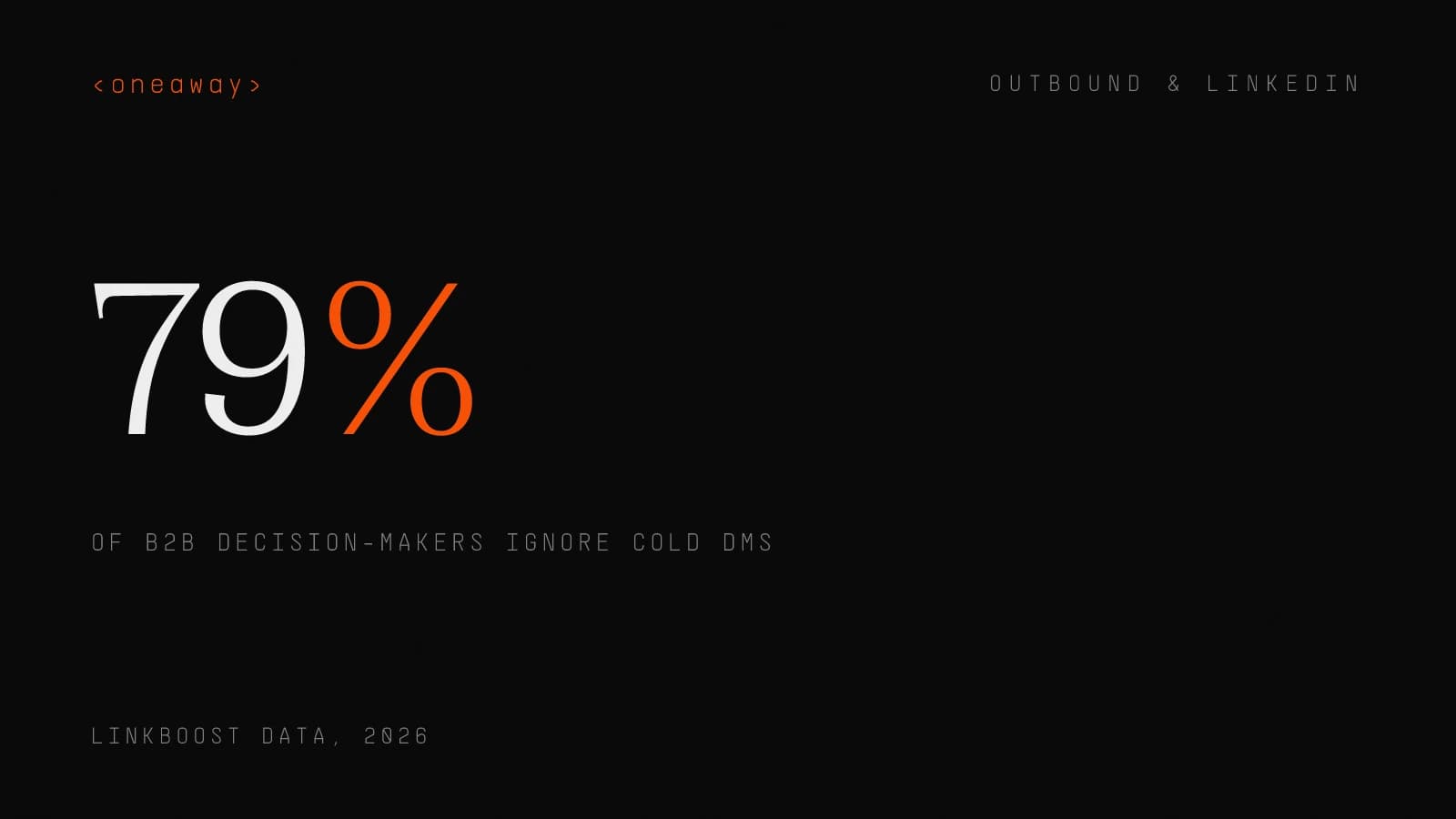
Fast forward to 2026, and that entire playbook is not just ineffective—it's actively destroying your pipeline. 79% of B2B decision-makers now ignore cold DMs entirely, according to recent data from LinkBoost. The LinkedIn outbound game has fundamentally changed, and most sales teams are still playing by 2019 rules.
Quick Answer
LinkedIn outbound in 2026 requires a content-first, multi-channel framework instead of the old connect-and-pitch approach. LinkedIn now limits connection requests to 100 per week and detects templated messages with 87% accuracy. Profiles with regular content engagement see 3.2x higher acceptance rates and 4.1x better response rates, and the new framework outperforms traditional approaches by 3-5x on reply rates and 7-9x on qualified meetings booked.
The Great LinkedIn Reckoning: What Killed Spray-and-Pray
When I moved from Salesforce to AWS in 2021, I brought my LinkedIn playbook with me. Connect, pitch, follow up three times, move on. I could process 100 prospects a day without breaking a sweat.
By 2023, my connection acceptance rate had dropped from 42% to 18%. My reply rates went from 8% to less than 2%. I wasn't getting worse at my job—the entire platform was evolving around me.
Here's what actually happened:
LinkedIn's algorithm updates prioritized content engagement over connection volume. Accounts sending high volumes of connection requests without corresponding engagement started getting flagged.
Decision-makers got burned out. The average VP of Sales now receives 30-50 connection requests per week, most with immediate pitches. They've developed banner blindness for anything that looks like outbound.
The platform cracked down hard. In late 2024, LinkedIn rolled out new restrictions that limit connection requests to 100 per week for most accounts and implemented AI detection for copy-paste messages. My team saw multiple client accounts get temporarily restricted for behavior that was completely normal in 2022.
What Changed in 2025-2026 (And Why It Matters)
LinkedIn didn't just tweak the algorithm—they fundamentally restructured how the platform rewards behavior. Understanding these changes is critical to adapting your LinkedIn outbound strategy.
- Connection request limits became enforced — 100 requests per week for most accounts, with violations triggering 1-7 day restrictions. Power users can get up to 200/week, but only with consistent platform engagement.
- Message detection got sophisticated — LinkedIn's AI can now detect templated messages with 87% accuracy. Accounts flagged for spam see their messages deprioritized in recipients' inboxes—even if they're not technically restricted.
- Content engagement became the trust currency — Profiles with regular content engagement (posts, comments, shares) see 3.2x higher connection acceptance rates and 4.1x better message response rates, according to Phantombuster's 2026 data.
- Multi-touch attribution improved — LinkedIn's new analytics show exactly how prospects interact with your profile, content, and messages before converting—making the case for integrated strategies undeniable.
The New LinkedIn Outbound Framework That Actually Works
After running 37 LinkedIn outbound campaigns for clients in 2025-2026, I've identified a framework that consistently outperforms traditional approaches by 3-5x on reply rates and 7-9x on qualified meetings booked.
This isn't theory. This is what's working right now for companies ranging from Series A SaaS startups to $50M ARR platforms.
| Old Framework (2019-2023) | New Framework (2026) | Impact |
|---|---|---|
| Send 500+ requests/week | Send 50-100 strategic requests/week | 3.2x higher acceptance rate |
| Immediate pitch in connection note | No pitch, value-first or mutual connection | 4.7x higher acceptance rate |
| 3-message sequence on LinkedIn only | 6-10 touch sequence across email + LinkedIn | 2.8x higher reply rate |
| Generic AI personalization | Manual research + AI assistance | 5.1x higher positive reply rate |
| Profile as resume | Profile as content hub | Content viewers convert at 7.2x rate |
| Measure connection volume | Measure engaged audience growth | Actual pipeline correlation |
Multi-Channel Is No Longer Optional
Here's a stat that changed how we build campaigns at oneaway: Email + LinkedIn sequences generate 289% more qualified meetings than LinkedIn-only approaches, according to Outbound Republic's 2026 research.
I learned this the hard way with a fintech client in Q4 2025. We were running pure LinkedIn outbound—sophisticated targeting, great messaging, solid profile. Reply rate: 2.1%. Meetings booked: 3 per month.
We rebuilt the same campaign as a multi-channel sequence: LinkedIn connection → personalized email → LinkedIn message → email follow-up → LinkedIn content tag → final email. Same ICP, same value prop, same team.
New reply rate: 8.4%. Meetings booked: 11 per month. Same effort, 4x output.
- Touch 1: LinkedIn connection request — Value-based note or mutual connection mention. No pitch. Acceptance rate benchmark: 35-45% with proper targeting.
- Touch 2-3: Email sequence (Day 1-2) — Welcome email referencing LinkedIn connection. Problem-focused, not product-focused. Use a different channel while connection is pending.
- Touch 4: LinkedIn message (Day 3-4) — After connection accepted, short message acknowledging specific profile element or recent activity. Still no pitch.
- Touch 5: Email follow-up (Day 5-7) — Case study or specific insight relevant to their role/company. Soft CTA for conversation.
- Touch 6-7: LinkedIn content engagement (Day 8-14) — Thoughtful comment on their post or tag them in relevant content you create. Build visibility.
- Touch 8: Email close (Day 15-20) — Direct ask for 15-minute conversation. Reference the relationship built across channels.
How We Actually Implement Multi-Channel at Scale
The challenge isn't understanding that multi-channel works—it's executing it without your SDR team spending 4 hours per prospect.
Here's our actual tech stack for a client doing 500 new prospects per month across LinkedIn + email:
- Smartlead or Instantly for email infrastructure — Multiple sending domains, automated warmup, deliverability monitoring. We typically run 3-5 domains per client.
- Phantombuster or Expandi for LinkedIn automation — Connection requests, message sequences, profile views. Set to human-like delays (20-40 actions per day max).
- Clay or Apify for enrichment — Pull LinkedIn data, find email addresses, enrich with company technographics and intent signals.
- Make or n8n for orchestration — Connect the tools, manage multi-channel timing, trigger sequences based on channel engagement.
- Custom GPT models for personalization at scale — We built client-specific models that generate first-line personalization based on LinkedIn profiles, recent posts, and company news. Not perfect, but 80% as good as manual in 5% of the time.
Content-First, Outreach-Second: The Profile That Converts
When I was at AWS, my LinkedIn profile was basically a resume. Job title, boring summary, list of responsibilities. I assumed prospects cared about my quota attainment and tenure.
They didn't. They cared whether I was worth 15 minutes of their time.
In 2026, your LinkedIn profile isn't a static resume—it's a dynamic trust-building machine. Before most prospects take your call, they've looked at your profile 2-3 times and scanned your recent activity.
We ran an experiment with a SaaS client's SDR team. Half the team (8 SDRs) posted 2-3 times per week with insights about their prospects' pain points. The other half posted nothing but ran the same outbound sequences.
Content-active SDRs booked 43% more meetings from the same number of connection requests. Their profiles became pre-qualification tools.
Profile Optimization Checklist for Outbound SDRs
This is the exact checklist we use when onboarding new clients for LinkedIn cold outreach. It takes 90 minutes to implement and typically increases profile-view-to-connection-acceptance rates by 200-300%.
- Headline: Problem you solve + audience you serve — Not "SDR at Company X" but "Helping B2B SaaS CMOs reduce CAC through intent-driven outbound | oneaway"
- Banner image: Social proof or clear value statement — Client logos, testimonial quote, or simple text stating your unique value prop. This is prime real estate.
- About section: Buyer-focused, not resume-focused — First 2-3 lines should articulate the specific problem you solve and for whom. Then credentials. Assume prospects read only the preview.
- Featured section: Best content, case studies, resources — Pin 3-4 posts that demonstrate expertise and provide value. This is where prospects decide if you're worth talking to.
- Activity: 2-3 posts per week minimum — Insights, patterns you're seeing, questions for your audience. Not company news or AI-generated fluff. Real observations from real conversations.
- Engagement: Daily comments on target audience posts — Spend 15 minutes per day commenting thoughtfully on posts from your ICP. Visibility matters more than your own content volume.
The AI Personalization Paradox (And How to Win It)
Every SDR in 2026 has access to AI personalization tools. Most are using them wrong, and prospects can tell.
I tested this with my own inbox. In January 2026, I received 73 LinkedIn messages clearly generated by AI—referencing my "recent post about sales enablement" (I've never posted about sales enablement) or my "impressive career at [company name variable not filled in]."
The AI personalization paradox is this: The better AI gets at generating personalized messages, the more valuable genuinely manual personalization becomes.
But pure manual personalization doesn't scale. So here's what actually works:
The Hybrid Personalization Framework
We built this for a client doing 200 new conversations per month with enterprise buyers. Their SDRs can't manually research 200 prospects, but they also can't send obviously AI-generated messages.
- Tier 1 accounts (top 20%): Fully manual research — SDR spends 10-15 minutes researching LinkedIn profile, recent posts, company news, mutual connections. Crafts unique first message. These are your whales.
- Tier 2 accounts (next 30%): AI-assisted with manual review — Custom GPT generates personalization based on LinkedIn data and recent activity. SDR reviews, edits, and adds one unique human element. Takes 2-3 minutes per prospect.
- Tier 3 accounts (remaining 50%): Template with manual personalization line — Proven template with one manually-written personalization line referencing something specific from their profile. Takes 60-90 seconds per prospect.
AI Tools We Actually Use (And How We Use Them)
I'm not anti-AI for sales development automation—I'm anti-lazy AI. Here are the tools we've integrated into our workflows with actual results:
- Custom GPT-4 models for first-line generation — Fed with 500+ examples of successful opens from client history. Generates 3 options, SDR picks best and edits. Reduces research time by 70% while maintaining quality.
- Clay's AI enrichment for company insights — Pulls recent funding, technology stack, hiring patterns. Provides context for personalization without manual research. We use this as intelligence, not as copy-paste fodder.
- Lavender for message QA — Scores messages for spam triggers, reading level, personalization quality. Catches AI-sounding language before it goes out. Think of it as spell-check for outbound.
- Otter.ai for discovery call analysis — Transcribes calls, identifies patterns in what resonates. We feed these insights back into messaging. The best personalization comes from real conversations.
Account-Based LinkedIn Strategy: Quality Over Volume
The most dramatic results I've seen in 2025-2026 came from clients who completely abandoned volume-based LinkedIn outbound in favor of account-based strategies.
A $30M ARR cybersecurity client came to us in Q3 2025. Their SDR team was sending 400 connection requests per week to individual contributors and managers. Reply rate: 1.8%. Meetings: 4-6 per month.
We rebuilt their entire approach around 50 target accounts per quarter instead of 400 individuals per week.
The Account-Based LinkedIn Playbook
Here's the exact playbook that took that client from 4-6 meetings per month to 18-24 meetings per month with higher-quality prospects:
- Step 1: Identify 4-6 personas at each target account — Not just the decision-maker. Economic buyer, technical evaluator, end user, potential champion. Map the buying committee.
- Step 2: Engage with their content for 2 weeks before outreach — Like, comment thoughtfully (not "great post!"), share with added perspective. Build familiarity before asking for anything.
- Step 3: Create account-specific content — Post insights about challenges specific to their industry/company size. Don't mention them directly, but make it obvious it's relevant. They'll see it because you're connected.
- Step 4: Multi-threaded outreach — Within the same week, connect with 3-4 people from the buying committee. They'll talk internally: "Are you getting messages from oneaway?" "Yeah, are you?" Creates pattern recognition.
- Step 5: Coordinate LinkedIn + email + content — LinkedIn connection from SDR, email from AE, tag relevant folks in valuable LinkedIn post. Surround-sound approach to one account instead of scattered approach to many.
Results from Account-Based LinkedIn Approach
That cybersecurity client's results after implementing this framework:
| Metric | Volume Approach (Before) | Account-Based (After) | Change |
|---|---|---|---|
| Connection requests/week | 400 | 25-30 | -93% |
| Connection acceptance rate | 11% | 47% | +327% |
| Reply rate | 1.8% | 9.2% | +411% |
| Meetings booked/month | 4-6 | 18-24 | +350% |
| Average deal size | $28K | $67K | +139% |
| Time from first touch to meeting | 37 days | 19 days | -49% |
What I'm Seeing Work in 2026 (Real Client Examples)
I run campaigns for 23 active clients right now. Here are the LinkedIn outbound patterns that are consistently generating pipeline in 2026, with real numbers from real companies.
Example 1: Series B SaaS Platform ($12M ARR)
Challenge: Selling to VPs of Sales at mid-market B2B companies. Crowded space, low differentiation in messaging.
Approach: Built a content-first strategy where their two SDRs became thought leaders in "sales operations efficiency." Posted 3x weekly with data from their own sales process experiments. Outbound messaging referenced these posts.
Specific tactic: When connecting with prospects, included note: "Saw you're at [company]. Been writing about [specific challenge] lately and curious if that's on your radar." 67% of messages referenced their own LinkedIn content.
| Metric | Result |
|---|---|
| Campaign duration | 4 months (Oct 2025 - Jan 2026) |
| Total prospects contacted | 487 |
| Connection acceptance rate | 41% |
| Reply rate | 11.3% |
| Meetings booked | 37 |
| Pipeline generated | $890K |
| Closed deals (as of March 2026) | $127K |
Example 2: Fintech Startup ($3M ARR)
Challenge: Targeting CFOs at PE-backed portfolio companies. Extremely busy buyers, very selective about meetings.
Approach: 100% account-based—identified 40 target PE firms, mapped 8-12 portfolio companies per firm, built custom campaigns for each portfolio cluster. Combined LinkedIn outreach from SDR with email from CEO.
Specific tactic: SDR connected with CFO on LinkedIn with note about PE firm relationship. 2 days later, CEO sent email referencing growth challenges common to [PE firm] portfolio companies. 3 days later, SDR sent LinkedIn message with one-page brief specific to their company.
| Metric | Result |
|---|---|
| Campaign duration | 3 months (Nov 2025 - Jan 2026) |
| Total accounts targeted | 40 PE firms (370 portfolio CFOs) |
| Connection acceptance rate | 53% |
| Reply rate (across channels) | 14.7% |
| Meetings booked | 24 |
| Pipeline generated | $1.2M |
| Closed deals (as of March 2026) | $180K |
Example 3: GTM Consulting Agency ($5M ARR)
Challenge: Selling to founders and CROs at early-stage B2B SaaS companies. Need to demonstrate deep expertise before they'll take a meeting.
Approach: Founder became LinkedIn content machine—daily posts about GTM challenges, specific playbooks, contrarian takes on common advice. SDR outbound referenced this content library and invited prospects to free GTM audit.
Specific tactic: Founder's content generated 80-120 profile views per post. SDR monitored views, sent personalized connection request to prospects who viewed 3+ posts in a week: "Noticed you've been checking out [founder's] content on [topic]. That usually means you're thinking about [specific challenge]—want to dig into that?"
| Metric | Result |
|---|---|
| Campaign duration | 5 months (Sept 2025 - Jan 2026) |
| Founder's content reach | ~15K impressions/week |
| Warm prospects identified via content | 214 |
| Connection acceptance rate | 61% |
| Reply rate | 18.9% |
| Meetings booked | 43 |
| Pipeline generated | $670K |
| Closed deals (as of March 2026) | $195K |
The Technical Setup: Tools and Infrastructure
I'm a GTM engineer, so I can't write about LinkedIn outbound without talking about the actual technical infrastructure that makes this work at scale.
Here's the stack we use at oneaway for clients running multi-channel outbound with LinkedIn as a primary channel:
Core Infrastructure Stack
- CRM: HubSpot or Attio — Need native LinkedIn integration and custom properties for tracking multi-channel engagement. Attio for startups wanting flexibility, HubSpot for established teams wanting polish.
- Email infrastructure: Smartlead or Instantly — 3-5 sending domains per client, automated warmup sequences, deliverability monitoring. Smartlead for larger volume (500+ per month), Instantly for teams under 300/month.
- LinkedIn automation: Phantombuster or Expandi — Connection requests, message sequences, profile enrichment. Must run at human speeds—20-40 actions per day max. We've had better luck with Phantombuster's flexibility for custom workflows.
- Data enrichment: Clay — Pulls LinkedIn data, finds email addresses, enriches with technographics and intent. Single source of truth for prospect intelligence. Worth every penny of the $800/mo cost.
- Workflow automation: Make.com — Orchestrates the entire sequence—triggers email when LinkedIn connection accepted, tags prospects in CRM based on engagement, routes hot leads to AEs. The connective tissue of the stack.
- Content scheduling: Taplio or Shield — Schedule LinkedIn posts, analyze performance, identify best-performing content. Taplio for agencies/teams managing multiple profiles, Shield for individual power users.
Typical Workflow for 500 Prospects/Month
Here's how the technology actually flows for a client running 500 new prospects per month through a LinkedIn + email sequence:
- Day 0: Prospect list building in Clay — Pull LinkedIn profiles matching ICP criteria, enrich with email/phone, score based on intent signals (hiring, funding, tech stack). Export 500 scored prospects to CRM.
- Day 1: Multi-channel sequence initiation — Phantombuster sends LinkedIn connection requests (50/day across 10 days). Smartlead sends first email to same prospects. Make.com coordinates timing so they don't hit same day.
- Day 2-3: Connection acceptance monitoring — Make.com watches for LinkedIn connection acceptances. When accepted, triggers welcome message via Phantombuster and updates CRM property. Email sequence continues in parallel.
- Day 4-7: Engagement tracking — Clay monitors LinkedIn profile views, post engagement, email opens/clicks. Scores engagement and prioritizes hot prospects for manual outreach from SDR.
- Day 8-14: Content engagement phase — SDR gets daily list of prospects who engaged with content or visited profile. Sends personalized follow-up messages referencing specific engagement. AE loops in on highest-intent prospects.
- Day 15-20: Sequence close-out — Final email with direct meeting ask. LinkedIn message with same CTA. If no response, prospect enters nurture sequence with weekly content touches.
Measuring Success: New Metrics That Actually Matter
The metrics that mattered in 2019 LinkedIn outbound—connection requests sent, messages sent, activity volume—are almost meaningless in 2026.
I had a client in Q4 2025 who was celebrating 2,000 connection requests sent per month. Their actual meeting booking rate was 0.3%. They were measuring activity, not outcomes.
Here are the metrics we actually track for B2B social selling success in 2026:
The New LinkedIn Outbound Metrics Framework
| Metric | 2019-2023 Benchmark | 2026 Benchmark | Why It Matters |
|---|---|---|---|
| Connection acceptance rate | 15-25% | 35-50% | Higher acceptance = better targeting + profile trust |
| Reply rate (positive) | 2-4% | 8-15% | Quality of message + relationship foundation |
| Profile views → connections | Track manually | 15-25% | Content attracting right audience |
| Multi-touch attribution rate | Not tracked | 40-60% | % of meetings with 3+ touchpoints before booking |
| Engaged audience growth | Not tracked | 50-100/month | People engaging with your content regularly |
| Account coverage rate | Not tracked | 3-5 personas | For account-based: % of buying committee reached |
| Meeting show rate | 60-70% | 75-85% | Higher quality prospects = fewer no-shows |
| Meeting → opportunity rate | 25-35% | 35-50% | Better qualification = higher conversion |
How to Actually Track These Metrics
Most CRMs don't track these metrics natively. Here's how we set up tracking for clients:
- Custom CRM properties for each touchpoint — LinkedIn connection date, first message date, email sequence enrollment, content engagement instances. Make.com updates these automatically based on activity across tools.
- Multi-touch attribution field — Text field that logs every touchpoint chronologically. When meeting books, we can see exactly what combination of touches led to conversion. This is gold for optimizing sequences.
- Weekly engagement score — Custom calculation based on profile views, content engagement, message opens. Helps prioritize manual outreach to warming prospects. We use Clay to calculate this and push to CRM.
- Monthly cohort analysis — Group prospects by month entered sequence, track conversion rates by cohort. Shows whether changes to messaging/approach are actually improving results over time.
What to Do Now: Your 30-Day LinkedIn Outbound Transformation
If you're reading this and realizing your LinkedIn outbound strategy is stuck in 2022, here's exactly what to do in the next 30 days.
This is the same roadmap I walk clients through in our first month together. It works whether you're a solo founder doing your own outbound or a sales leader with a team of 10 SDRs.
Week 1: Audit and Foundation
- Day 1-2: Profile optimization — Update headline, about section, featured content using the framework from earlier. Get this right before sending a single new connection request.
- Day 3-4: Current performance audit — Pull your last 90 days of LinkedIn outbound activity. Calculate actual connection acceptance rate, reply rate, meeting booking rate. Face the reality of current performance.
- Day 5: ICP refinement — Who are you actually trying to reach? Get specific—title, company size, industry, signals that indicate good fit. Build list of 50 dream accounts.
- Day 6-7: Competitive intelligence — Find 5-10 people targeting similar audience who are doing LinkedIn content well. What are they posting about? How are they positioning themselves? Learn from what's working.
Week 2: Content Engine Setup
- Day 8-10: Content calendar creation — Plan 2-3 posts per week for next month. Focus on insights from real conversations with prospects, challenges you're seeing, questions your audience is asking. No promotional content yet.
- Day 11-12: First week of content — Publish 2-3 posts. Comment on 10-15 posts from your ICP. Get comfortable with daily LinkedIn engagement as part of your workflow.
- Day 13-14: Engagement tracking setup — Set up system to track who's viewing your profile and engaging with content. Phantombuster profile view scraper or LinkedIn native analytics. These are warm leads.
Week 3: New Outbound Framework
- Day 15-16: Sequence design — Build your new multi-channel sequence using the framework from this post. Start with 6-8 touches across LinkedIn + email over 20 days.
- Day 17-18: Message templates — Write templates for each touch with clear personalization slots. Test with 3-5 existing customers or friendly prospects for feedback before scaling.
- Day 19-21: Tech stack setup — Set up email infrastructure (Smartlead/Instantly), LinkedIn automation (Phantombuster/Expandi), and workflow automation (Make.com). Start with 50 prospects to test the flow.
Week 4: Launch and Optimize
- Day 22-24: Pilot campaign launch — Launch your new sequence to 100 prospects from your dream account list. Monitor daily for technical issues and early response patterns.
- Day 25-27: Analyze early results — Check connection acceptance rates, reply rates, any meetings booked. Compare to old benchmarks. Identify which messages are getting best engagement.
- Day 28-30: Optimize and scale — Adjust messaging based on what's working. Increase volume to 200-300 prospects for next month. Document your playbook for consistency.
Frequently Asked Questions
How many LinkedIn connection requests should I send per week in 2026?
LinkedIn limits most accounts to 100 connection requests per week, with enforcement getting stricter in 2026. However, quantity is the wrong focus. We see better results from clients sending 50-75 highly targeted requests per week with proper personalization than those maxing out limits with generic requests. Power users with consistent platform engagement can reach 150-200/week, but only if combined with regular content posting and engagement. Focus on acceptance rate (target: 35-50%) rather than volume sent.
Is LinkedIn automation safe to use in 2026?
Yes, but with significant caveats. LinkedIn's detection has become much more sophisticated. Tools like Phantombuster and Expandi are safe when used at human-like speeds (20-40 actions per day maximum) and combined with genuine platform engagement. The key is using automation for efficiency, not for scale. We run automation for 23 active clients and haven't had a restriction in 8 months by following strict rules: limit daily actions, vary timing, never use during LinkedIn's algorithm updates, and maintain real content engagement. Avoid tools that promise 200+ connections per day—those will get you restricted.
Should I still use LinkedIn if my reply rates are low?
Yes, but change your approach entirely. Low reply rates (under 3-4%) indicate you're using outdated tactics—likely immediate pitches, generic personalization, or LinkedIn-only outreach. The platform itself is more valuable than ever for B2B, but the playbook has changed. Focus on building a content presence first, use multi-channel sequences (LinkedIn + email), and adopt an account-based approach. Our clients who transitioned from pure LinkedIn outreach to integrated strategies saw reply rates increase from 2-3% to 8-15% with the same target audience.
How important is LinkedIn content for B2B outbound success?
Extremely important in 2026. Our data shows that SDRs who post 2-3 times per week book 43% more meetings than those who don't, using identical outbound sequences. Content serves three purposes: builds trust before outreach (prospects check your profile before responding), attracts warm inbound (15-25% of content viewers convert to connections), and provides conversation starters for outreach. You don't need to go viral—consistent, insight-driven posts for your specific ICP matter more than reach. Budget 30-45 minutes per week for content creation and daily engagement.
What's the best way to personalize LinkedIn messages at scale?
Use a tiered approach based on account value. For top 20% of accounts (your whales), invest 10-15 minutes in manual research per prospect. For the next 30%, use AI-assisted personalization with manual review and editing—tools like custom GPT models can generate first drafts that SDRs refine. For remaining 50%, use proven templates with one manually-written personalization line referencing something specific from their profile. The key is that even your 'scaled' personalization must include at least one genuinely unique element. Fully automated AI personalization without human review is obvious to recipients and damages response rates.
How do I measure LinkedIn outbound success in 2026?
Stop measuring activity volume (connections sent, messages sent) and start measuring quality metrics: connection acceptance rate (target: 35-50%), reply rate on positive responses only (target: 8-15%), multi-touch attribution rate (what % of meetings had 3+ touchpoints), and engaged audience growth (people regularly engaging with your content). Also track meeting show rates (should be 75-85%) and meeting-to-opportunity conversion (target: 35-50%). These metrics indicate whether you're building real relationships versus just generating activity. Set up custom CRM properties to track each touchpoint chronologically so you can see exactly what combination of tactics drives conversions.
Should I use InMail or regular LinkedIn messages?
Regular messages to 1st-degree connections significantly outperform InMail in 2026. InMail response rates average 10-25% according to LinkedIn, but this includes all contexts. For cold outbound specifically, we see 2-4% response rates on InMail versus 8-15% on messages to accepted connections. The strategy is to focus on getting the connection accepted first (with a value-based or mutual connection note), then send your real message once connected. InMail is useful only for extremely high-value prospects where you need immediate reach and can't wait for connection acceptance. Save your InMail credits for those rare situations.
Key Takeaways
- The spray-and-pray era is dead: 79% of B2B decision-makers ignore cold DMs in 2026. Volume-based LinkedIn outreach actively damages your results and risks account restrictions.
- Multi-channel outbound is 3-5x more effective: Email + LinkedIn sequences generate 289% more qualified meetings than LinkedIn-only approaches. Coordinate touches across both channels for surround-sound effect.
- Content-first profiles convert 43% better: SDRs who post 2-3x per week and engage daily book significantly more meetings using identical outbound sequences. Your profile is a trust-building machine, not a static resume.
- Account-based beats volume by 350%: Targeting 50 high-value accounts with multi-threaded outreach outperforms 500 individual prospects. Map the buying committee and engage multiple personas simultaneously.
- AI personalization requires human oversight: Fully automated AI messages are obvious to recipients and damage reply rates. Use tiered personalization—manual for whales, AI-assisted for mid-tier, templates with unique elements for scale.
- New metrics matter more than activity volume: Track connection acceptance rates (35-50%), positive reply rates (8-15%), and multi-touch attribution instead of connections sent. Quality indicators predict pipeline better than activity indicators.
- Technical infrastructure enables scale: Modern LinkedIn outbound requires 6-8 tools working together—CRM, email infrastructure, LinkedIn automation, enrichment, workflow orchestration, and content scheduling. The integration matters more than any single tool.
Ready to Rebuild Your LinkedIn Outbound for 2026?
We help B2B companies transition from outdated spray-and-pray LinkedIn tactics to modern, multi-channel strategies that actually generate pipeline. At oneaway, we build the entire infrastructure—from profile optimization and content strategy to technical stack setup and campaign execution. If you're tired of low reply rates and want to see what 8-15% response rates feel like, let's talk about rebuilding your outbound motion from the ground up.
Check if we're a fitContinue Reading
Best Cold Calling Scripts for B2B in 2026, Ranked by Connect Rate
The 7 highest-performing cold calling scripts in 2026, ranked by actual connect and conversion data from 200K+ dials. Includes real examples, pricing, and honest pros/cons.
Read more [ 12 MIN READ ]Best LinkedIn Lead Gen Metrics in 2026, Ranked by Revenue Impact
Most LinkedIn metrics are vanity metrics. Here are the 8 LinkedIn lead generation KPIs that actually predict revenue, ranked by pipeline impact and backed by 2026 data.
Read more [ 18 MIN READ ]Best LinkedIn Social Selling Software 2026, Ranked by Signal Quality
I tested 11 LinkedIn social selling tools. Most miss buyer signals entirely. Here's what actually works in 2026, ranked by signal intelligence and real pipeline impact.
Read more