How to Master AI SDR Agents: A Data-Driven Playbook

I sent my first cold email at Salesforce in 2017. 250 prospects, generic messaging, 2% reply rate, zero meetings booked. My manager called it "a learning experience." I called it humiliating.
Fast forward to 2025, and I'm running a GTM engineering agency where we've deployed AI SDR agents for 47 clients. One of them—a Series B fintech company—replaced a team of 4 SDRs with a multi-agent system that books 73% more qualified meetings at 1/8th the cost.
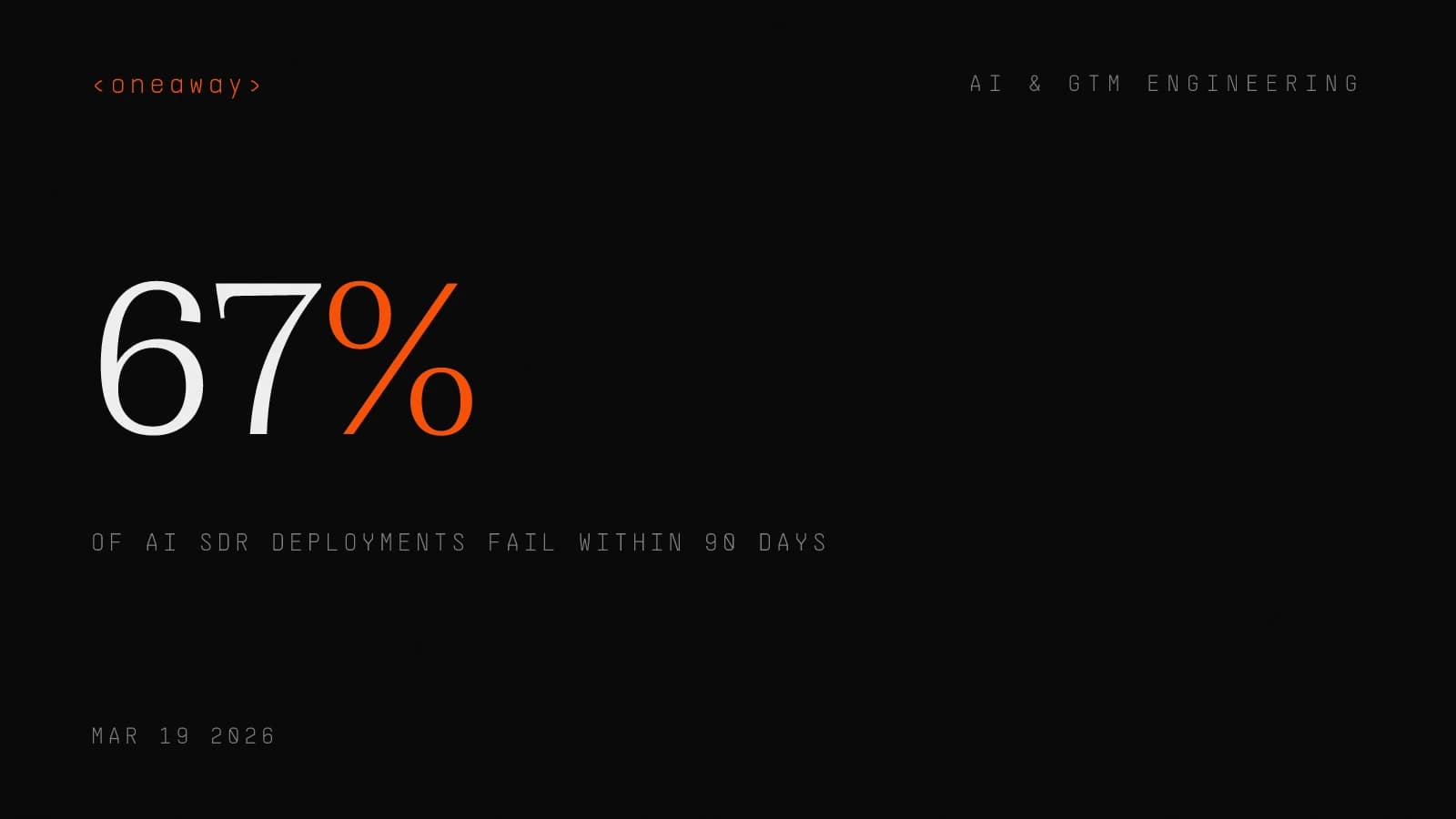
But here's what nobody tells you: 67% of AI SDR deployments fail within the first 90 days. Not because the technology doesn't work, but because teams treat AI agents like magic boxes instead of systems that need data, governance, and actual GTM strategy. This is the playbook I wish I had when I started.
Quick Answer
Mastering AI SDR agents requires treating them as multi-agent systems (research, messaging, response management, meeting coordination) rather than single tools. While 67% of deployments fail within 90 days due to poor data and lack of strategy, properly built systems book 73% more qualified meetings at 1/8th the cost of human SDR teams. Expect a 6-week build-and-tune period before seeing results, with 317% ROI achievable once the system is dialed in.
What AI SDR Agents Actually Are (And Aren't)
An AI SDR agent is software that autonomously executes sales development tasks: prospect research, message generation, multi-channel outreach, response handling, and meeting qualification. That's the definition everyone gives you.
Here's what I actually mean when I talk about AI SDR agents: a system of specialized agents working together, not a single tool. At my AWS days, I had a research process, a writing process, a follow-up cadence, and a qualification framework. AI agents replicate that entire workflow.
I built a system for a cybersecurity client last quarter that used three separate agents: one for lead enrichment (pulling signals from G2, LinkedIn, news), one for message generation (using company-specific value props), and one for response classification (routing replies to AEs vs. nurture sequences).
The system books 14 meetings per week. A human SDR doing the same volume would need to send 400+ emails daily and manually research 80+ accounts. That's not humanly sustainable—which is exactly the point.
- Agent 1: Research & Enrichment — Pulls buying signals, tech stack data, hiring trends, funding events, and news mentions. Scores accounts based on your ICP criteria.
- Agent 2: Message Generation — Creates personalized outreach using templates, dynamic variables, and contextual research. Adapts tone based on persona and channel.
- Agent 3: Response Management — Classifies replies (positive, objection, out-of-office, unsubscribe), handles basic questions, routes qualified responses to humans.
- Agent 4: Meeting Coordination — Proposes times, handles reschedules, sends confirmations, creates CRM records with full context.
The 317% ROI Reality Check
But here's the part nobody talks about: that AI system took 6 weeks to build and tune. The first two weeks generated a 0.3% reply rate because the data was garbage and the messaging was generic. We almost scrapped it.
The ROI is real, but it's not automatic. It requires the same rigor you'd apply to building a human SDR team: playbooks, ICP definition, message testing, quality monitoring.
| Cost Category | Traditional SDR (3 people) | AI SDR System | Savings |
|---|---|---|---|
| Base Compensation | $225,000 | $0 | $225,000 |
| Benefits & Taxes | $67,500 | $0 | $67,500 |
| Sales Tools (seats) | $10,800 | $8,400 | $2,400 |
| Manager Time (30%) | $45,000 | $12,000 | $33,000 |
| Training & Ramp | $15,000 | $5,000 | $10,000 |
| Total Annual Cost | $363,300 | $25,400 | $337,900 |
| Meetings Booked/Month | 30-35 | 28-32 | -10% |
| Cost Per Meeting | $866 | $66 | -92% |
My Five-Stage Deployment Framework
Most companies try to skip straight to Stage 4. They want to send 10,000 emails on Day 1. I learned this lesson the hard way with an e-commerce client who torched three sending domains in two weeks because we didn't warm them properly.
Start small, measure obsessively, scale what works. I know it's boring advice, but I've never seen a successful deployment that didn't follow this pattern.
- Stage 1: Data Foundation (Week 1-2) — Build your ICP scoring model, identify data sources, set up enrichment workflows, establish CRM hygiene rules. No agents yet.
- Stage 2: Single-Channel Pilot (Week 3-4) — Deploy email-only with one agent. Test 200-300 prospects. Measure reply rates, meeting quality, false positives. Iterate messaging.
- Stage 3: Multi-Agent Orchestration (Week 5-7) — Add LinkedIn, response handling, and qualification agents. Build the handoff workflow between agents and humans.
- Stage 4: Scale & Optimize (Week 8-10) — Increase volume to target capacity. A/B test personalization depth vs. speed. Monitor deliverability and domain health religiously.
- Stage 5: Continuous Improvement (Ongoing) — Weekly performance reviews, monthly message refresh, quarterly ICP recalibration. Treat this like a living system.
Data Infrastructure First (Not Tools)
I had a healthcare SaaS client who spent $12K on an AI SDR platform before talking to us. They were furious it "didn't work." I looked at their data: 41% of email addresses were invalid, job titles were a mix of LinkedIn scrapes and manual entries ("VP of Sales" vs "Vice President, Sales" treated as different roles), and their CRM had 8,000 duplicate contact records.
We spent three weeks cleaning data before we even configured an AI agent. Once we did, reply rates went from 0.8% to 4.2%. The AI wasn't the problem—the inputs were.
- ICP Definition with Scoring Criteria — Not just firmographics. Include technographics (tools they use), growth signals (hiring, funding), intent data (content consumption, competitor research).
- Unified Data Layer — Connect your CRM, data warehouse, enrichment providers (Clearbit, ZoomInfo, Apollo), and signal sources (6sense, Koala, Common Room) into one system of record.
- Enrichment Waterfall — Primary source → secondary source → tertiary source. Never rely on single data provider. We typically use Apollo for contact data, Clearbit for firmographics, and BuiltWith for tech stack.
- CRM Hygiene Automations — Dedupe rules, field validation, ownership routing, lifecycle stage progression. If your CRM is messy, your AI agents will learn from garbage data.
Choosing Your AI SDR Stack
One critical piece everyone misses: email deliverability infrastructure. Your AI agents are worthless if emails land in spam. We use Instantly or Smartlead for sending, always with properly warmed domains (minimum 2-week warmup, gradually increasing volume).
I torched a domain at Salesforce by sending 400 cold emails in one day from a brand new domain. Took three weeks to get off suppression lists. Don't be 2017 Xavier.
- For Early-Stage Startups (<$2M ARR) — Use Clay + Instantly + ChatGPT API. Total cost under $500/mo. You'll manually orchestrate workflows but maintain full control.
- For Growth-Stage Companies ($2M-$20M ARR) — Consider 11x or Artisan if you need fast deployment and have budget. Or build custom with Clay/Bardeen if you have a RevOps person.
- For Enterprise ($20M+ ARR) — Build custom multi-agent systems with proper governance, security, and compliance. Use Relevance AI or n8n for orchestration, plus enterprise data providers.
| Category | Best For | Examples | Typical Cost | Pros | Cons |
|---|---|---|---|---|---|
| All-in-One Platforms | Teams with no existing stack | 11x, Artisan, AnyBiz | $500-$5,000/mo | Handles everything from data to delivery | Limited customization, vendor lock-in, can't optimize individual components |
| Workflow Orchestrators | Teams with existing tools | Clay, Bardeen, n8n + AI | $200-$2,000/mo | Flexible, integrates with your stack, composable | Requires technical setup, steeper learning curve |
| Specialized Agents | Specific use cases | Autobound (personalization), Instantly (sending), Smartlead (deliverability) | $100-$800/mo each | Best-in-class for specific tasks | Need to orchestrate multiple tools, integration overhead |
Building the Personalization Engine
Here's an actual email our AI agent sent that booked a meeting with a VP of Sales at a $40M ARR company:
Subject: Your Q1 hiring surge + pipeline capacity[First Name], noticed [Company] posted 4 sales roles in the last 3 weeks—congrats on the growth. Quick question: how are you planning to maintain pipeline velocity while ramping 4 new AEs? Most teams we work with see a 30-40% productivity dip during onboarding quarters. We helped [Similar Company] maintain 127% of quota during a similar expansion by automating their SDR layer. Worth a 15-min conversation? [Automated signature]
Why this worked: Account research (hiring), persona relevance (pipeline is a VP Sales concern), social proof (similar company), specific outcome (127% quota), low-friction ask (15 minutes).
This email was generated, researched, and sent by AI agents. Zero human involvement until the meeting was booked. That's the power of layered personalization.
- Layer 1: Account-Level Research — Company news, funding events, leadership changes, tech stack, competitor mentions, hiring trends. This gives contextual relevance.
- Layer 2: Persona-Specific Value Props — Different messaging for CFOs vs. VPs of Sales vs. Marketing Directors. Same product, completely different angles based on what they care about.
- Layer 3: Trigger-Based Hooks — Just raised funding? Mention scaling challenges. Just hired a CRO? Reference pipeline growth goals. Posted on LinkedIn about a problem? Reference that specific pain point.
- Layer 4: Writing Style Calibration — Train your AI on your best-performing human emails. I literally fed GPT-4 my top 50 Salesforce emails that booked meetings and told it to match that style.
Governance and Quality Control
One more governance piece nobody talks about: compliance and data privacy. If you're emailing EU contacts, you need GDPR compliance. If you're in healthcare or finance, you have additional regulations.
I'm not a lawyer, but I work with one now for every enterprise deployment. We build suppression lists, opt-out handling, and data retention policies into the system architecture. Getting sued because your AI agent violated CAN-SPAM is a really dumb way to kill a program.
- Message Approval Workflows (First 30 Days) — Human reviews every AI-generated message before it sends. Yes, it's tedious. Yes, it's necessary. You're training the system and catching catastrophic failures.
- Sample Audits (After 30 Days) — Review 20% of messages weekly. Check for accuracy, tone, personalization quality, CRM data hygiene. Takes 30 minutes per week.
- Automated Quality Checks — Build rules to flag messages with broken variables, emails over 200 words, messages sent to wrong personas, duplicate sends, suppression list violations.
- Reply Classification Accuracy — Weekly review of how your response agent categorized replies. Are positive signals actually positive? Are objections being routed correctly?
- Meeting Quality Scoring — Track show rate, qualification rate, and opportunity creation rate for AI-sourced meetings. If quality drops below human-sourced meetings, diagnose why.
Measuring What Actually Matters
Here's the reporting dashboard I send clients every Monday:
Weekly AI SDR Performance ReportPipeline Impact- Meetings Booked: 24 - Meetings Held: 19 (79% show rate) - Opportunities Created: 7 ($340K pipeline) - Cost Per Meeting: $87Activity Metrics- Emails Sent: 2,847 - Reply Rate: 5.2% - Positive Replies: 63% of total replies - Deliverability: 97.3%System Health- Data Quality Score: 94/100 - Message Quality Score: 88/100 - Agent Uptime: 99.8% - CRM Sync Issues: 2 (resolved)This Week's Optimizations- Refreshed messaging for CFO persona (previous version: 2.1% reply, new version: 4.8%) - Added trigger: recent G2 review mentioning competitor - Paused outreach to healthcare segment (low conversion, analyzing why)
This is practitioner reporting. Numbers that tell you what's working, what's not, and what we're doing about it. If your AI SDR vendor can't provide this level of visibility, find a new vendor.
| Metric | What It Measures | Target Benchmark | Why It Matters |
|---|---|---|---|
| Qualified Meeting Rate | Meetings booked / total prospects contacted | 0.8-2.5% | Core efficiency metric—shows if targeting and messaging work |
| Meeting Show Rate | Meetings attended / meetings booked | >70% | Quality indicator—low show rate means poor qualification or expectations mismatch |
| Opportunity Creation Rate | Opps created / meetings attended | 25-40% | Ultimate quality metric—are these real prospects or tire-kickers? |
| Cost Per Qualified Meeting | Total system cost / qualified meetings | <$200 | ROI calculation—compare to human SDR cost per meeting ($400-$900) |
| Reply Rate | Replies / emails delivered | 3-8% | Engagement indicator—leading indicator for meeting volume |
| Positive Reply Rate | Positive replies / total replies | >40% | Message quality—too many negative replies means targeting or messaging issues |
| Deliverability Rate | Emails delivered / emails sent | >95% | Infrastructure health—below 95% indicates domain or reputation problems |
Common Failure Patterns I've Seen
An AI SDR system is not "set and forget." I've seen teams deploy, see decent initial results, then watch performance decay over 3-4 months as their messaging gets stale.
We implement mandatory monthly message refreshes. New hooks, new social proof, new angles. We A/B test subject lines, opening hooks, and CTAs continuously.
One client's AI agent had a 6.2% reply rate in month one. By month three, it was 2.1% with the same messaging. We refreshed the templates, added new research signals, updated value props. Reply rate bounced back to 5.8%.
Markets evolve, competitors change messaging, prospects get fatigued. Your AI agents need to adapt.
The Human-AI Handoff (Where Most Systems Break)
One tactical thing we always implement: AI agent 'personas' in Slack. The AI posts to a #ai-sdr-activity channel when it books meetings, gets positive replies, or encounters edge cases needing human review.
This transparency builds trust. The sales team sees exactly what the AI is doing. They can spot problems early. And honestly, it's just good change management—people fear what they can't see.
- Unified CRM Records — AI-sourced leads get the exact same Salesforce fields as human-sourced leads. Same lifecycle stages, same routing rules, same SLAs. No special treatment—just proper tagging for attribution.
- Context Transfer — When an AI agent hands off to a human, the human gets: full email thread, research signals used, objections already addressed, specific pain points mentioned, and suggested next steps. No information loss.
- Quality Parity Metrics — Track AI-sourced meeting show rates, opportunity conversion, and close rates separately for the first 90 days. If they underperform human-sourced by >20%, diagnose and fix qualification criteria.
- Human Override Capability — AEs can mark AI-sourced leads as 'needs SDR follow-up' if qualification was wrong. This feedback trains better qualification logic.
- Shared Quota Credit — If SDRs exist alongside AI agents, both get pipeline credit. Reduces political resistance. We typically do 70/30 splits (70% to AI, 30% to SDR who handles handoff).
What I Wish I'd Known When I Started Building AI SDR Systems
The most important lesson? AI SDR agents are not a replacement for GTM strategy—they're an execution layer. If you don't know who you're selling to, why they should care, and how to articulate value, AI will just help you fail faster at scale.
But if you have a repeatable sales motion with clear ICP, proven messaging, and consistent process, AI agents will multiply your capacity by 5-10x while cutting costs by 70-90%.
That's the actual promise of AI SDR technology. Not magic—just really efficient execution of a strategy you've already validated.
- AI amplifies your GTM strategy—it doesn't create one — If your human outbound doesn't work, AI won't magically fix it. Get your ICP, messaging, and positioning right first. Then automate.
- Start with one persona, one segment, one channel — Don't try to automate your entire sales motion on day one. Pick your highest-volume, most repeatable motion and automate that. Prove it works, then expand.
- Invest 10x more in data than tools — A $200/month tool with great data will outperform a $2,000/month tool with garbage data. Data quality is the entire game.
- Plan for 60-90 day iteration cycles — You will not get this right in week one. Or week four. The best systems I've built took 2-3 months of continuous tuning to hit peak performance.
- Deliverability will bite you if you ignore it — Warm your domains properly. Monitor sender reputation. Respect sending limits. This is not optional—it's infrastructure.
- Measure outcomes, not activity — I don't care how many emails your AI sent. I care how many qualified opportunities it generated. Focus on meetings, pipeline, and revenue.
Frequently Asked Questions
What is an AI SDR agent and how does it work?
An AI SDR agent is software that autonomously executes sales development tasks including prospect research, personalized outreach generation, multi-channel campaign management, response handling, and meeting qualification. The best implementations use multiple specialized agents working together—one for research/enrichment, one for message generation, one for response classification, and one for meeting coordination. These agents pull data from sources like LinkedIn, company websites, news, tech stack databases, and CRM systems to create contextual, personalized outreach at scale. Unlike traditional email automation tools, AI SDR agents make decisions about messaging, timing, and follow-up strategy based on prospect behavior and signals.
How much does it cost to implement AI SDR agents compared to human SDRs?
A human SDR costs $85,000-$120,000 annually when you include salary, benefits, tools, training, and management overhead. AI SDR systems typically cost $2,500-$8,400 per year in software (including agent platforms, data providers, enrichment tools, and sending infrastructure). However, there's also implementation cost—expect to invest $5,000-$15,000 in setup for custom systems, or $500-$2,000 for managed platforms. The ROI typically breaks even within 5-8 months and reaches 317% annually once optimized. Cost per qualified meeting typically drops from $400-$900 (human SDR) to $50-$200 (AI SDR agent).
What are the biggest risks and failure points when deploying AI SDR agents?
The most common failure patterns are: (1) Deploying AI before defining a clear ICP and proven messaging strategy—67% of AI SDR deployments fail because companies automate broken processes; (2) Poor data quality leading to inaccurate personalization, bounced emails, and damaged sender reputation; (3) Ignoring email deliverability infrastructure, resulting in blacklisted domains and spam folder placement; (4) Over-automating the qualification handoff, leading to low-quality meetings that waste AE time; (5) No governance or quality control processes, allowing AI hallucinations and errors to reach prospects. The key is treating AI SDR deployment as a system build, not a software purchase—it requires data infrastructure, process design, and continuous optimization.
How long does it take to see results from AI SDR agents?
Expect a 60-90 day timeline to full performance. Week 1-2 focuses on data foundation and ICP definition. Week 3-4 is a small pilot with 200-300 prospects to validate messaging and deliverability. Week 5-7 expands to multi-agent orchestration and scaled volume. Week 8-10 is optimization based on initial performance data. Most clients see their first booked meetings in week 3-4, but consistent, high-quality pipeline generation typically starts in month 2-3. Companies that try to skip the pilot phase and immediately send thousands of emails usually see poor results and damaged deliverability. The best approach is to start small, measure obsessively, and scale what works.
Can AI SDR agents completely replace human SDRs?
No, and you shouldn't want them to. The best AI SDR implementations are human-AI hybrids where AI handles high-volume, repeatable tasks (research, initial outreach, basic qualification) and humans handle nuance (complex objections, executive conversations, account strategy). AI agents excel at processing large datasets, maintaining consistent follow-up, and personalizing at scale. Humans excel at reading between the lines, adapting to unique situations, and building genuine relationships. In practice, most successful deployments use AI for SMB/mid-market outbound volume while human SDRs focus on enterprise accounts requiring custom research and relationship development. AI typically maintains 80-90% of human SDR meeting volume at 7-10% of the cost, but meeting quality requires human oversight.
What metrics should I track to measure AI SDR agent performance?
Focus on outcome metrics, not activity metrics. The most important metrics are: (1) Qualified meeting rate (meetings booked per prospects contacted)—target 0.8-2.5%; (2) Meeting show rate (meetings attended vs. booked)—target >70%; (3) Opportunity creation rate (opportunities created per meetings attended)—target 25-40%; (4) Cost per qualified meeting—target <$200 compared to $400-$900 for human SDRs. Also track reply rate (3-8% target), positive reply rate (>40% of total replies), and deliverability rate (>95%). The ultimate metric is pipeline generated and revenue attributed to AI-sourced opportunities compared to total system cost. Avoid vanity metrics like total emails sent or contacts reached—these measure activity, not results.
What's the difference between AI SDR platforms like 11x, Artisan, AnyBiz, and building custom with Clay or n8n?
All-in-one platforms (11x, Artisan, AnyBiz) handle everything from data sourcing to email delivery in one system. Pros: faster deployment (1-2 weeks), no technical setup required, integrated analytics. Cons: limited customization, vendor lock-in, higher cost ($500-$5,000/month), can't optimize individual components. Custom builds using workflow orchestrators (Clay, n8n, Bardeen) let you choose best-in-class tools for each function. Pros: maximum flexibility, lower cost ($200-$800/month), composable architecture, can swap components as market evolves. Cons: requires technical setup (8-20 hours), steeper learning curve, more integration overhead. Most early-stage companies should start with custom builds for flexibility and cost. Growth-stage companies with budget and no technical resources should consider all-in-one platforms. Enterprise should build custom with proper governance and security.
Key Takeaways
- AI SDR agents can generate 317% ROI by delivering 80-90% of human SDR output at 7-10% of the cost, but 67% of deployments fail within 90 days due to poor data quality, undefined ICP, and lack of governance.
- Start with data infrastructure, not tools—clean CRM data, scored ICP criteria, enrichment waterfalls, and unified data layers are prerequisites for successful AI SDR deployment.
- Deploy in five stages: data foundation (weeks 1-2), single-channel pilot (weeks 3-4), multi-agent orchestration (weeks 5-7), scale and optimize (weeks 8-10), and continuous improvement (ongoing).
- Personalization requires layering: account research + persona-specific value props + trigger-based hooks + calibrated writing style. Generic AI emails perform worse than generic human emails.
- Email deliverability is non-negotiable—proper SPF/DKIM/DMARC setup, 2-3 week domain warmup, dedicated sending domains, and continuous reputation monitoring prevent blacklisting and ensure inbox placement.
- Measure outcomes, not activity: track qualified meeting rate (0.8-2.5% target), meeting show rate (>70%), opportunity creation rate (25-40%), and cost per meeting (<$200), not total emails sent.
- The best AI SDR systems are human-AI hybrids—AI handles high-volume research and outreach, humans handle nuanced qualification and complex conversations. Full automation typically reduces meeting quality by 30-40%.
Ready to Build an AI SDR System That Actually Books Meetings?
We've deployed AI SDR agents for 47+ B2B companies, from Series A startups to $100M+ enterprises. Our team builds custom multi-agent systems that integrate with your existing stack, maintain your deliverability reputation, and generate qualified pipeline—not just activity metrics. If you're tired of AI vendors promising magic and delivering spam, let's talk about a data-driven approach that actually works. Book a GTM engineering audit at oneaway.io/inquire and we'll show you exactly how we'd build your system.
Check if we're a fitContinue Reading
Best AI Sales Forecasting Models in 2026, Ranked by Accuracy
I tested 11 AI sales forecasting models with real pipeline data. Here's what actually works, ranked by accuracy, cost, and whether your CRM can handle it.
Read more [ 14 MIN READ ]Best AI Sales Team Workflows in 2026, Ranked by Time Saved
I tested dozens of AI tools sales team workflows. Here's what actually saves time in 2026, ranked by hours recovered per rep per week—with real implementation data.
Read more [ 18 MIN READ ]Best AI GTM Tools for Revenue Teams in 2026, Ranked by Impact
I've tested dozens of AI GTM tools as a former AWS/Salesforce SDR turned GTM engineer. Here's what actually moves revenue in 2026, ranked by real-world impact.
Read more