B2B Pipeline Generation Mistakes That Kill Your Pipeline

I spent two years at Salesforce watching supposedly smart pipeline generation strategies produce absolutely nothing. We had all the tools, all the budget, and a brand that could open any door. Yet month after month, I watched SDR teams scramble to hit quota while leadership kept demanding "more activity."
The problem wasn't effort. It was that we were optimizing for metrics that had zero correlation with actual pipeline velocity. We celebrated MQLs that sales never touched. We tracked activity metrics that looked impressive in dashboards but produced terrible conversion rates. We ran campaigns that generated hundreds of leads and maybe two qualified opportunities.
Now I run a GTM engineering agency, and I see the same mistakes everywhere. The difference is that in 2026, these mistakes don't just waste budget—they actively kill your pipeline because buyers have fundamentally changed how they research and buy. Here's what's actually destroying your B2B pipeline generation efforts, and what we're doing instead with clients who are actually hitting their numbers.
Mistake #1: Optimizing for Lead Volume Instead of Pipeline Quality
This is the original sin of B2B pipeline generation. I saw it at AWS, I saw it at Salesforce, and I see it with almost every new client who comes to us wondering why their pipeline is anemic despite "thousands of leads."
Here's what it looked like at Salesforce: Marketing would run a webinar and celebrate 500 registrants. They'd pass 300 "MQLs" to sales based purely on attendance and job title. My team would attempt to follow up, and maybe 15 people would respond. Of those, perhaps 2 were actually in-market and had budget.
The conversion rate from MQL to opportunity was under 2%. But marketing kept getting congratulated for "lead generation" while sales kept missing quota.
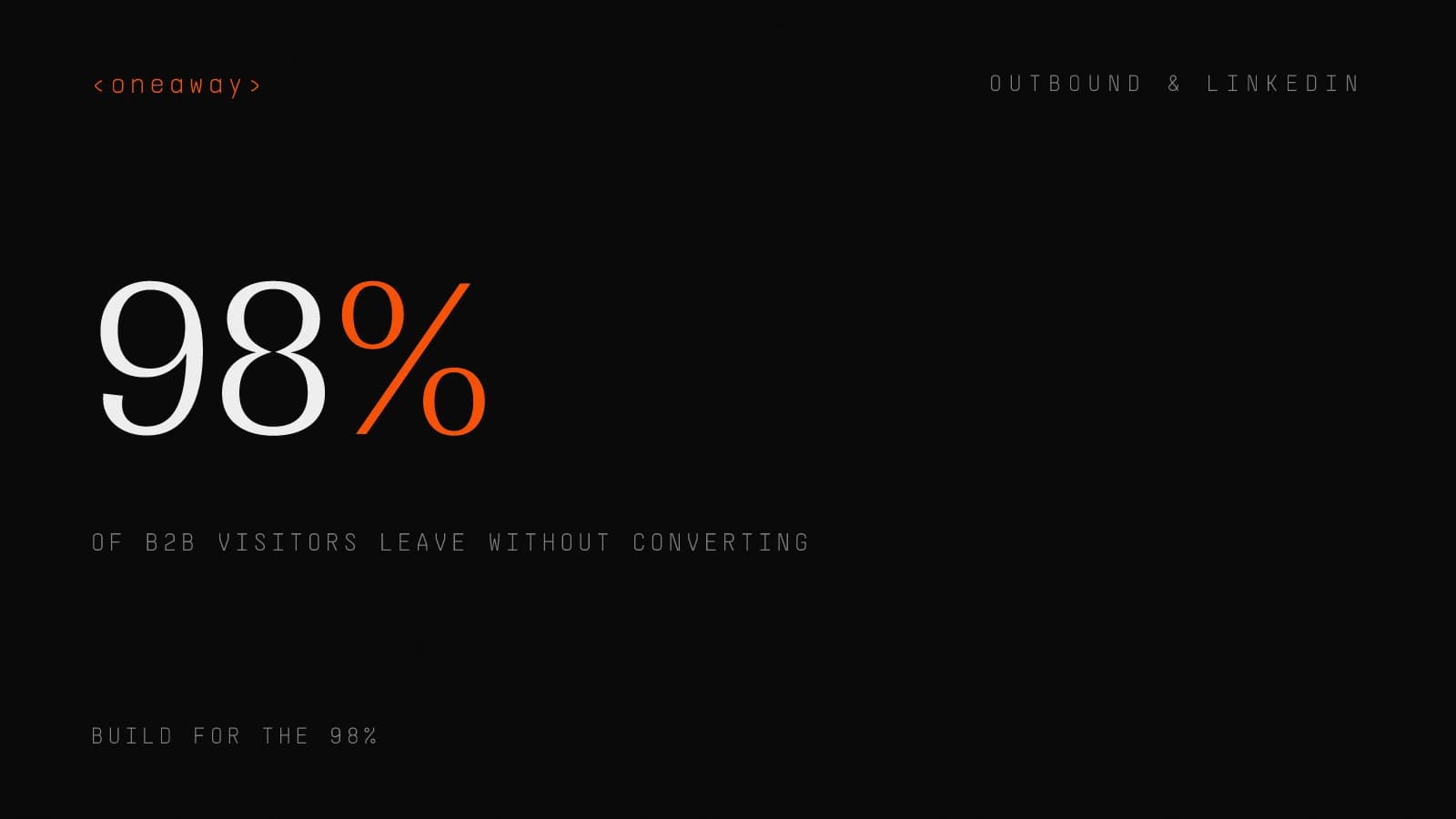
The fundamental problem: 98% of B2B website visitors leave without converting. That's not a conversion problem—that's a strategy problem. You're optimizing to capture the 2% who are ready to talk right now, while completely ignoring the 98% who are researching, learning, and forming opinions about your category.
- What we do instead: — We architect demand generation strategy around pipeline quality metrics, not lead volume. For a Series B SaaS client, we killed their lead gen forms entirely and built a content strategy that positioned them as category experts. Result: 67% fewer "leads" but 340% more qualified pipeline in 90 days.
- The measurement shift: — Track MQL-to-opportunity conversion rate and average deal size from different sources. If a channel produces 1,000 MQLs but converts at 0.5%, it's worse than a channel producing 50 leads at 15% conversion.
- The execution change: — Build for the 98%. Ungated content, thought leadership, actual insights buyers can use whether they buy from you or not. The 2% who are ready will raise their hand, and they'll be far more qualified.
Mistake #2: Gating Everything (While Your Competitors Don't)
The buyers who are serious don't need to be gated—they need to be educated and convinced. The ones who weren't serious were giving you garbage data anyway.
- We ungated it completely. — Downloads jumped to 1,400/month. We added a simple "Want help implementing this?" CTA at the end with a Calendly link.
- The results after 60 days: — 47 qualified meetings booked directly from the guide. 12 became opportunities. 4 closed within 90 days for $160K in pipeline.
- The conversion math: — The old gated version: 200 downloads × 2.5% SQL rate × 20% opportunity rate = 1 opportunity/month. The new ungated version: 1,400 reads × 3.4% direct booking rate × 25% opportunity rate = 12 opportunities/month.
Mistake #3: Spray-and-Pray Outbound That Destroys Your Brand
You don't have a volume problem. You have a relevance problem. And in 2026, relevance beats volume every single time.
- The data that should scare you: — 79% of B2B decision-makers actively ignore cold DMs and emails in 2026. Your spray-and-pray outbound isn't just ineffective—it's actively burning the market for when you actually have something relevant to say.
- What actually works: — Trigger-based outbound with genuine research. We built a system for a client that monitors 500 target accounts for hiring triggers, funding announcements, tech stack changes, and leadership moves. When a trigger fires, a human does 10 minutes of research and sends one highly contextualized email.
- The math that matters: — Old approach: 10,000 emails/month, 1.2% reply rate, 0.3% meeting rate = 30 meetings, mostly tire-kickers. New approach: 200 trigger-based emails/month, 18% reply rate, 8% meeting rate = 16 meetings, 75% qualified.
Mistake #4: Ignoring Pipeline Velocity Metrics
We rebuilt their qualified meeting booking process around three questions: Do they have the problem? Do they have budget? Is there a timeline? If the answer to any question was unclear, we didn't book the demo—we sent them to nurture content.
Results after one quarter: Pipeline generation dropped 35%. Pipeline velocity increased 127%. Deals that entered the pipeline closed 2.3x faster and at a 41% higher close rate. Revenue increased 28%.
- Average time in each stage: — Discovery to Demo: 23 days. Demo to Proposal: 31 days. Proposal to Closed: 47 days. Total sales cycle: 101 days on average.
- The velocity problem: — Only 18% of their pipeline was moving at the expected pace. 52% was stalled in Demo to Proposal for 45+ days. Another 30% had been in Proposal for 60+ days with no next steps.
- The root cause: — They were booking demos with anyone who'd take the meeting. No qualification, no discovery, no validation that the prospect had an actual problem, budget, or timeline. Sales was spending 80% of their time on deals that would never close.
| Metric | Before | After | Change |
|---|---|---|---|
| New pipeline/quarter | $2.3M | $1.5M | -35% |
| Avg. sales cycle | 101 days | 44 days | -56% |
| Close rate | 22% | 31% | +41% |
| Revenue/quarter | $506K | $648K | +28% |
Mistake #5: Treating Demos as Success Metrics
Stop celebrating activity. Start measuring outcomes. The goal isn't to fill your sales team's calendar—it's to fill it with people who can actually buy.
- The metric we use instead: — Qualified opportunity creation rate. We don't care about meetings booked. We care about meetings that advance to the next stage within 14 days and eventually become real opportunities with budget and timeline.
- How we changed the incentive structure: — For a client's SDR team, we shifted comp from "meetings booked" to "opportunities created + 90-day close rate." If an SDR's opportunities closed at high rates, they got accelerators. If their opportunities stalled or were marked unqualified, they got coaching.
- The immediate behavior change: — SDRs started asking harder questions before booking. They started disqualifying aggressively. They started sending prospects to content instead of forcing a demo. Meetings booked dropped 40%. Pipeline created increased 67%. Close rates jumped from 19% to 34%.
Mistake #6: No Buying Committee Strategy
The tool included ROI calculations, implementation timelines, and risk mitigation frameworks—everything the other stakeholders needed to evaluate the purchase. It was ungated, shareable, and designed to bring the full buying committee into the conversation early.
Results: Average stakeholder engagement increased from 2.1 to 4.8 within the first 30 days of pipeline creation. Sales cycles decreased by 34%. Close rates increased from 23% to 39%.
- Deals with 4+ engaged stakeholders by day 30: — Closed in 61 days on average with a 47% close rate.
- Deals with only 1-2 engaged stakeholders by day 30: — Took 127 days on average with an 18% close rate. Most stalled when the champion tried to sell internally and couldn't answer questions.
- The strategy shift: — We rebuilt their demand generation strategy around buying committee activation. Instead of gating a whitepaper to capture one contact, we created a "Business Case Builder" tool that prospects could share internally with their CFO, IT, and operations teams.
Mistake #7: Running Campaigns in Silos
We implemented what we call a "narrative-driven pipeline architecture." One core narrative about the market problem and your unique insight. Every campaign, every piece of content, every outbound message, every demo ladders up to that narrative.
For this client, the narrative was: "Sales teams are drowning in tools, but deals still stall because they can't collaborate cross-functionally." Every initiative reinforced this narrative from a different angle.
Within 90 days: Message consistency scores (measured through buyer interviews) increased from 34% to 81%. Pipeline velocity increased 67%. Deal sizes increased 23% because prospects understood the full value prop instead of just one feature.
- The webinar team: — Running monthly events on different topics with no consideration for what sales was hearing in conversations.
- The content team: — Publishing blog posts based on keyword research with no connection to actual buyer questions or pipeline stage.
- The SDR team: — Sending sequences based on persona and industry with no awareness of what content prospects had consumed.
- The AE team: — Building custom decks for every deal because no one knew what messaging was actually resonating.
Mistake #8: Wrong Data Infrastructure (Or No Infrastructure at All)
Within 60 days, they'd reallocated $47K/month from channels that looked good but converted poorly to channels that actually drove closed revenue. Pipeline quality increased 89% while marketing spend decreased 15%.
- First-touch attribution only: — Gives all credit to the first interaction, completely ignoring the 6-8 touchpoints that actually convinced the buyer.
- Last-touch attribution only: — Gives all credit to the demo request form, ignoring the webinar, podcast, and three nurture emails that got them there.
- No attribution at all: — Just guessing based on what prospects say in discovery calls (which is notoriously unreliable).
- CRM data quality below 60%: — Missing fields, duplicate records, no standardized values, making any analysis meaningless.
- No pipeline stage timestamps: — Can't calculate velocity metrics or identify where deals are stalling.
| Insight | Before | After |
|---|---|---|
| Time to identify best channels | Quarterly guess | Real-time data |
| Attribution accuracy | ~30% | ~85% |
| Wasted spend identified | $0 | $47K/month |
| Decision-making speed | Weeks | Hours |
What Actually Works: Our Pipeline Generation Framework
This isn't complicated, but it does require discipline. It requires saying no to vanity metrics. It requires marketing and sales actually working together. It requires investing in infrastructure, not just campaigns.
The companies that make these changes don't just see incremental improvements. They see pipeline quality double while costs decrease. They see sales cycles cut in half. They see close rates increase by 40-60%.
That's what's possible when you stop making the mistakes that kill pipeline and start building systems that actually work.
- Build for the 98%, capture the 2%: — Create genuinely useful content that helps buyers whether they buy from you or not. Ungate everything except high-touch resources (assessments, business case builders, ROI calculators). The people who are ready will self-identify.
- Trigger-based outbound, not spray-and-pray: — Monitor your target accounts for signals—hiring, funding, tech changes, leadership moves, expansion. When a signal fires, do real research and send one highly relevant message. 200 relevant emails beat 10,000 generic ones.
- Multi-threading from day one: — Design every campaign to engage multiple stakeholders. If you're targeting sales leaders, create content that helps them sell internally to their CFO, CIO, and ops team. Get the buying committee engaged early.
- Qualify ruthlessly: — Stop optimizing for meetings booked. Optimize for qualified opportunities created. If a prospect doesn't have problem, budget, and timeline, send them to nurture—don't waste sales time.
- Measure what matters: — Track pipeline velocity, not just pipeline volume. Track close rates by source. Track engagement by buying committee member. Track message consistency. Build data infrastructure that tells you what's actually working.
- One narrative, many channels: — Everything you do should reinforce one core narrative about the market and your unique insight. Coordinate across teams so prospects get a consistent, compelling story no matter how they interact with you.
Frequently Asked Questions
Key Takeaways
Frequently Asked Questions
What's the difference between demand generation and pipeline generation?
Demand generation creates awareness and interest in your category and solution—it's top-of-funnel education and thought leadership. Pipeline generation is the systematic conversion of that demand into qualified opportunities with defined budget, timeline, and decision-making process. Most companies focus too much on demand gen (vanity metrics like downloads and webinar attendance) and not enough on actual pipeline generation (qualified opportunities that move toward closed-won). The best B2B pipeline generation strategies integrate both: demand gen that educates and builds authority, paired with conversion systems that identify and qualify buyers who are actually ready to move forward.
How many stakeholders should we engage in enterprise B2B deals?
Based on our analysis of 200+ closed enterprise deals, successful deals involve an average of 6-7 stakeholders across different functions (business owner, finance, IT, legal, operations, executive sponsor). The key metric: deals with 4+ engaged stakeholders by day 30 close 2x faster and at significantly higher rates than deals with only 1-2 contacts. Your demand generation strategy should be designed to activate the entire buying committee, not just capture one champion's contact info. Create shareable assets (ROI calculators, business case templates, implementation roadmaps) that your champion can use to sell internally.
What are the most important outbound pipeline metrics to track?
Stop tracking activity metrics (emails sent, calls made, connection requests). Start tracking outcome metrics: (1) Reply rate to outbound sequences, (2) Meeting-to-qualified-opportunity conversion rate, (3) Time from first touch to opportunity creation, (4) Close rate by outbound source/campaign, (5) Average deal size from outbound vs. other sources. The goal isn't to maximize outbound volume—it's to maximize relevance and conversion. We've seen clients cut outbound volume by 70% while increasing qualified pipeline by 150% simply by targeting better triggers and personalizing better.
Should we still gate content in 2026?
Gate high-value, personalized resources that require interaction (ROI calculators, custom assessments, implementation planners, business case builders)—things where you provide actual customized value in exchange for information. Don't gate educational content (ebooks, guides, webinars, templates) that buyers need to learn and evaluate your category. The math is clear: ungated educational content reaches 5-10x more buyers, builds more authority, and actually produces more qualified pipeline because the people who raise their hand are genuinely interested, not just downloading one more PDF they'll never read.
How do we improve pipeline velocity without just discounting?
Pipeline velocity isn't about closing faster through price cuts—it's about removing friction from the buying process. The highest-impact changes: (1) Engage the full buying committee early so your champion isn't selling alone internally, (2) Create assets that answer common objections before they're raised (security documentation, implementation timelines, customer proof points), (3) Qualify ruthlessly so sales only works deals with real budget and timeline, (4) Standardize your sales narrative so every call builds on the last instead of restarting. We've helped clients cut sales cycles by 40-60% without changing pricing—just by removing the friction that causes deals to stall.
What's a good MQL-to-opportunity conversion rate?
Industry benchmarks vary widely (3-15%), but the real question is whether you're measuring the right thing. We've seen companies with 12% MQL-to-opportunity rates that have terrible pipeline quality (small deals, long cycles, low close rates) and companies with 5% rates that have fantastic pipeline (large deals, fast cycles, high close rates). Instead of optimizing MQL conversion, optimize for qualified pipeline creation. Ask: What percentage of MQLs become real opportunities with budget, timeline, and engaged buying committee? What percentage of those opportunities close, and how quickly? A channel that produces 50 MQLs with 20% opportunity conversion and 40% close rate is infinitely better than one producing 500 MQLs with 8% opportunity conversion and 15% close rate.
How can we better align marketing and sales for pipeline generation?
Stop organizing around handoffs (marketing generates leads, sales works them) and start organizing around outcomes (joint responsibility for qualified pipeline creation and velocity). Tactically: (1) Create shared definitions of qualified opportunities (not just MQLs), (2) Build joint dashboards tracking pipeline creation, velocity, and close rates by source, (3) Hold weekly pipeline review meetings where marketing and sales analyze what's working together, (4) Tie marketing compensation to pipeline quality metrics (opportunity creation, close rates) not just lead volume, (5) Build one unified narrative that both teams use consistently. The best-performing teams we work with don't have marketing and sales organizations—they have revenue teams with specialized functions.
Key Takeaways
- Stop optimizing for lead volume—98% of B2B visitors leave without converting, so build for the 98% with ungated, valuable content and let the 2% who are ready self-identify with higher qualification.
- Pipeline velocity matters more than pipeline volume—a deal that closes in 30 days is worth more than one that takes 180 days. Track time-in-stage and conversion rates by source, not just total pipeline created.
- Engage the full buying committee early—deals with 4+ stakeholders engaged by day 30 close 2x faster at significantly higher rates. Build shareable assets that help your champion sell internally.
- Trigger-based outbound beats spray-and-pray by 10x—200 highly relevant emails sent based on hiring, funding, or tech change signals will produce more qualified pipeline than 10,000 generic cold emails.
- Qualify ruthlessly before booking demos—unqualified meetings waste your best closers' time. If prospects don't have problem, budget, and timeline, send them to nurture content instead of forcing a demo.
- Build real data infrastructure—you can't optimize what you can't measure. Implement multi-touch attribution, track pipeline stage timestamps, and build dashboards showing what actually drives closed revenue, not just pipeline creation.
- One narrative, coordinated execution—stop running disconnected campaigns across channels. Build one compelling narrative about the market and your unique insight, then coordinate every team and campaign around it.
Related Reading
Stop Wasting Budget on Pipeline That Never Closes
We help B2B companies build pipeline generation systems that actually produce qualified opportunities and closed revenue—not just vanity metrics. If you're tired of celebrating MQLs that sales ignores and running campaigns that don't drive real pipeline, let's talk. We'll audit your current pipeline generation approach, identify what's killing your conversion rates, and build you a system that produces predictable, scalable revenue.
Check if we're a fitContinue Reading
Best Cold Calling Scripts for B2B in 2026, Ranked by Connect Rate
The 7 highest-performing cold calling scripts in 2026, ranked by actual connect and conversion data from 200K+ dials. Includes real examples, pricing, and honest pros/cons.
Read more [ 12 MIN READ ]Best LinkedIn Lead Gen Metrics in 2026, Ranked by Revenue Impact
Most LinkedIn metrics are vanity metrics. Here are the 8 LinkedIn lead generation KPIs that actually predict revenue, ranked by pipeline impact and backed by 2026 data.
Read more [ 18 MIN READ ]Best LinkedIn Social Selling Software 2026, Ranked by Signal Quality
I tested 11 LinkedIn social selling tools. Most miss buyer signals entirely. Here's what actually works in 2026, ranked by signal intelligence and real pipeline impact.
Read more