How Top Teams Use B2B Pipeline Generation to Close More Deals

I spent two years at Salesforce watching a bizarre pattern: some SDR teams consistently hit **150% of quota** while others struggled to break 70%. Same product. Same marketing budget. Same lead flow. The difference wasn't effort—it was **how they thought about B2B pipeline generation**.
The underperforming teams treated pipeline like a funnel you dump prospects into and hope for the best. The top performers? They built systematic engines with predictable inputs and outputs. When I moved to AWS and eventually started my own agency, I saw this pattern repeat itself dozens of times.
Here's what I've learned building pipeline systems for B2B companies that actually need to hit their numbers: pipeline generation isn't about volume anymore. It's about engineering a system where every piece—from targeting to qualification to handoff—is optimized for velocity and conversion. Let me show you exactly how the best teams are doing it in 2026.
Why Most B2B Pipeline Generation Actually Fails
At Salesforce, I saw this play out weekly. Our team had a strict qualification framework—BANT plus specific use case alignment. Other teams would book any meeting that breathed. Guess which approach led to 3x higher close rates?
The fundamental issue: most companies confuse activity with progress. They celebrate 100 cold calls made instead of 10 qualified conversations started. Top-performing teams flip this entirely.
- No clear definition of "qualified" — If sales and marketing can't agree on what makes a good opportunity, you're generating noise, not pipeline
- Single-channel dependence — Relying only on paid ads or only on cold email is like having a one-legged stool—it falls over the moment that channel stops working
- Manual qualification at scale — Having SDRs manually research every inbound lead is why your cost per qualified meeting is $800 when it should be $200
- No feedback loop — If you're not tracking which lead sources actually close, you're flying blind on where to invest
Pipeline Generation vs. Lead Generation (They're Not the Same)
The result? Their sales team went from complaining about lead quality to asking for more meetings. Close rate jumped from 12% to 28% in one quarter.
- Tighter ICP definition — We went from "mid-market companies" to "Series A-B SaaS companies with 50-200 employees, selling to enterprises, using Salesforce, with 2+ SDRs on the team"
- Qualification before handoff — SDRs stopped booking meetings with anyone who'd say yes. They started pre-qualifying on budget, timeline, pain, and decision process
- Source attribution that matters — We tracked every opportunity back to its source and killed the channels that generated meetings but not closed-won deals
| Lead Generation | Pipeline Generation |
|---|---|
| Optimizes for volume | Optimizes for quality and velocity |
| Measures MQLs, form fills, downloads | Measures qualified meetings booked and pipeline created |
| Marketing owns it | Marketing and sales co-own it |
| Success = lots of names in CRM | Success = predictable revenue outcomes |
| Typical conversion: 2-5% | Typical conversion: 15-40% |
The Qualified Meeting Booking System That Works
One of my clients implemented this system and their show rate jumped from 62% to 89%. Why? Because prospects who've been properly qualified actually want the meeting. They're not just being polite.
The economic impact is massive. If your AEs are doing 20 meetings per month and your old show rate was 60%, you're getting 12 actual conversations. At 89% show rate with the same 20 bookings, you get 18 conversations—a 50% increase in sales capacity without hiring anyone.
- Pre-meeting qualification checklist — Before an SDR books a meeting, they must confirm: company fits ICP, contact is right level/department, they have the problem you solve, there's urgency or an active initiative, and budget exists
- Two-step booking process — First call/email exchange is discovery. SDR gathers qualification info. Only if qualified does the AE meeting get booked
- Disqualification is celebrated — We literally have a "Fast No" leaderboard. SDRs get points for quickly disqualifying bad fits so AEs don't waste time
- Meeting briefs are mandatory — Every booked meeting includes a brief with qualification details, pain points discovered, competitive intel, and recommended approach
The Only Outbound Pipeline Metrics That Matter
The pipeline impact? They went from $600K/month in new pipeline to $1.8M/month with the same team size. The difference was systematic optimization of what actually matters.
- Qualified meetings booked per SDR per week — Target: 4-6 for outbound-focused SDRs. Below 3 means targeting or messaging is broken. Above 8 usually means quality is suffering
- Show rate — Should be 75%+. Below 70% means qualification is weak or meeting booking process is rushed
- Meeting-to-opportunity conversion — Target: 35-50%. This tells you if SDRs are qualifying properly and AEs are doing their job
- Cost per qualified meeting — Total cost (salary, tools, overhead) divided by qualified meetings. Should be $150-400 depending on deal size
- Pipeline velocity from source — How long does it take from first touch to closed-won? Track by channel. Some sources are faster than others
| Metric | Before System | After 90 Days |
|---|---|---|
| Qualified meetings/SDR/week | 2.8 | 5.4 |
| Show rate | 67% | 84% |
| Meeting-to-opp conversion | 28% | 46% |
| Cost per qualified meeting | $540 | $280 |
| Days from meeting to close | 78 | 52 |
Building a Demand Generation Strategy That Feeds Sales
I worked with a cybersecurity company that was spending $30K/month on content marketing with zero attribution to pipeline. We killed 80% of their content programs and reinvested in three high-intent plays:
Play 1: Target companies that just raised Series A/B funding (they need better security for SOC2 compliance). We built a dedicated landing page, ran LinkedIn ads to their decision-makers, and had SDRs send personalized sequences within 48 hours of funding announcement.
Play 2: Competitor displacement. When prospects visited competitor comparison pages on review sites, we retargeted them with case studies of companies who switched. SDRs followed up with a "switching kit" and migration checklist.
Play 3: Event-triggered outreach. When companies hired a new CISO or Head of Security, we sent them a personalized "first 90 days" guide and offered a free security audit.
Three plays. $30K total spend. Generated $2.4M in pipeline in the first quarter. The key wasn't doing more—it was doing less, better, with tighter sales alignment.
- Start with closed-won analysis — Look at your last 50 closed deals. What channels did they touch? What content did they consume? How long was the sales cycle? This tells you what actually works
- Build account-based plays — Instead of broad campaigns, create plays for specific account segments. Different messaging, different channels, different content for each ICP
- Layer intent signals — Use tools like 6sense, Bombora, or Clearbit to identify accounts actively researching your category. Hit them harder when they're in-market
- Create sales enablement, not just marketing content — Every piece of content should answer the question: "How does this help sales close deals faster?" If it doesn't, kill it
Pipeline Velocity: The Hidden Lever Top Teams Pull
I helped a Series C company cut their average sales cycle from 112 days to 73 days by implementing just two changes:
First, we created a "velocity scorecard" for every opportunity. Green = all stakeholders identified, business case delivered, timeline confirmed. Yellow = missing one. Red = missing two or more. Reps couldn't move deals to the next stage without going green.
Second, we built a standard "decision package" that included: ROI calculator pre-filled with their data, implementation timeline, reference calls with similar customers, and redlined contract with our standard terms. Instead of prospects having to ask for each piece, we gave them everything upfront.
The impact on revenue was stunning. Same close rate. Same deal size. But 39 days faster meant they could close 53% more deals per year with the same sales team. That's the power of optimizing for velocity.
- Qualify harder, earlier — The fastest way to improve velocity is to kill bad opportunities before they clog your pipeline. If there's no budget, no timeline, or no pain, disqualify immediately
- Multi-thread from day one — At AWS, we had a rule: if you're talking to one person, you don't have a deal. Top performers identify 3-5 stakeholders in the first two meetings and engage all of them
- Create urgency with business cases — Don't wait for prospects to calculate ROI. Do it for them. Build a custom business case showing cost of inaction by specific dates
- Reduce decision fatigue — Every additional decision point adds days to the cycle. Package solutions, reduce SKUs for initial purchase, and offer clear "good, better, best" paths
Signal-Based Prospecting (Not Spray and Pray)
I built a signal-based prospecting system for a B2B marketing platform that tripled their outbound response rate from 4% to 12%. Here's how:
We integrated six data sources: LinkedIn Sales Navigator for job changes and hiring, Clearbit for technology install, Bombora for intent topics, their own website for engagement data, Crunchbase for funding, and ZoomInfo for contact data.
Then we created signal-based playbooks. Each signal triggered a specific sequence with relevant messaging. Job change? Send our "first 90 days" playbook. Funding announcement? Congratulate them and share how similar companies used their funding to scale. High intent + website visit? Immediate call from SDR within 4 hours.
The system wasn't magic—it was just relevance at scale. Instead of "Hey, we help marketing teams," it was "I saw you just raised $20M and are hiring 3 demand gen people. Here's how two other Series B companies in your space ramped their teams faster with our platform."
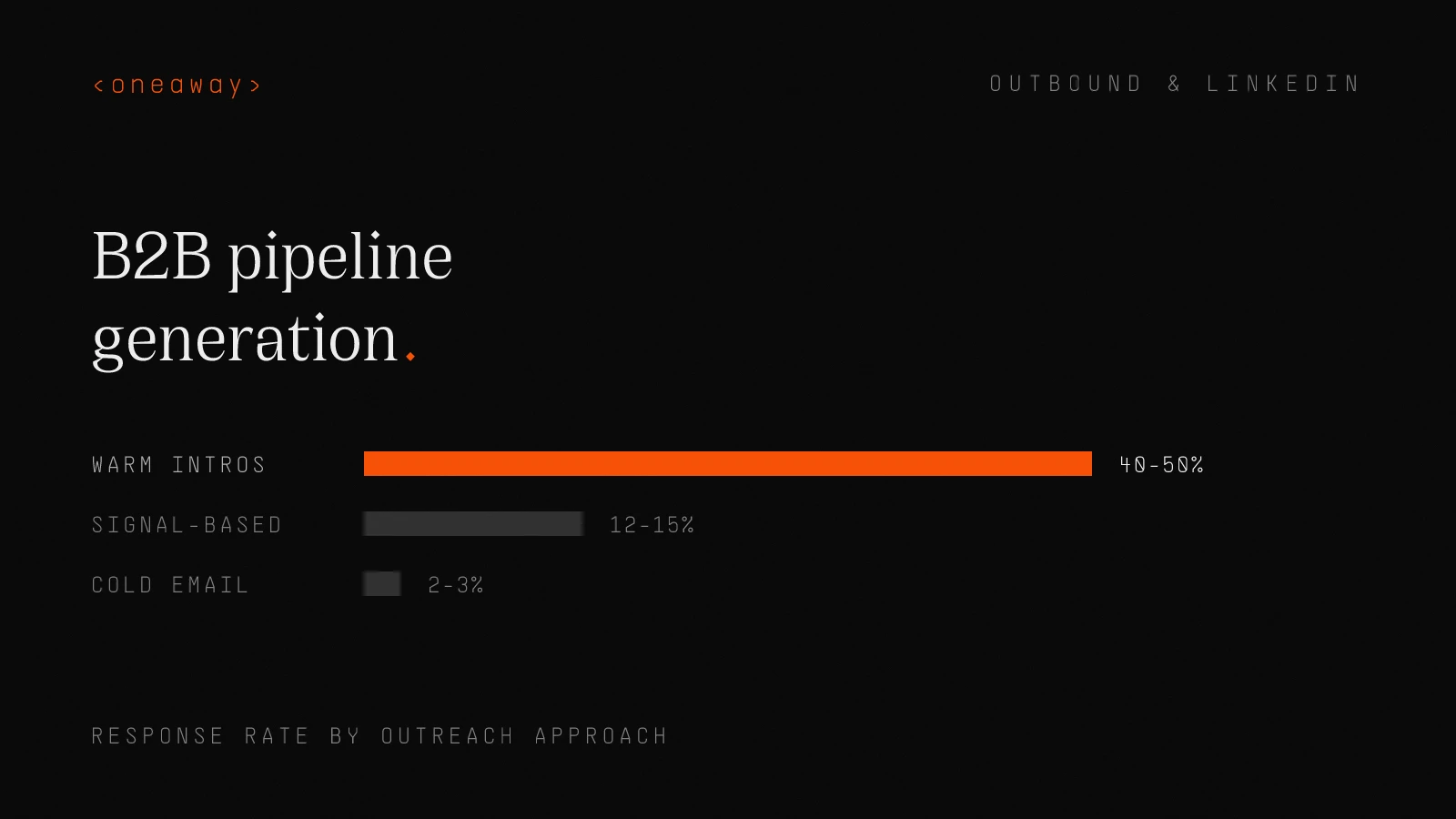
Response rates tell the story. Our average cold email gets 2-3% response. Signal-based emails get 12-15%. Warm introductions based on signals? 40-50%.
- Funding announcements — Companies that just raised money are in buying mode. They have budget and pressure to grow fast
- Hiring signals — When a company posts 3+ jobs in your buyer's department, they're investing in that function. That means budget and need
- Technology install/uninstall — If a prospect just adopted a complementary tool or removed a competitor, you have a clear opening
- Content engagement — Multiple people from the same account downloading your content or attending webinars? That's a buying committee forming
- Intent topic surges — When accounts research your category keywords 3x more than baseline, they're actively evaluating solutions
- Job changes — New executives want to make their mark in the first 90 days. They're more open to new solutions
The GTM Tech Stack for Modern Pipeline Generation
That's it. Six categories. Total cost for a 10-person sales team: $3-5K/month. I've seen teams spend $15K/month on tools and get worse results because nothing talks to anything else.
The key is integration and workflow, not features. At AWS, we had a simple workflow that every tool needed to support:
Step 1: Intent signal triggers account to enter "active" status in Salesforce. Step 2: Data enrichment runs automatically, identifying all decision-makers. Step 3: Outbound sequence launches within 24 hours with personalized messaging. Step 4: All touchpoints log to CRM. Step 5: Meetings automatically create opportunities with pre-filled qualification fields.
If a tool couldn't fit into this workflow, we didn't use it. Period.
The best tech stack decision I made for a client? We eliminated 12 tools they weren't fully using and reinvested that $8K/month into hiring another SDR. That human generated more pipeline than all those tools combined.
| Function | Tool Category | What To Look For |
|---|---|---|
| CRM & Data | Salesforce or HubSpot | Must have: custom objects, API access, workflow automation, and reporting you can actually use |
| Data Enrichment | Clearbit or ZoomInfo | Automatic enrichment on new records, technographics, and intent data integration |
| Intent Signals | 6sense or Bombora | Category-level intent, account surge alerts, and CRM integration |
| Outbound Sequences | Outreach or Salesloft | Multi-channel (email, phone, LinkedIn), A/B testing, and solid deliverability |
| Conversation Intelligence | Gong or Chorus | Call recording, deal intelligence, and coaching insights that actually help reps improve |
| Account Research | Apollo or LinkedIn Sales Nav | Search filters that match your ICP, contact export, and engagement tracking |
Real-World Pipeline Systems That Actually Work
What these three systems have in common: tight ICP focus, signal-based triggering, personalized messaging, and measurement of actual pipeline outcomes. None of them relied on outbound volume or marketing magic. They were engineered systems with predictable inputs and outputs.
Frequently Asked Questions
What's the difference between B2B pipeline generation and lead generation?
Lead generation focuses on filling the top of your funnel with contact information—form fills, downloads, webinar signups. Pipeline generation focuses on creating qualified sales opportunities that have real buying intent, budget, and timeline. Lead generation measures volume (MQLs, SQLs). Pipeline generation measures qualified meetings booked and actual pipeline created. The conversion rates are drastically different: lead gen typically converts 2-5% to opportunities, while well-executed pipeline generation converts 15-40%.
How many qualified meetings should an SDR book per week?
For outbound-focused SDRs, the target is 4-6 qualified meetings per week. Below 3 usually indicates issues with targeting, messaging, or qualification criteria. Above 8 often means quality is suffering—SDRs are booking meetings that won't convert to opportunities. For inbound SDRs handling higher volumes of engaged leads, 8-12 per week is achievable. The key metric isn't just meetings booked—it's the meeting-to-opportunity conversion rate, which should be 35-50%.
What are the most important outbound pipeline metrics to track?
Focus on five core metrics: (1) Qualified meetings booked per SDR per week, (2) Show rate (should be 75%+), (3) Meeting-to-opportunity conversion (target 35-50%), (4) Cost per qualified meeting (typically $150-400 depending on deal size), and (5) Pipeline velocity from source. These metrics tell you if your targeting is right, qualification is working, and whether you're creating pipeline efficiently. Everything else is vanity metrics.
How do you improve pipeline velocity?
Pipeline velocity is calculated as (Number of Opportunities × Average Deal Size × Win Rate) ÷ Sales Cycle Length. Most teams focus on the first three variables, but the biggest lever is reducing sales cycle length. Key tactics: qualify harder and earlier to kill bad opportunities fast, multi-thread by engaging 3-5 stakeholders from day one, create urgency with custom business cases showing cost of inaction, and reduce decision fatigue by packaging solutions and offering clear paths forward. Cutting sales cycle from 90 to 60 days means 50% more deals closed with the same pipeline.
What signals should we track for B2B prospecting in 2026?
The highest-converting signals are: funding announcements (companies just raised have budget and pressure to grow), hiring signals (3+ job posts in your buyer's department means investment and need), technology install/uninstall events, content engagement from multiple people at the same account (buying committee forming), intent topic surges (3x baseline research in your category), and job changes (new executives want wins in first 90 days). Signal-based prospecting typically generates 12-15% response rates vs. 2-3% for generic cold outreach.
What's the ideal GTM tech stack for B2B pipeline generation?
You need six core categories: (1) CRM for data management (Salesforce or HubSpot), (2) Data enrichment for automatic contact/company info (Clearbit or ZoomInfo), (3) Intent signals to identify in-market accounts (6sense or Bombora), (4) Outbound sequences for multi-channel engagement (Outreach or Salesloft), (5) Conversation intelligence for coaching and deal insights (Gong or Chorus), and (6) Account research for targeting (Apollo or LinkedIn Sales Navigator). Total cost for a 10-person team: $3-5K/month. More tools doesn't mean more pipeline—it usually means more chaos.
How do you build a demand generation strategy that actually feeds sales pipeline?
Start by analyzing your last 50 closed deals—what channels did they touch, what content did they consume, how long was the cycle? This tells you what actually works. Then build account-based plays for specific segments rather than broad campaigns. Layer in intent signals to identify accounts actively researching your category. Create sales enablement content, not just marketing content—every asset should answer "How does this help sales close deals faster?" Focus on fewer, better campaigns with tight sales alignment rather than trying to be everywhere.
Key Takeaways
- Pipeline generation is not lead generation—top teams optimize for qualified opportunities with real buying intent, not contact volume. Meeting-to-opportunity conversion should be 35-50%, not 2-5%.
- The five metrics that matter: qualified meetings per SDR per week (target: 4-6), show rate (75%+), meeting-to-opp conversion (35-50%), cost per qualified meeting ($150-400), and pipeline velocity by source.
- Qualification before handoff is non-negotiable—implement a two-step booking process where SDRs confirm ICP fit, decision-maker access, active pain, urgency, and budget before AEs get involved. This alone can increase show rates from 60% to 85%+.
- Pipeline velocity is the hidden lever—reducing sales cycle length from 90 to 60 days means closing 50% more deals with the same pipeline. Qualify harder earlier, multi-thread from day one, and create urgency with business cases.
- Signal-based prospecting beats cold outreach by 5-6x—track funding, hiring, tech changes, content engagement, intent surges, and job changes. Response rates jump from 2-3% to 12-15% when you lead with relevant triggers.
- Your tech stack should enable workflow, not add complexity—six tool categories are enough (CRM, enrichment, intent, sequences, conversation intelligence, research). More tools typically means more chaos, not more pipeline.
- Start with closed-won analysis—before building any demand generation strategy, analyze what channels and content your best customers touched. Kill programs that don't contribute to closed deals and double down on what works.
Related Reading
Ready to Build a Pipeline System That Actually Converts?
Most B2B companies are stuck generating leads that never convert. We build pipeline generation systems—with the right targeting, qualification frameworks, tech integration, and measurement—that create predictable revenue. If you're tired of vanity metrics and want to engineer a system where every dollar and hour invested produces measurable pipeline, let's talk.
Check if we're a fitContinue Reading
The Complete Guide to LinkedIn Outreach Templates in 2026
100,000+ LinkedIn DMs analyzed. Here are the templates, sequences, and honest tactics that actually get replies in 2026—no fluff, just what works.
Read more [ 14 MIN READ ]Best LinkedIn Content Formats 2026, Ranked by Reach
I tested every LinkedIn content format for 90 days. Here's what actually drives out-of-network reach in 2026, ranked by performance data from real campaigns.
Read more [ 14 MIN READ ]Best Cold Calling Scripts for B2B in 2026, Ranked by Connect Rate
The 7 highest-performing cold calling scripts in 2026, ranked by actual connect and conversion data from 200K+ dials. Includes real examples, pricing, and honest pros/cons.
Read more