GTM Engineering Mistakes That Kill Your Pipeline (2026 Guide)

I watched a Series B SaaS company spend **$240K** on a GTM engineer who automated their cold email to perfection. Beautiful Clay tables, flawless Smartlead integration, personalization tokens firing like clockwork. **Response rate dropped 40% in three months.**
The mistake wasn't the automation. It was automating a broken process. They hired a GTM engineer to scale what didn't work manually, and they scaled their way into a dead pipeline.
I made similar mistakes during my time as an SDR at Salesforce. We obsessed over email cadence tools and data enrichment while ignoring that our ICP was completely wrong. The tools worked perfectly. The pipeline died anyway.
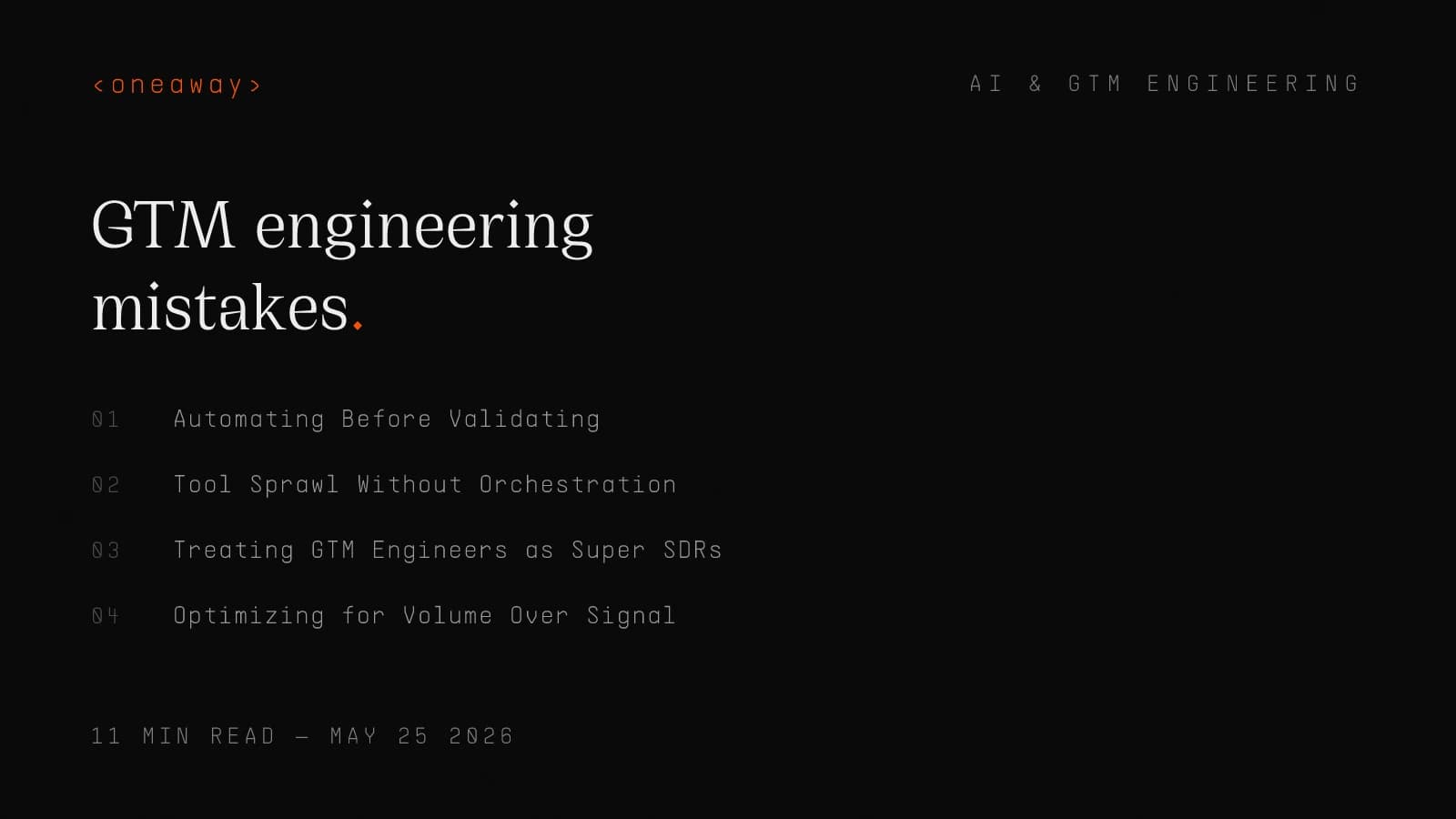
Mistake #1: Automating Before Validating
The company I mentioned earlier had zero validated messaging before they automated. They just scaled unproven hypotheses about their ICP.
At AWS, I learned this the hard way. We built an entire automated sequence targeting CTOs at mid-market companies. 47 emails sent per day, 0.3% reply rate. When I manually tested the same messaging on 20 prospects, I realized our value prop was completely off.
According to the 2026 State of GTM Engineering, 63% of companies are using GTM engineers primarily for automated outbound. But the highest-performing teams validate manually first, then automate what works.
- What dies: — Your pipeline when you automate bad messaging at scale
- What works: — Manual validation with 50-100 prospects, then systematic automation
- Our process: — We run manual campaigns for 2-3 weeks, track reply themes, iterate messaging, then hand validated sequences to automation
The Validation Framework We Use
Before we automate anything for clients, we run a 3-phase validation sprint:
Phase 1: Manual Testing (Week 1-2). Founder or senior AE sends 10 emails per day to ideal prospects. No tools, no automation, just Gmail and calendly links. We track: reply rate, meeting rate, objection themes.
Phase 2: Iteration (Week 3). We analyze what got responses and rebuild the sequence around those insights. Usually the best-performing emails have nothing to do with the original hypothesis.
Phase 3: Controlled Automation (Week 4). We automate the winning variation and send to 100 more prospects while the team continues manual outreach. If automated performance matches manual, we scale.
- Target metrics before automation: — 10%+ reply rate, 3%+ meeting rate from cold email
- Red flag to stop: — Reply rate under 3% after 100 sends means messaging needs work, not automation
- Client example: — B2B fintech client went from 1.2% to 14% reply rate by validating manually first
Mistake #2: Tool Sprawl Without Orchestration
I audited a client's stack last month: Clay, Smartlead, Apollo, Clearbit, 6sense, Instantly, HubSpot, Outreach. Eight tools. Zero orchestration layer. Data lived in silos, nothing talked to anything else.
They were spending $4,300/month on tools that couldn't share context. Their GTM engineer spent 60% of his time building Zapier bridges between systems instead of optimizing revenue systems.
The GTM Engineer's Toolkit research shows top performers use an orchestration layer (Clay, Cargo, n8n) as the central nervous system. Everything else plugs into it.
- What dies: — Your GTM engineer's time and your data integrity
- What works: — Choose one orchestration platform and route everything through it
- Our stack: — Clay for orchestration, Smartlead for sending, HubSpot as database, 6sense for signal, everything else is optional
| Tool Category | Sprawl Approach | Orchestrated Approach |
|---|---|---|
| Enrichment | Apollo + Clearbit + ZoomInfo = $800/mo, 3 logins | Clay with Apollo + Clearbit APIs = $400/mo, 1 system |
| Outbound | Outreach + Instantly + Smartlead = fragmented data | Smartlead via Clay = single source of truth |
| Signal | 6sense + Koala + Clearbit Reveal = duplicate alerts | 6sense + Clay webhook = unified scoring |
| Time Cost | GTM engineer spends 15 hrs/wk on integration | GTM engineer spends 3 hrs/wk on maintenance |
The Minimum Viable Stack
You don't need eight tools. You need four slots filled correctly:
Orchestration layer: Clay or Cargo (we use Clay). This is your brain. Everything flows through it.
CRM-as-database: HubSpot or Salesforce (we prefer HubSpot for <$10M ARR, Salesforce above). This is your memory.
Sending infrastructure: Smartlead, Instantly, or Lemlist (we use Smartlead). This is your mouth.
Signal platform: 6sense, Koala, or Common Room (we use 6sense). This is your eyes and ears.
That's it. Everything else is optional until you hit $5M ARR or 50,000 contacts.
Mistake #3: Treating GTM Engineers as Super SDRs
I've seen companies hire a $200K GTM engineer and assign them SDR quotas. It's like hiring a mechanical engineer and asking them to drive the car faster.
GTM engineers build systems that generate pipeline. SDRs work the system. When you ask a GTM engineer to carry a number, they stop building and start sending emails manually.
At Salesforce, we had a sales ops person who understood APIs and data flows. Management gave him a quota. He quit within 90 days to join a company that let him build instead of dial.
- What dies: — Your GTM engineer's leverage and their tenure at your company
- What works: — GTM engineers build systems, SDRs/AEs work the systems, clear separation
- The right KPIs: — System performance (reply %, cost per meeting, pipeline per $ spent), not individual quota
How We Structure GTM Teams
The right team structure separates building from executing:
GTM Engineer owns: Data flows, enrichment logic, signal scoring, automation sequences, tool integration, system performance metrics.
SDRs/AEs own: Working qualified leads, personalizing at scale within templates, discovery calls, pipeline progression, revenue numbers.
RevOps owns: CRM hygiene, reporting, attribution models, stack procurement, vendor relationships.
We ran this model with a Series A cybersecurity client: 1 GTM engineer, 4 SDRs. The engineer built lead scoring, enrichment, and automated top-of-funnel. SDRs focused on qualified leads only. Pipeline increased 210% in 5 months with the same headcount.
Mistake #4: Optimizing for Volume Over Signal
The worst GTM engineering I've seen optimizes for emails sent per day. One client was sending 10,000 cold emails weekly. Reply rate: 0.8%. Meetings booked: 4 per month.
When I dug into their Clay table, they had zero signal scoring. They were contacting everyone who matched a job title at a target account size. No intent data, no trigger events, no timing intelligence.
At AWS, our best quarter came when we cut outbound volume by 60% and focused on accounts showing buying signals. We sent fewer emails but hit prospects when they were actually in-market.
- What dies: — Your domain reputation and your brand when you spam at scale
- What works: — Signal-based targeting with 1/10 the volume and 5x the conversion
- Our filtering: — We layer 3-5 signals before anyone gets an email (intent data, tech stack changes, hiring, funding, etc.)
| Approach | Volume | Reply Rate | Monthly Meetings | Cost per Meeting |
|---|---|---|---|---|
| Volume-First (Before) | 10,000 emails/mo | 0.8% | 4 meetings | $1,075 |
| Signal-First (After) | 1,200 emails/mo | 6.2% | 18 meetings | $239 |
The Signal Stacking Method
A marketing automation company we work with used this framework and went from 2% to 11% reply rate. Same ICP, same messaging, just better timing based on signals.
- Intent signal: — Searching for solution keywords (via 6sense or Koala)
- Technology signal: — Using complementary or competitive tech (via BuiltWith or Clay)
- Growth signal: — Recent funding, hiring surge, or headcount growth (via Crunchbase or LinkedIn)
- Change signal: — New leadership, new fiscal year, recent acquisition (via news triggers)
- Engagement signal: — Website visit, content download, or event attendance (via your intent tools)
Mistake #5: Ignoring the Model Layer
Most companies treat AI as a copywriting assistant. They use ChatGPT to write emails and call it a day. That's not GTM engineering. That's expensive autocomplete.
The model layer is about using AI for decisions, not just content. Lead scoring, signal interpretation, routing logic, persona matching—that's where AI drives revenue.
I see companies spending $200/month on Clay but not using any of the AI enrichment features. They're manually scoring leads and routing them to reps based on static rules.
- What dies: — Speed-to-lead and scoring accuracy when humans do what AI should
- What works: — AI-powered lead scoring, auto-routing, and persona enrichment in your orchestration layer
- Our implementation: — We use Claude via Clay API to score every lead on 1-10 scale based on 15 variables, then route 8+ scores to humans
AI Use Cases That Actually Matter
A B2B SaaS client implemented AI lead scoring in Clay. Their SDRs went from working 200 leads per day to 50—but meeting booking rate tripled because AI identified the actual best-fit prospects.
- Lead scoring: — AI analyzes 20+ data points and scores leads more accurately than any human. We've seen 34% improvement in qualified lead rate.
- Persona detection: — AI reads LinkedIn profiles and classifies prospects into personas. Routing accuracy improves 40%+ vs. job title matching.
- Signal interpretation: — AI reads news articles, job postings, tech stack changes and extracts buying intent. Catches triggers humans miss.
- Message testing: — AI generates 5 variations of each message, tests them, and iterates. We've cut message optimization time from weeks to days.
- Data cleaning: — AI normalizes company names, fixes titles, enriches missing fields. Saves 10+ hours per week of manual cleanup.
Mistake #6: Skipping Enrichment Strategy
Enrichment is not "buy Apollo and pull emails." That's data acquisition. Enrichment strategy is deciding what data points matter, how to waterfall providers, and how to use enriched data in your sequences.
I audited a client who was paying for ZoomInfo, Apollo, and Clearbit—three premium enrichment tools. They were using them to get… email addresses. $1,400/month for what Hunter.io does for $49.
At Salesforce, we had access to every data tool you can imagine. The reps who crushed quota weren't using more data. They were using the right data in the right way.
- What dies: — Your enrichment budget when you pay for overlapping tools with no strategy
- What works: — Waterfall enrichment: start cheap (free APIs), escalate to premium only when needed
- Our waterfall: — LinkedIn via Phantombuster → Apollo → Clearbit → ZoomInfo (only for enterprise accounts)
The Enrichment Decision Tree
Here's how we decide what data to enrich and where to get it:
For SMB outbound (<$10M ARR companies): Free/cheap sources are fine. Use Apollo, Hunter, Phantombuster, public LinkedIn scraping.
For mid-market ($10M-$100M ARR): Layer in one premium tool. We use Clearbit for firmographic data and technographic signals.
For enterprise ($100M+ ARR): Premium tools make sense. ZoomInfo, 6sense, Bombora all have value at this level.
For intent data: Don't pay for intent until you're sending 5,000+ emails per month. Before that, use free signals (LinkedIn activity, website visits, content downloads).
| Data Type | Free/Cheap Option | Premium Option | When to Upgrade |
|---|---|---|---|
| Email addresses | Hunter, Apollo, Snov | ZoomInfo, Lusha | Enterprise accounts only |
| Job changes | LinkedIn Sales Nav, Phantombuster | UserGems, Champify | >$2M ARR with strong ACV |
| Intent signals | Website tracking, LinkedIn engagement | 6sense, Bombora, G2 | >5K emails/mo sent |
| Technographics | BuiltWith, Clay integrations | Clearbit, HG Insights | Product requires tech stack fit |
Mistake #7: Building Without Attribution
You can't optimize what you don't measure. I've seen GTM engineers build elaborate automated systems with zero tracking on what actually drives revenue.
One client had 12 different automated sequences running. When I asked which one generated the most pipeline, they didn't know. No UTM parameters, no campaign tracking, no source attribution.
At AWS, we tracked everything. Every email template, every sequence, every data source had attribution. We knew that sequence 3 targeting DevOps managers had a 2.8x higher meeting rate than sequence 1 targeting CTOs. So we killed sequence 1.
- What dies: — Your ability to optimize when you can't connect activity to revenue
- What works: — UTM parameters on everything, campaign IDs in your CRM, source tracking from first touch to close
- Our standard: — Every Clay campaign gets unique campaign ID, every email gets UTM, every meeting tracks original source
The Attribution Framework
A fintech client implemented this framework and discovered that 68% of their closed-won revenue came from just 2 of their 8 campaigns. We killed the other 6 and doubled down on the winners. Pipeline per $ spent increased 190%.
Mistake #8: Hiring Too Early (or Too Late)
Pre-revenue startups hire GTM engineers to "automate growth." There's nothing to automate. You need to figure out your ICP, your message, your offer first. That's founder-led sales work.
On the flip side, I see $10M ARR companies still running outbound with spreadsheets and Mailchimp. They're leaving $2M+ in pipeline on the table because they think "we're not ready for automation."
The 2026 State of GTM Engineering shows the sweet spot: companies between $1M-$10M ARR see the highest ROI from GTM engineering hires.
- Too early (<$500K ARR): — You don't have product-market fit or repeatable sales motion to automate
- Sweet spot ($1M-$10M ARR): — You've proven the manual motion, now you need to scale it systematically
- Too late (>$10M ARR): — You've lost 12-24 months of compounding pipeline growth and efficiency
| Stage | Revenue | What You Need | GTM Engineer ROI |
|---|---|---|---|
| Seed | $0-$500K | Founder-led sales, manual everything | Negative - too early |
| Series A | $500K-$3M | First GTM engineer or agency partner | High - 3-5x ROI typical |
| Series B | $3M-$10M | GTM engineer + RevOps working together | Very high - 5-8x ROI |
| Series C+ | $10M+ | GTM engineering team (2-4 people) | Moderate but essential - 2-3x ROI |
The Stage-Honest Answer
Here's exactly when to hire or engage a GTM engineer:
Don't hire if: You're still doing founder-led sales, you haven't closed 20+ similar deals, your ICP changes every quarter, you have <$500K ARR.
Do hire if: You've proven a repeatable sales motion, you're sending >1,000 outbound emails per month manually, you have product-market fit, you're between $1M-$10M ARR.
Definitely hire if: You're above $5M ARR and still running outbound through SDRs with basic email tools. You're losing to competitors who've automated.
Agency vs. in-house: Below $3M ARR, an agency like OneAway makes more sense (faster, cheaper, less risk). Above $3M, hire in-house or keep agency for overflow and strategy.
What Actually Works: The OneAway Framework
After building revenue systems for 40+ B2B companies and making every mistake on this list myself, here's the framework we use:
Step 1: Validate before automating. Run manual campaigns with 50-100 prospects. Get to 10%+ reply rate before building anything. If messaging doesn't work manually, automation makes it worse.
Step 2: Build the minimum viable stack. Orchestration layer (Clay) + CRM (HubSpot/Salesforce) + sending infrastructure (Smartlead) + signal platform (6sense). That's it. Add tools only when you hit a specific limitation.
Step 3: Layer signals, not volume. Require 3+ buying signals before outreach. Better to send 1,000 well-timed emails than 10,000 spray-and-pray emails.
Step 4: Implement the model layer. Use AI for lead scoring, persona detection, signal interpretation, and routing. Free up human time for high-value work.
Step 5: Build attribution from day one. Campaign IDs, UTM parameters, source tracking. Know what drives revenue so you can optimize systematically.
Step 6: Separate building from executing. GTM engineers build systems and optimize performance. SDRs and AEs work the systems and close deals. RevOps maintains infrastructure.
Client Case Study: $800K → $2.1M Pipeline
A Series A cybersecurity company came to us with the classic problem: they'd hired 3 SDRs, bought all the tools, and were sending 15,000 emails per month. Pipeline was flat. Cost per meeting was $1,200.
We ran a 60-day GTM engineering sprint following this exact framework:
Weeks 1-2: Killed all automation. Ran manual campaigns to 100 prospects across 3 ICP segments. Discovered their original target (CISOs at enterprise) had 0.9% reply rate, but security engineers at high-growth startups had 18% reply rate. Complete ICP pivot.
Weeks 3-4: Built signal scoring in Clay. Layered intent data (6sense), hiring signals (LinkedIn), tech stack signals (BuiltWith), and funding signals (Crunchbase). Required 3 of 4 signals before outreach.
Weeks 5-6: Implemented AI lead scoring via Claude API. Set up attribution tracking. Built automated sequences in Smartlead fed by Clay. SDRs focused only on 8+ scored leads.
Weeks 7-8: Optimized based on attribution data. Killed underperforming sequences, doubled down on winners, refined signal thresholds.
Results after 90 days: Reply rate increased from 2.1% to 12.4%. Monthly pipeline went from $800K to $2.1M. Cost per meeting dropped from $1,200 to $340. Same team, same budget, completely different system.
Frequently Asked Questions
What's the difference between a GTM engineer and a RevOps person?
GTM engineers build revenue systems using automation and AI. They code, integrate tools, design data flows, and optimize pipeline generation. RevOps focuses on CRM administration, reporting, process documentation, and stack management. GTM engineers are builders; RevOps are maintainers. Best teams have both working together—GTM engineer builds the system, RevOps keeps it running.
How much should I expect to pay a GTM engineer?
According to the 2026 State of GTM Engineering, full-time GTM engineers earn $120K-$250K depending on experience and location. Top performers at high-growth companies make $200K+. Agencies like OneAway typically cost $8K-$15K/month for similar output. For companies under $3M ARR, agencies offer better ROI. Above $5M ARR, in-house usually makes sense.
What tools do I need before hiring a GTM engineer?
You need a CRM (HubSpot or Salesforce) and proven product-market fit. That's it. A good GTM engineer will help you choose the rest of the stack based on your ICP, sales motion, and budget. Don't buy a bunch of tools before hiring—you'll end up with the wrong stack. Let the GTM engineer design the system, then procure tools.
Can AI really replace SDRs in 2026?
No, but AI can handle top-of-funnel qualification, lead scoring, and initial outreach orchestration. The best model is AI + SDRs working together: AI handles lead identification, enrichment, scoring, and routing. SDRs handle personalization at scale, discovery calls, and relationship building. Companies trying to eliminate SDRs entirely see conversion rates drop. The winning combo is AI for leverage, humans for closing.
How long does it take to see results from GTM engineering?
If you're starting from scratch: 60-90 days to build the system, validate messaging, and see consistent pipeline flow. If you're optimizing an existing system: 30-45 days to identify issues and implement fixes. Our typical engagement shows measurable improvement in reply rates within 3 weeks and pipeline impact within 6-8 weeks. Anyone promising results in 2 weeks is selling snake oil.
Should I hire a GTM engineer or use an agency?
Under $3M ARR: agency is faster and less risky. You get senior expertise immediately without the hiring process or salary commitment. Between $3M-$10M ARR: it depends on your hiring ability and speed needs. Above $10M ARR: hire in-house and use agencies for specialized projects or overflow work. We work with companies at all stages—some engage us before their first GTM hire, others bring us in to augment a team of three.
What's the biggest mistake companies make with sales automation?
Automating before validating. They build elaborate systems that scale broken messaging to thousands of prospects. The result: burned domains, dead pipelines, and wasted budget. Always validate messaging manually first—get to 10%+ reply rate with 50-100 sends—then automate what works. Automation amplifies results, good or bad. Make sure you're amplifying something that actually works.
Key Takeaways
- Validate before you automate. Get to 10%+ reply rate with manual outreach before building any automation. Scaling broken messaging kills your pipeline faster than no automation at all.
- Build the minimum viable stack first. You need 4 tools: orchestration (Clay), CRM (HubSpot/Salesforce), sending (Smartlead), and signal (6sense). Everything else is optional until you prove the core system works.
- Optimize for signal, not volume. Layer 3-5 buying signals before outreach. Better to send 1,000 well-timed emails than 10,000 spray-and-pray emails. Signal-based targeting delivers 5x better conversion at 1/10th the volume.
- Use AI for decisions, not just content. Lead scoring, persona detection, signal interpretation, and routing logic—that's where AI drives revenue. AI-written emails are the least valuable use case.
- Track attribution from day one. Every campaign needs a unique ID, every email needs UTM parameters, every meeting needs source tracking. You can't optimize what you don't measure.
- Separate building from executing. GTM engineers build systems. SDRs work the systems. RevOps maintains infrastructure. When you ask a $200K GTM engineer to carry quota, they become an expensive SDR.
- Hire at the right stage. The sweet spot is $1M-$10M ARR. Before $500K ARR, you're too early. After $10M ARR without GTM engineering, you've already lost 12-24 months of compounding pipeline growth.
Related Reading
- Buying Intent Signals: Best Practices, Tools & Strategies 2026
- The Complete Guide to B2B Data Enrichment in 2026
- B2B Sales Tech Stack Benchmarks Every Sales Leader Needs in 2026
- What Is a GTM Engineer? The Role Replacing Your SDR Team
- GTM Engineering From Scratch: A Blueprint for Revenue Teams
Tired of Automating the Wrong Things?
We've built revenue systems for 40+ B2B companies and seen every pipeline-killing mistake firsthand. If you're stuck scaling broken processes, burning budget on the wrong tools, or hiring a GTM engineer who doesn't know where to start—let's talk. We'll audit your current system, identify what's killing your pipeline, and show you exactly what to fix first. Book a free GTM engineering audit at oneaway.io/inquire.
Check if we're a fitContinue Reading
Best AI Sales Forecasting Models in 2026, Ranked by Accuracy
I tested 11 AI sales forecasting models with real pipeline data. Here's what actually works, ranked by accuracy, cost, and whether your CRM can handle it.
Read more [ 14 MIN READ ]Best AI Sales Team Workflows in 2026, Ranked by Time Saved
I tested dozens of AI tools sales team workflows. Here's what actually saves time in 2026, ranked by hours recovered per rep per week—with real implementation data.
Read more [ 18 MIN READ ]Best AI GTM Tools for Revenue Teams in 2026, Ranked by Impact
I've tested dozens of AI GTM tools as a former AWS/Salesforce SDR turned GTM engineer. Here's what actually moves revenue in 2026, ranked by real-world impact.
Read more