AI for Sales Mistakes That Kill Your Pipeline (What to Do Instead)

I watched a client burn **$47,000** on AI prospecting tools in Q1 2026 before they called us. Their reply rates had dropped from 8% to 1.2%. Their pipeline was down 64% year-over-year. And their VP of Sales was three weeks from getting fired.
The problem wasn't that they'd adopted AI for sales — it's that they'd made every mistake in the playbook. They bought tools based on pitch decks instead of workflows. They automated the wrong parts of their process. And they let AI do what humans should do while humans did what AI should handle.
I've been on both sides of this. As an SDR at Salesforce and AWS, I carried a quota and knew which hours actually mattered. Now, running oneaway.io, I build GTM systems for B2B companies trying to figure out where AI fits. The gap between the two perspectives is where millions of dollars disappear.
The 87-24 Gap: Why Most AI Investments Fail
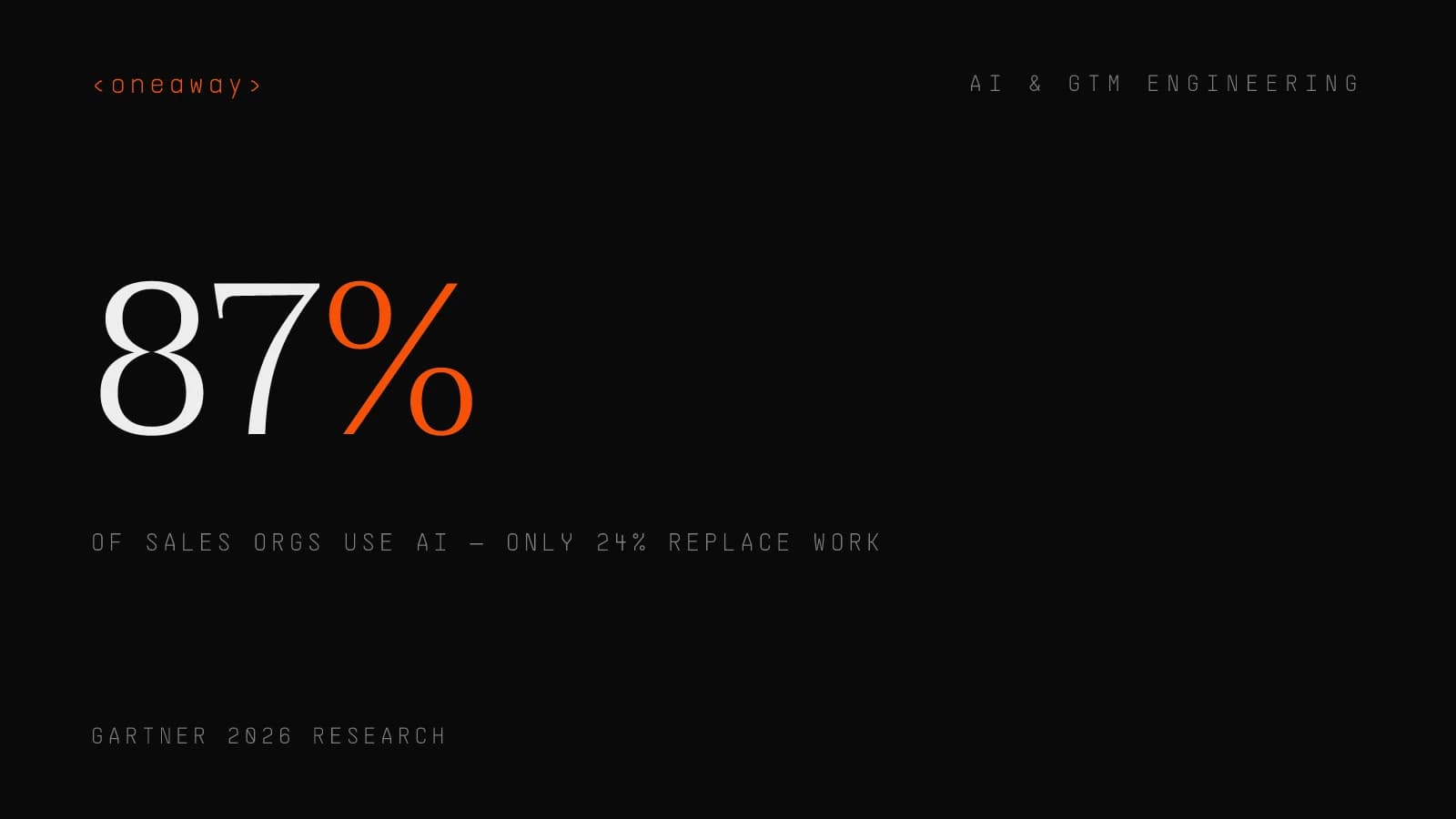
87% of sales organizations now use AI in some form. That's the headline number from Gartner's 2026 research that every vendor loves to quote.
But here's the number that actually matters: only 24% have deployed AI where it replaces manual work. The other 63% are paying for tools that create more work, not less.
I saw this firsthand at AWS. We piloted three different AI prospecting tools in 2023. Two of them required so much human review and correction that our SDRs spent more time babysitting the AI than they would have spent just doing the research themselves.
The third one worked — but only because we'd mapped our actual workflow first and knew exactly which 4 hours per week we wanted to eliminate.
- The procurement question changed: — Buyers no longer ask if a tool uses AI. They ask what the AI replaces, what it can't do, who's liable when it fails, and how the cost compares to headcount.
- The failure pattern is consistent: — Teams buy based on demos, deploy without workflow mapping, measure vanity metrics (emails sent, contacts enriched), then blame 'AI' when pipeline doesn't move.
- The actual blocker isn't technology: — It's that most teams don't know which parts of their sales process are bottlenecks worth automating versus strategic work worth protecting.
Mistake #1: Automating the Wrong Layer of Your Sales Stack
When we rebuilt the client's stack in this order, their reply rate jumped to 9.3% and they closed $340K in pipeline from the first 60 days.
The difference? We used AI to eliminate the 12 hours per week their team spent on B2B data enrichment and account research. Then we kept humans in the loop for message strategy and offer design — the part that actually differentiates you from competitors.
- Week 1: — Reply rate was 2.1%. Below their human baseline of 6%.
- Week 2: — We discovered the AI was 'personalizing' based on LinkedIn headlines and recent posts, but had zero context on buying intent, tech stack, or whether the company was even in their ICP.
- Week 3: — We pulled the plug and rebuilt from the data layer up.
| Layer | What It Does | Human vs AI Split |
|---|---|---|
| Data Foundation | ICP firmographics, tech stack, intent signals | AI: 90% | Human: 10% (validation) |
| Research & Enrichment | Account prioritization, stakeholder mapping | AI: 70% | Human: 30% (judgment calls) |
| Message Strategy | Offer design, positioning, sequencing | AI: 20% | Human: 80% (strategic) |
| Execution | Email sends, follow-ups, calendar booking | AI: 95% | Human: 5% (edge cases) |
Mistake #2: B2B Data Enrichment Without Intent Signals
We built a system for a Series B client that pulls data from sales intelligence platforms (6sense, Koala, Common Room) and scores accounts based on intent signal density.
Accounts with 3+ signals in 30 days get auto-prioritized. The AI handles enrichment and research. The SDR gets a brief, not a blank slate.
Result: Their AI prospecting time dropped from 15 hours/week to 3 hours/week. Pipeline from outbound increased 127% quarter-over-quarter.
The magic wasn't the AI. It was using AI to surface which accounts are worth a human's time right now.
- Layer 1 (Everyone does this): — Firmographic fit — company size, industry, location, tech stack.
- Layer 2 (Winners do this): — Intent signals — hiring patterns, tech stack changes, funding events, web traffic, content consumption.
- Layer 3 (Almost nobody does this): — Trigger-based prioritization — which accounts show 3+ signals in the past 30 days and should be top of your list today.
Mistake #3: Letting the AI SDR Replace Your Strategy
Same AI. Same database. Completely different results.
Their qualified meeting rate went from 0.4% to 3.8%. Pipeline increased by $890K in Q1 2026.
The lesson: AI for sales is not a replacement for sales strategy. It's an amplifier. If your strategy is weak, AI just scales your mediocrity faster.
- Segment 1: High intent, high fit — — Human SDRs own these accounts. AI does research prep only.
- Segment 2: Medium intent, high fit — — AI SDR sends sequences, but humans review before meeting confirmation.
- Segment 3: Low intent, medium fit — — AI nurtures until intent signal fires, then moves to Segment 2.
Mistake #4: Prompt Vomit (The Template Problem at Scale)
They're averaging 8.3% reply rate and $450K in pipeline per quarter from a single SDR spending 20 hours/week on outbound.
The unlock wasn't better AI. It was knowing where to keep the human in the loop.
- AI pulls accounts — matching ICP with 2+ intent signals
- AI enriches and summarizes — key research points (recent news, tech stack, likely pain points)
- Human SDR writes first email — using the research brief — takes 3-4 minutes per account
- AI handles follow-ups — based on engagement patterns
Mistake #5: Measuring AI Activity Instead of Pipeline Impact
When you optimize for activity, AI gives you infinite scale. When you optimize for pipeline, AI gives you leverage.
The teams winning with AI prospecting in 2026 are the ones who figured out that less volume and better targeting beats spray-and-pray at any scale.
- Vanity metrics teams track: — Contacts enriched, emails sent, sequences deployed, AI-generated 'insights'
- Revenue metrics that matter: — Reply rate by segment, meeting-to-SQL conversion, pipeline generated, cost per qualified opp, time saved per rep
| Metric | Before (Activity Focus) | After (Pipeline Focus) |
|---|---|---|
| Emails Sent/Quarter | 40,000 | 8,000 |
| Tool Spend/Month | $8,400 | $3,200 |
| Reply Rate | 1.8% | 8.1% |
| Meetings Booked | 42 | 97 |
| SQL Conversion | 31% | 64% |
| Pipeline Generated | $120K | $670K |
| Cost Per Opp | $1,935 | $198 |
What Actually Works: The Four-Layer AI Sales Stack
After building GTM systems for 40+ clients in the past 18 months, I've seen the pattern that works.
It's not about finding the perfect AI tool. It's about building a four-layer stack where each layer does what it's actually good at.
Layer 1: Data Foundation & Intent Signals
This is where sales intelligence platforms and B2B data enrichment live.
I use Clay for enrichment orchestration, pulling from Apollo, ZoomInfo, and Clearbit. For intent, we layer in 6sense (if budget allows) or Common Room and Koala (for product-led companies).
The goal: Know which accounts match your ICP and show buying intent before your SDR ever looks at them.
- Tools in this layer: — Clay, Apollo, ZoomInfo, Clearbit, 6sense, Koala, Common Room
- AI's job: — Continuous enrichment, intent scoring, account prioritization
- Human's job: — Validate ICP criteria, adjust scoring models quarterly
- ROI benchmark: — Should save 10-15 hours/week per SDR in research time
Layer 2: Research & Account Intelligence
This is where LLMs actually shine. I use GPT-4 or Claude to summarize company news, analyze tech stacks, identify likely pain points, and generate account briefs.
A client in the infrastructure space reduced research time from 45 minutes per account to 4 minutes. Their SDRs now get a one-page brief with:
Recent funding/leadership changes. Tech stack analysis. Likely pain points based on similar customers. Suggested talking points.
- Tools in this layer: — GPT-4, Claude, Perplexity, custom scripts in Clay
- AI's job: — Pull and synthesize information, generate research briefs
- Human's job: — Review briefs, add context, decide which accounts to prioritize
- ROI benchmark: — 10-15 min per account → 3-5 min per account
Layer 3: Offer Strategy & Message Design
This is the layer most teams get wrong. They let AI write the entire message.
AI should draft. Humans should decide strategy. What offer? What angle? What disqualifies this account?
I still write the first email for high-value accounts myself or have my SDRs do it. AI can handle follow-ups and lower-priority segments.
- Tools in this layer: — Humans (seriously), with AI as a drafting assistant
- AI's job: — Generate message variants, handle follow-up sequences
- Human's job: — Decide positioning, write first touch, review AI output
- ROI benchmark: — Reply rates should be 5-10%, not 1-3%
Layer 4: Execution & Follow-Up Automation
This is where outbound sales AI tools like Smartlead, Instantly, or lemlist come in. Send, track, follow up, book meetings.
AI should handle 95% of execution. Humans only step in for edge cases or high-value replies.
At AWS, I spent 6-8 hours per week on manual follow-ups and calendar coordination. That should be zero today.
- Tools in this layer: — Smartlead, Instantly, lemlist, Calendly, Apollo sequences
- AI's job: — Send emails, track engagement, trigger follow-ups, book meetings
- Human's job: — Handle complex replies, edge cases, deal with angry responses
- ROI benchmark: — Should eliminate 8-12 hours/week per SDR in execution time
Implementation Roadmap: 90-Day AI Sales Integration
Most teams try to implement everything at once. They fail.
I recommend a phased rollout over 90 days. Here's the exact roadmap we use with clients:
Days 1-30: Data Foundation
Success metric: Your SDRs should be able to pull a prioritized list of 50 accounts with full enrichment in under 5 minutes.
- Week 1: — Audit your current data sources. What's your ICP? What signals indicate buying intent? Document your manual research process.
- Week 2: — Set up Clay or similar orchestration tool. Connect your data sources (Apollo, ZoomInfo, etc.). Build your first enrichment workflow.
- Week 3: — Layer in intent data. If budget allows, add 6sense. If not, use website visitor tracking (Koala) and hiring data (LinkedIn + Clay).
- Week 4: — Test with 100 accounts. Validate accuracy. Adjust scoring model. Get SDR feedback.
Days 31-60: Research Automation & Strategy
Success metric: Research time per account should drop from 30-45 min to 5-10 min. First email quality should maintain 80%+ of your human baseline.
- Week 5: — Build your research automation. Use GPT-4 or Claude to generate account briefs. Template should include: company overview, recent news, tech stack, pain points, talking points.
- Week 6: — Test with 25 accounts. Compare AI briefs to human research. Refine prompts until quality is 80%+ of human output.
- Week 7: — Define your segmentation strategy. Which accounts get human-written emails? Which get AI + human review? Which get AI-only?
- Week 8: — Write your message frameworks. Create 3-5 templates for different segments/use cases. Let AI personalize from these frameworks.
Days 61-90: Execution & Optimization
Success metric: You should see 30-50% time savings with maintained or improved conversion rates.
- Week 9: — Set up your sending infrastructure. Choose Smartlead, Instantly, or lemlist. Configure domains, warm up sending accounts.
- Week 10: — Launch first AI-assisted campaign to 200 accounts. Segment A (50 accounts): Full human. Segment B (150 accounts): AI research + human first email + AI follow-ups.
- Week 11: — Track and compare. Reply rate, meeting rate, SQL rate by segment. Gather SDR feedback. What's working? What's not?
- Week 12: — Optimize and scale. Adjust segments, refine prompts, expand volume based on what's working.
ROI Benchmarks and When to Walk Away
The AI SDR category will see major consolidation in 2026-2027. The tools that survive will be the ones that integrate into existing workflows, not replace them.
Gartner found that sales orgs providing AI-enabled next best actions are 2.6x more likely to achieve commercial growth. But the key word is 'actions,' not automation. AI should tell your team what to do next, not do everything for them.
- Walk away if: — The tool requires more human oversight than doing it manually. Reply rates drop >15%. Cost per qualified opp exceeds your CAC threshold. Your team hates using it after 30 days.
- Double down if: — Time savings are measurable and consistent. Conversion rates maintain or improve. Your SDRs report better job satisfaction. Pipeline impact is clear within 60 days.
| Metric | Minimum Benchmark | Strong Performance |
|---|---|---|
| Time Saved per SDR | 8 hours/week | 15+ hours/week |
| Reply Rate (vs baseline) | Maintained (within 10%) | Improved 20%+ |
| Cost per Qualified Opp | < $500 | < $250 |
| Pipeline Impact | 15% increase | 50%+ increase |
| SDR Satisfaction | 7/10 or higher | 9/10 |
| Payback Period | < 6 months | < 3 months |
Frequently Asked Questions
What's the best AI tool for sales prospecting in 2026?
There's no single 'best' tool — it depends on your workflow. For data enrichment, Clay is the most flexible. For intent signals, 6sense leads enterprise while Koala works for PLG companies. For execution, Smartlead and Instantly dominate. The mistake is thinking you need one tool; you need a stack where each layer does what it's good at. Start with data foundation (Clay + Apollo/ZoomInfo), add research automation (GPT-4), then layer in execution tools. Most teams over-buy and under-integrate.
Should I replace my SDRs with AI SDRs?
No. AI SDRs work for low-touch, high-volume plays, but they can't replace strategic prospecting. I've tested this extensively — AI-only outbound gets 1-3% reply rates while AI-assisted (AI research + human strategy + AI execution) gets 6-10%. Use AI to eliminate research grunt work and follow-up busy work, but keep humans in the loop for offer design, first touch, and complex accounts. The ROI is in augmentation, not replacement. One AI-assisted SDR outperforms three AI-only SDRs.
How much does AI for sales actually cost?
It ranges wildly. You can build an effective stack for $500-800/month (Clay at $349, GPT-4 API at $50-100, Smartlead at $94) or spend $10K+/month on enterprise sales intelligence platforms. I've seen teams waste $50K+ on tools that don't integrate while others get 10x ROI from a $600/month stack. The key is starting with data and research automation (highest ROI, lowest cost) before adding expensive intent data or AI SDR tools. Don't buy based on demos — pilot for 60 days and measure time saved and pipeline impact.
What metrics should I track for AI sales tools?
Stop tracking activity metrics (emails sent, contacts enriched) and focus on pipeline metrics: reply rate by segment, meeting-to-SQL conversion, pipeline generated, cost per qualified opp, and time saved per rep. AI removes capacity as a constraint, so volume doesn't matter anymore. A tool that helps you send 10,000 emails at 1% reply rate (100 replies) is worse than one that helps you send 1,000 emails at 8% reply rate (80 replies) — and the latter takes less time. Track ROI as: (Pipeline Generated - Tool Cost) / Hours Saved. If that number isn't strongly positive in 60 days, kill the tool.
How do I prevent AI-generated emails from sounding generic?
Use AI for research, not writing. The best results come from AI pulling and synthesizing information (recent news, tech stack, pain points) while humans make strategic decisions (which angle to use, what offer to lead with). Let AI draft, but have humans review and edit the first email. Then AI can handle follow-ups. We tested this: standard AI emails got 1.9% reply rate, AI research + human writing got 7.2%. The other trick: Don't personalize like everyone else. Skip the 'I saw your LinkedIn post' opener. Lead with a specific problem you solve for companies like theirs with proof.
Can AI for sales work for complex B2B with long sales cycles?
Yes, but differently than for transactional sales. For complex B2B, AI should handle account research and prioritization, not message generation. Use AI to identify accounts showing buying signals (hiring, tech changes, funding), enrich with relevant context, and surface which accounts your AEs should focus on this week. Keep message strategy and relationship-building fully human. I've seen this work well in enterprise infrastructure, cybersecurity, and consulting — AI cuts research time by 70% while humans own strategy and relationships. The 90-day pipeline impact is typically 40-80% improvement, not from more volume but from better targeting.
What's the biggest mistake companies make with AI sales tools?
Automating before they have a strategy. Teams buy AI SDR tools, point them at their database, and expect magic. Instead, they get 10,000 generic emails and no pipeline. The right approach: map your workflow first, identify bottlenecks, then deploy AI to eliminate specific manual tasks. I've seen teams waste $47K+ by doing it backwards. Start with: What takes the most time? What's lowest value? What's most repetitive? Then find AI to solve those specific problems. AI amplifies your strategy — if your strategy is weak, AI just scales your mediocrity faster. Fix strategy first, then automate.
Key Takeaways
- 87% of sales orgs use AI, but only 24% deploy it where it replaces manual work — the gap is workflow mapping, not technology. Most teams automate the wrong layer (email sending) while ignoring the high-ROI work (research, prioritization).
- AI-only outbound gets 1-3% reply rates; AI-assisted gets 6-10% — use AI for research and execution, keep humans in the loop for strategy and first touch. One AI-assisted SDR outperforms three AI-only SDRs.
- B2B data enrichment without intent signals is waste — firmographics tell you who fits your ICP, intent signals tell you who's ready to buy now. Layer both for 3x better conversion rates and 70% less wasted outreach.
- The four-layer stack: Data Foundation → Research → Strategy → Execution — AI should own 90% of layers 1 and 4, 70% of layer 2, and only 20% of layer 3. Most teams get this backwards and let AI write strategy while humans do research.
- Measure pipeline impact, not activity — emails sent and contacts enriched are vanity metrics. Track reply rate by segment, cost per qualified opp, pipeline generated, and time saved per rep. Kill tools that don't show ROI in 60 days.
- Start with Clay + GPT-4 for $400-500/month before buying expensive AI SDR platforms. Most teams get better ROI from research automation ($8.33/hour saved) than full AI SDRs ($262/hour saved).
- Phase your rollout over 90 days: Data Foundation (Days 1-30) → Research Automation (Days 31-60) → Execution & Optimization (Days 61-90) — teams that implement everything at once fail. Build bottom-up, validate each layer, then scale what works.
Want to Build an AI Sales Stack That Actually Drives Pipeline?
Most teams waste $30-50K+ on AI tools that don't integrate with their workflow. We build GTM systems that eliminate research grunt work, maintain your conversion rates, and scale what's already working. If you're tired of paying for AI that creates more work instead of less, let's talk about what a properly-architected four-layer AI sales stack looks like for your team. Book a systems audit and we'll show you exactly where AI fits (and where it doesn't).
Check if we're a fitContinue Reading
Best AI Sales Forecasting Models in 2026, Ranked by Accuracy
I tested 11 AI sales forecasting models with real pipeline data. Here's what actually works, ranked by accuracy, cost, and whether your CRM can handle it.
Read more [ 14 MIN READ ]Best AI Sales Team Workflows in 2026, Ranked by Time Saved
I tested dozens of AI tools sales team workflows. Here's what actually saves time in 2026, ranked by hours recovered per rep per week—with real implementation data.
Read more [ 18 MIN READ ]Best AI GTM Tools for Revenue Teams in 2026, Ranked by Impact
I've tested dozens of AI GTM tools as a former AWS/Salesforce SDR turned GTM engineer. Here's what actually moves revenue in 2026, ranked by real-world impact.
Read more