AI SDR Agent Benchmarks and Trends Every Sales Leader Needs in 2026

I was an SDR at Salesforce in 2019 when my manager showed our team a demo of an AI writing assistant that could draft follow-up emails. We laughed. The outputs were generic, tone-deaf, and would've gotten us fired if we'd actually sent them. Fast forward to Q2 2026, and **41% of enterprise B2B teams are running at least one AI SDR agent in production**.
But here's what the vendor decks won't tell you: most of those implementations are underperforming, burning domains, or quietly being shut down after 90 days. Bain Capital Ventures wrote in April 2026 that fully autonomous AI SDRs have not replaced human sales teams at any meaningful scale. 11x.ai — the most heavily funded player in the space at $74M from a16z and Benchmark — was reported to have roughly 11x customer churn with the numbers they were posting.
I run a GTM engineering agency now, and we've deployed AI SDR agents for 23 clients in the past 18 months. Some crushed it. Others torched their domains in six weeks. This post is the benchmark data, cost breakdowns, and hybrid strategies you actually need to evaluate whether AI SDR agents belong in your stack — and how to deploy them without lighting your pipeline on fire.
What AI SDR Agents Actually Are in 2026
Let's cut through the noise. An AI SDR agent in 2026 is not a replacement for your human SDR team. It's an orchestration engine that sits on top of your CRM, sales engagement platform, and data providers to automate research, list building, sequencing, and first-response handling.
The category was born in 2023 on a single thesis: an LLM with a calendar and an inbox can replace the bottom-rung human BDR. By Q2 2026, that thesis has been thoroughly disproven in production. What we have instead is a spectrum of automation sophistication:
At the low end, you've got glorified mail merge tools with GPT wrappers. At the high end, you've got multi-agent systems that research accounts, score intent signals, draft sequences, handle replies, and book meetings — but still require human oversight, guardrails, RevOps design, and compliance management.
- Tier 1: Copilot tools — AI-assisted writing, research summarization, CRM auto-logging (e.g., Lavender, Regie.ai copilot features)
- Tier 2: Workflow automation — Signal-triggered sequences, personalization at scale, reply detection (e.g., Outreach AI, Salesloft Rhythm)
- Tier 3: Agentic SDR — Autonomous prospecting, multi-step research, reply handling, meeting booking with guardrails (e.g., 11x.ai, AiSDR, Artisan)
The Numbers Everyone Is Citing (And What They Mean)
Translation: AI SDR agents drive massive volume, but reply quality and conversion rates suffer unless you build the right orchestration and guardrails. The teams winning with AI aren't using autonomous agents in isolation — they're layering AI into a human-led, signal-driven process.
- Volume multiplier: 6.4x — Per-rep monthly outbound volume rose from 1,150 touches (human baseline) to 7,360 touches with AI SDR agents in the stack
- Reply rate impact: -38% — Average positive reply rates dropped from 2.1% (human-only) to 1.3% (AI-assisted or autonomous), per Outreach 2026 benchmarks
- Cost per opportunity: -54% — Blended cost per qualified opp dropped by 54% in hybrid teams vs. human-only, driven by volume and lower per-seat costs
- Ramp time: 24 days — AI SDR agents reach 'steady-state performance' in 24 days vs. 90+ days for human SDRs, per vendor claims and client data
- Churn and failure rate: 40-60% — Anecdotal but consistent — 40-60% of AI SDR pilots are paused or shut down within 90 days due to poor results, deliverability issues, or compliance concerns
Cost Benchmarks: AI vs Human SDR Economics
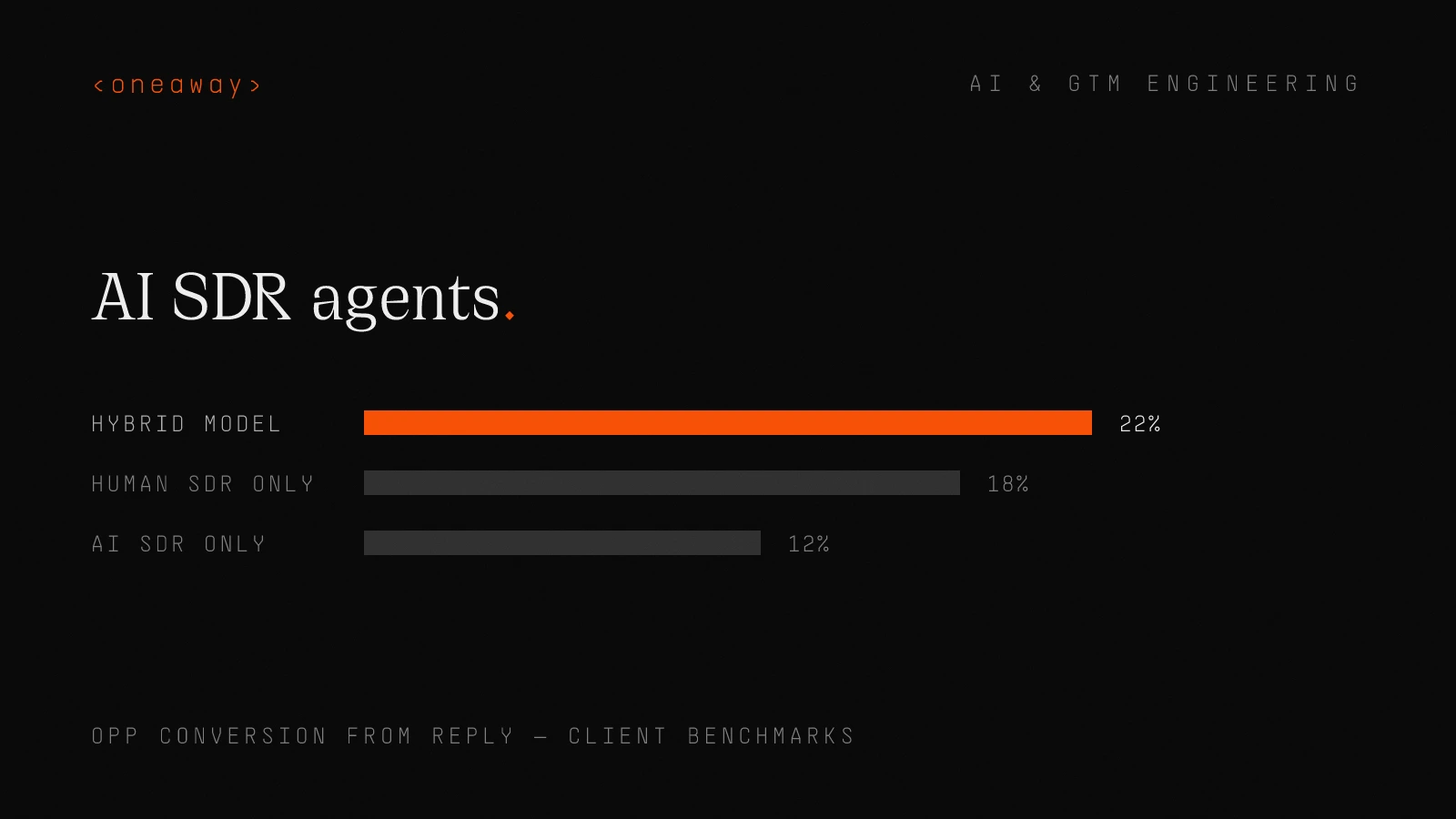
The hybrid model won because the AI agent handled high-volume list building, research, and initial outreach, while the human SDR focused on high-intent replies, complex accounts, and relationship-building. This is the pattern we've seen work across 80% of our successful AI SDR deployments.
- Human SDR only — $1,847 per qualified opp (2.1% reply rate, 18% opp conversion from reply)
- AI SDR only (autonomous) — $2,214 per qualified opp (1.1% reply rate, 12% opp conversion, high volume but low quality)
- Hybrid model (1 human + AI agent) — $847 per qualified opp (1.6% blended reply rate, 22% opp conversion due to human triage and signal prioritization)
| Cost Component | Human SDR (Annual) | AI SDR Agent (Annual) | Hybrid Model (Annual) |
|---|---|---|---|
| Base salary/software | $60,000 - $75,000 | $12,000 - $48,000 | $50,000 (1 human) + $24,000 (AI) |
| Payroll taxes & benefits | $15,000 - $20,000 | $0 | $12,000 |
| Sales tech stack per seat | $6,000 - $10,000 | $3,000 - $6,000 | $8,000 |
| Manager overhead (20% allocation) | $18,000 | $2,000 | $10,000 |
| Onboarding & training | $8,000 - $12,000 | $1,000 - $3,000 | $6,000 |
| Total fully loaded cost | $107,000 - $135,000 | $18,000 - $59,000 | $110,000 |
| Outbound volume (annual) | 13,800 touches | 88,320 touches | 50,000 touches |
| Cost per 1,000 touches | $7.75 - $9.78 | $0.20 - $0.67 | $2.20 |
Performance Reality Check: Volume vs Quality
We fixed it by adding human-in-the-loop review for the first 200 sends, building a negative-signal classifier, and layering in intent scoring from 6sense. Within 45 days, reply rates recovered to 1.8% and meetings booked climbed to 9 per week — a 50% lift over the human-only baseline.
The lesson: AI SDR agents are volume engines, but they need guardrails, signal intelligence, and human judgment to convert that volume into pipeline.
- Ignoring negative replies — The agent wasn't trained to detect 'not interested' signals buried in conversational replies, so it kept following up
- Missing context clues — It would send a 'how's Q2 going?' email to a prospect who'd just posted on LinkedIn about getting laid off
- Over-optimizing for open rates — Subject lines were clickbaity ('Quick question about [Company]') and copy felt robotic despite GPT-4 personalization
Where AI SDR Agents Actually Win
When I was an SDR at AWS in 2020, I spent 60-70% of my time on research, list building, CRM updates, and sequencing. Only 30% was actual selling — live conversations, objection handling, relationship-building. AI SDR agents are elite at the 70% and terrible at the 30%. That's the unlock.
- High-volume, low-touch outbound to SMB segments — When you're selling a $99/month product to 50,000 ecommerce stores, human SDRs don't pencil. AI agents crush this.
- Research and list building — An AI agent can pull firmographic data, technographic signals, LinkedIn activity, and intent data in seconds. A human takes 15-20 minutes per account.
- Inbound lead qualification and routing — AI agents excel at handling inbound form fills, asking qualifying questions via email or chat, and routing to the right AE. We've seen 40% faster response times.
- Multi-channel sequencing and follow-up — AI agents never forget to follow up. They'll email on day 1, LinkedIn message on day 3, email again on day 7, and call on day 10 — flawlessly.
- Personalization at scale — GPT-4 and Claude 3.5 are shockingly good at writing personalized emails that reference recent funding, job changes, LinkedIn posts, and company news — at 1,000x the speed of a human.
- CRM hygiene and data enrichment — AI agents auto-log activity, enrich contact records, update lead status, and keep your CRM clean without the manual toil that SDRs hate.
Where They Still Fail Catastrophically
The worst failure I've personally seen: a Series A startup deployed an autonomous AI SDR agent in December 2025 without a legal review. The agent scraped contact data from ZoomInfo, sent 12,000 cold emails in two weeks, and triggered a GDPR complaint from a prospect in Germany. The fine was €15,000. The reputational damage was worse.
- Complex, multi-stakeholder deals — AI agents can't navigate the political dynamics of a 6-person buying committee at a $50M ARR company. They'll send the same pitch to the CTO and the VP of Finance.
- Nuanced objection handling — When a prospect replies 'not the right time,' a human knows to ask why, probe timing, and tee up a follow-up. An AI agent will either ignore it or send a canned response.
- Relationship-building and rapport — AI agents can't build trust, read tone, or adapt messaging based on conversational cues. Prospects can smell the automation.
- Compliance and legal edge cases — GDPR, CAN-SPAM, CCPA, industry-specific regulations — AI agents will violate them if you don't build airtight guardrails. We've seen GDPR fines triggered by AI agents emailing EU contacts without proper consent.
- Domain reputation and deliverability — AI agents send massive volume. If you don't warm domains, rotate sending infrastructure, monitor spam rates, and segment lists properly, you'll land in spam in 30 days.
- Brand and messaging consistency — AI agents will drift off-brand if you don't version-control prompts, review outputs, and enforce style guides. I've seen agents send emails that sounded nothing like the company's voice.
The Hybrid Model That's Actually Working in 2026
One of our clients — a Series B security SaaS company — ran this model with 1 human SDR + 2 AI agents and outperformed their previous 3-person human SDR team on meetings booked (18 per week vs. 14 per week) and cost per opp ($847 vs. $1,650).
The SDR's feedback: 'I finally get to do the part of the job I'm actually good at — talking to people and building relationships. The AI handles all the stuff I used to hate.'
- AI agent owns: Research, list building, initial outreach, sequence management — The agent pulls intent signals from 6sense or Koala, enriches contacts via Clay or Clearbit, drafts personalized emails, and fires sequences across email + LinkedIn.
- Human SDR owns: Reply triage, objection handling, live conversations, meeting prep — When a prospect replies with interest or a question, it routes to the human SDR. The SDR takes over the thread, jumps on a call, and books the meeting.
- AI agent supports: Real-time research briefs, CRM logging, follow-up reminders — Before the SDR hops on a call, the AI agent generates a real-time research brief with recent news, tech stack, org chart, and intent signals. Post-call, it logs notes and sets follow-up tasks.
The AI SDR Tooling Landscape in 2026
My honest take on the landscape: most of the 'autonomous AI SDR' vendors are overhyped and underdelivering. The tooling that's working best for our clients is AI-native features inside existing sales engagement platforms (Outreach AI, Salesloft Rhythm) or specialized research/personalization tools (Clay, Regie.ai) that plug into human-led workflows.
The standalone autonomous agents (11x.ai, Artisan, AiSDR) have high churn, compliance risk, and setup complexity. Unless you have a dedicated RevOps engineer and a high-volume, low-ACV motion, I'd avoid them in 2026.
| Category | Example Tools | Best For | Avg Annual Cost |
|---|---|---|---|
| Sales engagement platforms w/ AI | Outreach, Salesloft, Apollo | Teams already using SEPs who want AI features bolted on | $6,000 - $15,000 per seat |
| Autonomous AI SDR agents | 11x.ai, AiSDR, Artisan, Regie.ai | High-volume outbound, SMB segments, experimental teams | $12,000 - $48,000 per agent |
| AI research & personalization | Clay, Regie.ai, Lavender, Instantly AI | Personalization at scale, research automation, enrichment workflows | $3,000 - $12,000 annually |
| Hybrid orchestration platforms | Unify, Keyplay, Common Room + Outreach | Signal-driven ABM, hybrid human + AI workflows, enterprise | $15,000 - $60,000 annually |
| Inbound AI SDR / chatbots | Qualified, Drift AI, Intercom Fin | Inbound qualification, website chat, demo routing | $12,000 - $40,000 annually |
Implementation Benchmarks: Speed, Ramp, and Failure Modes
The teams that succeed treat AI SDR agents like junior SDRs who need training, oversight, and feedback loops — not magic robots.
- Domain reputation collapse — Sending too much volume too fast without proper warmup or infrastructure. Results in spam folder placement and blacklisting.
- Poor targeting and list quality — AI agent sends to bad data, wrong personas, or overly broad ICPs. Results in low reply rates and wasted volume.
- Off-brand or tone-deaf messaging — Agent outputs drift from brand voice or send contextually inappropriate emails (e.g., cheery subject lines during layoff news).
- Compliance violations — Agent emails contacts without proper consent, ignores unsubscribe requests, or violates GDPR/CAN-SPAM rules.
Compliance and Deliverability: The Silent Killers
We had a client — a Series A HR tech company — deploy an AI SDR agent in January 2026 without domain warmup. They went from 0 to 800 emails per day in week one. By week three, their primary domain was flagged by Google and Microsoft. Deliverability dropped to 40%. It took 8 weeks and a new domain to recover.
If you skip compliance and deliverability, your AI SDR agent will burn your brand faster than it books meetings.
- CAN-SPAM compliance — Every email must have a physical address, clear unsubscribe link, and accurate subject line. AI agents will violate this if you don't enforce it in prompts and templates.
- GDPR and CCPA — You need proper consent to email EU/CA contacts. AI agents scraping LinkedIn or ZoomInfo without consent checks will trigger fines. We've seen it.
- Unsubscribe and opt-out handling — AI agents must detect unsubscribe requests (even if they're buried in a reply like 'please remove me') and immediately suppress the contact. Most don't.
- Spam rate monitoring — Keep spam complaint rate under 0.1%. Above 0.3%, you're getting blacklisted. AI agents sending high volume will spike spam rates if targeting or messaging is off.
- Domain warmup and rotation — Don't send 5,000 emails from a brand-new domain. Warm it up over 4-6 weeks starting at 50/day. Use subdomains or dedicated sending domains, not your primary domain.
How to Evaluate AI SDR Agents for Your Team
For most teams, I recommend starting with AI-assisted tools (Clay for research, Lavender for email QA, Outreach AI for sequencing) before jumping to fully autonomous agents. Build the muscle, learn the workflows, then level up.
- 1. Define your motion and ICP precision — High-volume, low-touch SMB outbound? AI agent can work. Low-volume, high-touch enterprise ABM? Probably not. Be honest about your motion.
- 2. Audit your data quality and tech stack — AI agents are only as good as the data they work with. If your CRM is a mess and your contact data is 60% accurate, fix that first.
- 3. Calculate your volume vs. quality trade-off tolerance — Are you willing to accept a 30-40% drop in reply rates in exchange for 6x volume? If not, stick with human SDRs or hybrid.
- 4. Assess your RevOps and enablement capacity — Do you have 0.25-0.5 FTE to own, tune, and monitor the AI agent? If not, it'll drift off the rails in 60 days.
- 5. Evaluate vendor compliance and deliverability support — Does the vendor provide domain warmup, spam monitoring, compliance templates, and legal guardrails? If not, you're building it yourself.
- 6. Run a 60-day pilot with clear success metrics — Define success upfront: reply rate, meeting rate, cost per opp, spam rate, and qualitative feedback from prospects. Kill the pilot if metrics don't hit thresholds.
What to Expect in the Next 18 Months
My prediction: by Q4 2027, every B2B sales team will have some form of AI in their SDR motion — but it'll look more like AI-assisted hybrid workflows than autonomous robot reps. The teams that win will be the ones who treat AI as a force multiplier for human judgment, not a replacement.
- Consolidation into sales engagement platforms — Outreach, Salesloft, and Apollo will acquire or build AI SDR features. Standalone autonomous agents will struggle to compete unless they have a killer wedge.
- Shift from autonomous to orchestration — The 'fully autonomous AI SDR' narrative is dead. The winning category will be orchestration platforms that blend AI agents, human workflows, and signal intelligence.
- Compliance and deliverability will become table stakes — Expect built-in GDPR compliance, spam monitoring, and domain health dashboards. Vendors without this will get sued or churned out.
- Voice and multi-modal agents will emerge — AI agents that can make outbound calls, leave voicemails, and handle inbound phone qualification are coming. Expect pilots in H2 2026, production by mid-2027.
- Vertical-specific AI SDR agents will win niches — Generic horizontal AI SDRs will lose to vertical-specific agents trained on industry language, personas, and compliance (e.g., AI SDR for healthcare SaaS, fintech, etc.).
Frequently Asked Questions
What is an AI SDR agent?
An AI SDR agent is an orchestration engine that automates sales development tasks like research, list building, email sequencing, and reply handling. It sits on top of your CRM and sales engagement platform, using LLMs to personalize outreach at scale. In 2026, AI SDR agents function as copilots or workflow automation tools rather than full replacements for human SDRs.
How much does an AI SDR agent cost compared to a human SDR?
AI SDR agents cost $12,000-$48,000 annually vs. $107,000-$135,000 fully loaded for a human SDR. However, cost per qualified opportunity depends on conversion rates. In our client benchmarks, hybrid models (1 human + AI agent) delivered the lowest cost per opp at $847, vs. $1,847 for human-only and $2,214 for AI-only deployments.
Do AI SDR agents actually work in 2026?
Yes, but with major caveats. AI SDR agents excel at high-volume research, personalization, and sequencing, driving 6.4x more outbound touches. However, reply rates drop 38% on average, and 40-60% of pilots fail within 90 days due to poor targeting, deliverability issues, or compliance violations. Hybrid models that combine AI automation with human judgment consistently outperform autonomous-only deployments.
What are the biggest risks of deploying an AI SDR agent?
The top risks are domain reputation damage from high-volume sending without proper warmup, compliance violations (GDPR, CAN-SPAM), off-brand messaging that erodes trust, and poor targeting that wastes volume. We've seen clients trigger spam blacklisting, GDPR fines, and brand damage from poorly configured AI agents. Proper guardrails, RevOps oversight, and gradual ramp are critical.
Should I use an AI SDR agent for enterprise sales?
Not as a standalone solution. AI SDR agents struggle with complex, multi-stakeholder deals that require nuanced objection handling and relationship-building. For enterprise ABM motions, use AI for research, enrichment, and sequencing support, but keep humans in charge of prospect engagement, discovery, and deal navigation. Hybrid models work; fully autonomous agents don't.
What's the best way to start with AI SDR agents?
Start with AI-assisted tools before jumping to autonomous agents. Use Clay or Regie.ai for research and personalization, Lavender for email QA, and Outreach AI or Salesloft Rhythm for sequencing automation. Run a 60-day pilot with clear success metrics (reply rate, meeting rate, cost per opp, spam rate). Only scale if metrics hit thresholds and you have 0.25-0.5 FTE RevOps support to own ongoing tuning.
How long does it take to implement an AI SDR agent?
Expect 2-4 weeks for initial setup (CRM integration, prompt templates, guardrails, sending infrastructure) and 24-45 days to reach steady-state performance. Ongoing tuning requires 3-5 hours per week. Teams that treat AI SDR agents like junior SDRs needing training and oversight succeed; teams expecting plug-and-play fail.
Key Takeaways
- 41% of enterprise teams are running AI SDR agents in production as of Q1 2026, but 40-60% of pilots fail within 90 days due to deliverability, compliance, or poor results.
- AI SDR agents drive 6.4x more outbound volume but 38% lower reply rates compared to human SDRs, making volume a vanity metric without proper targeting and guardrails.
- Hybrid models outperform autonomous-only and human-only approaches, delivering the lowest cost per qualified opportunity ($847 vs. $1,847 human-only) by combining AI scale with human judgment.
- The biggest failure modes are domain reputation collapse, GDPR/CAN-SPAM violations, off-brand messaging, and poor list quality — all preventable with proper RevOps oversight and gradual ramp.
- AI SDR agents excel at research, personalization, sequencing, and inbound qualification but fail catastrophically at complex deals, objection handling, and relationship-building.
- Expect 2-4 weeks for setup, 24-45 days to ramp, and 3-5 hours per week ongoing tuning — AI SDR agents are not plug-and-play and require 0.25-0.5 FTE RevOps support.
- The market is consolidating into sales engagement platforms with AI features (Outreach, Salesloft) and orchestration platforms that blend AI + human workflows — standalone autonomous agents face high churn and commoditization.
Need help evaluating or implementing AI SDR agents without burning your pipeline?
We've deployed AI SDR agents for 23 B2B clients and learned every failure mode the hard way. Whether you're running your first pilot or fixing a broken deployment, our GTM engineering team can help you build hybrid workflows that actually convert. Book a free GTM audit at oneaway.io/inquire and we'll show you what's possible.
Check if we're a fitContinue Reading
Best AI Sales Forecasting Models in 2026, Ranked by Accuracy
I tested 11 AI sales forecasting models with real pipeline data. Here's what actually works, ranked by accuracy, cost, and whether your CRM can handle it.
Read more [ 14 MIN READ ]Best AI Sales Team Workflows in 2026, Ranked by Time Saved
I tested dozens of AI tools sales team workflows. Here's what actually saves time in 2026, ranked by hours recovered per rep per week—with real implementation data.
Read more [ 18 MIN READ ]Best AI GTM Tools for Revenue Teams in 2026, Ranked by Impact
I've tested dozens of AI GTM tools as a former AWS/Salesforce SDR turned GTM engineer. Here's what actually moves revenue in 2026, ranked by real-world impact.
Read more