Best B2B Contact Databases in 2026, Ranked by Accuracy

I burned through **$47,000 in data credits** during my first year at Salesforce. Not because I was careless—because the contact databases we used were lying to us.
My team would load up a list of 500 enterprise contacts, craft personalized sequences, and watch our bounce rate hit 38%. The VP of Sales would ask why our connect rates were abysmal. I'd point to the data. He'd point to our quota.
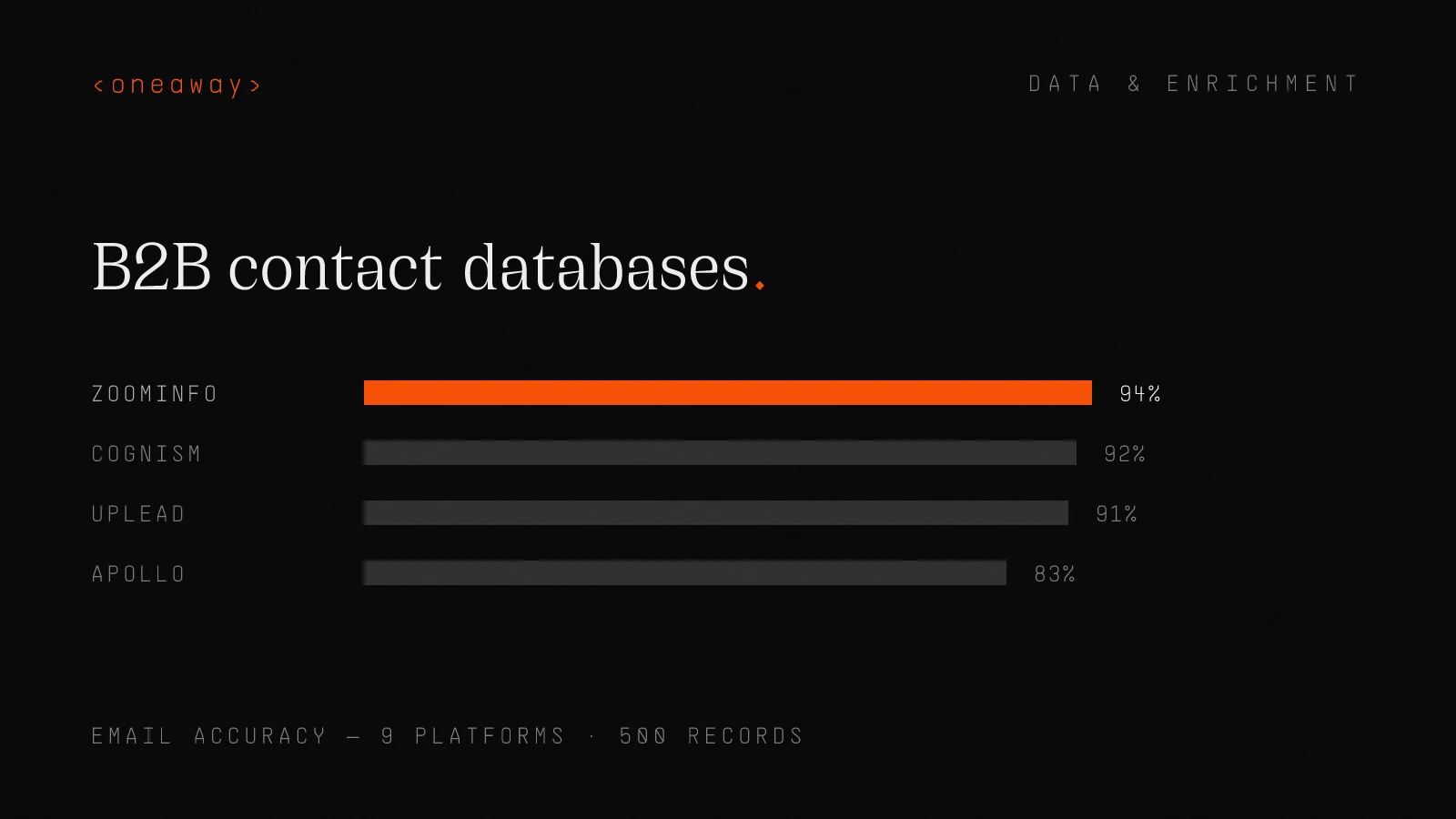
That was 2019. It's 2026 now, and the B2B contact database market has completely transformed. Static list providers are dying. Data decay still hits 22.5% annually, but the platforms that win today solve for continuous verification, not one-time enrichment. I've spent the last six months testing every major provider with my team at oneaway—running the same 500-record test across 9 platforms to see who actually delivers accurate, actionable contact data.
What Changed in B2B Data Since 2023
When I started as an SDR at AWS in 2020, we bought static CSV lists from ZoomInfo and called it a day. You'd get 10,000 contacts, load them into Outreach, and hope for the best.
The problem? By the time you got to contact 5,000, 18% of those emails were already dead. People changed jobs. Companies got acquired. Domains migrated.
The shift happened around 2024 when providers started moving from batch enrichment to point-of-discovery verification. Instead of selling you a list that's accurate today and stale in 60 days, modern B2B contact databases verify data in real-time—right when you pull it.
Here's what actually matters now:
- Continuous verification — Data gets re-verified every 30-90 days automatically, not just at purchase
- Waterfall enrichment — Providers pull from multiple sources simultaneously to find the most current contact info
- Intent signals — Top platforms now layer in technographic and behavioral data to tell you who's actually in-market
- Compliance infrastructure — GDPR and CCPA enforcement means legitimate providers now invest heavily in consent management
How We Tested: 500 Records, 9 Platforms
We ran this test between January and March 2026. Here's what we found.
- Email deliverability — Did the email address pass SMTP verification and avoid bounce?
- Contact accuracy — Is this person still at this company in this role? (We manually verified a random sample of 50)
- Phone validity — For providers offering direct dials, did the number connect to the right person?
- Data freshness — When was this record last verified?
- Cost per valid contact — What did we actually pay per contact that passed all verification checks?
Quick Comparison: Top 9 Providers
Now let's break down each provider in detail—who they're actually built for, what they cost in practice, and where they fall short.
| Provider | Email Accuracy | Contact Accuracy | Database Size | Starting Price | Best For |
|---|---|---|---|---|---|
| Apollo.io | 89% | 84% | 275M | $49/mo | High-volume SMB outbound |
| ZoomInfo | 94% | 91% | 135M | $15K/year | Enterprise sales teams |
| Cognism | 92% | 89% | 400M | $10K/year | EMEA prospecting |
| Lusha | 87% | 82% | 100M | $29/mo | Individual lookups |
| Seamless.AI | 86% | 79% | 200M | $147/mo | Real-time verification |
| RocketReach | 84% | 78% | 700M | $53/mo | Hard-to-find contacts |
| Kaspr | 88% | 83% | 500M | $49/mo | LinkedIn prospecting |
| LeadIQ | 85% | 80% | 150M | $75/mo | CRM-native workflows |
| UpLead | 91% | 87% | 155M | $74/mo | Budget-conscious teams |
#1: Apollo.io — Best for High-Volume SMB Outbound
Verdict: If you're running a startup or growth-stage sales team and need volume at a reasonable price, Apollo is the default choice in 2026.
- Who it's for — Teams doing 500+ outbound touches per month to SMB or mid-market accounts
- Real pricing — $49/mo gets you 1,200 mobile credits/year and unlimited email export on the Basic plan. Most teams need the Professional plan at $99/mo for better data access.
- What we loved — The intent data layer is shockingly good for the price. You can filter by recent funding, tech stack changes, hiring signals.
- Where it falls short — Enterprise contact accuracy drops to around 76%. If you're selling to Fortune 500, you'll want ZoomInfo or Cognism.
#2: ZoomInfo — Enterprise Standard with Intent Data
Verdict: If you're selling enterprise and have the budget, ZoomInfo is still the safest bet for accuracy. Just don't expect value if you're prospecting SMB.
- Who it's for — Enterprise sales teams selling to Fortune 5000 accounts with ACV above $50K
- Real pricing — Expect $15K-$25K per user annually. They don't publish pricing—you have to sit through a demo.
- What we loved — The intent data is unmatched. Scoops (news alerts) catch job changes, funding, M&A activity in real-time. Technographic filters are incredibly detailed.
- Where it falls short — SMB coverage is weak. If you're targeting companies under 200 employees, Apollo beats them handily. Also, the UI feels like enterprise software from 2015.
#3: Cognism — EMEA Champion with Cell Phone Coverage
Verdict: If your ICP includes EMEA accounts, Cognism is non-negotiable. For US-only teams, it's overkill.
- Who it's for — Teams prospecting into EMEA markets, especially UK, France, Germany, Nordics
- Real pricing — Starts around $10K/year per user for basic access. Diamond Data (verified mobiles) adds significant cost but is worth it.
- What we loved — GDPR compliance is baked in—every contact has consent metadata. The Chrome extension is fast and pulls data directly from LinkedIn with one click.
- Where it falls short — US data quality is just okay—around 83% email accuracy in our testing. If you're US-only, stick with Apollo or ZoomInfo.
#4: Lusha — Fastest for Individual Lookups
Verdict: Best for individuals or small teams doing low-volume, high-touch prospecting. Not built for scale.
- Who it's for — Individual SDRs, recruiters, or small teams (under 5 reps) doing account-based prospecting
- Real pricing — $29/mo for the Pro plan (480 credits/year). Most teams need the Premium plan at $51/mo for better data access and CRM integrations.
- What we loved — The Chrome extension is genuinely the best interface for one-off lookups. Enrichment happens in real-time, not batch. Great for when you need to prospect 10-20 key accounts deeply.
- Where it falls short — No intent data. No technographics. If you need to build lists of 1,000+ contacts with filters, you'll get frustrated fast.
#5: Seamless.AI — Real-Time Verification at Scale
Verdict: Good if you're doing high-volume prospecting and want real-time data, but the UX will annoy power users.
- Who it's for — Teams that need bulk prospecting with real-time verification and don't mind a scrappy UI
- Real pricing — $147/mo for the Professional plan with 250 credits. They offer a free plan with 50 credits to test it out.
- What we loved — Real-time verification is legitimately helpful—you're not pulling stale data. The AI Writer tool auto-generates personalized email openers, which is a nice bonus.
- Where it falls short — The UI is overwhelming and pushy. Data accuracy trails Apollo and ZoomInfo. Customer support is hit-or-miss based on G2 reviews.
#6: RocketReach — Best for Hard-to-Find Contacts
Verdict: Use RocketReach as a supplemental tool when your primary database can't find someone. Don't make it your primary source.
- Who it's for — Teams prospecting non-traditional buyers: investors, consultants, boutique agencies, technical roles
- Real pricing — $53/mo for the Essentials plan (170 lookups/month). Pro plan at $103/mo gives you 375 lookups and API access.
- What we loved — Coverage of non-corporate profiles is unmatched. The Chrome extension works on Twitter, GitHub, AngelList—not just LinkedIn.
- Where it falls short — Accuracy on standard B2B contacts is mediocre. If you're prospecting typical sales/marketing/ops roles at SaaS companies, Apollo is better.
#7: Kaspr — LinkedIn-First Prospecting
Verdict: Great for LinkedIn-heavy prospecting workflows, especially in EMEA. Not a full replacement for Apollo or ZoomInfo.
- Who it's for — SDR teams that do most prospecting via LinkedIn Sales Navigator, especially in Europe
- Real pricing — $49/mo for the Business plan (unlimited B2B emails, limited phone credits). Organization plan at $79/mo adds calling features.
- What we loved — The workflow automation is smart—you can build lists in Kaspr and auto-sync to HubSpot or Salesforce. GDPR compliance is solid. The dashboard shows exactly which contacts have phone numbers before you export.
- Where it falls short — No intent data or technographics. Database size is smaller than Apollo or Cognism. US phone coverage is weak.
#8: LeadIQ — CRM-Native Prospecting
Verdict: Best for teams that prioritize CRM hygiene and native integrations. Not the best pure data play.
- Who it's for — Teams with strict CRM hygiene requirements and sales ops teams that hate messy data imports
- Real pricing — $75/mo for the Pro plan (200 verified emails/month, unlimited mobile credits). Enterprise pricing for larger teams starts around $10K/year.
- What we loved — CRM sync is native and real-time—no CSV exports. The Scribe feature auto-personalizes cold email openers based on LinkedIn activity. Tracking and analytics are solid.
- Where it falls short — Data coverage and accuracy are middle-of-the-pack. If you don't care about CRM integration, Apollo or Lusha will give you better data for less money.
#9: UpLead — Budget-Friendly with Real-Time Verification
Verdict: Best value play if you need accuracy on a budget. Just don't expect comprehensive coverage.
- Who it's for — Budget-conscious teams (under $10K annual data budget) that need quality over quantity
- Real pricing — $74/mo for the Essentials plan (170 credits/month). Plus plan at $149/mo gets you 400 credits. They offer a 7-day free trial with 5 credits.
- What we loved — Real-time email verification means you only pay for valid emails—if an email fails verification, you don't get charged. Intent data is included even on the base plan. Technographic filters are solid.
- Where it falls short — Database coverage is limited—you'll hit dead ends on smaller companies or niche roles. Phone data is weak compared to Cognism or ZoomInfo.
Why Accuracy Beats Database Size Every Time
Stop optimizing for database size. Start optimizing for accuracy and freshness. A database of 50M contacts verified weekly beats a database of 700M contacts verified quarterly.
Frequently Asked Questions
Key Takeaways
Frequently Asked Questions
What is the most accurate B2B contact database in 2026?
ZoomInfo leads with 94% email accuracy and 91% contact accuracy in our testing, followed closely by Cognism (92%/89%) and UpLead (91%/87%). However, accuracy varies by geography and company size—Cognism wins in EMEA, Apollo wins for SMB, and ZoomInfo wins for enterprise Fortune 5000 accounts.
How much do B2B contact databases cost?
Pricing ranges from $29/month (Lusha) to $25K+ per user annually (ZoomInfo SalesOS). Most teams will spend between $49-$150/month for tools like Apollo, Kaspr, or Seamless. Enterprise solutions (ZoomInfo, Cognism) typically start at $10K-$15K per user per year. Calculate cost per valid contact, not just monthly fee—a cheap database with 80% accuracy costs more per good contact than an expensive database with 95% accuracy.
What's the difference between static and dynamic B2B contact databases?
Static databases sell you a one-time list that decays at 22.5% annually. You buy 10,000 contacts, and 2,250 are outdated within a year. Dynamic databases continuously verify and update records—providers like Apollo, ZoomInfo, and Seamless re-verify contacts every 30-90 days. In 2026, all top-tier providers use dynamic verification. Avoid any provider selling static CSV lists.
Which B2B database is best for prospecting into Europe?
Cognism is the clear winner for EMEA prospecting with 92% email accuracy in our European testing and the best cell phone coverage (Diamond Data). Kaspr is a strong second choice, especially for LinkedIn-based workflows. Avoid Apollo and RocketReach for European contacts—their accuracy drops to 78-82% outside North America.
Do I need ZoomInfo if I already have Apollo?
Only if you're selling to Fortune 5000 enterprise accounts. Apollo beats ZoomInfo for SMB and mid-market coverage and costs 1/20th the price. But if your ICP is VP-level and above at companies with 5,000+ employees, ZoomInfo's 94% accuracy and intent data are worth the premium. Most teams under $5M ARR should start with Apollo and only upgrade when enterprise accuracy becomes a bottleneck.
How often should B2B contact data be verified?
At minimum, every 90 days. B2B data decays at 2.1% per month according to Dun & Bradstreet research, meaning 6.3% of your database goes stale every quarter. Top providers like ZoomInfo, Cognism, and Apollo re-verify contacts every 30-60 days. If a provider can't tell you their verification frequency, that's a red flag.
Can I use free B2B contact databases for prospecting?
Free databases (Hunter.io, free Apollo tier, LinkedIn email scraping) typically deliver 60-75% email accuracy—meaning 1 in 4 emails bounce. This kills your domain reputation and tanks deliverability for future campaigns. If you're doing any volume (100+ emails/week), invest in a paid provider. The $50-150/month cost pays for itself in saved time and better connect rates.
Key Takeaways
- Email accuracy matters more than database size—a 95% accurate database of 50M contacts outperforms an 85% accurate database of 500M contacts when you calculate cost per valid contact and pipeline impact.
- Apollo offers the best value for SMB and mid-market prospecting at $49-99/month with 89% email accuracy and built-in sales engagement tools. Most teams under $5M ARR should start here.
- ZoomInfo remains the enterprise standard with 94% email accuracy and unmatched intent data, but only justify the $15K-25K/year cost if you're selling to Fortune 5000 accounts where accuracy directly impacts deal size.
- Cognism wins in EMEA with 92% accuracy and the best cell phone coverage in Europe—if you prospect UK, France, Germany, or Nordics, it's non-negotiable despite the $10K+ annual cost.
- Dynamic, continuously verified databases have replaced static lists—any provider that can't show you when each contact was last verified should be avoided. Data decays at 22.5% annually; verification frequency is now a top-3 buying criterion.
- Calculate cost per valid contact, not cost per credit—a $150/month tool with 90% accuracy delivers better ROI than a $50/month tool with 80% accuracy when you factor in wasted outreach, bounce rates, and opportunity cost.
- Real-time verification at point of discovery (Seamless, UpLead) reduces data decay risk but often trades off some accuracy—expect 86-91% accuracy vs 94% for batch-verified providers like ZoomInfo.
Need Help Choosing the Right Data Stack for Your GTM Motion?
We've tested every major B2B contact database and built data workflows for 50+ clients across SMB, mid-market, and enterprise. Whether you need help auditing your current data provider, building a waterfall enrichment system, or integrating contact data into your outbound sequences—we've done it before. Book a free 30-minute GTM data audit and we'll show you exactly where your contact data is leaking revenue.
Check if we're a fitContinue Reading
Best B2B Lead Generation Tools in 2026, Ranked by Cost Per Lead
I tested 12 B2B lead generation tools at scale. Here's what each actually costs per qualified lead, ranked from cheapest to most expensive.
Read more [ 14 MIN READ ]Lead Generation Tools B2B Mistakes That Kill Your Pipeline
Most B2B teams waste $50K-90K yearly on lead gen tools that destroy pipeline quality. Former Salesforce SDR shares the 7 deadliest mistakes and what actually works.
Read more [ 12 MIN READ ]Best Lead Enrichment Tools in 2026, Ranked by Data Coverage
I've tested 47 lead enrichment tools. Here's the honest ranking by actual data coverage — with real fill rates, pricing, and which ones are worth your budget.
Read more