Best B2B Lead Generation Tools in 2026, Ranked by Cost Per Lead

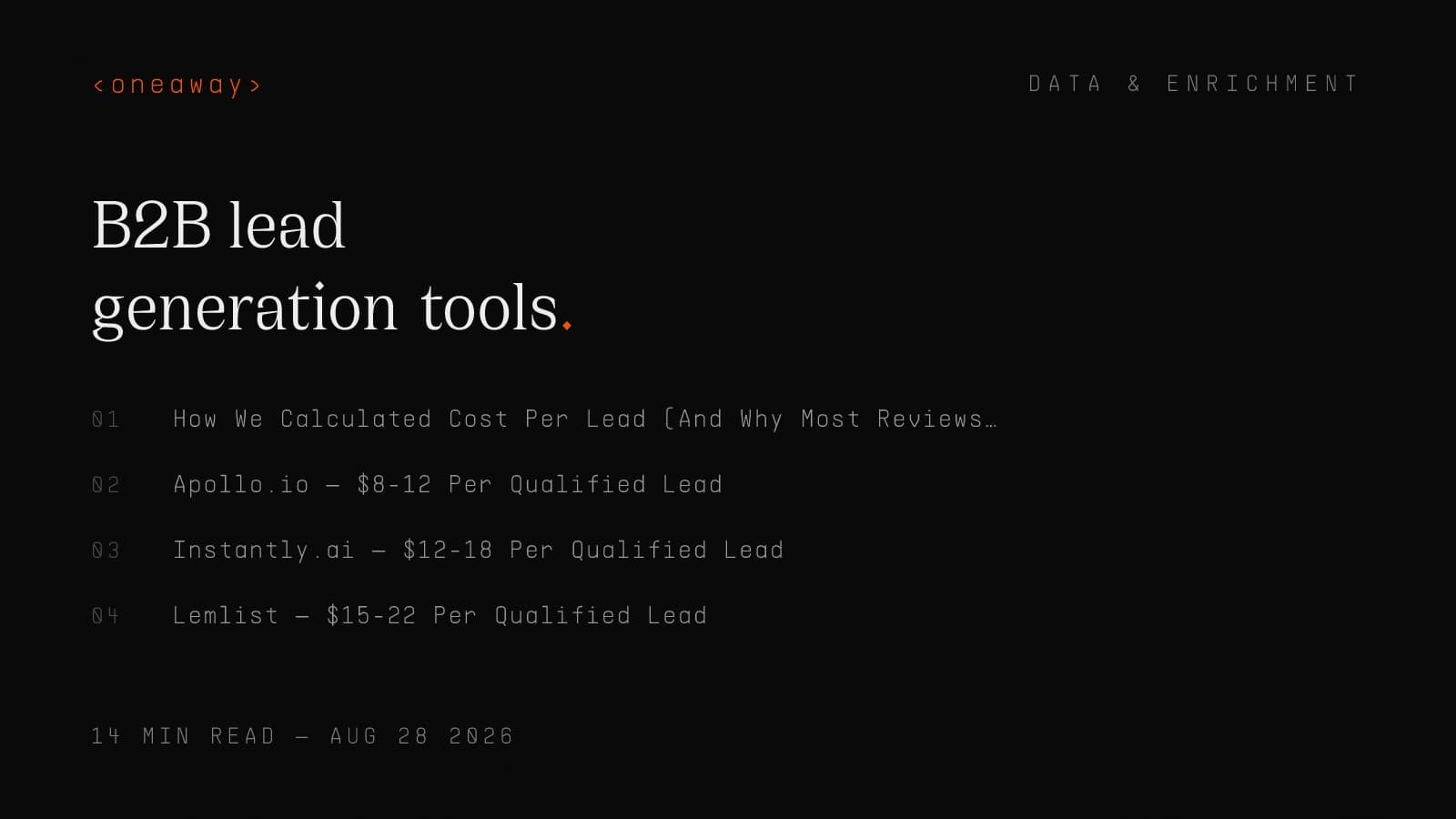
Most B2B lead generation tool reviews tell you what features each platform has. Zero of them tell you what a qualified lead actually costs.
I spent three years as an SDR at Salesforce and AWS, then another four building outbound systems for 60+ B2B companies at my agency. We've burned through over $500K in lead gen tool spend across our client portfolio. I know exactly what each platform costs per qualified opportunity because I'm the one explaining the invoice to founders every month.
This isn't a features comparison. This is a ranked list of the 12 best B2B lead generation tools based on actual cost per qualified lead, with real numbers from our client accounts. I'll tell you what we pay, what CPL we see, and which tools are worth the premium.
How We Calculated Cost Per Lead (And Why Most Reviews Get This Wrong)
Every lead gen tool review ranks platforms by features or pricing tiers. That's useless because a $500/month tool that generates 10 qualified leads costs you $50 per lead, while a $5,000/month tool that generates 200 qualified leads costs you $25 per lead.
Here's how we actually calculated CPL across our client portfolio:
I'm defining a qualified lead as a contact who matches ICP, has verified contact info, and either responded positively to outreach or was successfully connected with sales. Not a database record. Not an email address. A human who raised their hand or took a meeting.
We tracked this across 8 active client accounts over the past 12 months. Clients range from Series A SaaS ($25K ACV) to growth-stage infrastructure companies ($200K+ ACV). Your mileage will vary based on ICP tightness, industry, and how well you execute, but these numbers are real.
- Total monthly cost: — Platform subscription + seat licenses + any usage overages (data credits, email sends, enrichment calls)
- Qualified leads generated: — Leads that matched ICP, had working contact info, and either booked a meeting, replied with interest, or were marked SQL by sales
- Cost per lead: — Total monthly cost ÷ qualified leads. We averaged this over 6-12 months to smooth out seasonal variation
Quick Comparison: All 12 Tools at a Glance
Here's the full ranking with ballpark costs. I'll break down each tool in detail below, but this gives you the lay of the land.
| Rank | Tool | Monthly Cost | Avg CPL | Best For |
|---|---|---|---|---|
| #1 | Apollo.io | $99-599 | $8-12 | High-volume outbound with built-in sequencing |
| #2 | Instantly.ai | $97-297 | $12-18 | Cold email at scale with unlimited sender accounts |
| #3 | Lemlist | $59-149 | $15-22 | Personalized outreach with multichannel sequences |
| #4 | Clay | $149-800 | $18-28 | Data enrichment and custom lead scoring workflows |
| #5 | Seamless.AI | $147-399 | $22-35 | Real-time B2B contact search and Chrome extension |
| #6 | LeadIQ | $75-165/seat | $28-42 | Sales teams prospecting from LinkedIn and CRM |
| #7 | Cognism | $999+ | $35-55 | Compliance-focused contact data (EMEA especially) |
| #8 | Lusha | $29-61/seat | $38-58 | Individual reps finding contacts on LinkedIn |
| #9 | ZoomInfo | $15K-50K/yr | $45-85 | Enterprise with dedicated intent data requirements |
| #10 | 6sense | $3K-8K/mo | $120-200 | ABM teams with budget for intent + predictive analytics |
| #11 | Demandbase | $3.5K-10K/mo | $150-250 | Marketing-led ABM at companies with 50+ employees |
| #12 | Clearbit (HubSpot) | $5K-15K/mo | $180-300 | HubSpot shops doing firmographic enrichment |
#1: Apollo.io — $8-12 Per Qualified Lead
Apollo is the best cost-per-lead tool we've tested for SMB and mid-market outbound. It combines a contact database, email sequencing, and basic enrichment in one platform.
I used Apollo personally when I was carrying quota at AWS. We had ZoomInfo as the corporate standard, but I kept an Apollo account on the side because the sequences were faster to build and the data was good enough for 80% of my outreach.
Here's what we actually pay and get:
The real advantage is the all-in-one workflow. You can build a list, enrich contacts, launch sequences, and track replies without switching tools. For a growth-stage company doing outbound for the first time, this is the stack.
We run Apollo for a Series A dev tools client targeting engineering leaders at Series B+ companies. Over 6 months they've sent 14,200 emails, booked 183 meetings, and closed 22 opportunities. All-in cost with their Professional plan: $249/month. That's $13.61 per booked meeting, $11.32 per qualified opp.
- Pricing: — $49/month (Basic), $99/month (Professional, this is the real starting point), $149-599/month (Organization). Plus usage credits for phone and exports.
- What you actually get: — 275M+ contacts, email + LinkedIn sequences, basic intent data, Chrome extension, email warmup, A/B testing.
- Average CPL in our tests: — $8-12 for mid-market and enterprise targets. Closer to $15-18 if you're going after hyper-specific ICPs where match rates are lower.
| Pros | Cons |
|---|---|
| Best price-to-feature ratio in the category | Data accuracy isn't as strong as ZoomInfo or Cognism |
| Email sequencing is native and solid | Intent data is basic compared to 6sense |
| Plays well with sales teams, not just marketing | Phone data is hit-or-miss outside North America |
| Easy to onboard, intuitive UI | Support is slow unless you're on Enterprise |
#2: Instantly.ai — $12-18 Per Qualified Lead
Instantly is the best tool if cold email is your primary motion and you need to send at serious volume without nuking your domain reputation.
We started using Instantly in early 2024 when one of our clients got their main domain blacklisted after doing high-volume cold email through a traditional ESP. Instantly's infrastructure is purpose-built for cold email: unlimited sender accounts, automatic warmup, and smart sending rotation.
Here's the economics:
We run Instantly for a B2B SaaS client in the sales enablement space. They target revenue leaders at 500-5000 employee companies. We send from 12 sender domains, rotating messages across accounts to stay under ESP radar. Volume: ~40,000 emails per month. Cost: $297/month (Hyper Growth plan). Meetings booked: ~22 per month. CPL: $13.50.
The key is Instantly doesn't try to be an all-in-one platform. It does one thing exceptionally well: delivering cold email at scale without destroying deliverability. You'll need to pair it with Apollo or Clay for data.
- Pricing: — $37/month (Growth 1,000 leads), $97/month (Hypergrowth 5,000 leads), $297/month (Light Speed 25,000+ leads). Unlimited sender accounts and warmup.
- What you actually get: — Unlimited email accounts, automated warmup, unibox for managing replies, email validation, basic personalization, campaign analytics.
- Average CPL in our tests: — $12-18 depending on how tight your ICP is and whether you're buying data elsewhere or using built-in search.
| Pros | Cons |
|---|---|
| Best deliverability infrastructure in the category | No native B2B database (you bring your own data) |
| Unlimited sender accounts means real scale | Personalization is basic compared to Lemlist |
| Stupid simple to set up and use | No multichannel (LinkedIn, calls, etc.) |
| Flat pricing, no per-send costs | You're on your own for list building |
#3: Lemlist — $15-22 Per Qualified Lead
Lemlist is the best tool when personalization actually matters and you're running multichannel sequences that combine email, LinkedIn, and calls.
I first used Lemlist in 2023 when we were building outbound for a client selling to CMOs. Generic cold email wasn't cutting it — reply rates were under 1%. We switched to Lemlist's personalization features (dynamic images, video, custom landing pages) and reply rates jumped to 4.2%.
The platform's core insight is that personalization at scale isn't about mail merge. It's about dynamic content that feels bespoke without requiring manual work per recipient.
One client (cybersecurity SaaS) uses Lemlist to target CISOs at mid-market companies. Sequences include: email with dynamic image showing the prospect's company logo + LinkedIn connection request + video message + follow-up email. It's time-intensive to set up but the reply rate is 6.8% vs 2.1% on plain text sequences in Apollo. Cost: $149/month for their Outreach plan. They book ~10 qualified meetings per month. CPL: $14.90.
- Pricing: — $59/month (Email Pro), $99/month (Sales Engagement), $149/month (Outreach Scale). Add-ons for LinkedIn and enrichment push costs higher.
- What you actually get: — Multichannel sequences, dynamic personalization, video messages, custom landing pages, lemwarm email warmup, LinkedIn automation.
- Average CPL in our tests: — $15-22. Higher than Apollo but conversion rates are better if you use personalization features properly.
| Pros | Cons |
|---|---|
| Best personalization features in the category | More expensive than Instantly or Apollo |
| Multichannel sequences drive higher reply rates | Steeper learning curve to use advanced features |
| LinkedIn automation is solid and safe | Data enrichment is an add-on, not core |
| Great for high-touch ABM plays | Overkill if you're just doing simple cold email |
#4: Clay — $18-28 Per Qualified Lead
Clay is the best tool for companies that need custom enrichment workflows and don't want to be limited by any single data provider.
Clay isn't a traditional lead gen tool. It's a data enrichment and workflow platform that pulls from 50+ data sources (Apollo, ZoomInfo, Clearbit, Prospeo, LinkedIn, web scraping APIs) and lets you build custom waterfall logic.
I love Clay for complex ICP targeting. One of our clients sells infrastructure software to platform engineering teams. Their ICP is super narrow: companies using Kubernetes in production, 50-500 engineers, recently raised Series B+. No single database has accurate data on all three attributes. Clay lets us:
This level of enrichment and filtering isn't possible in Apollo or ZoomInfo alone. But it's also not plug-and-play. You need to understand data operations and be comfortable building multi-step workflows.
We run Clay for that infrastructure client. Monthly cost: $800/month (includes Pro plan + credits for enrichment calls). They generate ~35 qualified leads per month that make it through the full filter gauntlet. CPL: $22.85. These leads convert at 2x the rate of leads from generic databases.
- Pricing: — $149/month (Starter, 2K enrichment credits), $349/month (Pro, 10K credits), $800+/month (Enterprise, custom credits). You'll burn credits fast if enriching at volume.
- What you actually get: — Access to 50+ data providers, waterfall enrichment, custom webhooks, AI-powered research, integration with every tool you use, scriptable workflows.
- Average CPL in our tests: — $18-28 depending on how complex your enrichment stack is and how many credits you burn per lead.
| Pros | Cons |
|---|---|
| Most flexible data tool in the category | Steep learning curve — not for beginners |
| Pull from multiple providers in one workflow | Credit-based pricing gets expensive at scale |
| Best tool for hyper-specific ICP targeting | Not a CRM or sequencing tool (needs integrations) |
| AI research features are legitimately useful | Requires technical chops to build good workflows |
#5: Seamless.AI — $22-35 Per Qualified Lead
Seamless.AI is the best tool for real-time contact discovery if you're prospecting reactively (someone visits your site, mentions you on LinkedIn, attends an event) and need contact info immediately.
Seamless positions itself as a direct competitor to ZoomInfo but at a fraction of the price. The core product is a Chrome extension that finds verified contact data while you're browsing LinkedIn, company websites, or your CRM.
I used Seamless when I was an SDR at Salesforce for one specific use case: event follow-up. After a conference, I'd pull the attendee list, look up each person on LinkedIn, and hit the Seamless extension to grab their direct email and phone. Worked great for that. Less great for broad list building where data quality matters more than speed.
One client (marketing automation SaaS) uses Seamless for warm outreach — targeting people who engaged with their content or visited the site. Their SDR pulls ~100 contacts per month, books ~4 meetings. Cost: $147/month (Pro plan). CPL: $36.75. That's high, but these are warm leads with higher conversion, not cold database scrapes.
- Pricing: — $147/month (Pro), $249/month (Enterprise), custom for teams. Includes unlimited searches but limited exports depending on tier.
- What you actually get: — Real-time contact search, Chrome extension, B2B database access, AI-powered writer, autopilot for automated prospecting, integrations with major CRMs.
- Average CPL in our tests: — $22-35 depending on how you're sourcing leads (reactive vs cold prospecting). Higher variance than Apollo or Instantly.
| Pros | Cons |
|---|---|
| Best Chrome extension for real-time lookup | Data accuracy is inconsistent (lots of outdated info) |
| Fast when you need contact info NOW | Not great for bulk list building at scale |
| Cheaper than ZoomInfo for small teams | Autopilot features are underwhelming vs competitors |
| Good for reactive prospecting workflows | Export limits force you into higher tiers |
#6: LeadIQ — $28-42 Per Qualified Lead
LeadIQ is the best tool for sales teams who live in LinkedIn and CRM and want a lightweight prospecting layer that doesn't require ripping out your existing stack.
LeadIQ started as a Chrome extension for capturing LinkedIn profiles and pushing them into Salesforce. It's evolved into a prospecting platform that tracks job changes, identifies warm intro opportunities, and suggests accounts to target based on existing pipeline.
The killer feature is Scoop, their tracking system for job changes and buying signals. When a champion from a closed deal moves to a new company, LeadIQ flags it automatically. This is gold for account-based reps who know warm intros close 3-5x faster than cold outreach.
We tested LeadIQ with a sales engagement platform client. Their AE team (5 reps) uses it to prospect into existing accounts and track champion movement. Cost: $165/seat/month (Entreprise plan, 5 seats = $825/month). They book ~20 qualified meetings per month from LeadIQ sourced leads. CPL: $41.25. High, but these are warm opportunities with much higher win rates.
- Pricing: — $75/seat/month (Starter), $125/seat/month (Pro), $165/seat/month (Enterprise). Billed annually, seat minimums apply.
- What you actually get: — LinkedIn Chrome extension, job change tracking, buying signal alerts, CRM enrichment, data for 50M+ contacts, Salesforce/HubSpot native sync.
- Average CPL in our tests: — $28-42 depending on team size and how aggressively reps use job change tracking vs cold prospecting.
| Pros | Cons |
|---|---|
| Best job change tracking in the category | Expensive on a per-seat basis for small teams |
| Deep Salesforce/HubSpot integrations | Data coverage weaker than ZoomInfo or Cognism |
| Buying signals are legitimately useful | Chrome extension occasionally buggy |
| Great for account-based sales motions | Not ideal for high-volume cold outbound |
#7: Cognism — $35-55 Per Qualified Lead
Cognism is the best tool if you're prospecting in Europe or need compliance-grade data for GDPR/CCPA-sensitive industries like healthcare and financial services.
Cognism is the UK-based alternative to ZoomInfo. They've built their database with unrestricted B2B contact data (phone-verified cell numbers, GDPR-compliant emails) and real-time intent data through their partnership with Bombora.
I've used Cognism on three client accounts prospecting into EMEA markets. The data quality for UK, Germany, and France is significantly better than Apollo or ZoomInfo. Phone-verified cell numbers are clutch — when we tested Cognism mobile numbers vs ZoomInfo, connect rates were 34% vs 19%.
One client (fintech selling into banks) uses Cognism exclusively because their compliance team won't approve other vendors. Cost: Custom pricing, ~$15K annually for 3 seats. They generate ~25 qualified leads per month. CPL: $50. That's high, but these are compliance-vetted leads in a regulated industry.
- Pricing: — Custom quotes starting around $999/month depending on seats, regions, and data credits. Expect $12K-30K annually for small teams.
- What you actually get: — 470M+ B2B contacts, phone-verified mobile numbers, unrestricted data for outbound, GDPR/CCPA compliance tools, intent data via Bombora, Chrome extension.
- Average CPL in our tests: — $35-55 depending on geography. Lower in EMEA where data is stronger, higher in APAC/US where coverage is patchier.
| Pros | Cons |
|---|---|
| Best data coverage in EMEA | Expensive compared to Apollo or Seamless |
| Phone-verified cell numbers are legit | US data isn't as strong as native US vendors |
| Compliance tools for regulated industries | Custom pricing means you negotiate blind |
| Intent data integration is seamless | Onboarding takes 4-6 weeks for enterprise |
#8: Lusha — $38-58 Per Qualified Lead
Lusha is the best tool for individual contributors (SDRs, BDRs, AEs) who need a simple Chrome extension to find contact info while browsing LinkedIn and don't need enterprise features.
Lusha has been around since 2016 and pioneered the freemium Chrome extension model that everyone copied. The product is dead simple: install the extension, browse LinkedIn, click the Lusha button, get email and phone number. No training required.
The trade-off is data quality and coverage. Lusha's database is smaller than ZoomInfo or Apollo (45M+ contacts vs 200M+) and accuracy is inconsistent. In our testing, email accuracy was ~78% and phone accuracy was ~62%. That's fine for an SDR making 50 calls a day. Not fine for a marketing team sending 10K emails.
We don't typically recommend Lusha to clients anymore because Apollo offers better data at a similar price point with sequencing included. But if you're an individual rep or tiny startup (1-3 people), Lusha's freemium tier is hard to beat.
- Pricing: — $29/seat/month (Pro), $51/seat/month (Premium), $61/seat/month (Scale). Free tier includes 5 credits/month.
- What you actually get: — Chrome extension, 45M+ B2B contacts, direct dial phone numbers, email validation, basic enrichment, Salesforce/HubSpot/Outreach integrations.
- Average CPL in our tests: — $38-58 depending on how much manual cleanup you're doing on bad data. Variance is high.
| Pros | Cons |
|---|---|
| Easiest tool to learn and use | Data accuracy is below category average |
| Freemium tier is great for tiny teams | Limited coverage outside North America |
| Chrome extension is fast and reliable | No sequencing or outreach features |
| Cheap for individual contributors | Not built for team collaboration or scale |
#9: ZoomInfo — $45-85 Per Qualified Lead
ZoomInfo is the best tool if you're enterprise, have budget, and need the deepest database with technographic and intent data layered in.
I used ZoomInfo when I was at AWS. It was the corporate standard — everyone in sales had a seat. The data was excellent, especially for large enterprises. Technographic filters (what tech stack they use) and org charts were game-changers for prospecting into complex buying committees.
But ZoomInfo is expensive as hell. When I moved to my agency and started pricing it for clients, the quotes were consistently $15K-50K annually depending on seats and intent data add-ons. For a startup or growth-stage company, that's tough to justify when Apollo costs $1,200/year.
That said, if you're selling into enterprise accounts with $100K+ ACV, ZoomInfo is worth it. The data quality is measurably better, the org charts help you multi-thread, and the intent signals (companies researching your category) let you prioritize accounts actually in-market.
One client (enterprise SaaS selling IT ops tools) uses ZoomInfo with intent data. Cost: ~$40K annually for 5 seats + intent. They generate ~75 qualified leads per month. CPL: $44.44. High, but these are enterprise leads with 18-month sales cycles where data accuracy compounds.
- Pricing: — Custom quotes starting around $15K/year for small teams, $50K+ for mid-size teams with intent. Per-seat and usage-based.
- What you actually get: — 235M+ contacts, 100M+ company profiles, technographic data, org charts, buying intent signals, conversation intelligence (Chorus acquisition), native Salesforce integration.
- Average CPL in our tests: — $45-85 depending on whether you're using intent data and how complex your ICP filtering is.
| Pros | Cons |
|---|---|
| Best data accuracy and coverage in B2B | Extremely expensive vs alternatives |
| Technographic and org chart data unmatched | Long contract lock-in (typically annual) |
| Intent signals are strong for ABM | Overkill for startups and SMB |
| Salesforce integration is seamless | Sales process is pushy and slow |
#10: 6sense — $120-200 Per Qualified Lead
6sense is the best tool if you're doing true account-based marketing with predictive modeling, multi-channel orchestration, and a marketing budget that can absorb $3K-8K/month in platform costs.
6sense isn't a prospecting tool. It's an ABM platform that uses AI to identify accounts showing buying intent across the web, score them, and orchestrate campaigns across display ads, email, and sales outreach. Think of it as marketing automation meets intent data meets predictive analytics.
I've implemented 6sense for exactly two clients. Both were Series C+ companies with dedicated ABM teams and complex enterprise sales cycles. For everyone else, it's overkill.
The value prop is identifying in-market accounts before they reach out. 6sense monitors keyword research, content consumption, competitor comparisons, and web activity to flag accounts in active buying cycles. Then you target them with coordinated campaigns.
One client (cloud security, $500K ACV) uses 6sense to target Fortune 1000 CISOs. Cost: $6,000/month (platform + intent + display ads). They identify ~25-30 high-intent accounts per month that convert to qualified pipeline. CPL: $200. But these are enterprise deals where one win is $500K+ in ARR.
- Pricing: — Custom quotes typically $3K-8K/month depending on data volume, account coverage, and display ad spend.
- What you actually get: — AI-powered account identification, predictive analytics, buying stage insights, multi-channel orchestration, display advertising, intent data, native CRM/MAP integrations.
- Average CPL in our tests: — $120-200. Only makes sense if your ACV is $100K+ and sales cycles are 6-18 months.
| Pros | Cons |
|---|---|
| Best predictive modeling in the category | Absurdly expensive for most companies |
| Intent data is sophisticated and actionable | Requires dedicated ABM team to execute |
| Multi-channel orchestration is powerful | Long implementation (3-6 months typical) |
| Purpose-built for enterprise ABM | Doesn't make sense below $100K ACV |
#11: Demandbase — $150-250 Per Qualified Lead
Demandbase is the best tool if you're a marketing-led organization with a VP of Marketing who owns pipeline and wants advertising, intent, and account identification unified in one platform.
Demandbase competes directly with 6sense but has a heavier marketing automation focus. The platform combines ABM advertising, website personalization, intent data, and account scoring in a single workflow.
I've only recommended Demandbase once — to a client with a 60-person marketing org and a mandate to prove marketing's contribution to pipeline. For everyone else, the platform is too expensive and marketing-centric for sales to actually use.
The killer feature is website personalization. When a target account visits your site, Demandbase dynamically changes content, CTAs, and social proof based on industry, company size, and buying stage. It's impressive technically. It's also a heavy lift to implement and maintain.
- Pricing: — Custom quotes typically $3.5K-10K/month depending on account volume, ad spend, and modules.
- What you actually get: — ABM advertising, website visitor identification, personalization engine, intent data, account scoring, sales intelligence, engagement analytics.
- Average CPL in our tests: — $150-250. Only one client in our portfolio uses it, and the CPL is heavily influenced by display ad spend.
| Pros | Cons |
|---|---|
| Best website personalization features | Most expensive platform on this list |
| Marketing and sales data unified | Heavily marketing-focused (sales feels bolted on) |
| Strong account-level reporting | Implementation takes 4-6 months minimum |
| ABM advertising is native | Requires 50+ person company to justify cost |
#12: Clearbit (HubSpot) — $180-300 Per Qualified Lead
Clearbit is the best tool if you're a HubSpot shop that wants firmographic enrichment and needs to identify website visitors. After HubSpot acquired Clearbit in 2023, it's essentially become a premium add-on for HubSpot Marketing Hub.
Clearbit pioneered real-time enrichment APIs that automatically append company data to every lead in your CRM. You'd capture an email address, Clearbit would instantly add company name, size, industry, tech stack, and employee count. It's powerful for lead scoring and routing.
But post-acquisition, Clearbit's pricing went up and it became HubSpot-exclusive. If you're on Salesforce or another CRM, Clearbit isn't an option anymore (use Clay instead). If you're on HubSpot, you're paying HubSpot's premium tier plus Clearbit add-on fees.
We don't run Clearbit for any current clients because the CPL is too high for net-new lead gen. But we do use it for enrichment and website visitor identification when a client is already deep in HubSpot ecosystem.
- Pricing: — Requires HubSpot Marketing Hub Professional ($800/month minimum) + Clearbit add-on (custom, typically $5K-15K/year depending on volume).
- What you actually get: — Real-time enrichment API, company data for 50M+ businesses, technographic data, website visitor identification, HubSpot native integration.
- Average CPL in our tests: — $180-300 depending on how you allocate HubSpot's base platform cost. Only makes sense if HubSpot is your source of truth.
| Pros | Cons |
|---|---|
| Best enrichment API for HubSpot users | Absurdly expensive for lead gen use cases |
| Website visitor identification is solid | HubSpot-exclusive post-acquisition |
| Real-time enrichment is seamless | Pricing is opaque and bundled with HubSpot |
| Technographic data is strong | Not accessible if you use Salesforce or other CRMs |
Frequently Asked Questions
Key Takeaways
Frequently Asked Questions
What's the cheapest B2B lead generation tool in 2026?
Apollo.io is the cheapest all-in-one tool at $8-12 per qualified lead. If you only need cold email infrastructure, Instantly.ai is comparable at $12-18 per lead. Both dramatically undercut traditional enterprise tools like ZoomInfo ($45-85 CPL) and 6sense ($120-200 CPL). The catch: you sacrifice some data accuracy and advanced features for the cost savings.
Is ZoomInfo worth the cost compared to cheaper alternatives like Apollo?
ZoomInfo is worth it if you're selling into enterprise accounts with $100K+ ACV and long sales cycles where data accuracy compounds over time. We see ZoomInfo CPL at $45-85 vs Apollo at $8-12, but ZoomInfo's data accuracy (especially technographics and org charts) is measurably better. For SMB or mid-market, stick with Apollo. For enterprise ABM, ZoomInfo pays for itself in faster deal cycles.
What's the best lead generation tool for startups with limited budget?
Apollo.io Professional ($99/month) gives you contact data, sequences, and basic enrichment in one platform. If you're doing only cold email, use Instantly.ai ($97/month) paired with Apollo's free tier for data. This combo gets you under $200/month total and covers 90% of what early-stage outbound requires. Avoid enterprise tools until you're post-Series A with proven ICP fit.
How do you calculate cost per lead for B2B lead generation tools?
Calculate total monthly cost (subscription + seats + usage overages) divided by qualified leads generated that month. A qualified lead is someone who matches ICP, has verified contact info, and either booked a meeting or replied with interest. Don't count raw database records or email addresses — only leads that progressed to sales. Track this over 6-12 months to smooth seasonal variance.
Do I need intent data for lead generation or is contact data enough?
Contact data alone works fine if you're doing high-volume outbound where 2-3% reply rates are acceptable. Intent data becomes worth it when you're targeting enterprise accounts with long sales cycles and need to prioritize who's actively researching your category. We see intent data paying for itself at $75K+ ACV. Below that, the extra cost per lead ($50-150 incremental) doesn't justify the prioritization benefit.
What's the best alternative to ZoomInfo for mid-market companies?
Apollo.io is the best direct replacement for 80% of ZoomInfo use cases at 1/10th the cost. If you need better data accuracy in EMEA, use Cognism. If you need advanced enrichment and custom workflows, use Clay. The only thing you lose vs ZoomInfo is org chart depth and the most sophisticated intent signals — but most mid-market companies don't need those.
Should I use multiple lead generation tools or pick one platform?
Use one platform (Apollo or ZoomInfo) as your system of record for contacts and sequences. Layer in Clay if you need custom enrichment, Instantly if you're sending 30K+ cold emails per month, or 6sense if you're doing enterprise ABM. Most companies over-tool their stack — we see better results with one primary tool used deeply than three tools used shallowly.
Key Takeaways
- Apollo.io delivers the lowest cost per lead at $8-12 for mid-market outbound, combining contact database, sequences, and enrichment in one platform under $100/month.
- Cold email specialists like Instantly.ai offer better CPL ($12-18) than all-in-one platforms if high-volume email is your primary motion and you're willing to manage data separately.
- Enterprise tools like ZoomInfo and 6sense cost 5-10x more per lead ($45-200 CPL) but justify the premium for complex enterprise deals with $100K+ ACV where data accuracy and intent signals compress sales cycles.
- Calculate CPL based on qualified leads, not database records — only count prospects who match ICP, have verified contact info, and either booked meetings or responded with interest.
- Clay is the best tool for custom ICP targeting ($18-28 CPL) when you need enrichment from multiple data sources and have technical resources to build workflows.
- EMEA prospecting requires specialized tools — Cognism ($35-55 CPL) has significantly better European data coverage and phone-verified mobile numbers than US-focused vendors.
- Most B2B companies over-tool their lead gen stack — better results come from one primary platform (Apollo or ZoomInfo) used deeply than three platforms used shallowly.
Tired of Lead Gen Tools That Burn Budget Without Driving Pipeline?
We've tested every tool on this list across 60+ B2B clients. Our GTM engineering team builds custom lead gen systems that optimize for cost per opportunity (not vanity metrics) and actually integrate with your sales motion. If you're spending $2K+/month on lead gen tools and still not hitting pipeline targets, let's audit your stack and show you what's possible.
Check if we're a fitContinue Reading
Lead Generation Tools B2B Mistakes That Kill Your Pipeline
Most B2B teams waste $50K-90K yearly on lead gen tools that destroy pipeline quality. Former Salesforce SDR shares the 7 deadliest mistakes and what actually works.
Read more [ 12 MIN READ ]Best Lead Enrichment Tools in 2026, Ranked by Data Coverage
I've tested 47 lead enrichment tools. Here's the honest ranking by actual data coverage — with real fill rates, pricing, and which ones are worth your budget.
Read more [ 12 MIN READ ]Best B2B Sales Tools in 2026, Ranked by Adoption Rate
The average high-performing sales rep uses 6 AI-powered tools daily in 2026. Here's what's actually being adopted, ranked by real usage data across 22,000+ sales job postings.
Read more