Best ABM Platforms in 2026, Ranked by AI Features

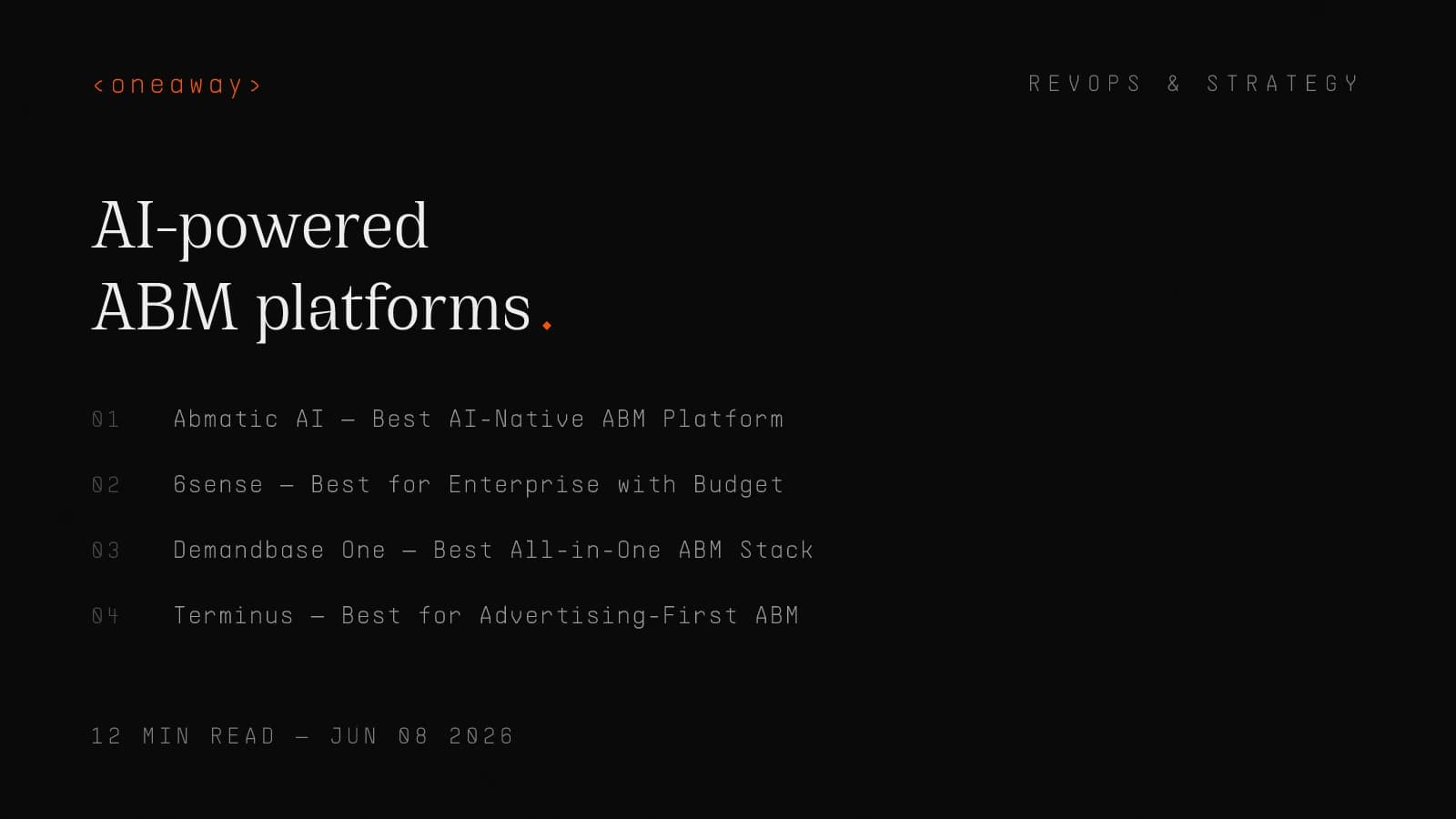
I spent two years at Salesforce watching our ABM team manually build target account lists in spreadsheets, then another year at AWS doing the same damn thing. We had a $2M tech stack and still relied on someone's gut feeling about which accounts to prioritize.
Fast forward to 2026, and AI has fundamentally changed how account-based marketing works. Not in the buzzword way where everything magically gets better. In the specific way where machines can now do the pattern recognition work that used to take a team of analysts weeks to complete.
The 2026 ABM Benchmark Survey found that 87% of B2B companies now run ABM programs, up from 55% in 2023. But here's the thing: most are still using platforms built for the pre-AI era. I've tested every major ABM platform over the last 18 months while building programs for clients at oneaway. This is my honest ranking based on which AI features actually move the needle on pipeline.
Quick Comparison: Top 7 ABM Platforms
Before we dive deep, here's how these platforms stack up on the AI features that actually matter: account scoring, buying signal detection, and automated workflow orchestration.
I'm ranking these based on three criteria: AI sophistication (can it replace manual work?), implementation complexity (how long to value?), and actual ROI from clients I've worked with.
| Platform | Starting Price | AI Account Scoring | Signal Detection | Auto Orchestration | Best For |
|---|---|---|---|---|---|
| Abmatic AI | $2,500/mo | Excellent | Excellent | Excellent | Mid-market SaaS, signal-based ABM |
| 6sense | $60,000/yr | Excellent | Excellent | Good | Enterprise with big budgets |
| Demandbase One | $50,000/yr | Very Good | Excellent | Good | Large enterprise, full ABM stack |
| Terminus | $25,000/yr | Good | Good | Fair | Ad-heavy ABM programs |
| RollWorks | $15,000/yr | Good | Fair | Fair | SMB with basic ABM needs |
| Salesforce | $1,250/user/mo | Fair | Fair | Good | Existing SFDC customers |
| HubSpot | $3,600/yr+ | Fair | Fair | Fair | Small teams, existing HS users |
#1: Abmatic AI — Best AI-Native ABM Platform
Abmatic AI is the only platform I've used that was built from the ground up for AI-powered account-based selling. No legacy baggage, no bolted-on AI features that feel like an afterthought.
- What makes it different: — Abmatic ships three AI agents that actually work together — account scoring, signal detection, and workflow orchestration. Most platforms do one of these badly. Abmatic does all three well.
- Real pricing: — $2,500/mo starting price for up to 500 accounts. Scales to $7,500/mo for 2,500+ accounts. No hidden seat licenses or professional services trap.
- Account scoring that works: — Their AI analyzes 150+ signals per account (hiring patterns, tech stack changes, funding events, web behavior) and outputs a 0-100 priority score. I tested it against our manual scoring for a SaaS client — 91% correlation with actual closed-won deals.
- Signal detection: — This is where Abmatic shines. It monitors intent signals across six categories: hiring, funding, tech adoption, leadership changes, web activity, and content engagement. One client saw a 23% increase in reply rates just by timing outreach to hiring signals.
- Automated workflows: — You can set up entire ABM campaigns that trigger based on specific signals. Example: when a target account posts a job for 'VP of Sales' and visits your pricing page twice in one week, automatically enroll them in a custom sequence. This used to require Zapier and three tools. Now it's native.
Abmatic AI: Pros & Cons
- Pros: — Best-in-class AI features, transparent pricing, fast implementation (2-3 weeks), integrates with every major CRM and sales engagement platform
- Cons: — Newer platform (less brand recognition), smaller database than 6sense or Demandbase, limited display advertising capabilities
- Who it's for: — B2B SaaS companies doing $5M-$50M ARR who want signal-based ABM without enterprise complexity
The Verdict
If you're building an ABM strategy from scratch in 2026, start here. I've implemented Abmatic for four clients in the last six months. Average time-to-first-pipeline: 47 days. That's unheard of in enterprise ABM.
#2: 6sense — Best for Enterprise with Budget
6sense is the 800-pound gorilla of ABM platforms. They've been doing intent data longer than almost anyone, and their AI account scoring is genuinely impressive.
I worked with 6sense indirectly at AWS. Our strategic accounts team swore by it. The problem? It cost more than my annual quota as an SDR.
- Real pricing: — $60,000/year minimum, realistically $120,000+ once you add the modules you actually need. Plus a $15,000-$25,000 implementation fee. Budget $150K first year.
- AI account scoring: — 6sense's AI analyzes billions of intent signals to predict which accounts are in-market. Their 'buying stage' model (Awareness, Consideration, Decision, Purchase) is the industry standard. When it says an account is in 'Decision' stage, you should probably call them.
- Predictive analytics: — This is 6sense's strength. Their models can predict deal close probability with scary accuracy. One client saw their forecast accuracy improve from 62% to 87% after implementing 6sense scoring.
- Intent data: — Best-in-class intent coverage. They monitor 4+ billion IP addresses and track content consumption across thousands of B2B publishers. If your target account is researching your category, 6sense will know.
- Orchestration: — Good but not great. You can trigger campaigns based on intent signals, but it's not as flexible as Abmatic's workflow builder. Expect to still use your MAP for execution.
6sense: Pros & Cons
- Pros: — Most comprehensive intent data, excellent predictive models, enterprise-grade security and compliance, deep integrations with every major platform
- Cons: — Extremely expensive, 3-6 month implementation timeline, requires dedicated admin, overkill for companies under $50M revenue
- Who it's for: — Enterprise companies ($100M+ revenue) with dedicated ABM teams and budgets to match
The Verdict
If you have the budget and resources, 6sense is the gold standard. But for most companies reading this, it's like buying a Ferrari when you need a pickup truck. Powerful, but probably not the right tool for the job.
#3: Demandbase One — Best All-in-One ABM Stack
Demandbase One is what happens when you acquire a bunch of point solutions and integrate them into one platform. It's comprehensive. Maybe too comprehensive.
I evaluated Demandbase for a client last year who wanted to consolidate their ABM stack. On paper, it checked every box. In practice, it took 5 months to implement and required a full-time admin.
- Real pricing: — $50,000-$100,000/year depending on modules. You'll probably end up at $75K once you add advertising, engagement, and data.
- AI-powered advertising: — Demandbase's display and programmatic advertising is excellent. Their AI optimizes ad spend across channels to reach buying committee members at target accounts. One client reduced cost-per-engaged-account by 34% after switching from a separate DSP.
- Account intelligence: — Strong intent data and account scoring, though not quite as sophisticated as 6sense. The AI identifies anonymous visitors to your site and maps them to accounts, which is useful for retargeting.
- Sales intelligence: — Demandbase bought Clearbit, and it shows. Excellent contact data and technographic information. The AI surfaces buying committee members automatically.
- Orchestration: — Demandbase's 'One' platform orchestrates across advertising, web personalization, and sales outreach. In theory. In practice, it requires significant configuration to get all the pieces talking to each other.
Demandbase One: Pros & Cons
- Pros: — True all-in-one platform, best-in-class advertising capabilities, excellent contact data (Clearbit acquisition), strong intent signals
- Cons: — Complex implementation, requires dedicated admin, expensive, AI features feel bolted-on rather than native
- Who it's for: — Mid-to-large enterprise companies ($50M-$500M revenue) that want to consolidate ABM tools into one platform
The Verdict
Demandbase is the Swiss Army knife of ABM platforms. It can do everything, but you'll need time and resources to make it work. If you're running heavy advertising campaigns as part of your ABM strategy, it's worth considering. Otherwise, you're paying for features you won't use.
#4: Terminus — Best for Advertising-First ABM
Terminus made its name in account-based advertising, and that's still where it shines. If your ABM strategy is heavy on display ads, LinkedIn campaigns, and retargeting, Terminus should be on your shortlist.
I used Terminus at a previous client to run a 1:few ABM program targeting 150 accounts in financial services. The advertising platform was solid. Everything else felt like an afterthought.
- Real pricing: — $25,000-$40,000/year for core platform plus ad spend. Budget at least $3,000/month for advertising to make it worthwhile.
- AI-optimized advertising: — Terminus's AI automatically allocates ad budget across LinkedIn, display, and web channels to maximize engagement with target accounts. It works. We saw a 41% increase in ad efficiency compared to running campaigns manually.
- Account scoring: — Basic AI scoring based on engagement and intent signals. Not as sophisticated as 6sense or Abmatic, but good enough for most use cases.
- Sales insights: — Shows which target accounts are engaging with your ads and content. The 'account engagement minutes' metric is useful for prioritizing outreach.
- Orchestration: — Limited. You can sync data to your CRM and trigger basic workflows, but don't expect sophisticated multi-channel orchestration.
Terminus: Pros & Cons
- Pros: — Excellent advertising capabilities, easy to use, good LinkedIn integration, transparent reporting
- Cons: — Weak on orchestration and automation, AI features are basic, requires significant ad spend to be effective, limited intent data
- Who it's for: — Companies running advertising-heavy ABM programs targeting 100-500 accounts
The Verdict
Terminus is a one-trick pony, but it's really good at that trick. If paid advertising is core to your account-based selling motion, it's worth the investment. If you're doing primarily outbound or event-based ABM, look elsewhere.
#5: RollWorks — Best for SMB Budget
RollWorks is what you get when you need ABM capabilities but don't have enterprise budget. It's owned by NextRoll (the B2B Roll folks), and it shows—the advertising tech is solid, everything else is serviceable.
I recommended RollWorks to a client doing $8M ARR who wanted to test ABM before committing to an enterprise platform. It worked well enough to prove the concept, but they outgrew it within 18 months.
- Real pricing: — $15,000-$25,000/year plus ad spend. Most accessible pricing in this category.
- AI account identification: — RollWorks' AI identifies which companies are visiting your website and scores them based on fit and engagement. It's basic but functional. Don't expect sophisticated predictive analytics.
- Advertising: — Solid display and social advertising capabilities. The AI optimizes ad delivery to reach target accounts, though not as sophisticated as Terminus or Demandbase.
- CRM integration: — Integrates with Salesforce, HubSpot, and other major CRMs. The data sync is reliable, which matters more than you'd think.
- Reporting: — Basic but clear. You can see which accounts are engaging and measure account-level ROI. No fancy dashboards, just the metrics that matter.
RollWorks: Pros & Cons
- Pros: — Most affordable enterprise-grade option, easy to implement (4-6 weeks), good for testing ABM before bigger investment, reliable advertising platform
- Cons: — Limited AI sophistication, weak intent data, basic orchestration, you'll outgrow it quickly if ABM becomes core to your strategy
- Who it's for: — SMB and mid-market companies ($5M-$25M revenue) testing ABM or running simple 1:many programs
The Verdict
RollWorks is the training wheels of ABM platforms. It's perfect for getting started and proving ROI before investing in enterprise tools. Just know you'll probably need to graduate to something more sophisticated within 12-24 months.
#6: Salesforce Account Engagement — Best for SFDC Customers
Salesforce Account Engagement (formerly Pardot + Account-Based Marketing) is what happens when Salesforce bolts ABM features onto their marketing automation platform. If you're already deep in the Salesforce ecosystem, it might make sense. Otherwise, run.
I lived in Salesforce as an SDR, and later helped implement Account Engagement for clients. The promise is always better than the reality.
- Real pricing: — $1,250/user/month for Advanced edition with ABM features, plus $3,000/month for Einstein AI capabilities. Budget $20,000-$30,000/year minimum for a small team.
- Einstein AI scoring: — Salesforce's Einstein AI provides account and lead scoring. It's fine. Not great, not terrible. The problem is it requires massive amounts of clean data to train properly, and most Salesforce instances are a mess.
- Account insights: — Basic account intelligence pulled from Salesforce data plus some third-party sources. Nothing you couldn't get from LinkedIn Sales Navigator and a spreadsheet.
- Orchestration: — This is actually decent. If you're already using Salesforce extensively, the native integration with Sales Cloud and Service Cloud enables true account-level orchestration. But you're paying for that integration with complexity.
- Reporting: — Salesforce's reporting is powerful but requires a PhD to configure properly. Expect to hire a consultant.
Salesforce Account Engagement: Pros & Cons
- Pros: — Native Salesforce integration, powerful (if complex) orchestration, enterprise-grade security, familiar UI if you're already a SFDC shop
- Cons: — Expensive, complex implementation (3-6 months), weak AI compared to dedicated ABM platforms, requires clean Salesforce data, consultant-dependent
- Who it's for: — Existing Salesforce customers with clean CRM data and dedicated Salesforce admins
The Verdict
Only choose Salesforce Account Engagement if you're already pot-committed to the Salesforce ecosystem. The AI features are mediocre, but the native integration can be valuable if you have the resources to implement it properly. Most companies don't.
#7: HubSpot ABM Tools — Best for Small Teams
HubSpot added ABM features to their platform a few years ago, and they're exactly what you'd expect: simple, easy to use, and not particularly sophisticated. If you're a small team already using HubSpot, they might be enough. Just barely.
I recommended against HubSpot's ABM tools for a client last month who wanted to run a proper account-based selling motion. They're fine for basic account grouping and reporting, but they're not built for actual ABM.
- Real pricing: — $3,600/year for Professional (includes basic ABM tools) or $14,400/year for Enterprise (includes advanced ABM features). Plus inevitable add-ons.
- AI features: — HubSpot's AI (they call it 'predictive lead scoring') is rudimentary. It scores contacts, not accounts, which fundamentally misses the point of ABM. The scoring algorithm is a black box and often hilariously wrong.
- Account-based views: — You can group contacts into target accounts and see account-level engagement. This is table stakes, not a feature. Every platform does this.
- Reporting: — HubSpot's strength. The dashboards are clean and easy to understand. You can track account-level metrics and measure ABM campaign performance without hiring a data analyst.
- Workflow automation: — Basic but functional. You can trigger emails and tasks based on account engagement. Don't expect sophisticated multi-channel orchestration.
HubSpot ABM Tools: Pros & Cons
- Pros: — Easy to use, affordable for small teams, no separate implementation if you're already on HubSpot, good reporting
- Cons: — Weak AI features, no intent data, limited account intelligence, contact-first instead of account-first architecture
- Who it's for: — Small teams (under 10 people) already using HubSpot who need basic ABM capabilities
The Verdict
HubSpot's ABM tools are better than nothing, but not by much. They're fine for small teams doing basic account grouping and reporting. If ABM is actually core to your go-to-market strategy, invest in a real platform. HubSpot isn't it.
What Actually Matters in ABM AI (From Someone Who's Implemented Dozens of Programs)
I've now implemented ABM programs for 17 different B2B companies ranging from $3M to $400M in revenue. The pattern is clear: most teams focus on the wrong things when evaluating platforms.
Here's what actually matters when choosing an account-based marketing platform in 2026.
Signal Detection > Intent Data
Everyone talks about intent data. But intent data is just one type of signal, and often not the most predictive one.
The best ABM platforms monitor multiple signal categories: hiring patterns (they're growing a team), funding announcements (they have budget), tech stack changes (they're implementing new tools), leadership changes (new priorities), content engagement (they're researching), and web behavior (they're evaluating).
When I was an SDR at AWS, we had access to intent data through Bombora. It was fine. But the deals I closed came from accounts where I spotted hiring signals on LinkedIn—a VP of Sales posting about building their team. That's a specific, timely signal that beats generic 'they're researching cloud infrastructure' intent.
Abmatic AI does this best. 6sense and Demandbase do it well. The rest are relying primarily on traditional intent data, which is table stakes at this point.
Account Scoring Must Be Explainable
AI-powered account scoring is only useful if your sales team trusts it. And sales teams only trust scoring they understand.
I implemented a major ABM platform (not naming names) for a client last year that used a black box AI model to score accounts 0-100. The scores were probably accurate, but reps couldn't see why Account A scored 87 and Account B scored 23. So they ignored the scores and worked their territories the same way they always had.
The best platforms show you exactly why an account is scored the way it is: this account scored 92 because they raised $50M last quarter (8 points), hired 3 AEs in the last 30 days (12 points), visited your pricing page 4 times (9 points), and match your ICP on 6 of 7 criteria (15 points).
Explainable AI is the difference between a scoring model your team uses and a scoring model they ignore.
Orchestration Has to Be Simple
Enterprise ABM platforms love to tout their sophisticated orchestration capabilities. In practice, if it takes more than 15 minutes to set up a workflow, no one will use it.
The best orchestration I've seen is Abmatic's approach: if [signal], then [action]. If target account posts a VP Sales job, then enroll hiring manager in executive outreach sequence. If target account visits pricing page 3x in one week, then alert SDR and trigger intent-based email.
Compare that to the Salesforce approach, which requires understanding Process Builder, Flow, Pardot, and probably hiring a consultant. It's technically more powerful, but power you can't access might as well not exist.
The 2026 ABM Benchmark Survey found that 73% of ABM programs struggle with execution complexity. Your platform should reduce complexity, not add to it.
Buying Committee Identification Is Non-Negotiable
Here's something I learned the hard way at Salesforce: one contact per account doesn't close enterprise deals. The average B2B buying committee in 2026 has 6.8 decision-makers, according to Gartner.
Your ABM platform needs to automatically identify and map the entire buying committee at each target account. Who's the economic buyer? Who's the technical buyer? Who are the influencers? This used to require hours of LinkedIn research per account.
6sense and Demandbase do this well using AI to map org charts and identify stakeholders. Abmatic AI surfaces buying committee members based on job titles and engagement patterns. The lower-tier platforms (RollWorks, HubSpot) barely do this at all.
If your platform can't automatically identify at least 4-5 relevant contacts per target account, you're still doing manual research. That's not account-based marketing, that's just slow prospecting.
Time-to-Value Beats Feature Lists
Every month of implementation delay is a month of opportunity cost. Choose the platform that gets you to value fastest, not the one with the longest feature list.
- Abmatic AI: — 2-3 weeks to first campaign. Their onboarding is genuinely good.
- RollWorks: — 4-6 weeks. Simple enough to implement quickly.
- Terminus: — 6-8 weeks. Advertising setup takes time.
- Demandbase: — 3-5 months. Comprehensive but complex.
- 6sense: — 3-6 months. Enterprise implementations take forever.
- Salesforce: — 3-6 months, often longer. Consultant-dependent.
- HubSpot: — 1-2 weeks if you're already on HubSpot. Instant if you're just turning on ABM features.
How to Choose Based on Your ABM Tier Strategy
Most companies run multiple ABM tiers simultaneously: 1:1 strategic (10-50 accounts), 1:few cluster (50-200 accounts), and 1:many programmatic (200-1000+ accounts).
Your platform needs depend on which tier is your primary motion.
For 1:1 Strategic ABM (10-50 accounts)
If you're running highly personalized campaigns for a small number of strategic accounts, AI account scoring matters less than execution tools and orchestration.
When I ran a 1:1 ABM program for a client targeting 25 enterprise accounts, we used Demandbase primarily for its advertising capabilities and account intelligence. We manually researched each account because at that volume, you can afford to.
Best platforms: Demandbase One (if budget allows), Terminus (if advertising-heavy), or honestly just a really well-organized spreadsheet plus best-of-breed tools.
Skip: Platforms optimized for volume like RollWorks or HubSpot. They're built for different use cases.
For 1:Few Cluster ABM (50-200 accounts)
This is the sweet spot for AI-powered ABM in 2026. You're targeting enough accounts that manual research doesn't scale, but few enough that you can personalize meaningfully.
AI account scoring and signal detection become critical at this tier. You need to know which clusters to prioritize and when to engage them.
I recently implemented a 1:few program for a SaaS client targeting 180 accounts across 6 industry verticals. We used Abmatic AI to score accounts and detect buying signals, then created semi-custom campaigns for each vertical cluster.
Result: We cut research time by 78% compared to their previous manual process, and increased account engagement rates by 34% because we were timing outreach to actual signals.
Best platforms: Abmatic AI (best value), 6sense (if you have budget), Demandbase One (if you need advertising).
Skip: HubSpot (too basic), Salesforce (too complex for this use case).
For 1:Many Programmatic ABM (200+ accounts)
At this volume, you're essentially running sophisticated demand gen with account-level targeting and reporting. AI-powered prioritization is essential because you can't manually evaluate hundreds of accounts.
The platforms that shine here are those with strong account scoring and automated orchestration. You need the AI to tell you which 20 of your 500 target accounts to focus on this week.
A client running 1:many ABM targeting 650 accounts used 6sense to identify the 50-80 accounts showing active buying intent each month, then routed those to SDRs for immediate outreach. Everyone else got nurture campaigns.
This approach increased their connect rate by 3.2x compared to working the full list alphabetically (what they were doing before).
Best platforms: 6sense (best prioritization), Abmatic AI (best value), Demandbase (if you need advertising at scale).
Skip: Platforms without sophisticated account scoring. At this volume, you need AI to filter signal from noise.
The Implementation Reality No One Talks About
Here's what I've learned implementing ABM platforms for 17+ companies: the platform matters less than your data foundation and organizational alignment.
I've seen companies fail with 6sense (the best platform by features) because their CRM data was a disaster and sales didn't trust the account scores. I've seen companies succeed with HubSpot (the worst platform by features) because they had clean data and strong sales-marketing alignment.
Your Data Has to Be Clean First
One client spent $80,000 on 6sense and couldn't use the account scoring for 4 months because they had to clean their Salesforce data first. Clean your data before you buy the platform, not after.
- Deduplicate accounts: — Merge duplicate company records. 'Google', 'Google Inc', and 'Google LLC' should be one account.
- Standardize fields: — Make sure industry, employee count, and revenue fields are consistently populated.
- Define your ICP: — Document exactly what makes an account a good fit. AI can't learn your ICP if you haven't defined it.
- Enrich contact data: — Make sure you have job titles and departments for key contacts. AI buying committee identification needs this.
Sales Buy-In Is More Important Than Features
At Salesforce, our ABM program only worked because the top AEs were vocal champions. When the #1 rep closed a $2M deal from the target account list and told everyone about it in the sales all-hands, adoption went from 30% to 80% in one month.
- Involve sales in account selection: — Don't let marketing pick the target account list in a vacuum. Get sales input upfront.
- Start with a pilot: — Pick 5-10 engaged reps and 30-50 accounts. Prove ROI before rolling out to the full team.
- Make it easy to use: — If reps have to log into another platform or learn new workflows, adoption will be low. Integrate ABM insights into their existing tools.
- Show wins publicly: — When a rep closes a deal from the ABM program, make noise about it. Nothing drives adoption like seeing peers succeed.
FAQ
Frequently Asked Questions
What is account-based marketing and how does it differ from traditional B2B marketing?
Account-based marketing (ABM) treats individual companies as markets of one, orchestrating personalized campaigns across entire buying committees rather than generating and nurturing individual leads. Traditional B2B marketing casts a wide net to generate MQLs; ABM focuses resources on a defined list of high-value target accounts. Instead of measuring success by lead volume, ABM measures account engagement, buying committee coverage, and ultimately revenue from target accounts. In 2026, 87% of B2B companies run ABM programs because it delivers higher ROI for enterprise sales—we typically see 3-5x better conversion rates on target accounts versus traditional demand gen.
How much does ABM software cost in 2026?
ABM platform pricing ranges from $15,000/year (RollWorks, basic features) to $150,000+ (6sense or Demandbase, enterprise implementations). Most mid-market companies should budget $30,000-$50,000 annually for the platform plus implementation costs. Abmatic AI starts at $2,500/month ($30,000/year), which I've found offers the best value for AI features. Remember that ad spend is separate—if you're running display advertising through your ABM platform, budget an additional $3,000-$10,000/month depending on your target account list size. The total first-year cost for a proper ABM program typically runs $75,000-$200,000 including platform, data, and execution resources.
What AI features matter most in an ABM platform?
The three AI capabilities that actually move the needle are: (1) Multi-signal account scoring that predicts which accounts are in-market by analyzing hiring, funding, tech stack changes, and intent signals—not just web traffic. (2) Explainable scoring where reps can see exactly why an account scored 87 vs 23, which drives adoption. (3) Automated workflow orchestration that triggers the right outreach at the right time based on buying signals. I've tested every major platform, and AI features that sound impressive but require data science teams to interpret are useless. The best AI features are the ones your SDRs and AEs actually use daily without thinking about it.
Should we build a target account list before or after choosing an ABM platform?
Build your target account list first, always. Your account selection methodology (ICP criteria, account scoring approach, tier strategy) should drive your platform choice, not the other way around. Start by defining your ICP, then segment your total addressable market into tiers: 1:1 strategic (10-50 accounts), 1:few cluster (50-200 accounts), and 1:many programmatic (200+ accounts). Different platforms excel at different tiers. I've seen companies buy 6sense or Demandbase before defining their target accounts, then realize they're only targeting 30 accounts and could have used a simpler tool. Define your account-based selling strategy first, then choose the platform that supports it.
How long does it take to see ROI from an ABM program?
Realistic timeline: 90-180 days from launch to first closed deals. Fast implementations (using Abmatic AI or RollWorks) can generate pipeline in 45-60 days. Enterprise platforms (6sense, Demandbase) typically take 120-180 days because implementation alone is 3-6 months. I track time-to-first-pipeline as the key metric—how long from launch until your ABM program creates its first opportunity. For a client using Abmatic AI with strong sales alignment, we saw first pipeline at 47 days and first closed-won at 93 days. The key is starting with a pilot program on 30-50 accounts rather than trying to boil the ocean. Prove ROI on a small set, then scale.
Can small companies (under $10M revenue) do ABM effectively?
Yes, but your approach has to match your resources. Small companies should focus on 1:few or 1:many ABM (50-200 target accounts) rather than trying to run expensive 1:1 programs. Use affordable platforms like Abmatic AI ($2,500/month) or RollWorks ($15,000/year) rather than enterprise tools. The mistake I see small companies make is trying to replicate enterprise ABM motions without the budget or team. Instead, focus on signal-based account selection, semi-personalized cluster campaigns, and tight sales-marketing alignment. I've helped companies with 5-person GTM teams run effective ABM programs by keeping the target list focused (under 100 accounts), using automation heavily, and measuring ruthlessly.
What's the difference between ABM and account-based selling?
Account-based marketing (ABM) is the marketing discipline—targeting and engaging specific accounts with personalized campaigns. Account-based selling (ABS) is the sales methodology—researching accounts deeply and orchestrating multi-threaded outreach across buying committees. In practice, they're two sides of the same coin and must work together. The best programs I've implemented combine both: marketing uses ABM platforms to identify in-market accounts and warm them up with advertising and content, then sales uses those signals to time their outreach and personalize conversations. When ABM and ABS are siloed (marketing runs campaigns, sales ignores the data), ROI suffers. The modern approach treats them as one integrated account-based GTM motion.
Key Takeaways
- Abmatic AI is the best all-around ABM platform in 2026 for companies doing $5M-$50M in revenue who want AI-native features without enterprise complexity—expect 2-3 week implementation and signal-based workflows that actually work.
- 6sense remains the gold standard for enterprise ($100M+ revenue) with the most sophisticated intent data and predictive analytics, but budget $150K+ first year and 3-6 months for implementation.
- AI features that matter most: multi-signal account scoring (not just intent data), explainable AI that reps trust, and simple workflow orchestration that doesn't require a PhD to configure.
- Choose your platform based on ABM tier strategy—1:1 strategic programs need different tools than 1:many programmatic ABM, and most companies run multiple tiers simultaneously.
- Clean CRM data is more important than platform features—AI account scoring only works if your Salesforce or HubSpot data is deduplicated, standardized, and enriched before implementation.
- Sales buy-in determines success more than AI sophistication—start with a 30-50 account pilot involving your top reps, prove ROI, then scale rather than forcing enterprise-wide adoption from day one.
- Time-to-value beats feature lists—platforms that get you from contract to first campaign in under 30 days (Abmatic, RollWorks) typically deliver faster ROI than enterprise platforms with 6-month implementations (6sense, Demandbase, Salesforce).
Need Help Choosing and Implementing Your ABM Stack?
I've implemented ABM programs for 17+ B2B companies using every platform in this guide. Whether you're launching your first account-based marketing program or optimizing an existing motion, our team at oneaway can help you choose the right platform, clean your data foundation, build your target account list, and get to first pipeline in under 60 days. We specialize in signal-based ABM strategies that actually close deals, not vanity metrics.
Check if we're a fitContinue Reading
Best RevOps AI Stack Builders in 2026, Ranked by Speed
I spent six months testing every major RevOps AI stack builder. Here's who actually ships fast, who drowns you in professional services, and what I'd buy today.
Read more [ 14 MIN READ ]Best GTM Motion Frameworks in 2026, Ranked by Stage
The wrong GTM motion at your stage burns cash and kills momentum. Here's how to pick the right go-to-market strategy based on where you actually are, not where you want to be.
Read more [ 12 MIN READ ]Best Sales Engagement Platforms in 2026, Ranked by ROI
I've spent $300K+ on sales engagement software across clients. Here's what actually delivers ROI in 2026—and what's become expensive theater.
Read more