Buying Intent Signals From Scratch: A Revenue Team Blueprint

I spent two years at Salesforce cold calling into accounts that weren't ready. My manager would dump a list of 200 companies on my desk every Monday, and I'd dial through them like a machine. No context. No timing. Just activity metrics.
The conversion rate was brutal. Maybe 1-2% of those calls turned into anything real. I was optimizing for volume when I should have been optimizing for timing.
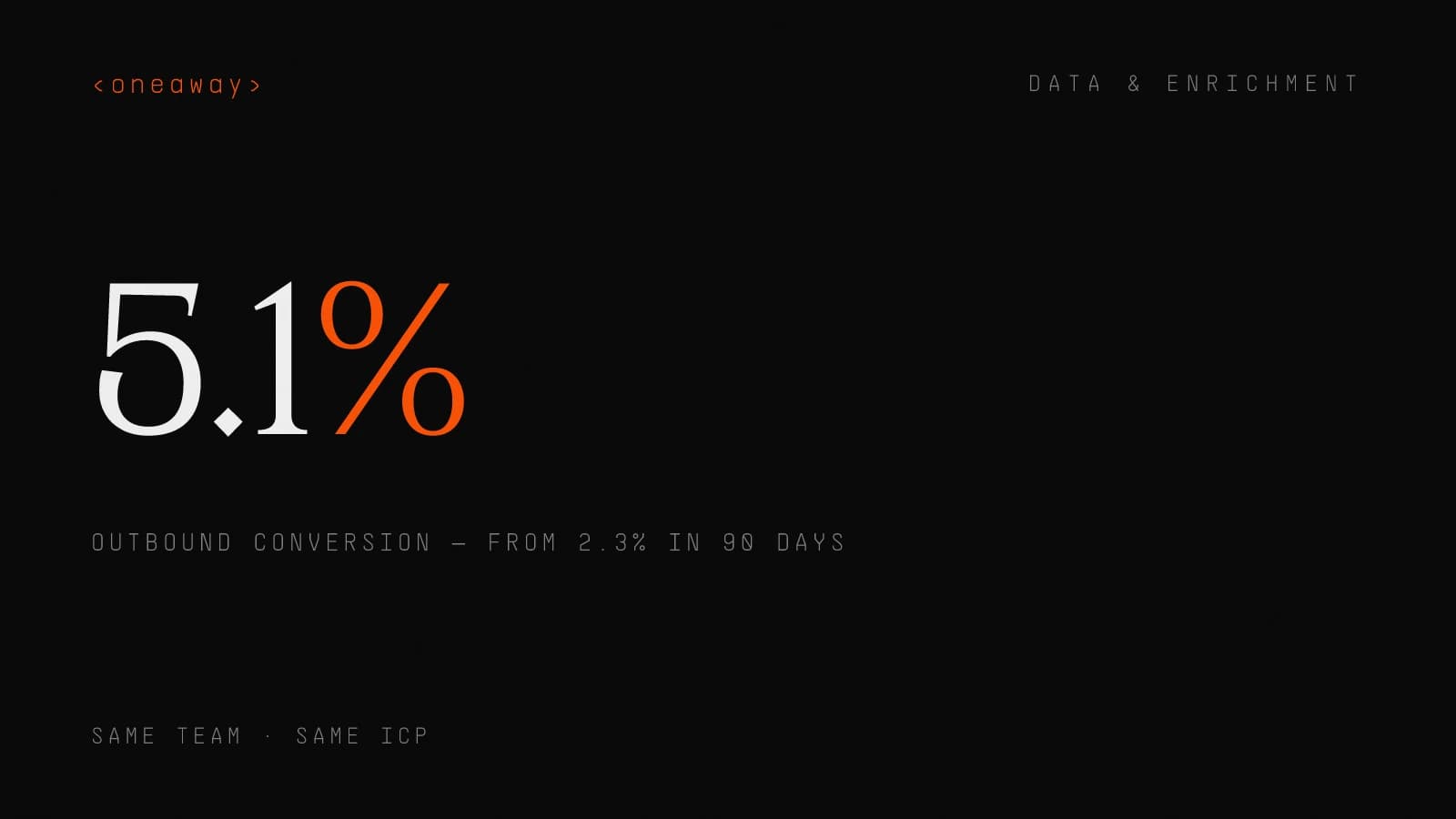
Fast forward to today. My team at OneAway just wrapped a project where we built a buying intent signals system from scratch for a Series B SaaS company. Their outbound conversion rate went from 2.3% to 5.1% in 90 days. Same team. Same ICP. Different approach to timing.
Why Intent Signals Actually Matter (And Why Most Teams Get Them Wrong)
Let me tell you about a call I took at AWS. A Director of Engineering from a mid-market fintech company picked up on my fourth attempt. Before I could finish my pitch, he interrupted: "Actually, we're evaluating this right now. We have a Q2 budget allocated. Can you send pricing?"
That call felt like magic. Turns out it wasn't magic—it was timing. His company had just announced a $30M Series B two weeks prior. They'd posted three cloud engineering roles. Their CTO had been researching migration strategies on G2.
I had none of that context when I dialed. I got lucky. Buying intent signals are about manufacturing that luck at scale.
Here's what the data actually shows: Accounts showing 3+ intent signals convert at 2-3x the rate of cold accounts. The Martal Group study found that signal-based outbound consistently doubles conversion rates compared to spray-and-pray approaches.
But most teams buy an intent data platform, look at the dashboard once, and then ignore it. The sales team doesn't trust the scores. Marketing can't figure out how to route the alerts. The data sits there while everyone goes back to cold calling alphabetically through their TAM.
The Six Signal Categories That Actually Drive Pipeline
Not all signals are created equal. After building signal systems for dozens of B2B companies, we've identified six categories that consistently predict buying behavior.
I'm going to walk through each one with real examples from our client work. This isn't theoretical—these are the exact signals we track and weight in our scoring models.
- First-Party Website Behavior — This is your highest-signal data because it's direct behavioral evidence on your own property. We track: pricing page visits, case study downloads, competitor comparison views, documentation browsing, and demo page views. At OneAway, we consider any pricing page visit from a target account a Tier 1 signal. One client saw that accounts visiting pricing 2+ times had a 31% conversion rate vs. 4% for single-visit accounts.
- Third-Party Intent Data — This is where accounts are researching your category across the broader web—review sites, publisher networks, content syndication platforms. We use this to identify accounts in-market before they hit your website. The key is topic relevance. An account showing intent around 'revenue operations automation' is more valuable than generic 'CRM software' if you sell RevOps tools. I learned this the hard way at Salesforce when I chased every 'Salesforce alternative' signal and wasted weeks on companies evaluating marketing automation, not sales tools.
- Technographic Changes — This is installation, removal, or significant changes to technology in your stack category. A company dropping your competitor is a massive signal. We had a client in the data warehouse space who built an entire outbound motion around Snowflake removal signals. Their cold email response rate was 23% vs. 3% on generic outbound. Technographic data is expensive but incredibly high-signal when you target it correctly.
- Hiring Signals — Job postings reveal budget, priorities, and growth phase. When a company posts for a 'Director of Revenue Operations' role, they're about to evaluate your category. We track job postings in three buckets: roles that use your product, roles that buy your product, and roles that indicate company growth stage. A Series B company hiring their first VP of Sales is in a completely different buying mode than a Series D company backfilling an AE role.
- Funding & Firmographic Events — This includes funding rounds, leadership changes, M&A activity, earnings announcements, and expansion news. These create budget availability and buying windows. The data shows that companies are 3x more likely to buy new software in the 90 days following a funding round. At AWS, our highest conversion rates came from accounts 30-60 days post-funding announcement. Before that, they're too chaotic. After 90 days, they've already made their initial buying decisions.
- Engagement & Relationship Signals — These are interactions with your brand—email opens, LinkedIn engagement, event attendance, webinar participation, content downloads, and champion job changes. These are lower-intent signals but critical for account warming and relationship tracking. We had one client who tracked when champions changed companies and had a dedicated playbook to re-engage them in their new role. That single playbook generated 18% of their pipeline in 2025.
Step 1: Capture First-Party Signals (Start Here, Not With Buying Intent Data)
I implemented a version of this at Salesforce in 2019 before it was trendy. My manager thought I was wasting time. But I started getting 2-3 warm handoffs per week from marketing instead of zero. My close rate on those leads was 41% vs 8% on my regular cold outbound.
- Website Deanonymization — We use Koala, Clearbit Reveal, or 6sense to identify companies visiting your site. This reveals the account before they fill out a form. We track: company name, employee count, industry, pages visited, visit frequency, and session duration. The free tier of most tools gives you 500-1000 identified companies per month. That's enough to start.
- Page-Level Tracking — Not all page visits are equal. We tier pages by intent level: Tier 1 (pricing, demo request, contact sales), Tier 2 (case studies, product pages, integrations), Tier 3 (blog, general content). We built a Segment event tracking system for a client that fired Slack alerts when target accounts hit Tier 1 pages. Their SDR response time went from 24 hours to 8 minutes. Conversion rate on those leads doubled.
- Form Enrichment — Every form submission should trigger automatic enrichment—company data, technographics, funding info, employee count. We use Clearbit or ZoomInfo APIs to append data instantly. This feeds your scoring model in real-time. The key is passing this enriched data to your CRM and your signal scoring system simultaneously.
- Email Engagement Tracking — Track opens, clicks, and reply sentiment at the account level, not just the contact level. When 3+ people from the same account open your emails in a week, that's a signal. We build account-level engagement scores in HubSpot or Salesforce that aggregate individual contact behavior. This reveals buying committee formation.
Step 2: Layer in Third-Party Intent Data (But Don't Get Distracted by Shiny Objects)
The mistake everyone makes: Buying every data source and drowning in noise. Start with one. Get your workflows right. Then layer in others.
We typically start clients with G2 intent if they have good category presence, or Bombora if they need top-of-funnel volume. Once those workflows are producing pipeline, we add technographics or additional intent sources.
- Bombora (Topic-Level Intent) — Tracks content consumption across 4,000+ B2B sites. Shows when accounts surge on specific topics. We use this for early-stage awareness—before accounts hit your site. Cost: $15k-40k/year depending on volume. Best for: Mid-market and enterprise sales with 6+ month cycles. We had a cybersecurity client use Bombora 'zero trust architecture' intent to build target lists. Their email open rates were 34% vs. 18% on non-intent lists.
- G2 Buyer Intent — Tracks companies researching on G2—comparisons, reviews, category browsing. This is high-intent data because they're actively evaluating vendors. Cost: Starts at $1,500/month. Best for: Companies with strong G2 presence and direct competitors on the platform. The signal quality is excellent but volume is lower than Bombora. We use this as a Tier 1 trigger for immediate outreach.
- ZoomInfo Intent — Combines topic intent with their company database. The advantage is having contact data and intent in one place. Cost: $15k-30k/year. Best for: Teams that want a single platform for both prospecting and intent. The intent quality is decent but not as deep as specialized providers. We use this for clients who want operational simplicity over best-of-breed.
- BuiltWith / Datanyze (Technographic Data) — Tracks technology installation and removal. This is gold for replacement plays and ecosystem targeting. Cost: $300-1,000/month. Best for: Companies with clear technology triggers (competitor replacement, ecosystem integration, tech stack expansion). We built an entire outbound motion for a client around Marketo to HubSpot migrations. 16% meeting booking rate.
Step 3: Build Your Signal Scoring Model (This Is Where Most Teams Fail)
The critical concept here is decay. A pricing page visit from 6 months ago is worthless. A funding announcement from yesterday is gold. Your scoring model needs to devalue signals over time.
We implement this in HubSpot workflows or Salesforce formula fields. Every signal has a score, a timestamp, and a decay function. The total account score is the sum of all non-decayed signals.
Here's what good looks like: An account hits 150+ points, they automatically route to sales with a Slack alert that shows exactly which signals fired. The rep has context before they pick up the phone.
When I was at AWS, I built a janky version of this in a Google Sheet. I'd manually check it every morning and prioritize my outbound based on the scores. My manager thought I was just getting lucky. My numbers were 40% higher than team average for six straight quarters.
| Signal Type | Weight | Decay Rate | Example Trigger |
|---|---|---|---|
| Pricing page visit | 100 points | 7 days | Immediate Slack alert to AE |
| G2 comparison view | 80 points | 14 days | Added to high-intent sequence |
| Competitor removal | 90 points | 30 days | Personalized video outreach |
| Funding announcement | 60 points | 60 days | Enter nurture sequence day 30 |
| Job posting (user role) | 50 points | 45 days | LinkedIn outreach from SDR |
| 3rd party topic surge | 40 points | 21 days | Added to targeted content campaign |
| Webinar attendance | 30 points | 14 days | Follow-up email sequence |
| Email open (single) | 5 points | 7 days | No immediate action, score only |
Step 4: Create Signal-Based Routing & Playbooks (The Execution Layer)
The playbook is just as important as the routing. Your rep needs to know exactly what to say/send based on the signal.
We create signal-specific templates for email, LinkedIn, and phone. Each template references the signal and provides value around that context. The messaging feels timely and relevant instead of random cold outreach.
- Tier 1 Signals (Immediate Sales Action) — These are demo requests, pricing page visits, G2 comparisons, competitor removal. Route to assigned AE within 5 minutes via Slack alert. If unassigned, round-robin to available rep. The message includes: account name, signal fired, recent history, and ICP fit score. We use Chili Piper or Calendly for instant meeting booking. One client's demo request to booked meeting rate went from 47% to 73% when we implemented instant routing with context.
- Tier 2 Signals (SDR Sequences) — These are topic surges, job postings, funding news, case study downloads. Route to SDR for targeted outbound sequence. The sequence references the specific signal: 'Saw you're hiring a Rev Ops Director…' or 'Congrats on the Series B…' We A/B tested signal-specific messaging vs. generic cold email for a client. Signal-specific had 31% reply rate vs. 8% generic.
- Tier 3 Signals (Marketing Nurture) — These are blog visits, email opens, LinkedIn engagement, general content downloads. Route to targeted content campaign or nurture sequence. These accounts aren't ready for sales yet but they're warmer than cold. We use this to build relationship over time and watch for Tier 1/2 signal escalation.
- Multi-Signal Amplification — When an account fires signals across multiple categories in a short window, escalate priority. An account that hits your pricing page AND shows Bombora topic surge AND posted a job opening should be your #1 priority. We create special 'hot account' routing for 3+ simultaneous signals. These accounts get white-glove treatment—personalized video, direct mail, multi-threading from AE and SDR.
The Tech Stack We Actually Use (Not What Vendors Want You to Buy)
Real talk: You don't need the enterprise stack until you're doing $20M+ ARR with a 30+ person sales team. Start scrappy.
My first intent system at OneAway was built with Koala (website tracking), G2 intent, Make.com for orchestration, and HubSpot for CRM. Total cost: $2,400/month. It generated $340k in pipeline in the first quarter.
The enterprise stack is faster, more automated, and handles more volume. But it won't magically fix broken workflows or poor ICP definition. Get the process right first, then upgrade the tools.
| Function | Enterprise Stack | Startup Stack | Typical Cost |
|---|---|---|---|
| Website deanonymization | 6sense, Demandbase | Koala, Clearbit Reveal | $12k vs $300/mo |
| Intent data | Bombora + G2 | G2 Buyer Intent only | $30k vs $1.5k/mo |
| Technographics | ZoomInfo Sales OS | BuiltWith or Datanyze | $25k vs $500/mo |
| Enrichment | ZoomInfo, Clearbit | Apollo.io, Clay.com | $15k vs $500/mo |
| CRM/Automation | Salesforce Enterprise | HubSpot Pro | $150/seat vs $50/seat |
| Signal orchestration | Qualified, Factors.ai | Make.com or Zapier | $20k vs $300/mo |
| Meeting scheduling | Chili Piper | Calendly | $1.5k vs $120/mo |
The Mistakes That Kill Intent Programs (I've Made All of These)
The biggest mistake I made personally was at Salesforce. I built a beautiful signal tracking system in my personal spreadsheet but never shared it with my team. I was protective of my 'secret weapon.'
When I left for AWS, that system died. No one benefited from the learning. Now at OneAway, we build everything in shared systems and document relentlessly. The compounding value is exponentially higher.
- Buying data before defining workflows — Teams buy Bombora or ZoomInfo without knowing what they'll do with the signals. The data piles up. No one looks at it. You just burned $30k. Define your routing logic and playbooks BEFORE you buy data sources. We now make clients do a workflow mapping exercise before we'll even recommend vendors.
- Treating all signals equally — A LinkedIn like is not the same as a pricing page visit. Your scoring model needs to reflect signal quality and recency. I had a client who gave equal weight to everything. Their 'hot accounts' list was 800 companies long and totally useless. We re-scored based on signal quality. The list shrank to 60 accounts. Conversion rate tripled.
- Ignoring signal decay — A funding announcement from 9 months ago is cold. Topic intent from 2 weeks ago is stale. Build time decay into your scoring or you'll be chasing ghosts. We use a 30-day half-life for most signals, meaning they lose 50% of their value every 30 days.
- No feedback loop from sales — Your reps need to flag false positives and confirm true positives. This trains your model. We built a simple Slack reaction system—thumbs up for good signal, thumbs down for junk. After 90 days of feedback, we'd adjusted scoring and improved signal quality by 40%.
- Over-rotating to automation — Intent signals should trigger human outreach, not automated email blasts. The signal tells you WHO and WHEN. The human provides the HOW (personalization, relationship, value). I see teams build fully automated 'intent-triggered' sequences that feel just as cold as regular cold email. The signal is wasted.
- Forgetting about ICP fit — A strong signal from a bad-fit account is still a waste of time. We layer ICP scoring on top of intent scoring. An account needs BOTH high intent AND high ICP fit to be truly priority. This seems obvious but I've watched countless teams chase high-intent signals from companies that could never actually buy.
What a Real Implementation Looks Like (The 90-Day Rollout)
The moment I knew it worked: Their VP Sales messaged me on day 87: 'My reps are fighting over who gets the high-intent accounts. Six months ago they complained about lead quality. This is a completely different team.'
That's what good signal systems do. They turn your revenue team from order-takers into hunters with heat-seeking missiles.
- Refined scoring based on closed/won data — G2 intent and pricing visits were strongest predictors. Adjusted weights accordingly.
- Added multi-signal amplification logic — Accounts with 3+ signals in 14 days got executive outreach from VP Sales.
- Implemented signal decay — Reduced score by 50% every 21 days. This cleaned up the 'warm' list dramatically.
- Built signal attribution in HubSpot — Could now track which signals contributed to closed/won deals. This gave marketing ROI visibility they'd never had. Results after 90 days: Conversion rate hit 5.1%. Deal cycle down to 103 days. Signal-sourced pipeline at $1.2M. Sales team bought in fully.
Frequently Asked Questions
What are buying intent signals in B2B sales?
Buying intent signals are behavioral, firmographic, and contextual data points that indicate an account is actively researching or evaluating a purchase. They include first-party signals like website visits and content downloads, third-party intent data showing topic research across the web, technographic changes like competitor removal, hiring signals, funding events, and engagement with your brand. These signals help sales teams identify and prioritize accounts that are more likely to convert, typically 2-3x higher than cold outreach.
How do you track buying intent signals without expensive tools?
Start with free or low-cost tools for first-party tracking: use Koala or Clearbit Reveal's free tiers for website deanonymization, set up Google Analytics event tracking for high-intent page visits, track email engagement in your CRM, and monitor LinkedIn engagement manually. For third-party data, G2 Buyer Intent starts at $1,500/month and provides high-quality signals. You can also manually monitor funding announcements via Crunchbase free tier and job postings on LinkedIn. A scrappy stack costs under $500/month and works perfectly for teams under $5M ARR.
What's the difference between first-party and third-party intent data?
First-party intent data is behavioral information you capture directly on your own properties—your website, emails, events, and content. It's the highest-signal data because it shows explicit interest in YOUR product. Third-party intent data tracks account behavior across external sites like publisher networks, review platforms, and content syndication. It helps identify accounts researching your category before they visit your site. First-party should always be your foundation, but third-party helps you catch accounts earlier in their buying journey and expand your reach beyond your existing traffic.
How do you score and prioritize intent signals effectively?
Build a weighted scoring model based on signal quality and recency. High-intent signals like pricing page visits or G2 comparisons should score 80-100 points, while lower-intent signals like blog visits score 5-10 points. Implement time decay—reduce scores by 50% every 21-30 days so old signals don't pollute your priorities. Layer ICP fit on top of intent scoring so you're only chasing high-intent accounts that also match your ideal customer profile. Set clear thresholds: 150+ points = immediate sales action, 75-149 = SDR outreach, under 75 = marketing nurture. Refine weights based on closed/won data after 90 days.
What tools are essential for a buying intent signals system?
For website tracking: Koala, Clearbit Reveal, or 6sense for visitor identification. For intent data: G2 Buyer Intent or Bombora for topic-level signals. For technographics: BuiltWith or ZoomInfo. For enrichment: Clearbit, Apollo, or Clay. For orchestration: Make.com, Zapier, or native CRM workflows in HubSpot/Salesforce. For alerts and routing: Slack integrations and Chili Piper or Calendly for meeting booking. A startup stack costs $2-3k/month total, while enterprise stacks run $50-100k/year. Start with the basics and upgrade as you prove ROI.
How long does it take to see results from intent signal programs?
You'll see early indicators in 30 days—conversations started from high-intent alerts and improved response rates on signal-triggered outreach. Meaningful pipeline impact typically shows at 60-90 days as deals progress through your funnel. Conversion rate improvements become clear at 90 days when you have enough closed/won data to measure. Our clients typically see 1.5-2x conversion rate improvements within a quarter, but expect 6-12 months to fully optimize scoring, routing, and playbooks. The key is starting simple, measuring everything, and iterating based on actual closed/won signals.
What's the biggest mistake teams make with intent data?
Buying data before defining workflows. Teams spend $30-50k on Bombora or ZoomInfo without knowing what they'll actually DO when a signal fires. The data sits unused while everyone defaults back to cold calling. The second biggest mistake is treating all signals equally—a LinkedIn like is not the same as a pricing page visit, but teams score them the same. Start by mapping your routing logic and playbooks on paper, then buy only the data sources you need to execute those workflows. Get the process right before you spend on premium data.
Key Takeaways
- Start with first-party signals before buying expensive intent data—website deanonymization, page-level tracking, and email engagement give you the highest-signal data and cost under $500/month to implement properly.
- Build a weighted scoring model with time decay—not all signals are equal, and a pricing page visit from 6 months ago is worthless. Score based on signal quality (80-100 points for high-intent, 5-10 for low-intent) and reduce scores by 50% every 21-30 days.
- Create signal-specific playbooks and routing—accounts firing Tier 1 signals (pricing visits, G2 comparisons) should reach sales within 5 minutes with full context. Your messaging must reference the specific trigger to feel timely and relevant.
- Layer ICP fit on top of intent scoring—a strong signal from a bad-fit account wastes time. Only chase accounts that show BOTH high intent AND high ICP fit to maximize conversion rates.
- Expect 2-3x conversion rate improvements—signal-based outbound consistently doubles or triples conversion rates compared to cold outreach, but requires 90 days to show meaningful pipeline impact and 6-12 months to fully optimize.
- Don't automate away the human element—intent signals tell you WHO and WHEN, but humans provide the HOW through personalization and relationship building. Use signals to trigger informed human outreach, not robotic email sequences.
- Build feedback loops from sales to marketing—have reps flag false positives and confirm true positives to continuously refine your scoring model. 90 days of feedback typically improves signal quality by 40%.
Related Reading
Ready to Build Your Signal-Based Selling System?
We've built buying intent signal systems for dozens of B2B companies—from scrappy startups to $50M ARR enterprises. If you're tired of spray-and-pray outbound and ready to convert at 2-3x your current rate, let's talk. We'll audit your current signal capture, design your scoring model, and implement the routing workflows that turn intent data into actual pipeline. Book a free signals audit at oneaway.io/inquire.
Check if we're a fitContinue Reading
Best B2B Lead Generation Tools in 2026, Ranked by Cost Per Lead
I tested 12 B2B lead generation tools at scale. Here's what each actually costs per qualified lead, ranked from cheapest to most expensive.
Read more [ 14 MIN READ ]Lead Generation Tools B2B Mistakes That Kill Your Pipeline
Most B2B teams waste $50K-90K yearly on lead gen tools that destroy pipeline quality. Former Salesforce SDR shares the 7 deadliest mistakes and what actually works.
Read more [ 12 MIN READ ]Best Lead Enrichment Tools in 2026, Ranked by Data Coverage
I've tested 47 lead enrichment tools. Here's the honest ranking by actual data coverage — with real fill rates, pricing, and which ones are worth your budget.
Read more