Best Clay Alternatives in 2026 (Cheaper & Better)

Most “Clay alternatives” lists hand you 14 SaaS tools you've never heard of and call it a day. That's lazy. If you're shopping for a Clay alternative, you don't want a longer menu — you want to know what to actually switch to, and why.
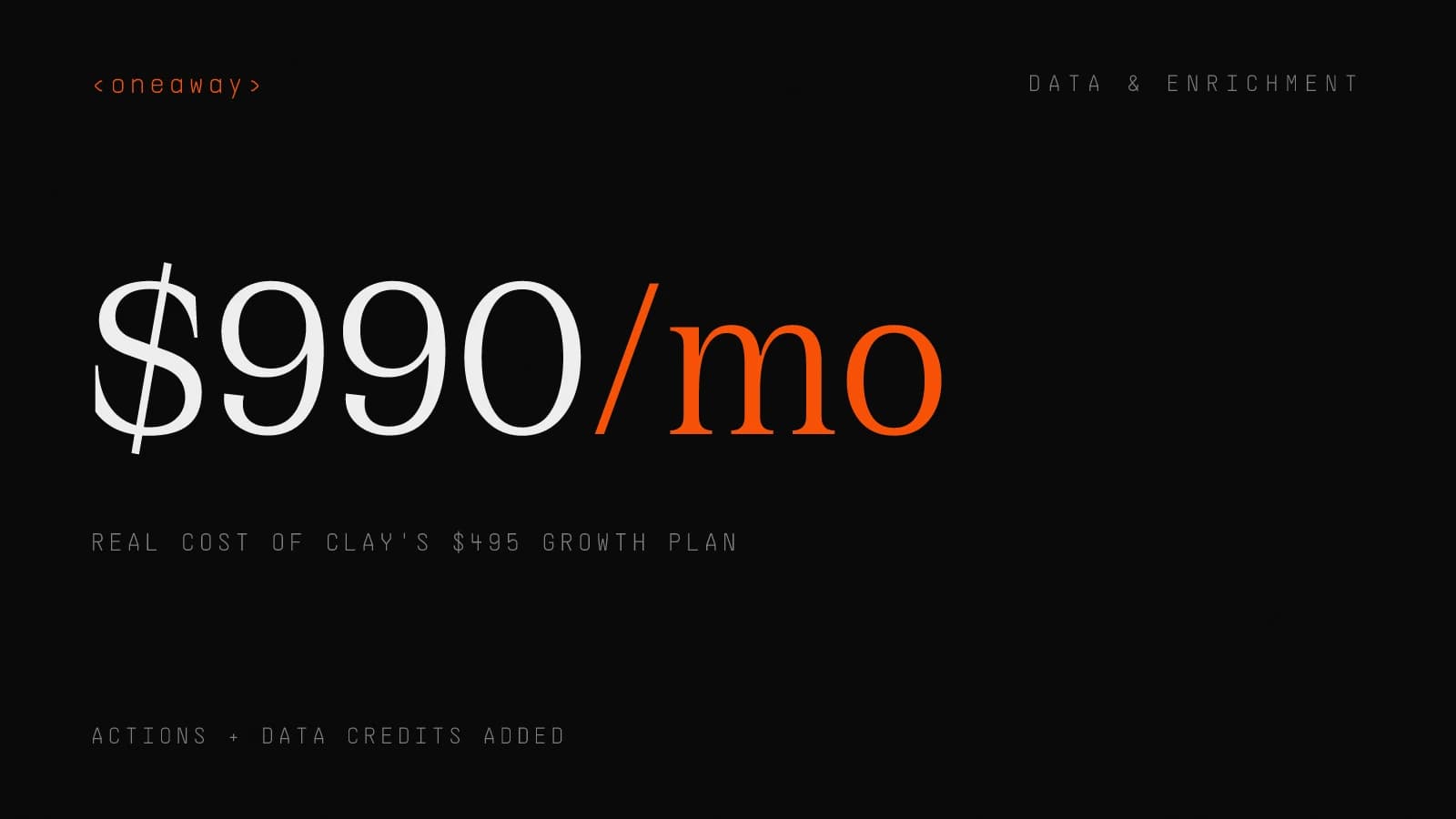
I ran my agency on Clay for almost two years. It's powerful. But once you scale, the math turns against you. The Growth plan says $495/mo on the pricing page. Add the Actions and Data Credits you need to actually use it and the real number is closer to $990/mo. Then you start hitting row caps, expiring credits, and a learning curve that eats your week.
If you only read one line: the best Clay alternative in 2026 isn't another tool — it's a Claude Code workflow that does the same enrichment, cleaning, ICP scoring, and campaign launch for about $100/month, with no code. If you'd rather buy a platform than build, the honest contenders are Apollo, FullEnrich, Cognism, Breeze Intelligence, and ZoomInfo — covered below, with real pricing where it's public.
Quick answer: the best Clay alternatives in 2026
- Best overall (replace it entirely): A Claude Code workflow — full enrichment, cleaning, scoring, and launch. ~$100/mo.
- Best all-in-one platform: Apollo — database + sequencing in one. From $49/user/mo.
- Best for pure enrichment: FullEnrich — waterfall email/phone, pay only for hits. From ~$29/mo.
- Best for compliant phone data: Cognism — phone-verified mobiles, GDPR-first. Custom pricing.
- Best inside HubSpot: Breeze Intelligence (formerly Clearbit) — native HubSpot enrichment. ~$0.45/credit.
- Best enterprise database: ZoomInfo — deepest data, deepest contract. Custom (~$15K/yr+).
Comparison table
| Tool / Approach | Best for | Pricing | vs Clay |
|---|---|---|---|
| Claude Code workflow | Owning the whole system | ~$100/mo + API at cost | No credits, no row caps, no markup |
| Apollo | All-in-one data + sending | $49–$119/user/mo (annual) | Per-seat, not per-credit; sequencing built in |
| FullEnrich | Waterfall contact enrichment | From ~$29/mo | Only pay for hits; simpler, no orchestration layer |
| Cognism | Compliant phone-verified data | Custom (annual contract) | Cleaner phone data; no self-serve, no monthly |
| Breeze Intelligence | HubSpot-native enrichment | ~$0.45/credit, ~$75/mo min | Lives in your CRM; requires HubSpot |
| ZoomInfo | Enterprise data depth | Custom (~$15K/yr+) | Bigger database, far bigger price tag |
Prices are current as of June 2026 and reflect entry tiers. Real cost runs higher once you add seats, credits, and the tools that sit around each platform — same as Clay.
Why teams are leaving Clay
I used Clay for years, so this isn't a hit piece — it's a math problem. People leave for three reasons, and they're all business-model decisions, not bugs.
1. The real price is double the sticker. Clay restructured its plans in March 2026 — three self-serve tiers (Starter, Explorer, Pro) became two: Launch at $185/mo and Growth at $495/mo. But the Growth plan fee is just the door charge. To run real enrichment you add Actions (orchestration) and Data Credits (the actual data). In practice that lands around $990/mo, roughly double the advertised number. Independent pricing breakdowns put the subscription at only 40–60% of true cost of ownership.
2. The credit system bleeds money. Credits are charged per enrichment attempt — found or not. Multiple analyses peg failed-lookup rates at 20–30% (email finding fails ~25–35%, phone enrichment 30–40%). So a chunk of every dollar buys nothing. Credits expire monthly. Run out mid-campaign and top-ups carry a ~50% markup. None of this shows up on the pricing page.
3. The learning curve is real, and the caps are real. Clay is powerful, which means it's complex. Tables max out at 50,000 rows. The UI lags past 30–40 columns. API throttles cap daily processing. To raise any of those ceilings, you negotiate an Enterprise contract that starts around $30,000/year. For a lot of teams, that's a lot of overhead for “enrich a list and send.”
If those three things are why you're here, good news: every option below fixes at least one of them. The first one fixes all three.
1. The Claude Code workflow — the alternative that actually replaces Clay
What it is: Instead of renting an enrichment platform, you build your own using Claude Code — Anthropic's AI coding tool you talk to in plain English. You describe what you need (“upload this CSV, clean the company names, run MX lookups, score every contact against this ICP, then launch the campaign”) and it builds the system. No code. Your data lives in your own Postgres database, not someone else's spreadsheet.
I'm not a developer. I don't write code. I replaced Clay entirely with a $100/mo Claude Code subscription and it does more than Clay ever did for me — CSV upload and auto-detection, company-name cleaning, contact cleaning, MX-record classification, website scraping with LLM analysis, deep research, cold-email detection, ICP scoring, and end-to-end campaign launch. Same chat window, one subscription.
Best for: Anyone spending $500+/mo on Clay who's hitting credit limits or row caps, agencies juggling multiple clients, and operators who want to own their data instead of renting it. (Full breakdown: Clay alternative: Claude Code.)
Pricing: ~$100/mo for the Claude Code subscription (the Max plan). Add API calls for enrichment and scraping — paid directly at cost, no middleman markup, usually $50–80/mo — plus near-free Postgres. A 5,000-contact campaign that runs ~$1,400/mo on a full Clay stack runs ~$250–280/mo this way.
Pro: No credits, no row caps, no expiring balances. You own the database, so every enrichment compounds — query across every client and campaign you've ever run. Add any API in minutes; you're not waiting for a marketplace.
Con: It's not a drag-and-drop UI. You build it conversationally over about a week of focused sessions, and you have to be specific about what you want. If you need to be live in an hour, a packaged tool is faster out of the box.
2. Apollo — best all-in-one platform
What it is: A sales-intelligence platform that bundles a 210M+ contact database with built-in email sequencing and a dialer. It's the most direct “buy it instead of build it” Clay substitute, because enrichment and outreach live in one product.
Best for: Teams that want data and sending in a single tool and prefer predictable per-seat pricing over per-attempt credits.
Pricing: Free plan, then Basic $49/user/mo, Professional $79/user/mo, Organization $119/user/mo (annual billing). Monthly billing runs higher — $59 / $99 / $149. Organization requires a 3-user minimum.
Pro: Per-seat pricing means no per-lookup credit anxiety for core use, and the built-in sequencer means you don't bolt on a separate sending tool.
Con: The credit system is still the cost driver for heavy data pulls — credits expire each cycle, phone numbers cost 8x emails, and overages run $0.20 each. And Apollo's native deliverability for cold sending is weak; most serious senders pull lists from Apollo and send through dedicated infrastructure.
3. FullEnrich — best for pure enrichment
What it is: A waterfall enrichment tool focused on one job: finding work emails and mobile numbers by cascading through multiple data providers until one returns a hit. No orchestration layer, no formula columns — just contact data.
Best for: Teams that already have their workflow figured out and just need accurate email/phone enrichment without Clay's complexity. (More on the method: waterfall enrichment.)
Pricing: Starts around $29/mo for ~500 credits on the Starter plan, with higher tiers for more volume. Credits roll over (3 months on monthly plans), users are unlimited with no seat fees, and — critically — you're only charged when data is found. (Pricing note: most current sources cite ~$29/mo for Starter; one lists $69/mo. Confirm the live tier on their site before buying.)
Pro: The “pay only for hits” model removes the failed-lookup waste that makes Clay's credits feel like a tax. Transparent, predictable, no per-seat fees.
Con: It's enrichment only. No scoring, no research agents, no campaign launch — you'll still need other tools for everything around the data.
4. Cognism — best for compliant phone data
What it is: A B2B data provider built around compliance and phone-verified mobile numbers. Its “Diamond Data” product delivers human-verified mobiles with do-not-call screening across many countries — the kind of phone accuracy aggregated databases struggle to match.
Best for: Teams that dial as part of outbound, sell into Europe, or need GDPR-grade compliance that a US-centric tool may not give you.
Pricing: Custom only — no public pricing, no monthly option, annual contracts. Third-party procurement sources estimate roughly $1,500–$2,500 per user/year plus a platform fee, so a small team can run well into five figures. Treat those as estimates and get a real quote. (Flagging: Cognism does not publish list prices; ranges here are third-party estimates, not confirmed rates.)
Pro: Best-in-class phone-verified data and compliance coverage. If connect rates on the phone matter, this is the data layer to beat.
Con: No self-serve, no monthly billing, and the annual-contract commitment is the opposite of Clay's pay-as-you-go feel. Overkill if you're email-only.
5. Breeze Intelligence (formerly Clearbit) — best inside HubSpot
What it is: After HubSpot acquired Clearbit, it became Breeze Intelligence — enrichment that runs natively inside HubSpot workflows instead of as a separate platform. If your team lives in HubSpot, the data shows up where you already work.
Best for: HubSpot shops that want company and contact enrichment to happen automatically inside the CRM, with no separate tool to manage.
Pricing: Credit-based at roughly $0.45 per credit (1 credit = 1 record enriched), sold in packs, with a practical minimum around $75/mo on top of your HubSpot subscription. Credits reset every 30 days with no rollover. Note: as of late 2025, basic contact/company enrichment is free with HubSpot Starter+ Core seats — credits are for advanced features like buyer intent.
Pro: Zero integration friction if you're already on HubSpot. Enrichment is invisible — it just populates your records.
Con: It only makes sense inside HubSpot. The layered system of credit packs plus subscription requirements can quietly climb into five figures, and there's no rollover, so unused credits vanish.
6. ZoomInfo — best enterprise database
What it is: The deepest, most comprehensive B2B database on the market, with org charts, intent data, and technographics. The legacy enterprise pick for large sales orgs that need data depth above all else.
Best for: Enterprise teams with budget who need the widest coverage and the most mature CRM integrations — and who'd rather buy depth than orchestrate it.
Pricing: Custom only — no public pricing. Professional starts around $14,995/year, climbing to $40,000+ for top tiers, with a 3-seat minimum and annual contracts. Vendr's verified data puts the median contract around $31,875/year. (Flagging: ZoomInfo does not publish prices; figures are from third-party procurement data, not confirmed rates.)
Pro: Unmatched database depth and enterprise-grade integrations.
Con: The price is in a different universe from Clay, and the long annual contract is a real commitment. Wrong tool entirely for a lean team or a solo operator.
How to actually replace Clay
Switching off Clay isn't a one-click migration. Here's the order I'd do it in.
- Pull your real number first. Open your last 3 Clay invoices and add it all up — platform fee, Actions, Data Credits, top-ups. That all-in figure (usually $700–$1,400/mo), not the sticker price, is what you're comparing against. Most people are shocked.
- Decide build vs. buy. If you want to own your data and you're comfortable describing what you need in plain English, the Claude Code workflow wins on cost and ceiling. If you need to be operational today and prefer a UI, pick a platform from the list.
- Export everything before you cancel. Get your enriched lists and tables out of Clay while your subscription is still active. If you're moving to a database you own, this is where the compounding starts. (Background: the complete guide to B2B data enrichment in 2026.)
- Map tool to job, not tool to hype. Need email/phone hits? FullEnrich. Compliant dialing data? Cognism. All-in-one with sending? Apollo. Live in HubSpot? Breeze. Enterprise depth? ZoomInfo. Want one system that does all of it and launches campaigns? Claude Code.
- Run a 100-lead test before you commit. Enrich the same 100 contacts in your new setup and check hit rate and accuracy against what Clay gave you. Decide on data, not on a pricing page.
This is the work a GTM engineer does, and it's exactly the part most teams underestimate.
Frequently asked questions
What is the best Clay alternative in 2026?
For most teams scaling outbound, the best alternative is a Claude Code workflow — about $100/mo, no code, and it replaces enrichment, cleaning, ICP scoring, and campaign launch with no credit limits or row caps. If you'd rather buy a platform, Apollo is the strongest all-in-one and FullEnrich is the best pure-enrichment pick.
How much does Clay actually cost?
Clay's Growth plan advertises $495/mo, but the real cost is closer to $990/mo once you add the required Actions (~$205/mo) and Data Credits (~$290/mo). Add LinkedIn Sales Navigator and a sending tool and a full stack often exceeds $1,200/mo. Enterprise contracts start around $30,000/year.
Is there a cheaper alternative to Clay?
Yes. FullEnrich starts around $29/mo for pure enrichment. Apollo starts at $49/user/mo for an all-in-one platform. And a Claude Code workflow runs about $100/mo while replacing far more than enrichment alone.
Why are people switching away from Clay?
Three reasons: the advertised price roughly doubles once you add Actions and Data Credits, the credit system charges for failed lookups (20–30% waste) and expires monthly, and the learning curve plus row caps push growing teams toward expensive Enterprise contracts.
Can I replace Clay without knowing how to code?
Yes. With Claude Code you describe what you need in plain English and it builds the system — no code required, though you do need to be specific about your workflow. If you prefer a visual interface, Apollo and FullEnrich work out of the box.
Key takeaways
- Clay's real price is roughly double the sticker. The $495 Growth plan lands near $990/mo once Actions and Data Credits are added.
- The best Clay alternative isn't another tool — it's a system you own. A ~$100/mo Claude Code workflow replaces enrichment, cleaning, scoring, and launch, with no credits or row caps.
- If you want to buy, not build: Apollo (all-in-one), FullEnrich (pure enrichment, pay only for hits), Cognism (compliant phone data), Breeze Intelligence (HubSpot-native), ZoomInfo (enterprise depth).
- Watch the credit trap. Tools that charge for failed lookups and expire credits monthly hide real cost. FullEnrich's “pay only for hits” model is the cleaner approach.
- Pull your real Clay number before you switch, and run a 100-lead test. Decide on data, not on a pricing page.
Want it done for you?
If you've read this far, you already know the work isn't picking a tool — it's running the system. Enrichment, cleaning, ICP scoring, sequencing, deliverability, launch. That's a full-time job, and most teams underestimate it.
That's what we do at OneAway. We run the entire enrichment-to-outbound system done-for-you — the same Claude Code-powered workflow, operated by people who do it every day, so you get qualified meetings on your calendar instead of a new tool to learn. If you'd rather skip the build, book a fit call.
Continue Reading
Best B2B Lead Generation Tools in 2026, Ranked by Cost Per Lead
I tested 12 B2B lead generation tools at scale. Here's what each actually costs per qualified lead, ranked from cheapest to most expensive.
Read more [ 14 MIN READ ]Lead Generation Tools B2B Mistakes That Kill Your Pipeline
Most B2B teams waste $50K-90K yearly on lead gen tools that destroy pipeline quality. Former Salesforce SDR shares the 7 deadliest mistakes and what actually works.
Read more [ 12 MIN READ ]Best Lead Enrichment Tools in 2026, Ranked by Data Coverage
I've tested 47 lead enrichment tools. Here's the honest ranking by actual data coverage — with real fill rates, pricing, and which ones are worth your budget.
Read more