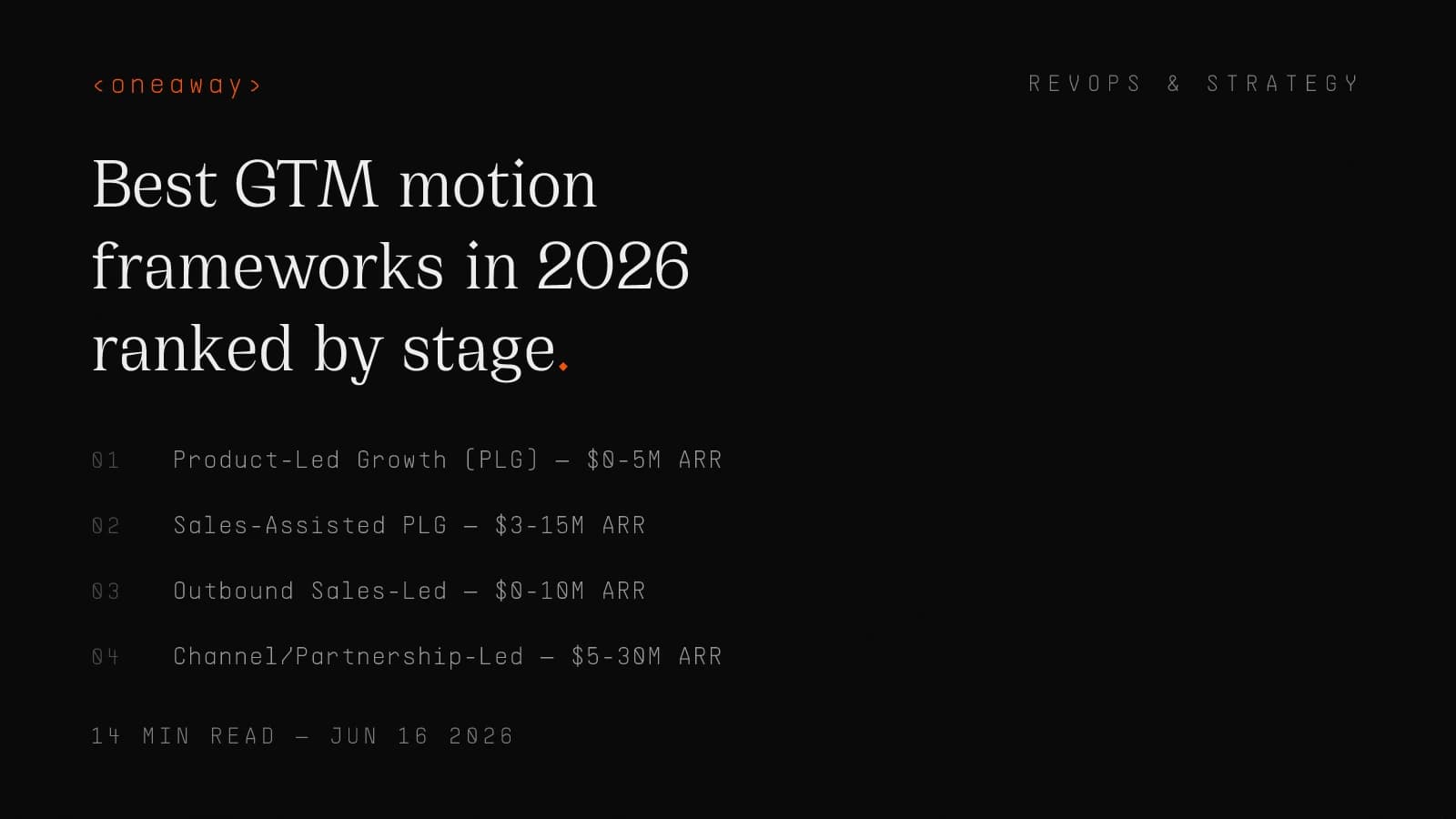
Best GTM Motion Frameworks in 2026, Ranked by Stage

I watched a $3M ARR company try to run enterprise ABM in 2024. They hired two AEs, a marketing ops person, and bought 6figr and Demandbase before they had product-market fit. Burned $400K in six months. Pipeline stayed at zero.
The problem wasn't execution. It was stage mismatch. They picked a GTM motion designed for $50M ARR companies when they needed to prove anyone would actually use their product.
Your go-to-market strategy isn't about what motion sounds sexiest or what worked at your last company. It's about matching your motion to your stage, resources, and unit economics. Get this wrong and you're optimizing the wrong system. Get it right and everything else gets easier.
Quick Comparison: GTM Motions by Stage
I've run or audited GTM systems for 40+ B2B companies since leaving AWS in 2021. The pattern is clear: stage determines motion viability more than industry, product, or founder preference.
Here's the honest breakdown of which motions actually work at each stage, based on the 2026 Treetop GTM Report data from 60+ mid-market engagements and what I've seen in the field.
| GTM Motion | Best Stage | CAC Target | Time to First Revenue | Team Size at Start | Honest Success Rate |
|---|---|---|---|---|---|
| Product-Led Growth | $0-5M ARR | $200-800 | 30-90 days | 2-4 | 25% (hard to execute) |
| Sales-Assisted PLG | $3-15M ARR | $1,200-3,500 | 14-45 days | 4-8 | 55% |
| Outbound Sales-Led | $0-10M ARR | $2,500-8,000 | 90-180 days | 3-6 | 45% |
| Channel/Partnership | $5-30M ARR | $3,000-12,000 | 6-12 months | 2-5 | 30% |
| Account-Based Marketing | $15M+ ARR | $15,000-50,000 | 6-18 months | 8-15 | 60% (if ready) |
| Hybrid (Multi-Thread) | $20M+ ARR | Varies widely | 3-12 months | 15+ | 70% (complexity risk) |
| Community-Led Growth | Any stage | $500-3,000 | 6-24 months | 1-3 | 35% (long game) |
#1: Product-Led Growth (PLG) — $0-5M ARR
Product-led growth means users can discover, try, and buy your product without talking to sales. The product is the primary acquisition, conversion, and expansion engine.
This sounds simple. It's not. I've seen 20+ companies attempt PLG. Most fail because they underestimate the product investment required to make self-service actually work.
- Who it's for: — Developer tools, horizontal workflow products, or anything with a clear 'aha moment' achievable in under 30 minutes. You need a product that creates value before asking for a credit card.
- Real requirements: — 3+ engineers dedicated to onboarding, activation, and growth features. Product analytics stack (Amplitude/Mixpanel + session replay). Self-serve billing. Support infrastructure that scales without humans.
- CAC target: — $200-800 for freemium, $500-1,500 for free trial. If you're above this, your conversion funnel is broken or your ICP is wrong.
- Honest pros: — Lowest CAC at scale. Compounding growth engine. Works globally from day one. No expensive AE headcount early.
- Honest cons: — Takes 12-18 months to work. Requires exceptional product. Churn can be brutal (15-25% monthly for freemium is normal early). Most founders give up too soon.
Real Example: Why PLG Failed for a Compliance Tool
We worked with a GRC platform in 2023 that tried pure PLG. Compliance officers signed up, explored for 15 minutes, then ghosted. The time-to-value was too long and the decision required committee buy-in.
They pivoted to sales-assisted PLG (next section) and 3x'd conversion in 90 days. Sometimes the problem isn't execution—it's motion-market mismatch.
Verdict
Choose PLG if: Your product has a sub-30-minute aha moment, doesn't require implementation, and targets individual contributors or small teams. You have engineering resources to invest in growth infrastructure.
#2: Sales-Assisted PLG — $3-15M ARR
Sales-assisted PLG combines self-serve signup with human intervention at key conversion points. Users try the product, sales steps in when expansion signals fire.
This is the highest-ROI motion I've seen in 2025-2026 for mid-market products. It works because you let product qualify leads and only deploy expensive humans on warm, high-intent accounts.
- Who it's for: — Products with PLG DNA but $10K+ ACV expansion potential. Anything where individual users love it but team/company-wide adoption requires coordination.
- Real requirements: — Self-serve onboarding that works + 2-4 AEs + automated signals (PQLs). You need Pocus, Calixa, or equivalent for product-qualified lead scoring. RevOps infrastructure to route hot accounts.
- Trigger points: — User hits paywall, invites 5+ teammates, achieves specific usage milestone, belongs to target account segment (employee count, industry, tech stack).
- CAC target: — $1,200-3,500 blended (lower for pure self-serve conversions, higher for sales-assisted deals).
- Honest pros: — Best of both worlds. Product qualifies leads and proves value. Sales focuses only on expansion-ready accounts. Shorter sales cycles than pure outbound.
- Honest cons: — Complex to orchestrate. Requires tight product-sales alignment (hard culturally). Can confuse users if handoff is clunky. Pricing strategy must support both motions.
Real Example: How We Built This for a Dev Tool
One of our clients went from $4M to $12M ARR in 18 months with sales-assisted PLG. Here's the playbook we built:
Trigger 1: User hits 10 API calls in 7 days → Automated email with calendar link to growth AE (not pushy, offering architecture review).
Trigger 2: Workspace adds 3rd user → AE gets Slack notification, joins product with custom onboarding video + expansion offer.
Trigger 3: Free tier user from target account (500+ employees, tech stack match) signs up → Immediately routed to enterprise AE with warm intro email.
Conversion rate from free to paid went from 8% to 22%. Average deal size jumped from $8K to $24K because AEs focused on expansion, not acquisition.
Verdict
Choose sales-assisted PLG if: You have a product users love enough to try on their own, but expansion requires coordination or budget approval. This is the 2026 sweet spot for $3-15M ARR companies.
#3: Outbound Sales-Led — $0-10M ARR
Outbound sales-led means your GTM motion is built around proactive prospecting: cold email, cold calling, LinkedIn outreach, and account research. Reps generate pipeline through targeted outreach, not inbound or product signups.
I spent two years as an SDR at Salesforce and AWS doing this motion. It works when your ICP is narrow, identifiable, and reachable through standard B2B channels. It fails when you try to boil the ocean.
- Who it's for: — Complex products that require education. High ACV ($15K+). Clear ICP with identifiable buying signals. Products solving urgent, expensive problems for specific personas.
- Real requirements: — 1-2 SDRs + 1-2 AEs to start. Outbound infrastructure (Apollo/Clay for data, Outreach/Salesloft for sequences, ZoomInfo for contact data). Strong messaging and positioning.
- CAC target: — $2,500-8,000 depending on ACV. If you're selling $50K deals, $6K CAC is fine. If you're selling $15K deals, you need to be under $3K.
- Honest pros: — Predictable pipeline generation. Works even with zero brand. Fast iteration on messaging. Full control over who you target and when.
- Honest cons: — Expensive (human-intensive). Long ramp time (4-6 months for new reps). Deliverability and channel saturation are real problems in 2026. Doesn't scale linearly.
Real Example: My Worst and Best Outbound Campaigns
Worst: At AWS, I spent three months in 2019 cold calling CIOs about migration services. Booked 4 meetings from 600+ calls. It sucked because I was too junior to talk to that persona and the value prop was generic.
Best: At Salesforce, I targeted RevOps managers at Series B companies who just raised funding (public data from Crunchbase). Sent 200 hyper-personalized emails over two weeks referencing their funding round and specific GTM pain points. Booked 34 meetings, closed 11 deals.
The difference wasn't effort. It was ICP precision and message relevance. Outbound works when you actually know who you're selling to and why they should care right now.
Verdict
Choose outbound sales-led if: You have a narrow ICP, high ACV ($15K+), and need predictable pipeline immediately. This motion forces you to learn your market fast. Just don't cheap out on tooling or talent.
#4: Channel/Partnership-Led — $5-30M ARR
Channel or partnership-led GTM means a significant portion of your revenue comes through resellers, integrations, referral partners, or marketplace distribution (AWS Marketplace, Shopify App Store, HubSpot Marketplace, etc.).
This motion is wildly underrated and poorly executed by most companies. I've seen it work brilliantly exactly twice. I've seen it fail 15+ times.
- Who it's for: — Products that naturally sit inside another platform's workflow. Infrastructure/security tools sold through AWS/GCP. Anything where your ICP already has a trusted vendor relationship.
- Real requirements: — 1-2 dedicated partnership managers (not a side project for sales). Channel/marketplace-specific assets (co-sell decks, ROI calculators, integration docs). Legal and finance infrastructure for revenue sharing.
- CAC target: — $3,000-12,000 blended (higher because you're splitting revenue 20-40% with partners).
- Honest pros: — Access to warm intros and trusted distribution. Faster credibility building. Works well for enterprise deals where procurement prefers existing vendor relationships.
- Honest cons: — Takes 6-12 months to see results. Partners prioritize their revenue, not yours. You give up margin and customer relationship control. Most partnerships generate zero revenue.
Real Example: AWS Marketplace Success Story
We helped a security tool get AWS Marketplace distribution in 2024. First six months: $40K total. They almost gave up.
Then they cracked the code: co-sell with AWS account teams. They built a simple ROI calculator showing AWS spend reduction, trained AWS SAs on demo delivery, and showed up to AWS-hosted customer events.
Next 12 months: $2.4M through marketplace. The difference was treating AWS as a sales channel, not a listing page. They invested in the relationship and gave AWS teams reasons to recommend them.
Verdict
Choose channel/partnership-led if: Your product integrates deeply with platforms your ICP already uses, you have 6-12 months to invest before seeing returns, and you can afford 20-40% margin loss. Treat it as a long-term strategic play, not a quick revenue fix.
#5: Account-Based Marketing (ABM) — $15M+ ARR
ABM is a GTM motion where you identify a specific list of high-value target accounts and run coordinated, multi-threaded campaigns to engage multiple stakeholders within those accounts simultaneously.
This is the most resource-intensive motion on this list. It only works if you have proven product-market fit, clear ICP, and $50K+ ACV to justify the cost.
- Who it's for: — Enterprise products ($50K+ ACV). Long sales cycles (6-12+ months). Multiple decision makers. Clear list of 100-500 target accounts you can name.
- Real requirements: — Minimum 8-person GTM team (SDRs, AEs, marketing, ops). ABM platform (Demandbase, 6sense, or RollWorks). Intent data + ad budget ($5K-20K/month). Content engine for account-specific assets.
- CAC target: — $15,000-50,000 (justified by $100K+ deal sizes).
- Honest pros: — Highest win rates when done right (30-40% vs. 10-15% for spray-and-pray). Efficient use of sales time. Creates category authority. Strong signal to market about who you serve.
- Honest cons: — Expensive to run. Takes 6-18 months to see results. Fails catastrophically if ICP is wrong. Requires tight marketing-sales alignment (culturally hard).
Real Example: ABM Done Right vs. Wrong
Wrong: That $3M ARR company I mentioned in the intro tried to run ABM with a list of 2,000 'target accounts' (way too many), generic display ads, and no sales follow-up process. Burned cash, created zero pipeline.
Right: We ran ABM for a $22M ARR data platform targeting 150 enterprise healthcare systems. Here's what worked:
Built account-specific landing pages for each health system showing their exact use case (we researched public info about their tech stack and pain points). Ran LinkedIn ads + direct mail to 5-7 stakeholders per account. SDRs called only after 3+ touches showed intent.
Result: $4.2M pipeline from 38 engaged accounts in 9 months. Win rate was 42% vs. 18% on non-ABM deals. The difference was focus and coordination.
Verdict
Choose ABM if: You're at $15M+ ARR, selling $50K+ deals, and can commit serious resources (team + budget + time) to a focused account list. Don't try this too early—it's a scaling motion, not a discovery motion.
#6: Hybrid Motion (Multi-Threading) — $20M+ ARR
Hybrid motion means running multiple GTM motions simultaneously: PLG for bottom-up adoption + outbound for enterprise + ABM for strategic accounts. You're market segmentation at scale.
This is where most $20M+ ARR companies end up because different customer segments require different motions. The challenge is operational complexity—you're essentially running 2-3 companies in parallel.
- Who it's for: — Companies with multiple valid ICPs (SMB + mid-market + enterprise). Products with both self-serve and enterprise use cases. Teams with 15+ people in GTM and strong RevOps.
- Real requirements: — Segmented teams (different AEs for PLG vs. enterprise). Separate comp plans and quotas. RevOps to orchestrate routing and prevent channel conflict. Strong data infrastructure to track attribution.
- CAC target: — Varies by segment. You need separate unit economics by motion and ruthless discipline to prevent higher-cost teams from stealing lower-cost leads.
- Honest pros: — Maximizes TAM coverage. Reduces dependence on any single motion. Higher growth ceiling. Competitive moat (complexity is hard to copy).
- Honest cons: — Operationally complex. Easy to create internal conflict over account ownership. Requires sophisticated RevOps. Most companies execute this poorly.
Real Example: Multi-Motion Success at $35M ARR
One of our clients runs three parallel motions beautifully. PLG for <$10K deals (pure self-serve, no sales involvement). Sales-assisted for $10-50K (product-qualified leads go to mid-market AEs). ABM for $50K+ (named account list, enterprise AEs only).
The key was clear segmentation rules in Salesforce that auto-routed leads based on company size and product usage. No judgment calls. If you're a 5,000-person company, you go to enterprise even if you signed up for free.
They grew from $25M to $45M ARR in 24 months by optimizing each motion independently instead of trying to force one playbook across all segments.
Verdict
Choose hybrid motion if: You're at $20M+ ARR with multiple proven customer segments. You have strong RevOps leadership and the operational discipline to run multiple playbooks without chaos. This is an optimization play for mature companies, not a startup strategy.
#7: Community-Led Growth — Stage-Agnostic
Community-led growth means building an engaged community (Slack, Discord, forum, in-person events) that drives awareness, activation, and retention. The community becomes a distribution channel and retention mechanism.
This is the slowest-burn motion but creates the deepest moat. I've seen it work across every stage—from $0 to $100M+—but only when founders commit for the long haul.
- Who it's for: — Products with network effects, complex workflows that require peer learning, or categories where buyers trust community recommendations over vendor marketing (dev tools, data, design).
- Real requirements: — 1-2 dedicated community managers. Platform (Slack, Discord, Circle, or Discourse). Content strategy that rewards contribution. Events budget. Founder/exec engagement (can't be delegated entirely).
- CAC target: — $500-3,000 blended (community drives awareness, product converts).
- Honest pros: — Highest retention and NPS. Word-of-mouth on steroids. Competitive moat that's nearly impossible to replicate. Works globally. Low marginal cost at scale.
- Honest cons: — Takes 6-24 months to see meaningful results. Requires authentic engagement (you can't fake it). Community can turn negative if product/company stumbles. Doesn't directly create pipeline—hard to justify to boards.
Real Example: Community as Competitive Moat
I've watched dbt Labs build one of the strongest community moats in B2B SaaS. They started Slack + conferences when they had <$1M ARR. Today at $100M+, their community is why competitors can't touch them.
The Coalesce conference, weekly #advice-dbt-for-beginners Slack activity, and user-generated content on Discourse created a learning ecosystem that makes switching costs emotional, not just technical. NRR is 130%+ largely because the community drives expansion.
Key lesson: They invested in community before it was obviously working. Most companies quit after 6 months when metrics are flat. dbt gave it 3 years.
Verdict
Choose community-led if: You're building for a technical or creative audience that values peer learning. You can commit 2+ years to building it. You're willing to invest in non-obvious channels. This is a long-term strategic bet, not a short-term growth lever.
How to Actually Choose Your GTM Motion
Most founders pick their GTM motion based on what worked at their last company or what's trendy. Both are terrible strategies.
Here's the decision framework I use with clients:
- Start with unit economics: — What's your realistic ACV? If it's under $5K, you need PLG or very efficient outbound. If it's $50K+, you can afford ABM or enterprise sales.
- Assess time-to-value: — Can a user get value in under 30 minutes without help? If yes, PLG is possible. If no, you need human-assisted motions.
- Define your ICP precision: — Can you list your top 100 target accounts by name? If yes, ABM. If you can describe them but there are 10,000+ companies that match, outbound. If your ICP is 'anyone with X problem,' PLG.
- Inventory your resources: — Don't pick a motion you can't resource properly. ABM with no budget and 2 people is worse than focused outbound. Sales-assisted PLG with no product analytics is impossible.
- Check market maturity: — Is your category established or are you creating it? Established = outbound/ABM can work. New category = you need PLG or community to let people self-educate.
The One-Page Selection Framework
Here's the simple decision tree I give every client:
- ACV < $5K + fast time-to-value: — Start with PLG, add sales assist at scale
- ACV $5-25K + narrow ICP: — Start with outbound, optimize ruthlessly
- ACV $25-50K + some product virality: — Sales-assisted PLG or outbound depending on complexity
- ACV $50K+ + <500 target accounts: — ABM if you're $15M+ ARR, otherwise focused outbound to named accounts
- Multiple distinct segments: — Only run hybrid if you're $20M+ and have RevOps to orchestrate it
- Technical/creative audience + long sales cycles: — Layer community on top of whatever primary motion you choose
The Three Biggest Mistakes I See
After working with 40+ companies on GTM strategy, these are the mistakes that kill momentum:
- Mistake #1: Choosing motion before validating ICP. — You can't pick a go-to-market strategy if you don't know who you're going to market with. I've seen companies pick ABM when they couldn't even name 50 target accounts. Validate ICP first, motion second.
- Mistake #2: Running multiple motions too early. — Companies at $2M ARR trying to do PLG + outbound + partnerships = three mediocre systems instead of one working system. Pick one, prove it, then layer.
- Mistake #3: Copying motions from different stages. — Reading how Snowflake does ABM when you're at $800K ARR is dangerous. Their playbook requires resources and market position you don't have. Learn from your stage, not your aspirations.
Final Thoughts: Motion Isn't Permanent
Your go-to-market strategy should evolve as you scale. PLG early, sales-assisted mid-stage, hybrid at scale is a common path.
The companies that grow efficiently treat their GTM motion as a system to optimize, not an identity to defend. When unit economics change or you move upmarket, your motion should change too.
I've rebuilt GTM systems for companies that grew from $3M to $25M. The motion at $3M never survives to $25M unchanged. That's not failure—that's growth.
Frequently Asked Questions
Frequently Asked Questions
What is a GTM motion and how is it different from a go-to-market strategy?
A GTM motion is the specific channel and sales approach you use to acquire customers (PLG, outbound, ABM, etc.). Your go-to-market strategy is broader—it includes your motion plus positioning, pricing, market segmentation, and how all your GTM functions work together. Think of motion as the 'how you sell' and strategy as the complete system.
Can you run multiple GTM motions at the same time?
Yes, but only if you're at $15-20M+ ARR with strong RevOps infrastructure. Most companies try to run multiple motions too early and execute all of them poorly. Pick one motion, prove it works, then layer additional motions for different segments. The exception is community—you can build community alongside any other motion from day one.
How do I know if my current GTM motion is working?
Look at three metrics: CAC payback period (should be under 12 months for most B2B), sales cycle length trend (flat or decreasing is good), and quota attainment (70%+ of reps hitting quota). If two of three are broken, your motion is wrong for your stage or ICP. Don't optimize a broken system—change the motion.
What's the typical timeline to see results from a new GTM motion?
PLG takes 12-18 months to compound. Outbound shows results in 90-180 days if your ICP is right. Sales-assisted PLG shows traction in 3-6 months. ABM takes 6-12 months for first deals, 12-18 months to prove ROI. Channel partnerships take 6-12 months minimum. Most founders quit too early—give your motion at least two quarters before deciding it's not working.
Should I choose my GTM motion based on my product or my market?
Both, but market (ICP + buying behavior) matters more than product. A complex product can work with PLG if your ICP expects self-serve (developers). A simple product might need enterprise sales if your buyers require procurement and committee decisions (security tools). Start with how your ICP actually buys, then adapt your product experience to match.
What's the minimum team size to run each GTM motion effectively?
PLG: 3-5 (PM, 2 engineers, growth lead). Outbound: 3-4 (1-2 SDRs, 1-2 AEs). Sales-assisted PLG: 5-8 (PLG team + AEs). ABM: 8-12 (SDRs, AEs, marketing, ops). Hybrid: 15+ (segmented teams per motion). Channel: 2-3 (partnership manager + sales engineer). Community: 1-2 dedicated roles but requires exec involvement.
How has the best go-to-market strategy changed in 2026?
Three big shifts based on the 2026 Treetop and ICONIQ reports: (1) Sales-assisted PLG is now the default for $5-20M ARR companies—pure PLG is harder. (2) Outbound deliverability is worse, so ICP precision matters more than volume. (3) Hybrid motions are standard at $20M+ because one motion can't cover SMB through enterprise. The trend is toward motion segmentation by customer size, not one-size-fits-all.
Key Takeaways
- Your GTM motion must match your stage and unit economics, not your aspirations. A $3M ARR company running ABM is burning money—pick outbound or PLG instead.
- Sales-assisted PLG is the 2026 sweet spot for $3-15M ARR companies: lowest CAC, highest conversion, best of product-led and sales-led.
- Pure PLG takes 12-18 months to work and requires significant product investment. Most companies quit too early or underestimate the engineering resources required for self-serve onboarding.
- ABM only works at $15M+ ARR with $50K+ ACV. If you try it earlier, you'll waste budget on a motion you're not ready to execute.
- Community-led growth creates the strongest moat but takes 6-24 months to see results. Commit for the long haul or don't start—half-hearted community efforts fail.
- Hybrid motions (multiple GTM strategies simultaneously) work at $20M+ ARR but require strong RevOps infrastructure and segmented teams to prevent chaos.
- The fastest way to validate your GTM motion: check CAC payback period, sales cycle trends, and quota attainment. If two of three are broken, change your motion.
Related Reading
Need help choosing or fixing your GTM motion?
We've built and rebuilt GTM systems for 40+ B2B companies from $1M to $50M ARR. Whether you're picking your first motion or scaling to hybrid, we'll help you match strategy to stage and build the infrastructure to execute. Let's diagnose what's broken and fix it.
Check if we're a fitContinue Reading
Best RevOps AI Stack Builders in 2026, Ranked by Speed
I spent six months testing every major RevOps AI stack builder. Here's who actually ships fast, who drowns you in professional services, and what I'd buy today.
Read more [ 12 MIN READ ]Best ABM Platforms in 2026, Ranked by AI Features
I ranked the top account-based marketing platforms by their AI capabilities after running ABM programs at scale. Here's what actually works in 2026.
Read more [ 12 MIN READ ]Best Sales Engagement Platforms in 2026, Ranked by ROI
I've spent $300K+ on sales engagement software across clients. Here's what actually delivers ROI in 2026—and what's become expensive theater.
Read more