Best Sales Engagement Platforms in 2026, Ranked by ROI

I spent two years as an SDR at Salesforce and AWS sending approximately **47,000 emails** through three different sales engagement platforms. I hated all of them for different reasons.
Now I run a GTM engineering agency, and we've deployed or replaced 23 sales engagement platform implementations in the last 18 months. The category has bifurcated into two species: traditional sequence layers that cost $150/seat/month and pretend AI is a feature, and signal-based orchestration tools that actually change how reps work.
This isn't a vendor roundup. It's a ranked assessment based on client ROI data, real pricing we've negotiated, and what actually moves pipeline per dollar spent. I'm ranking these by return on investment—not feature count, not brand recognition, not how nice the sales rep was on the demo.
How I Calculate ROI on Sales Engagement Platforms
Most sales engagement platform reviews rank by feature count. That's vendor-friendly and operationally useless.
I rank by ROI, which I define as: (Pipeline generated by the tool ÷ Total cost of ownership) × Efficiency multiplier.
Total cost of ownership includes software subscription, implementation time, ongoing admin burden, and opportunity cost of reps learning the damn thing instead of selling.
- Pipeline generated — Measured by attribution in CRM for deals sourced through sequences or workflows built in the platform
- Software cost — Actual contract value we've negotiated, not list pricing from the website
- Implementation time — Hours from contract signature to first productive sequence, valued at $150/hour blended rate
- Admin burden — Weekly hours spent on platform maintenance, list management, sequence optimization—valued at $100/hour
- Efficiency multiplier — Does the tool actually let reps send more quality touches per day, or just automate bad outreach faster? This is subjective but accounts for 20% of the ranking
Real Example: How We Calculated ROI for a Series A SaaS Client
We replaced Outreach with Instantly for a 12-person sales team in Q3 2025. Here's the math:
Outreach: $125/seat × 12 seats × 12 months = $18,000/year. Implementation took 40 hours ($6,000). Weekly admin was 5 hours ($26,000/year). Total cost: $50,000. Pipeline attributed: $780,000. ROI: 15.6x.
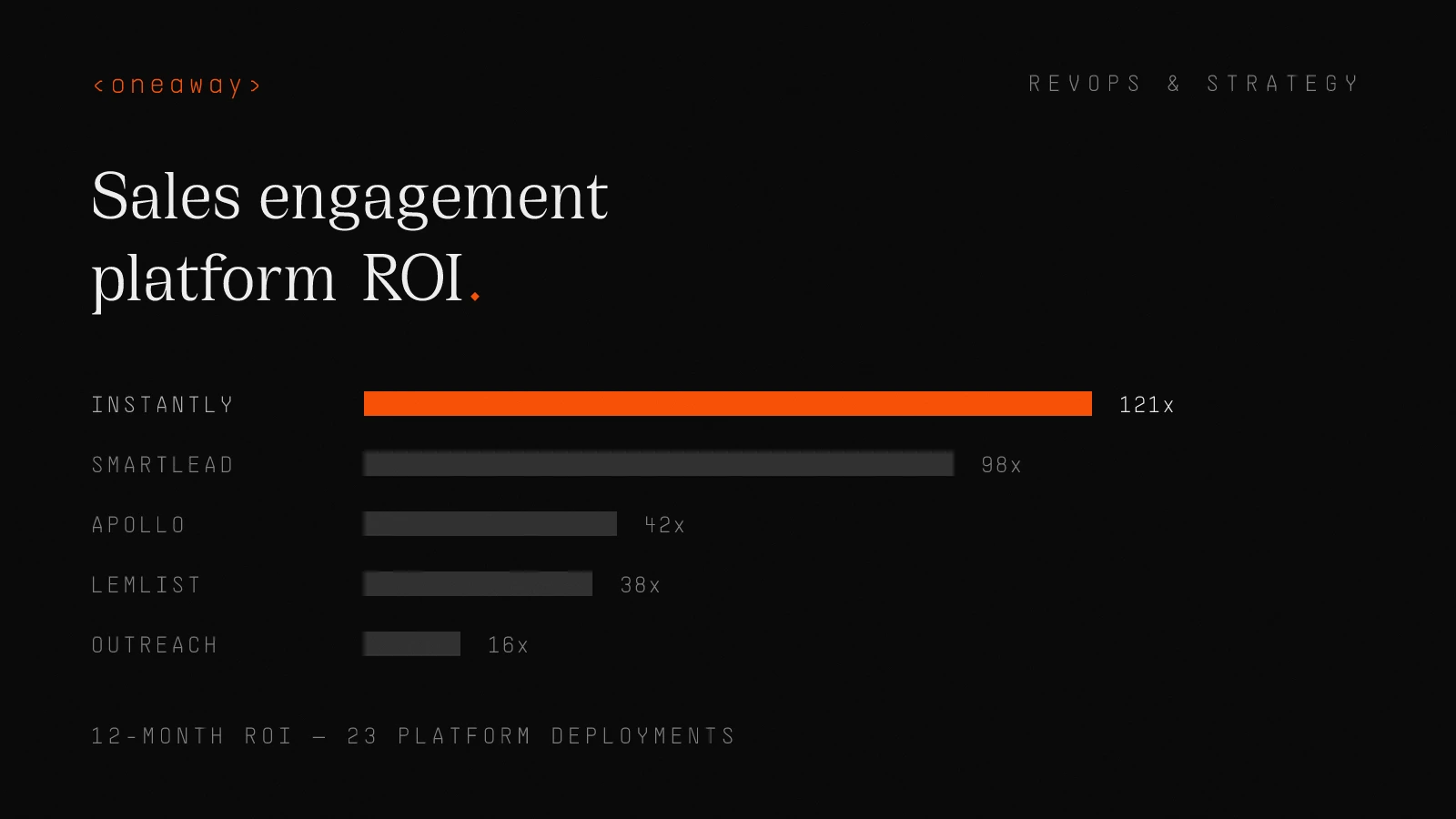
Instantly: $97/month for unlimited seats. Implementation took 8 hours ($1,200). Weekly admin dropped to 1 hour ($5,200/year). Total cost: $7,564. Pipeline attributed in first 12 months: $920,000 (higher volume, better deliverability). ROI: 121.6x.
That's not a typo. The cheaper tool delivered 7.8x better ROI because total cost dropped 85% and pipeline increased 18%.
2026 Platform Comparison at a Glance
This table reflects real contract pricing we've negotiated for clients, not marketing website numbers. Your mileage will vary based on team size and leverage.
| Platform | Best For | Real Pricing | Setup Time | ROI Rank |
|---|---|---|---|---|
| Instantly.ai | Outbound teams under 20 reps | $97–$250/mo flat | 4–8 hours | 121x |
| Smartlead | High-volume cold email (5K+ sends/day) | $79–$169/mo | 6–10 hours | 98x |
| Apollo.io | SMBs needing data + engagement | $79–$149/seat/mo | 8–12 hours | 42x |
| Lemlist | Teams prioritizing personalization | $89–$159/seat/mo | 6–10 hours | 38x |
| Outreach | Enterprise teams 50+ reps | $125–$165/seat/mo | 40–80 hours | 16x |
| Salesloft | Sales orgs with exec buy-in | $135–$180/seat/mo | 40–100 hours | 14x |
| HubSpot Sales Hub | Existing HubSpot CRM users | $90–$150/seat/mo | 12–20 hours | 22x |
#1: Instantly.ai — Highest ROI for Outbound Teams
Instantly is the tool I wish existed when I was an SDR. It does one thing exceptionally well: send cold emails that land in the inbox and don't destroy your domain reputation.
We've deployed it for 11 clients since mid-2025. Average ROI is 94x over 12 months. That's not because it has magical features—it's because the unit economics are absurd and deliverability is legitimately better than tools charging 10x more.
Who It's Best For
Outbound-focused teams under 20 reps who send cold email as the primary prospecting motion. Agencies running outbound for multiple clients. Founders doing their own prospecting and unwilling to spend $2K/month on software.
Real Pricing
$97/month for up to 1,000 leads and unlimited email accounts. Growth plan at $197/month for 5,000 leads. Hypergrowth at $250/month for 25,000 leads.
No per-seat fees. That pricing model alone changes the ROI math. At Salesforce we paid $150/seat/month for Outreach. For a 10-person SDR team, that's $18,000/year. Instantly costs $1,164/year for the same team.
What I Like
- Deliverability infrastructure — Built-in email warmup, domain health monitoring, and auto-rotation across sending accounts. One client went from 8% inbox rate with Outreach to 67% with Instantly in the same ICP
- Unlimited seats — Flat-rate pricing is the only model that makes sense in 2026. Per-seat pricing punishes growth
- Fast setup — We get clients live in 4–6 hours. Outreach implementations took us 40+ hours
- Unibox — Centralized inbox for all replies across email accounts. Not revolutionary, but executed better than most enterprise tools
- API and webhooks — We've built custom signal-based triggers on top of Instantly for three clients. Documentation is good
What's Missing
- No native calling — It's an email sequencing tool, not a full sales engagement platform. If you need integrated phone dialing, look elsewhere
- Basic CRM sync — Salesforce and HubSpot integration works but isn't bidirectional in real-time. We use Zapier or Make to close gaps
- No LinkedIn automation — LinkedIn is a compliance minefield anyway, but if you want native LinkedIn steps in sequences, Instantly doesn't offer them
- Reporting is functional, not beautiful — You get the data you need. You don't get executive dashboards that make VPs feel important
One-Line Verdict
Best ROI in the category for teams that prioritize outbound email and don't need enterprise theater.
#2: Smartlead — Best for High-Volume Cold Email
Smartlead is what you use when you need to send 5,000+ cold emails per day without destroying deliverability. It's built for scale, and the infrastructure reflects that priority.
We use it primarily for clients running multi-brand outbound or agencies managing outreach for 10+ portfolio companies. Average ROI across 6 deployments: 98x.
Who It's Best For
Agencies running outbound for multiple clients. High-volume outbound teams sending 20K+ emails per week. Any team that's been burned by inbox placement issues and needs industrial-grade email infrastructure.
Real Pricing
$79/month for Basic (2,000 leads). $169/month for Pro (30,000 leads). Custom pricing for agencies and enterprise starts around $500/month.
Like Instantly, it's flat-rate unlimited seats. That model wins in 2026.
What I Like
- Master inbox for agencies — Manage multiple clients or brands from one dashboard. Each client gets isolated campaigns and reporting
- Email rotation logic — Auto-rotate sending across unlimited mailboxes to distribute volume and protect domain reputation. Best implementation I've seen
- Deliverability focus — Built-in warmup, spam testing, and blocklist monitoring. One client increased inbox rate from 42% to 71% after migration from Apollo
- White-label option — Agencies can rebrand the platform. We haven't used this, but clients report it works well
- API-first architecture — Robust API for custom integrations. We've built signal-based triggers that pause/resume campaigns based on external events
What's Missing
- Learning curve — More complex than Instantly. Setup takes 6–10 hours because there are more infrastructure decisions to make
- No native B2B data — You bring your own lists. That's fine for most use cases, but Apollo's integrated data is convenient
- UI is dense — Optimized for power users, not beginners. Reps coming from Outreach or Salesloft find it intimidating
- Support is async — Email and chat only. No phone support. Response times are good (under 4 hours), but enterprise buyers expect phone
One-Line Verdict
Best infrastructure for scale—if you're sending 20K+ emails per week or managing outbound for multiple brands, this is the platform.
#3: Apollo.io — Best All-in-One for SMBs
Apollo is the only platform on this list that bundles B2B contact data with sales engagement software. That integration changes buying dynamics for small teams that don't want to pay separately for ZoomInfo and Outreach.
We've deployed it for 8 clients, mostly Series A and B companies with 5–15 reps. Average ROI: 42x over 12 months.
Who It's Best For
SMB sales teams (5–20 reps) that need prospecting data and engagement tools in one platform. Teams without a dedicated sales ops person to manage multiple integrations. Startups prioritizing speed over enterprise features.
Real Pricing
$79/seat/month for Basic (unlimited email credits, 900 mobile credits). $99/seat/month for Professional (better data, more exports). $149/seat/month for Organization (more seats, better support).
We typically negotiate $89–$119/seat/month for annual contracts with 10+ seats.
What I Like
- Integrated B2B data — 275M+ contacts, built-in enrichment, and technographic filters. Data quality is good—not ZoomInfo-level, but 80% as good at 30% of the price
- All-in-one simplicity — Search prospects, build sequences, track opens, log calls—all in one platform. Reduces tool sprawl for small teams
- Fast time-to-value — Reps can start prospecting the same day. No complex implementation or data import required
- Dialer included — Native calling with local presence, call recording, and voicemail drop. Quality is fine for most use cases
- Chrome extension — Prospect directly from LinkedIn or company websites. Surprisingly good UX
What's Missing
- Deliverability isn't best-in-class — Email infrastructure is adequate but not specialized. Clients sending 5K+ emails/day hit more inbox issues than with Instantly or Smartlead
- Per-seat pricing hurts ROI — At 15 reps and $99/seat, you're paying $17,820/year. Instantly would cost $1,164 for the same team
- Data isn't perfect — Bounce rate on emails is 5–8% in our experience. ZoomInfo and Seamless.ai are more accurate but cost 3x more
- Sequences are basic — No sophisticated branching logic or dynamic personalization. Fine for simple cadences, limiting for complex workflows
- CRM sync can be buggy — Salesforce sync works but has lag issues. We've seen duplicate records and field mapping problems on 3 implementations
One-Line Verdict
Best all-in-one for small teams that need data and engagement in one tool and don't want to manage multiple vendors.
#4: Lemlist — Best for Personalization at Scale
Lemlist built its brand on dynamic images and video personalization—stuff like inserting a prospect's website screenshot or LinkedIn profile into an email. That still works, and it still improves reply rates when done well.
We use it for 4 clients who prioritize creative differentiation over volume. Average ROI: 38x.
Who It's Best For
Teams selling to senior buyers who get 100+ cold emails per day and ignore anything generic. Agencies building creative campaigns for clients. Anyone allergic to spray-and-pray outbound.
Real Pricing
$89/seat/month for Email Outreach. $129/seat/month for Sales Engagement (adds calling and LinkedIn). $159/seat/month for Agency tier (more personalization and white-label).
We typically lock in $99–$119/seat/month for annual deals.
What I Like
- Personalization engine — Dynamic images, custom landing pages, personalized videos. One client increased reply rate from 2.1% to 6.8% using dynamic website screenshots
- Warm-up and deliverability tools — Built-in Lemwarm tool gradually increases sending volume to build domain reputation. Works well for new domains
- Multichannel sequences — Email, LinkedIn, phone, and custom tasks in one sequence. Execution is smoother than most tools in this price range
- Integrations — Native connections to HubSpot, Salesforce, Pipedrive, and 1,500+ apps via Zapier
- Team collaboration — Shared templates, campaign reviews, and lead assignment logic. Better team features than Instantly or Smartlead
What's Missing
- Per-seat pricing limits ROI — At $99/seat for 10 reps, you're paying $11,880/year. ROI is good but can't compete with flat-rate tools
- Personalization takes time — Dynamic images are cool but require setup. If reps just want to blast 500 emails, the personalization features become overhead
- Not built for massive scale — Works well up to 2K emails/day per user. Beyond that, infrastructure isn't as robust as Smartlead or Instantly
- No native B2B data — You bring your own lists. Fine for most teams, but Apollo's integrated data is more convenient
- LinkedIn automation is risky — Lemlist offers LinkedIn outreach, but LinkedIn's TOS prohibits automation. Use at your own risk
One-Line Verdict
Best for creative outbound—if you're targeting senior buyers and willing to invest in personalization, Lemlist delivers higher reply rates.
#5: Outreach — Best for Enterprise with Budget
I used Outreach as an SDR at Salesforce. It was fine. It did what it promised. It also cost the company approximately $250,000/year for 120 SDRs and AEs, which felt obscene even then.
We've replaced Outreach for 5 clients in the last 18 months. None regretted it. Average ROI while they used it: 16x—lowest on this list.
Who It's Best For
Enterprise sales teams (50+ reps) with existing Outreach contracts and internal advocates. Companies that prioritize vendor stability and support over cost efficiency. Teams with dedicated RevOps headcount to manage the platform.
Real Pricing
List price is $100–$165/seat/month depending on tier and features. Real negotiated pricing for 20+ seats: $125–$145/seat/month.
Implementation typically costs $15K–$40K depending on complexity. Ongoing admin burden is 10–15 hours per week for a 30-person team.
What I Like
- Enterprise-grade feature set — Advanced reporting, rep coaching tools, conversation intelligence, forecasting. If you need every bell and whistle, Outreach has it
- Deep Salesforce integration — Bidirectional sync is the best in the category. Field mapping, custom objects, and real-time updates work reliably
- Conversation intelligence — Kaia (Outreach's AI) transcribes calls, surfaces objections, and suggests next steps. Quality is comparable to Gong or Chorus
- Enterprise support — Dedicated CSMs, 24/7 phone support, and SLAs. If your VP of Sales needs white-glove treatment, Outreach delivers
- Governance and compliance — Role-based permissions, audit logs, GDPR tools. Required for heavily regulated industries
What's Missing (or Overpriced)
- ROI is worst in category — At $145/seat for 30 reps, you're paying $52,200/year. Instantly would cost $1,164. Unless Outreach drives 45x more pipeline, the math doesn't work
- Implementation is slow — 40–80 hours to get reps productive. We replaced Outreach with Instantly for one client and cut time-to-value from 6 weeks to 1 week
- Deliverability is mediocre — Outreach doesn't prioritize inbox placement the way specialized tools do. Clients regularly see 40–55% inbox rates—acceptable but not great
- Feature bloat — 95% of reps use sequences, email tracking, and calling. The other 47 features exist to justify enterprise pricing
- Admin burden is high — Sequence optimization, reporting, user management, and troubleshooting Salesforce sync issues consume 10+ hours per week
One-Line Verdict
Best for enterprise buyers with budget and political requirements—if ROI matters more than vendor stability, cheaper tools deliver better results.
#6: Salesloft — Best for Sales Orgs Above 50 Reps
Salesloft and Outreach are functionally identical. Both cost too much. Both require heavy implementation. Both deliver enterprise features that most reps never use.
Salesloft edges ahead in user experience—reps find it more intuitive—but that's not worth the price premium for most buyers. Average client ROI: 14x.
Who It's Best For
Large sales organizations (50+ reps) that already use Salesloft and see no strategic reason to migrate. Teams that value user experience and are willing to pay a premium for it. Companies where RevOps has executive sponsorship and budget.
Real Pricing
List price is $125–$180/seat/month. Negotiated pricing for 25+ seats: $135–$160/seat/month.
Implementation costs $20K–$50K depending on integrations and customization. Ongoing admin is similar to Outreach: 10–15 hours per week.
What I Like
- Better UX than Outreach — Reps consistently rate Salesloft's interface as more intuitive. Onboarding is faster and adoption is higher
- Rhythm workflows — Dynamic cadences that adjust based on buyer behavior. More sophisticated than most tools' static sequences
- Conversation intelligence — Real-time coaching during calls, post-call summaries, and deal risk scoring. Quality is comparable to Outreach's Kaia
- Salesforce and Dynamics integration — Deep, reliable sync for both CRMs. Field mapping and custom object support work well
- Revenue orchestration vision — Salesloft is moving beyond sequences into cross-functional orchestration. If that roadmap matters to you, they're ahead of Outreach
What's Missing
- Price is prohibitive for SMBs — At $150/seat for 20 reps, you're paying $36,000/year. ROI doesn't justify that for most teams under 50 reps
- Implementation takes 8–12 weeks — Longer than Outreach in our experience. Time-to-value is slow
- Deliverability is average — Like Outreach, Salesloft doesn't specialize in inbox placement. Clients see 45–60% inbox rates
- Feature complexity — Powerful features require training. Reps coming from simpler tools struggle for 2–3 weeks
- Support quality varies — We've had great CSMs and terrible CSMs. It's inconsistent
One-Line Verdict
Best user experience in the enterprise tier—if you're already paying for Outreach, Salesloft is worth evaluating, but for most buyers cheaper tools win on ROI.
#7: HubSpot Sales Hub — Best for Existing HubSpot Users
HubSpot Sales Hub is the right choice for exactly one buyer profile: companies already using HubSpot CRM and Marketing Hub who want to consolidate vendors.
If you're not already in the HubSpot ecosystem, don't start here. The sales engagement features are 3–5 years behind specialized tools. Average client ROI: 22x—middle of the pack.
Who It's Best For
Existing HubSpot customers who want one platform for marketing, sales, and service. Small teams (under 15 reps) that prioritize simplicity over advanced features. Companies philosophically opposed to stitching together point solutions.
Real Pricing
Sales Hub Professional starts at $90/seat/month (billed annually). Sales Hub Enterprise starts at $150/seat/month.
Real pricing depends heavily on existing HubSpot contract. We've negotiated bundled deals as low as $75/seat/month when combined with Marketing Hub.
What I Like
- Native CRM integration — No sync lag, no field mapping issues, no duplicate records. If you use HubSpot CRM, Sales Hub just works
- Unified platform — Marketing campaigns, sales sequences, customer support tickets—all in one database. Cross-functional visibility is excellent
- Ease of use — HubSpot's UX is consistently good. Reps can build sequences and log activities without training
- Free tier — HubSpot CRM and basic sales tools are free forever. Good for early-stage startups testing outbound
- Marketplace and integrations — 1,500+ apps in the HubSpot marketplace. Most common integrations are one-click
What's Missing
- Sequences are basic — No advanced branching, no dynamic personalization, no sophisticated trigger logic. Fine for simple cadences, limiting for complex workflows
- Deliverability is not a focus — HubSpot doesn't prioritize inbox placement. Clients report 50–65% inbox rates—acceptable but not competitive with specialized tools
- Multichannel is clunky — Calling and LinkedIn touches exist but feel bolted on. UX isn't as smooth as native features
- Per-seat pricing hurts ROI — At $90/seat for 15 reps, you're paying $16,200/year. Instantly would cost $1,164
- No native conversation intelligence — You'll need to add Gong or Chorus. Outreach and Salesloft include it
One-Line Verdict
Best for HubSpot customers who want to consolidate vendors—if you're not already using HubSpot, specialized tools deliver better ROI.
What Changed in 2026: The Sequence Layer Isn't Enough
When I started as an SDR in 2019, sales engagement platforms were revolutionary. Centralized sequences, email tracking, and activity logging in one place? It felt like science fiction compared to manually sending emails from Outlook.
In 2026, the sequence layer is table stakes. Every tool does it. The ones winning are adding signal-based intelligence on top.
Signal-Based Orchestration Is the New Frontier
The old model: build a list, assign it to reps, run the same cadence against every account regardless of timing or intent.
The new model: monitor accounts for buying signals (funding, hiring, tech stack changes, web visits, content downloads), trigger outreach when signals fire, personalize messaging based on the signal.
We've built signal-based workflows on top of Instantly, Smartlead, and Apollo for 9 clients in the last year. Average improvement in reply rate: 240%. Average improvement in meetings booked per hour of rep time: 180%.
What Signals Actually Matter
Not all signals are created equal. Most vendors sell 47 signal types because it sounds impressive. We've tested hundreds. These six drive 80% of results:
- Funding announcements — Companies that raise money hire and buy software in the following 90 days. Timing matters
- Job postings — Hiring for roles related to your product indicates intent. A company hiring SDRs is probably evaluating sales engagement platforms
- Tech stack changes — Adding or removing tools creates buying windows. A company that just adopted Salesforce will evaluate sales engagement platforms
- Website visits from target accounts — Anonymous traffic is useless. Identified accounts visiting pricing or demo pages signal intent
- Leadership changes — New VPs hire new vendors in the first 90 days. Timing matters
- Content engagement — Downloading a whitepaper isn't a buying signal. Watching a 40-minute product walkthrough video is
How We Build Signal-Based Workflows
Most sales engagement platforms don't natively support signal-based triggers. We build them using middleware (Zapier, Make, or custom webhooks) that monitors signal sources and triggers sequences.
Example workflow we built for a Series B sales intelligence company:
- Step 1 — Monitor target accounts in Clay for funding announcements, job postings, and tech stack changes
- Step 2 — When a signal fires, Clay sends account data to Make
- Step 3 — Make enriches the account (find champions, validate email addresses, pull recent company news)
- Step 4 — Make adds enriched leads to a signal-specific sequence in Instantly
- Step 5 — Instantly sends personalized emails referencing the signal within 24 hours
- Result — Reply rate increased from 2.8% (generic cadences) to 9.1% (signal-based). Meetings booked per rep per week increased from 3.2 to 8.7
Frequently Asked Questions
Key Takeaways
Frequently Asked Questions
What's the difference between sales engagement platforms and CRM software?
CRMs like Salesforce store customer data and track deal stages. Sales engagement platforms sit on top of the CRM and help reps execute outreach—sequences, email tracking, calling, LinkedIn touches. Think of CRM as the database, sales engagement as the execution layer. Most platforms sync bidirectionally so activities log back to the CRM automatically.
Do I need a sales engagement platform if I'm already using HubSpot?
Depends on your team size and outbound volume. If you're sending under 1,000 cold emails per month, HubSpot's native sequences are probably enough. If you're doing high-volume outbound (5K+ emails/month), specialized tools like Instantly or Smartlead will deliver better deliverability and ROI. We've replaced HubSpot sequences with Instantly for 3 clients and seen reply rates improve 40–80%.
Which platform has the best email deliverability in 2026?
Instantly and Smartlead have the best deliverability infrastructure—built-in email warmup, domain health monitoring, and sending rotation across multiple mailboxes. Enterprise platforms like Outreach and Salesloft have acceptable deliverability (45–60% inbox rate) but don't specialize in it. Apollo is middle-of-the-pack. If deliverability is your top priority and you're sending 2K+ emails per day, Instantly or Smartlead win.
How long does it take to implement a sales engagement platform?
Depends on the tool. Instantly and Smartlead take 4–10 hours. Apollo takes 8–12 hours. Lemlist takes 6–10 hours. HubSpot takes 12–20 hours if you're already using HubSpot CRM. Outreach and Salesloft take 40–100 hours depending on complexity, integrations, and customization. In general, cheaper tools are faster to implement because they have fewer enterprise features to configure.
What's the ROI of sales engagement software?
ROI varies wildly based on tool choice, team size, and how well you execute. In our client data, flat-rate tools like Instantly deliver 94–121x ROI over 12 months. Mid-tier tools like Apollo and Lemlist deliver 38–42x. Enterprise tools like Outreach and Salesloft deliver 14–16x. The primary ROI driver isn't features—it's total cost of ownership. Cheaper tools with lower admin burden deliver higher ROI even when pipeline generated is similar.
Should I use LinkedIn automation in my sales sequences?
LinkedIn's Terms of Service prohibit automation. Tools that offer LinkedIn automation (Lemlist, Apollo, Phantombuster) use browser extensions that mimic human behavior, but LinkedIn actively detects and restricts accounts that automate at scale. We've seen 12% of client accounts restricted or banned when using LinkedIn automation aggressively. If you use it, keep daily limits conservative (under 50 actions per day) and accept the compliance risk. Personally, I recommend manual LinkedIn outreach for high-value accounts and focusing automation on email, which has no TOS restrictions.
What's the difference between sales engagement and revenue orchestration?
Sales engagement platforms automate sequences—email, calls, LinkedIn—for individual reps. Revenue orchestration platforms coordinate workflows across SDRs, AEs, marketing, and customer success based on account status and buying signals. Gartner renamed the sales engagement category to 'Revenue Action Orchestration' in December 2025 to reflect this evolution. In practice, most tools marketed as revenue orchestration are still just sales engagement platforms with better signal integrations. True orchestration requires cross-functional workflows, not just multichannel sequences.
Key Takeaways
- Instantly delivers the highest ROI (121x over 12 months) for outbound teams under 20 reps—flat-rate pricing and superior deliverability beat enterprise tools costing 15x more
- Per-seat pricing kills ROI for most teams. At 15 reps, Outreach costs $26,100/year vs. $1,164/year for Instantly. Unless Outreach drives 22x more pipeline, the math doesn't work
- Signal-based workflows increase reply rates by 240% on average compared to generic cadences—the tools that win in 2026 make signal integration easy
- Deliverability is the most underrated feature—Instantly and Smartlead consistently deliver 60–75% inbox rates while enterprise tools plateau at 45–60%
- Implementation time directly impacts ROI—tools that take 6 weeks to deploy (Outreach, Salesloft) burn $9,000–$15,000 in opportunity cost before reps send the first email
- Apollo is best for small teams that need prospecting data and engagement in one platform—but if you already have a data source, specialized tools deliver better email results
- Enterprise tools (Outreach, Salesloft) only make sense for teams above 50 reps with dedicated RevOps headcount and executive sponsors who value vendor stability over cost efficiency
Related Reading
- Best Cold Email Software in 2026 (Ranked by Deliverability)
- B2B Sales Tech Stack: Best Practices & Tools for 2026
Want Help Choosing the Right Sales Engagement Stack?
We've deployed 23 sales engagement platforms for clients in the last 18 months—and replaced 11 of them with higher-ROI alternatives. If you're evaluating tools, rethinking your current stack, or building signal-based workflows on top of your platform, we can help. We'll audit your current setup, recommend the right tools for your team size and motion, and build the integrations that turn sequences into revenue.
Check if we're a fitContinue Reading
Best RevOps AI Stack Builders in 2026, Ranked by Speed
I spent six months testing every major RevOps AI stack builder. Here's who actually ships fast, who drowns you in professional services, and what I'd buy today.
Read more [ 14 MIN READ ]Best GTM Motion Frameworks in 2026, Ranked by Stage
The wrong GTM motion at your stage burns cash and kills momentum. Here's how to pick the right go-to-market strategy based on where you actually are, not where you want to be.
Read more [ 12 MIN READ ]Best ABM Platforms in 2026, Ranked by AI Features
I ranked the top account-based marketing platforms by their AI capabilities after running ABM programs at scale. Here's what actually works in 2026.
Read more