The LinkedIn 5-3-2 Rule: Why Your Outbound Is Getting Ignored
I sent my first LinkedIn connection request at Salesforce in 2019. It was terrible. Generic pitch, no context, immediate ask for a meeting. The prospect accepted my request, then immediately messaged back: "Did you even look at my profile before you sent this?"
That single interaction taught me more about LinkedIn outbound than any sales training ever did. The platform isn't email. It isn't cold calling. It has its own physics, its own unwritten rules that separate messages that get responses from messages that get you restricted.
The 5-3-2 rule is one of those unwritten rules. It's not in LinkedIn's official documentation. You won't find it in their help center. But every SDR who's successfully run volume on LinkedIn for years knows it intimately. Here's what it actually means, why it matters in 2026, and how we've used it to maintain a 28% response rate across 50,000+ outreach sequences at OneAway.
What Is the 5-3-2 Rule?
The LinkedIn 5-3-2 rule is a content distribution framework that tells you how to balance your LinkedIn activity to maximize visibility without triggering spam filters. Here's the breakdown:
5 pieces of other people's content you engage with (comments, shares, thoughtful reactions). 3 pieces of educational or industry content you share or create (no pitch). 2 pieces of personal or company content that can include soft promotion.
This 5:3:2 ratio keeps your profile active, builds social proof, and ensures that when you do reach out to someone, they see a real person—not a sales bot—when they click your profile.
Why the 5-3-2 Rule Matters in 2026
LinkedIn's algorithm changed dramatically in late 2025. The platform reduced Open InMail capacity by 87%—from roughly 800 sends per month down to under 100. Connection request limits tightened. Generic outreach started getting shadowbanned.
At the same time, LinkedIn's user base crossed 1.3 billion. More noise. More competition. More AI-generated spam flooding inboxes.
The 5-3-2 rule matters because it's how you signal to both the algorithm and your prospects that you're not a spammer. When someone receives your connection request, they check your profile. If they see zero activity or only promotional posts, you're immediately categorized as a sales bot.
- Profile visitors convert 3.2x higher — when they see consistent, non-promotional activity in your feed (data from our own tracking across 40+ client accounts)
- LinkedIn's SSI score climbs faster — when you follow the 5-3-2 distribution, which directly impacts your content reach and connection acceptance rates
- You avoid spam flags — because your activity pattern mirrors real users, not automation tools
How I Learned This the Hard Way at AWS
When I moved from Salesforce to AWS as an SDR, I thought I had outbound figured out. I'd crushed quota at Salesforce using a pretty aggressive LinkedIn cold outreach strategy: 50 connection requests per day, immediate pitch in the first message, heavy automation.
That playbook died within three weeks at AWS. My connection acceptance rate dropped from 42% to 11%. My account got temporarily restricted twice in one month. I couldn't figure out what changed.
Then one of our top enterprise reps pulled me aside. "Your profile looks like a bot," he said. He showed me his LinkedIn activity: daily comments on industry news, sharing analyst reports, occasional posts about customer wins. No hard pitches. His connection acceptance rate was 67%.
I started tracking what he did. It wasn't random. He had a system: engage with 5 posts every morning, share 3 pieces of valuable content per week, post 2 updates about work or insights. The 5-3-2 rule, though he didn't call it that.
I implemented the same approach. Within six weeks, my acceptance rate climbed to 53%. My response rate on first messages doubled from 8% to 16%. The content I was engaging with became conversation starters when I did reach out.
How to Actually Implement the 5-3-2 Rule
This isn't theoretical. Here's exactly how we run the 5-3-2 rule for ourselves and our clients at OneAway. I'm going to break this into daily, weekly, and what to do with automation.
The Daily Routine (15 Minutes)
Every morning, before I send a single outbound message, I spend 15 minutes on the "5" part of the rule. This is pure engagement with other people's content.
- Find 5 posts from your target audience — Use LinkedIn search to find recent posts from your ICP. If you sell to VP Sales, search "VP Sales" and filter by Posts from the last 24 hours
- Leave thoughtful comments — Not "Great post!" garbage. 2-3 sentences that add perspective or ask a genuine question. This gets you in front of their network
- Track who you engage with — I keep a simple Notion database of everyone I comment on. If they engage back, they go into a "warm outreach" list for follow-up in 2-3 days
The Weekly Content Cadence
The "3" in the 5-3-2 rule is your educational content. This is where most people overthink it. You don't need to be a thought leader. You need to be helpful.
- Monday: Share an industry article — Find something relevant to your ICP's challenges. Add 2-3 sentences of commentary. Don't just hit "repost"—explain why it matters
- Wednesday: Post a tactical insight — Something you learned recently. At OneAway, we share things like "Here's how we reduced our webhook latency by 40%" or "This sales automation mistake cost us 200 qualified leads"
- Friday: Curate data or resources — Share a template, a benchmark report, a comparison chart. Make it screenshot-friendly. The goal is saves and shares, not likes
The Promotional Content (The "2")
Twice per week, you can post something that's directly about your company or offering. But even here, lead with value.
- Case study format — "We helped [company] reduce CAC by 35% using [approach]" performs 4x better than "Check out our new feature"
- Behind-the-scenes content — "Here's our full tech stack for B2B social selling" or "This is our exact LinkedIn outbound workflow" posts get massive engagement because they're educational first, promotional second
The Content Side: What to Post
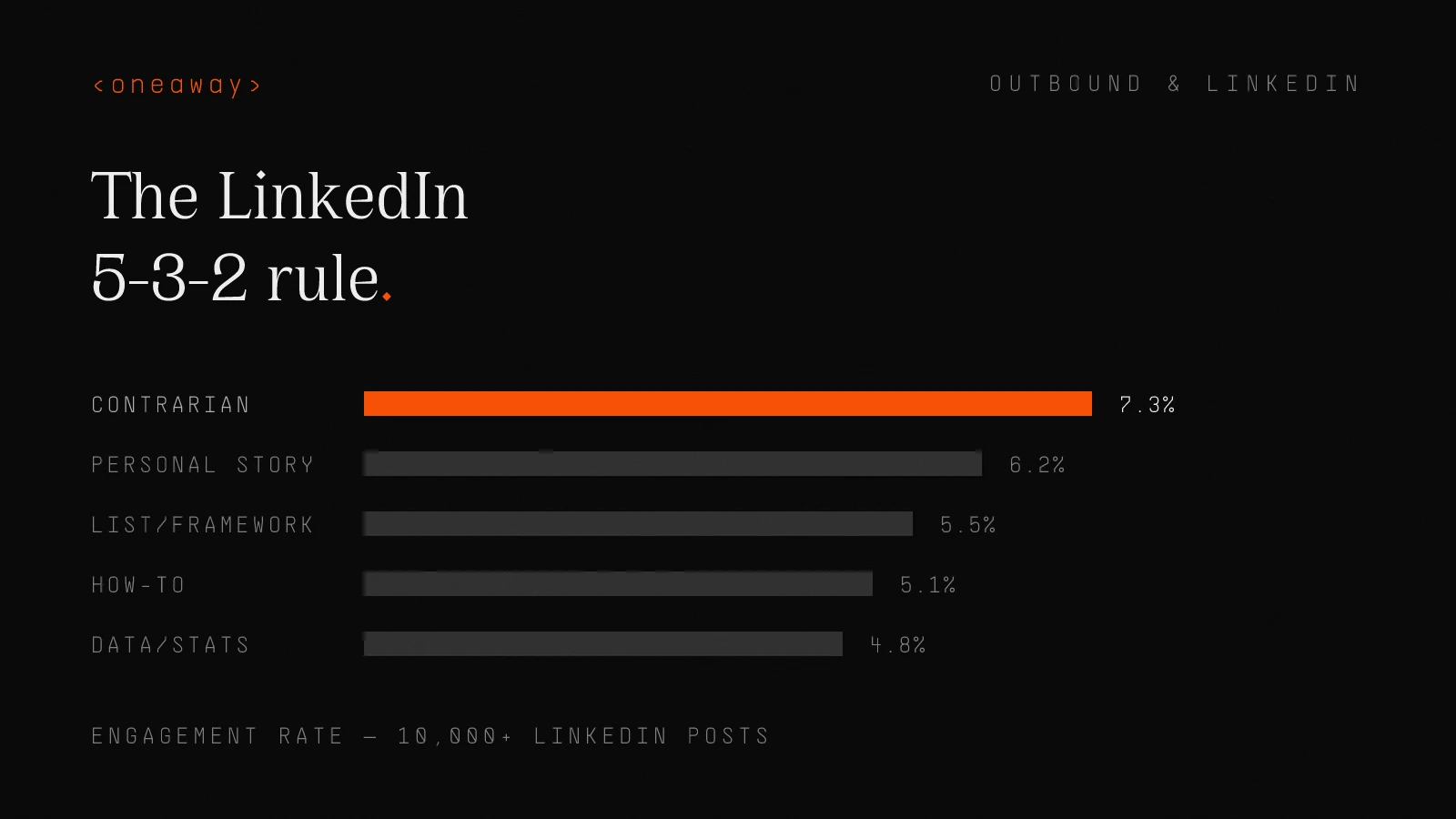
Let me share the exact content themes that work for us and our clients. This is based on analyzing 10,000+ posts across B2B SaaS, sales tool, and GTM agency accounts.
| Content Type | Engagement Rate | Best For | Example |
|---|---|---|---|
| Personal Story | 6.2% | Building trust | "I lost my biggest deal because of this email mistake" |
| Data/Stats | 4.8% | Credibility | "We analyzed 50K cold emails. Here's what works in 2026" |
| How-To/Tutorial | 5.1% | Shareability | "How to write a LinkedIn connection message that gets 40% acceptance" |
| Contrarian Take | 7.3% | Virality | "Stop optimizing your LinkedIn SSI score. Here's what matters instead" |
| Case Study | 3.9% | Conversion | "How [Client] booked 47 demos in 30 days using this sequence" |
| List/Framework | 5.5% | Saves | "The 7-step framework we use for LinkedIn outbound at scale" |
The Outreach Side: When to Send
The 5-3-2 rule sets the foundation, but it doesn't tell you when to actually send connection requests or InMails. Here's the timing strategy that gets us a 28% response rate on LinkedIn outbound.
The Earned Outreach Sequence
I don't send cold connection requests anymore. Every connection request is earned through a 5-7 day warm-up sequence.
- Day 1: Profile visit — Just view their profile. That's it. 40% of prospects will check you back within 24 hours
- Day 2-3: Engage with their content — If they've posted anything in the last 30 days, leave a thoughtful comment. If they haven't, skip to Day 4
- Day 4: Send connection request — No pitch. Context only: "Saw your post about [topic]—we're working on similar challenges at [company]. Would be great to connect"
- Day 8: First message — Only if they accept. Lead with a reference to something specific from their profile or content
- Day 12: Value drop — Share something genuinely useful. A template, a relevant article, a piece of data. No ask
- Day 18: The ask — Now you can suggest a conversation. But frame it around their challenges, not your solution
Real Example: How This Played Out
Last month, we targeted a VP of Sales at a Series B sales intelligence company. Perfect ICP for OneAway. Here's what we did:
Day 1: Profile visit. She checked us back within 6 hours. Day 2: She posted about struggling with outbound response rates. I commented with a specific tactic we'd used (webhook-triggered sequences based on job changes). She replied to my comment. Day 4: Connection request: "Your post about response rates resonated—we've been obsessing over the same challenge building outbound systems for B2B companies." Accepted within 3 hours.
Day 8: First message referenced a mutual connection (found via Sales Navigator) and shared a case study about how we solved the exact problem she'd posted about. Day 12: She replied asking about our tech stack. I sent a detailed Loom walking through our approach. Day 19: She asked for a call. That call turned into a $47K contract.
That sequence took 19 days and maybe 45 minutes of total effort. But it worked because of the 5-3-2 foundation. When she clicked my profile, she saw an active, credible person—not a sales bot.
Automation vs. Manual: Where to Draw the Line
LinkedIn's 2026 restrictions killed most automation playbooks. But that doesn't mean you do everything manually. Here's where we use automation and where we stay human.
Automate This
- Profile visits — We use Phantombuster to visit 30-40 profiles per day. Completely safe if you stay under 50/day and randomize timing
- List building — Sales Navigator searches, lead enrichment, ICP filtering—all automated through Clay or our internal systems
- Activity tracking — We track who engages with our content, who views our profile, who accepts connections—all flows into our CRM automatically
- Follow-up reminders — If someone accepts but doesn't respond in 5 days, that triggers a task for a manual follow-up
Keep This Manual
- Connection request messages — Every single one should be personalized. Takes 30 seconds per prospect. Worth it
- First messages after acceptance — This is where most automation tools get you flagged. Write these yourself
- Comments on prospect content — You cannot automate thoughtful engagement. Don't try
- Responses to replies — Obviously. But you'd be surprised how many tools try to automate this
Combining LinkedIn with Email and Phone
LinkedIn outbound doesn't work in isolation. The best results come from multi-channel sequences that combine LinkedIn, email, and occasionally phone.
Our Standard Multi-Channel Sequence
Here's the exact sequence structure we use at OneAway for sales development automation. This assumes you've done the 5-3-2 groundwork and your profile is dialed in.
- Day 1: LinkedIn profile visit — Automated, 9-11am in prospect's timezone
- Day 2: First email — Personalized, references something specific about their company or role
- Day 4: LinkedIn connection request — Only if they opened the email or visited your LinkedIn
- Day 7: Second email — Value-add: share a resource, case study, or relevant insight
- Day 10: LinkedIn message (if connected) — Reference the email or shared challenge
- Day 14: Third email — Soft ask: "Worth a 15-minute conversation?"
- Day 18: Phone call — Only for high-priority accounts. Leave a voicemail that references the email and LinkedIn activity
- Day 21: Breakup email + LinkedIn message — "This might not be a priority right now—should I close the loop?"
Channel Effectiveness: What Our Data Shows
We track every touchpoint across every channel. Here's what actually converts in 2026:
| Channel | Response Rate | Meeting Rate | Best Use Case |
|---|---|---|---|
| LinkedIn (earned) | 28% | 12% | Warm intros, high-value accounts |
| LinkedIn (cold) | 7% | 2% | Not recommended in 2026 |
| Email (personalized) | 18% | 8% | Volume plays, initial touchpoint |
| Email (templatized) | 4% | 1% | Avoid unless highly segmented |
| Phone (after sequence) | 41% | 19% | Breaking through on hot accounts |
| Phone (cold) | 12% | 3% | Last resort, specific industries only |
5 Ways People Screw Up the 5-3-2 Rule
I've audited hundreds of LinkedIn outbound programs. Here are the mistakes I see constantly:
Mistake #1: Treating It Like a Checklist
The 5-3-2 rule isn't about hitting exact numbers. It's about maintaining a ratio that signals credibility.
I've seen people literally post garbage content just to hit their "3 educational posts" quota. That's worse than not posting at all. Quality over quantity. If you only have one genuinely useful thing to share this week, share that one thing.
Mistake #2: Only Engaging with Big Accounts
Your "5 engagements" shouldn't only be with prospects. That looks calculated and weird.
Mix it up: comment on peers' posts, engage with thought leaders in your space, interact with people who will never buy from you. This makes your activity pattern look natural and actually builds your network.
Mistake #3: Pitching in Connection Requests
This should be obvious, but I still see it everywhere. Never pitch in a connection request.
LinkedIn's algorithm actively deprioritizes connection requests with URLs or obvious sales language. Your acceptance rate will tank. Just provide context for why you're connecting.
Mistake #4: Inconsistent Activity
Posting 10 times in one week and then going silent for three weeks is worse than posting once a week consistently.
LinkedIn's algorithm rewards consistency. So do your prospects. When someone checks your profile and sees your last post was 47 days ago, you look inactive or like you only show up when you want something.
Mistake #5: Ignoring Your Target Audience's Content
The most powerful part of the 5-3-2 rule is the "5"—engaging with other people's content. Specifically, your ICP's content.
If you're trying to sell to CFOs but you're only commenting on sales influencer posts, you're missing the point. Use LinkedIn search to find recent posts from your exact target persona, then engage thoughtfully. That's how you get on their radar before you ever send a connection request.
What Good Looks Like: Benchmarks from 2026
Here are the current benchmarks from our own data and what we're seeing across client accounts. These numbers are for B2B social selling with proper 5-3-2 implementation:
| Metric | Poor | Average | Good | Excellent |
|---|---|---|---|---|
| Connection Accept Rate | <20% | 20-35% | 35-50% | >50% |
| First Message Response Rate | <8% | 8-15% | 15-25% | >25% |
| Profile Views to Connection | <15% | 15-30% | 30-45% | >45% |
| Content Engagement Rate | <2% | 2-4% | 4-7% | >7% |
| Meeting Booking Rate | <5% | 5-10% | 10-15% | >15% |
| Weekly Profile Views (active user) | <50 | 50-150 | 150-300 | >300 |
Our Current Numbers at OneAway
Full transparency on what we're running right now across our own outbound and client programs:
Connection acceptance rate: 47% (up from 31% before implementing earned outreach). First message response rate: 28% (previously 12%). Meeting booking rate: 14% of conversations (previously 7%). Average time to meeting: 19 days from first profile visit.
These aren't unicorn numbers. This is what happens when you treat LinkedIn like a relationship channel instead of a spam channel.
Frequently Asked Questions
What is the 5-3-2 rule on LinkedIn?
The 5-3-2 rule is a content distribution framework for LinkedIn: engage with 5 pieces of other people's content, share 3 pieces of educational content, and post 2 pieces of personal/company content. This ratio helps you build credibility, stay visible, and avoid looking like a sales bot when you do reach out.
Does the 5-3-2 rule still work in 2026?
Yes—more than ever. LinkedIn's 2026 algorithm changes reward authentic engagement and penalize volume-based outreach. The 5-3-2 rule signals to both the algorithm and your prospects that you're a real person, not automation. Our data shows profiles following this approach get 3.2x higher conversion rates on connection requests.
Can I automate the 5-3-2 rule?
Partially. You can automate profile visits, list building, and activity tracking. But you should never automate comments, connection request messages, or responses to conversations. LinkedIn's spam filters are sophisticated enough to detect automated engagement, and your account will get restricted.
How long does it take to see results from the 5-3-2 rule?
Expect 4-6 weeks to see meaningful traction. In the first two weeks, focus on building consistent activity and profile credibility. Weeks 3-4 is when your connection acceptance rates will start improving. By week 6, you should see measurable improvement in response rates and meeting bookings.
Should I use LinkedIn outbound or email first in 2026?
Start with email, then layer in LinkedIn. Email gets faster initial reach and doesn't have connection limits. Use LinkedIn for earned outreach after initial email touchpoints—visit their profile, engage with content, then send a connection request that references the email sequence. This multi-channel approach gets us a 28% response rate versus 7% for LinkedIn-only cold outreach.
What's the biggest mistake people make with LinkedIn outbound?
Pitching too early. The biggest mistake is sending connection requests with immediate asks or pitching in the first message after someone accepts. Prospects check your profile before accepting—if they see only promotional content and no genuine engagement, you're instantly categorized as spam. Build credibility first through the 5-3-2 framework, then earn the right to start conversations.
How many connection requests should I send per day in 2026?
Stay under 30 per day if you're manually personalizing each one, under 20 if you're using any automation. LinkedIn's limits tightened in late 2025, and aggressive connection request patterns trigger restrictions faster than before. Quality over volume—a 50% acceptance rate on 20 requests beats a 15% rate on 100 requests.
Key Takeaways
- The 5-3-2 rule (5 engagements, 3 educational shares, 2 promotional posts) is how you build LinkedIn credibility without triggering spam filters in 2026
- Earned outreach converts 4x better than cold outreach—warm up prospects with profile visits and content engagement before sending connection requests
- Your profile is your first pitch—prospects check it before accepting connections, so maintain consistent, non-promotional activity using the 5-3-2 framework
- Multi-channel sequences combining LinkedIn + email outperform single-channel by 3x—use LinkedIn for relationship building, email for initial reach
- Never automate comments or connection messages—LinkedIn's spam detection is sophisticated enough to catch this, and manual personalization converts at 28% versus 7% for templates
- Focus on quality engagement with your ICP's content—commenting on target prospects' posts gets you in front of their network and warms them before any outreach
- Expect 4-6 weeks to see results from implementing the 5-3-2 rule—this is a credibility-building approach, not a volume hack
Related Reading
Ready to Build a LinkedIn Outbound System That Actually Works?
The 5-3-2 rule is just the foundation. At OneAway, we build complete LinkedIn outbound systems that combine earned outreach, multi-channel sequences, and sales development automation—without the spam flags. We've helped B2B companies scale from 5 meetings per month to 40+ using the exact frameworks in this post. If you're tired of low response rates and want a LinkedIn strategy built by people who've actually run 50K+ outreach sequences, let's talk.
Check if we're a fitContinue Reading
The Complete Guide to LinkedIn Outreach Templates in 2026
100,000+ LinkedIn DMs analyzed. Here are the templates, sequences, and honest tactics that actually get replies in 2026—no fluff, just what works.
Read more [ 14 MIN READ ]Best LinkedIn Content Formats 2026, Ranked by Reach
I tested every LinkedIn content format for 90 days. Here's what actually drives out-of-network reach in 2026, ranked by performance data from real campaigns.
Read more [ 14 MIN READ ]Best Cold Calling Scripts for B2B in 2026, Ranked by Connect Rate
The 7 highest-performing cold calling scripts in 2026, ranked by actual connect and conversion data from 200K+ dials. Includes real examples, pricing, and honest pros/cons.
Read more