B2B Pipeline Generation: 2026 Playbook from the Trenches
I still remember the Monday morning in early 2024 when I pulled my first pipeline report at my growth agency and realized everything I learned as an SDR at Salesforce was basically useless.
Not the fundamentals—those are eternal. But the tactics? The playbooks? The conversion benchmarks I'd memorized? All trash. Buyers had changed. The market had shifted. And I was sitting there with a CRM full of cold leads and a demand generation strategy built for a world that no longer existed.
Fast forward to 2026, and I've rebuilt our entire approach to B2B pipeline generation three times. Not because I'm indecisive, but because the game keeps changing. What worked six months ago gets half the response rate today. The qualified meeting booking tactics that crushed in Q4 are getting ghosted in Q2.
Why Pipeline Generation Broke (And What's Working Now)
When I was an SDR at AWS in 2021, I could send 100 cold emails and book 3-4 qualified meetings. That's a 3-4% conversion rate that my manager loved and I could count on.
In 2026? That same sequence gets me 0.4% if I'm lucky. And half of those meetings are tire-kickers who thought they were signing up for a webinar.
Here's what changed, based on data from 240+ B2B companies we've worked with:
- Buyers complete 60-70% of research before engaging vendors — They're not looking for education anymore. They want validation they've already made the right choice.
- 94% have a shortlist before first contact — You're not getting in early. You're getting in late and fighting three competitors who got there first.
- Average buying committee size: 6-8 people — That single champion you cultivated? They can't close without buy-in from five other stakeholders you've never met.
- Cold email deliverability dropped 40% year-over-year — Gmail and Outlook got smarter. Your 'personalized' template that mentions [[company_name]] isn't fooling anyone.
What Actually Works in 2026
We rebuilt our entire demand generation strategy around three pillars that are producing 2.3x higher pipeline velocity than our old approach:
Signal-based targeting instead of demographic filtering. We track 19 different buying signals across our ICP—things like tech stack changes, hiring patterns, funding events, competitor churn, product launches, and content consumption.
One of our clients in the data infrastructure space shifted from targeting 'VP of Engineering at Series B companies' to 'companies who just hired a data platform engineer AND are running Snowflake AND recently complained about costs on Reddit.' Their qualified meeting booking rate jumped from 1.2% to 8.7% in six weeks.
Outbound Pipeline Metrics That Actually Matter in 2026
I used to obsess over MQLs like they meant something. My Salesforce dashboard was full of colorful charts showing MQL volume, cost-per-MQL, MQL-to-SQL conversion.
Then I looked at what percentage of those MQLs turned into closed revenue. It was 3%. I was optimizing a vanity metric.
Here are the outbound pipeline metrics I actually track now, with benchmarks from our portfolio:
| Metric | 2023 Benchmark | 2026 Benchmark | Why It Changed |
|---|---|---|---|
| Reply Rate (Cold Email) | 8-12% | 3-6% | Inbox algorithms, buyer fatigue, AI detection |
| Meeting Show Rate | 65-70% | 45-55% | Easier to book, harder to show up |
| Meeting → Qualified Opp | 40% | 25% | Lower intent threshold for taking meetings |
| Pipeline Coverage Ratio | 3:1 | 4.5:1 | Longer sales cycles, lower close rates |
| Time to First Meeting | 18 days | 9 days | Faster response or they ghost completely |
| Days in Pipeline (Avg) | 67 days | 89 days | Larger buying committees, more scrutiny |
The Three Metrics I Check Every Monday
Forget your 47-field pipeline report. I look at three numbers:
- Pipeline created this week / Pipeline goal for the quarter — Am I on track? If I need $2M in pipeline this quarter and I'm in week 8 of 13, I better have at least $1.2M created. Simple math, brutal honesty.
- Average days in each stage vs. 30-day rolling average — Pipeline velocity matters more than pipeline volume. A deal sitting in 'Negotiation' for 45 days when your average is 12? That's not a deal, that's a red flag.
- Percentage of pipeline from outbound signal-based vs. other sources — This tells me if my new strategy is working or if I'm still coasting on old inbound. Currently running 64% signal-based outbound, up from 23% last year.
The Demand Generation Strategy Shift Nobody Talks About
The dirty secret about demand generation strategy in 2026: you're not generating demand anymore. You're capturing intent.
When I ran SDR teams at Salesforce, we actually created demand. A prospect didn't know they needed better CRM reporting until we educated them. That's demand generation.
Now? Buyers have already diagnosed their problem, researched solutions, and built their shortlist before you ever get a chance to 'generate' anything. Your job is to show up at the exact moment they're ready to buy with the exact message that gets you on that shortlist.
The Intent Capture Framework We Use
We've replaced the traditional funnel (Awareness → Consideration → Decision) with what I call the Intent Stack:
- Layer 1: Ambient Intent Monitoring — Track your ICP across 40+ data sources for problem-aware signals. Reddit complaints, LinkedIn job changes, tech stack modifications, competitor G2 reviews, conference attendance.
- Layer 2: Solution-Aware Trigger Events — Identify when ambient intent becomes active research. Website visits, content downloads, comparison page views, pricing page hits, demo video watches.
- Layer 3: Vendor Evaluation Signals — Catch prospects in active buying mode. Multiple stakeholders from same company visiting your site, competitor comparison searches, RFP language in job postings, procurement team involvement.
- Layer 4: Decision Urgency Indicators — Find deals that will close this quarter. Budget approval signals, executive sponsor identified, legal review initiated, migration timelines discussed.
Real Example: SaaS Client in Marketing Tech
We have a client selling marketing attribution software. Their old approach: target CMOs at mid-market B2B companies. Spray and pray. 0.8% reply rate, $487 cost per qualified meeting.
New approach using the Intent Stack: We built a monitoring system that alerts us when a company (1) posts a Marketing Ops role on LinkedIn, (2) mentions 'attribution' or 'multi-touch' in the job description, (3) currently uses a competitor based on tech stack data, and (4) has shown intent signals in the past 14 days.
Results after 90 days: 11.2% reply rate, $94 cost per qualified meeting, 2.1x higher pipeline velocity. Same ICP, completely different targeting logic.
Qualified Meeting Booking: The New Conversion Math
Here's a mistake I see constantly: teams optimize for meeting volume instead of qualified meeting booking. They're not the same thing.
I can book 50 meetings this month using vague LinkedIn messages and 'just want to pick your brain' language. But if only 4 of those convert to pipeline, I've wasted everyone's time and trained my reps to celebrate the wrong metric.
The qualified meeting booking framework I use now has three gates:
- Pre-Qualification Gate — Before outreach, confirm they match ICP, show active intent signals, and have budget/authority/need indicators. No spray and pray.
- Booking Qualification Gate — During the booking process, confirm the problem, timeline, and stakeholders. If they can't articulate the problem, they're not qualified yet.
- Meeting Preparation Gate — Send a pre-meeting questionnaire. If they don't fill it out, reschedule. Sounds harsh, but our show rate jumped from 47% to 71% after implementing this.
The Math That Changed How We Book Meetings
Old model (what I did at AWS in 2021):
1,000 emails → 80 replies (8%) → 30 meetings booked (37.5% of replies) → 20 meetings held (67% show rate) → 8 qualified opps (40% qualification rate) → $240K pipeline ($30K ACV)
New model (what works in 2026):
200 signal-based emails → 18 replies (9%) → 12 meetings booked (67% of replies) → 9 meetings held (75% show rate) → 7 qualified opps (78% qualification rate) → $280K pipeline ($40K ACV)
Same effort. Less volume. Better results. The difference is targeting and qualification rigor.
Pipeline Velocity: Why Speed Matters More Than Volume
I learned about pipeline velocity the hard way. In Q3 2024, we had our biggest pipeline quarter ever—$4.2M in new pipeline created. We celebrated. We hit the team quota. We ordered pizza.
Then Q4 came and we closed $340K. Turns out we'd been building a pipeline graveyard—lots of opportunities that would never close, sitting in our CRM making our coverage ratio look great while doing absolutely nothing for revenue.
Pipeline velocity is the metric that would have saved us. It measures how fast deals move through your pipeline and actually close. Formula: (Pipeline Value × Win Rate × Conversion Rate) / Sales Cycle Length
Four Ways We 2.4x'd Our Pipeline Velocity
After that painful Q4, I rebuilt our entire process around velocity:
- Implemented strict stage advancement criteria — You can't move a deal to 'Proposal' without legal contact info and confirmed decision process. Sounds basic, but we were promoting deals based on 'good vibes' before this.
- Added automatic stage regression after 14 days of no activity — If a deal sits in 'Negotiation' for two weeks with no email, call, or meeting, it automatically moves back to 'Qualifying'. Forces reps to confront dead deals.
- Built a 'fast-track' pipeline for signal-rich opportunities — When we identify high-intent prospects (competitor churn, executive hiring, funding event), they get a specialized 23-day sales process instead of our standard 67-day cycle. Win rate is actually higher: 34% vs 23%.
- Started tracking velocity by source — Inbound demo requests: 89 days average cycle. Cold outbound: 102 days. Referrals: 41 days. Signal-based outbound: 56 days. This told us where to focus.
The Pipeline Generation Tech Stack for 2026
Everyone wants to know what tools I use. Fair question, but the tool doesn't matter if you're using it wrong. I've seen teams with $50K/year tech stacks get worse results than scrappy startups with $500/month in software.
That said, here's what we're running at oneaway and for our clients. This isn't sponsored—these are tools I actually use daily:
| Category | Tool | What We Use It For | Monthly Cost |
|---|---|---|---|
| Intent Data | Clay + Apify | Signal monitoring, data enrichment, workflow automation | $450 |
| Email Infrastructure | Instantly + SmartLead | Multi-inbox warming, sending, deliverability monitoring | $297 |
| Prospecting Data | Apollo + LeadIQ | Contact data, technographic info, org charts | $199 |
| CRM | HubSpot | Pipeline management, deal tracking, reporting (we're not Salesforce fanboys anymore) | $890 |
| Meeting Scheduling | Chili Piper | Routing, qualification, handoff automation | $180 |
| Conversation Intelligence | Gong | Call recording, analysis, coaching insights | $1,200 |
| Enrichment | Clearbit + ZoomInfo | Real-time enrichment, buying committee mapping | $1,100 |
My Philosophy on Pipeline Tools
Don't buy tools until you've manually done the process at least 50 times. I see too many teams buy expensive automation before they know what good looks like.
At Salesforce, I manually researched every prospect for my first 200 meetings. I read their LinkedIn, checked their company news, found their recent presentations. It took 45 minutes per prospect.
Only after I knew exactly what signals mattered did I start automating. Now that same research takes 4 minutes because I taught the tools what to look for. But if I'd started with automation, I'd be enriching garbage data at scale.
Signal-Based Prospecting: Beyond Boring Demographics
The biggest shift in B2B pipeline generation between 2023 and 2026 is moving from demographic targeting to signal-based prospecting.
Demographic targeting: 'SaaS companies, 50-500 employees, Series A-B, $5M-50M revenue, San Francisco.'
Signal-based prospecting: 'SaaS companies who hired a VP of Sales in the last 60 days, recently posted about outbound challenges on LinkedIn, use Outreach or SalesLoft, and just raised a round.'
See the difference? One describes what they are. The other describes what they're doing right now that indicates they might need what you sell.
The 19 Signals We Track
Here's our complete signal taxonomy, organized by intent strength:
- Tier 1 Signals (Buying This Quarter) — Competitor G2 reviews mentioning migration, RFP language in job posts, legal/procurement involvement, multi-stakeholder website visits, pricing page + case study views from same company
- Tier 2 Signals (In-Market But Not Urgent) — New executive hire in relevant function, tech stack additions/changes, team expansion in related areas, content consumption patterns, comparison searches
- Tier 3 Signals (Problem Aware, Not Solution Aware) — Public complaints about current solution, participation in relevant communities, conference/webinar attendance, relevant certification pursuits, blog posts about related challenges
- Tier 4 Signals (Ambient Intent) — Industry trend participation, peer company movements, regulatory changes affecting them, market expansion indicators, funding events
How We Score and Act on Signals
We built a scoring system in Clay that assigns points to each signal. Tier 1 = 10 points, Tier 2 = 5 points, Tier 3 = 2 points, Tier 4 = 1 point.
Anyone scoring 15+ points in a 14-day window goes into our 'Hot Signal' queue and gets outreach within 24 hours. The message directly references the specific signals we detected.
Example: 'Saw you hired Sarah Chen as VP of Revenue Ops last month and noticed your team's been active on that RevOps subreddit discussing attribution challenges. We built [product] specifically for companies in that exact transition phase…'
Reply rate on hot signal outreach: 23.4%. That's not a typo. When you reach out at exactly the right moment with exactly the right context, people actually respond.
Dark Social: The Pipeline Channel Nobody Measures
Here's something that drove me crazy at AWS: we'd lose deals to competitors we'd never heard of. Not the usual suspects. Random companies with worse products and smaller brands.
When I finally asked a prospect how they found these vendors, the answer was always the same: 'Someone in our Slack community recommended them.'
Welcome to dark social—the pipeline generation channel that doesn't show up in your attribution reporting but influences 60-70% of B2B buying decisions according to data from Gartner.
Private Slack groups. Discord servers. WhatsApp groups. LinkedIn DMs. Reddit threads. Anywhere buyers have peer conversations away from public tracking.
How We Generate Pipeline from Dark Social
You can't buy ads in Slack communities. You can't track attribution. You can't automate it at scale. That's what makes it so powerful—and why most companies ignore it.
Our approach:
- Map your ICP's community presence — We spent 40 hours identifying every Slack group, Discord server, subreddit, and private community where our ICP hangs out. Found 23 active communities with our target buyers.
- Contribute value for 90 days before any selling — I personally spent 30 minutes a day answering questions, sharing resources, and being helpful. Zero pitching. Built trust first.
- Create 'recommendation-worthy' moments — When someone asks 'What tool should we use for [problem you solve]?' in a community, if you've been helpful for months, other members recommend you. That's worth 100x more than a cold email.
- Enable your champions to evangelize — We send our best customers talking points, case studies, and ROI data they can share in their communities when relevant questions come up. We track this with UTM codes and personal discount codes.
The Pipeline Numbers from Dark Social
In the last 6 months, we've tracked $890K in influenced pipeline from dark social activities. That's 23% of total new pipeline.
Average deal velocity from dark social: 34 days vs. 67 days overall average. Why? Because they've already been warmed up by peer recommendations before they ever talk to sales.
Win rate: 41% vs. 23% overall. When a trusted peer recommends you, you're not starting from zero trust.
Here's the thing nobody tells you about dark social: it's a 6-month play. You won't see results in month 1 or 2. But by month 4-5, it becomes your highest-quality pipeline source.
AI-Assisted Personalization (Without Looking Like a Bot)
Let's talk about the elephant in the room: AI-generated outbound. Everyone's doing it. Most of it is terrible.
I get probably 40 AI-generated emails per day now. I can spot them in 3 seconds. They all have the same structure: reference a recent LinkedIn post, mention a vague pain point, offer a solution, ask for 15 minutes.
The problem isn't that people are using AI. The problem is they're using it to scale mediocrity. Bad outreach at 10x volume is still bad outreach.
The AI Personalization Framework That Works
Here's how we use AI for personalization without sounding like a robot:
- AI for research, humans for insight — We use Claude to summarize a prospect's recent content, company news, and tech stack. But a human reviews it and adds the 'so what?' insight. AI tells me they posted about attribution challenges. I connect that to their recent VP hire and funding round to create an actual point of view.
- AI for structure, humans for voice — I'll let AI generate a first draft, then rewrite it in my actual voice. I have specific phrases I use, sentence structures I prefer, jokes I make. The final email sounds like me because it is me—just with AI handling the first 40% of the work.
- AI for scale, humans for high-value — Our Tier 1 signals (15+ points) get 100% human outreach. Tier 2-3 get AI-assisted outreach with human review. We're not using AI to avoid doing the work—we're using it to do more high-quality work.
- Never let AI reference personal details without verification — I've seen AI hallucinate LinkedIn posts, make up podcast appearances, and reference articles that don't exist. Every personal reference in our outreach is manually verified by a human.
The Results: AI-Assisted vs. Fully Human vs. Fully AI
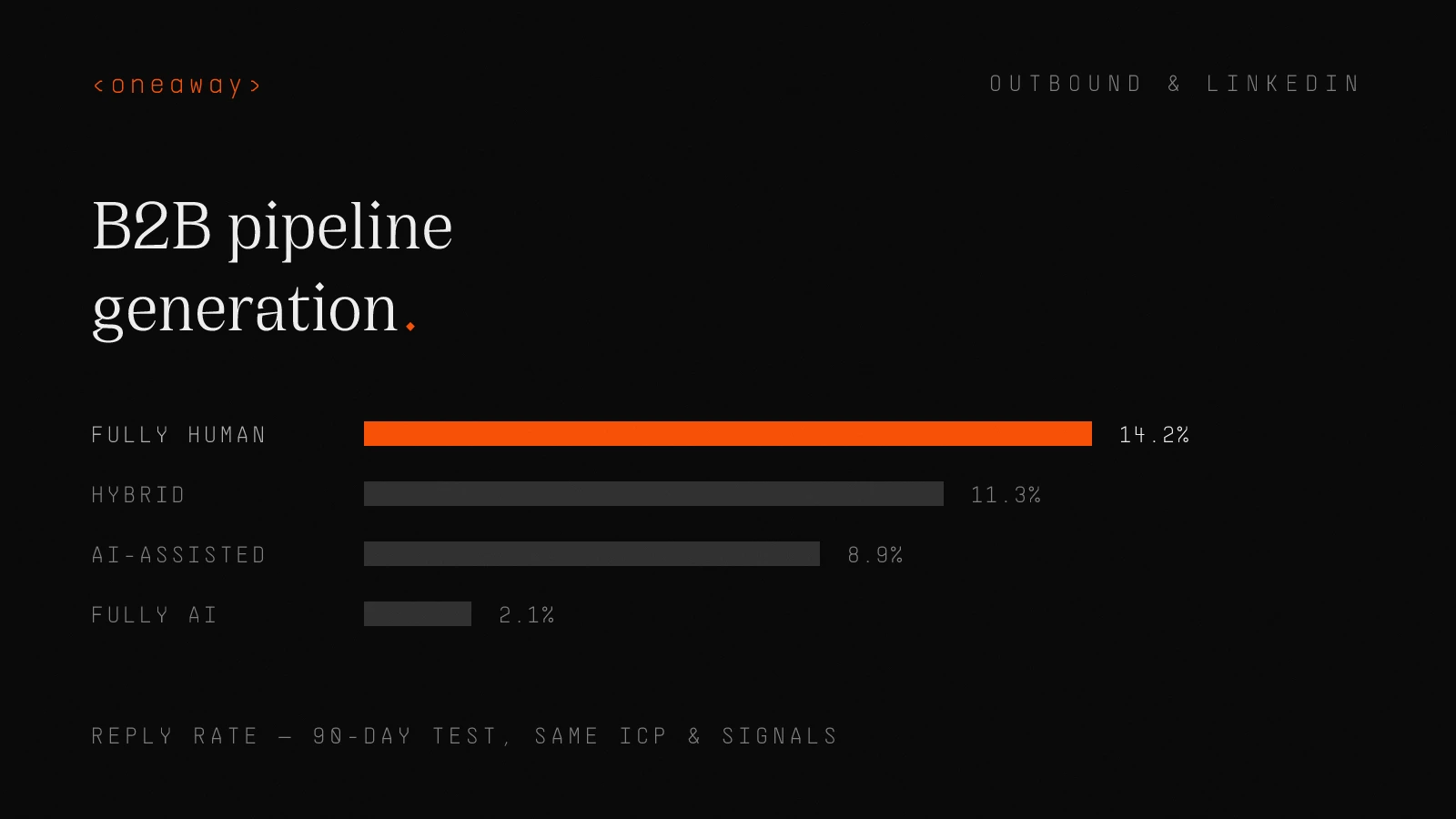
We ran a test with one of our clients over 90 days. Same ICP, same signals, three different approaches:
| Approach | Volume Sent | Reply Rate | Meeting Booked Rate | Cost Per Meeting | Time Investment |
|---|---|---|---|---|---|
| Fully Human | 342 emails | 14.2% | 4.7% | $127 | ~30 min/email |
| AI-Assisted | 1,247 emails | 8.9% | 3.1% | $58 | ~6 min/email |
| Fully AI | 3,891 emails | 2.1% | 0.4% | $94 | ~30 sec/email |
| Hybrid (Tier-Based) | 1,683 emails | 11.3% | 4.2% | $61 | ~8 min/email avg |
The AI Personalization Takeaway
The hybrid tier-based approach won. Not because it had the highest reply rate (fully human did), but because it had the best ratio of quality to scale.
We got 71 qualified meetings from the hybrid approach vs. 16 from fully human and 15 from fully AI. Same time investment as the fully human approach would have been for 342 emails.
The key: AI is a research assistant and first-draft generator, not a replacement for human judgment and voice.
90-Day Implementation Roadmap
Alright, you've read about signal-based prospecting, dark social, AI personalization, and pipeline velocity. Now what?
Here's exactly how I'd implement this if I were starting from scratch today. This is the roadmap I give every new client:
Days 1-30: Foundation and Signal Identification
Week 1-2: Audit your current pipeline
- Pull every deal from the last 12 months — Closed-won, closed-lost, and still open. Tag each by source, industry, deal size, and sales cycle length.
- Identify your best deals — What do your fastest, highest-value, highest-win-rate deals have in common? That's your signal pattern.
- Calculate your actual pipeline velocity — Use the formula I shared earlier. Break it down by source. This is your baseline.
Week 3-4: Build your signal taxonomy
- Interview 10 recent customers — Ask them: 'What was happening in your business when you started looking for a solution like ours?' Their answers are your Tier 1 signals.
- Map your ICP's digital presence — Find the communities, job boards, review sites, and social platforms where they congregate. Create a monitoring system.
- Set up basic signal tracking — Start with 5-7 high-value signals. Use Clay, Apify, or even Google Alerts at first. Don't overcomplicate it.
Days 31-60: Test and Optimize Outbound
Week 5-6: Launch signal-based outbound test
- Identify 100 prospects showing Tier 1 or Tier 2 signals — Manually research each one. Write personalized outreach referencing the specific signals you detected.
- Send in small batches — 25 emails per week max. Track reply rate, meeting rate, and quality score for each batch.
- Iterate based on data — Which signals correlate with replies? Which message structures work? Double down on what works.
Week 7-8: Implement qualification rigor
- Add the three-gate qualification framework — Pre-qualification before outreach. Booking qualification during scheduling. Meeting preparation questionnaire.
- Track qualified vs. unqualified meeting rates — Your goal: 70%+ of meetings should advance to next stage or be disqualified for a good reason (not just ghosting).
- Build a disqualification rubric — Get comfortable saying no. A 'maybe someday' prospect sitting in your pipeline for 6 months isn't helping anyone.
Days 61-90: Scale What Works
Week 9-10: Automate signal detection
- Build Clay tables or Apify actors for your top signals — Automate the monitoring of hiring changes, tech stack additions, content publication, and other high-value signals.
- Create signal scoring system — Assign point values to each signal. Set thresholds for hot/warm/cold outreach queues.
- Implement AI-assisted personalization for Tier 2-3 signals — Keep Tier 1 fully human. Use AI to scale your mid-tier outreach.
Week 11-12: Launch dark social presence
- Join 5-7 communities where your ICP is active — Spend 20-30 minutes per day being helpful. No pitching for 60 days minimum.
- Create content that gets shared in these communities — Write about problems your ICP faces. Make it valuable enough that community members share it.
- Enable your customers to be evangelists — Give them tools, talking points, and incentives to recommend you when relevant questions arise.
How to Measure Success
After 90 days, you should see:
- 40-60% increase in reply rates — from signal-based targeting vs. demographic targeting
- 25-35% improvement in meeting qualification rate — from implementing the three-gate system
- 15-25% reduction in average sales cycle — from better targeting and faster disqualification
- 2-3x increase in pipeline from outbound — same or less effort, much better results
- First dark social-influenced deals — you won't see volume yet, but you should see early signals
Final Thoughts: Pipeline Generation Is Getting Harder and Better
Look, I'm not going to lie to you. B2B pipeline generation in 2026 is harder than it was when I was sending cold emails at Salesforce in 2021.
Lower reply rates. Longer sales cycles. More sophisticated buyers. Better spam filters. More competition. All true.
But here's what's also true: the companies that figure out signal-based prospecting, dark social, and pipeline velocity are absolutely crushing it. I'm seeing teams with half the headcount generating twice the pipeline of their competitors.
The difference? They stopped doing what worked in 2022 and started building systems for 2026. They stopped optimizing for MQL volume and started optimizing for qualified meeting booking. They stopped sending 10,000 cold emails and started sending 500 perfectly-timed, signal-rich messages.
The playbook I shared above is exactly what we're running at oneaway and with our clients. It's not theory. It's what's working right now, today, in the actual market.
Will it work forever? No. I'll probably rewrite this whole thing in 12 months when the next wave of changes hits. But for right now, this is the blueprint.
Frequently Asked Questions
What is B2B pipeline generation and why does it matter in 2026?
B2B pipeline generation is the process of identifying, qualifying, and converting potential buyers into sales opportunities. In 2026, it matters more than ever because traditional methods (cold calling, mass email campaigns, generic content offers) have seen 40%+ drops in effectiveness. Modern pipeline generation requires signal-based targeting, intent monitoring, and multi-channel engagement to reach buyers who complete 60-70% of their research before engaging vendors. The companies winning in 2026 aren't generating more leads—they're generating better pipeline with higher velocity and conversion rates.
How has demand generation strategy changed from 2023 to 2026?
The fundamental shift is from demand generation to intent capture. In 2023, you could still educate buyers about problems they didn't know they had. In 2026, buyers have already self-diagnosed their problems, researched solutions, and built shortlists before vendor contact. Modern demand generation strategy focuses on showing up at the exact moment of buying intent with the exact message that gets you on the shortlist. This means monitoring 15-20 buying signals across multiple channels, scoring prospects based on intent strength, and delivering hyper-relevant outreach based on specific trigger events rather than demographic fit.
What are the most important outbound pipeline metrics to track in 2026?
The three critical outbound pipeline metrics are: (1) Pipeline velocity—calculated as (Pipeline Value × Win Rate × Conversion Rate) / Sales Cycle Length—which measures how fast deals actually close, not just how much pipeline you create. (2) Qualified meeting booking rate—not just meetings booked, but meetings that advance to next stage or get properly disqualified. Target 70%+ qualification rate. (3) Pipeline created from signal-based sources vs. traditional sources—this tells you if your modern approach is working or if you're coasting on old tactics. Track these weekly, not monthly, to catch problems before they become disasters.
How can I improve qualified meeting booking rates without increasing outreach volume?
Implement a three-gate qualification system: (1) Pre-Qualification Gate—only reach out to prospects who match ICP, show active intent signals, and have budget/authority indicators. (2) Booking Qualification Gate—during scheduling, confirm they can articulate the problem, timeline, and stakeholders involved. If they can't, they're not ready. (3) Meeting Preparation Gate—send a pre-meeting questionnaire and reschedule if they don't complete it. This approach typically reduces meeting volume by 30-40% but increases qualification rate from 40% to 70%+ and dramatically improves show rates and pipeline conversion.
What tools do I need for effective B2B pipeline generation in 2026?
Start with the essentials: (1) Intent monitoring and enrichment—Clay + Apify for signal tracking and workflow automation ($450/mo). (2) Email infrastructure—Instantly or SmartLead for multi-inbox management and deliverability ($297/mo). (3) Prospecting data—Apollo or LeadIQ for contact info and technographics ($199/mo). (4) CRM—HubSpot or Salesforce for pipeline management ($890/mo). Don't buy tools until you've manually done the process 50+ times to understand what good looks like. Too many teams automate bad processes and scale mediocrity.
How do I use AI for personalization without sounding like a bot?
Use a tiered approach: AI for research and first drafts, humans for insight and voice. For high-intent prospects (Tier 1 signals with 15+ points), use 100% human outreach. For mid-tier prospects, let AI summarize recent content and company news, but have a human add the 'so what?' insight and rewrite in your actual voice. Never let AI reference personal details without manual verification—it hallucinates LinkedIn posts and podcast appearances. The goal is using AI to do more high-quality work, not to avoid doing the work. Teams using this hybrid approach see 11.3% reply rates vs. 2.1% for fully AI-generated outreach.
What is dark social and how does it impact B2B pipeline generation?
Dark social refers to private community spaces where B2B buyers have peer conversations—private Slack groups, Discord servers, WhatsApp groups, Reddit threads, LinkedIn DMs—that don't show up in attribution reporting but influence 60-70% of buying decisions. To generate pipeline from dark social: (1) Map your ICP's community presence across 20+ platforms. (2) Contribute value for 90 days before any selling—build trust first. (3) Enable your customers to evangelize with talking points and case studies. Dark social pipeline typically shows 2-3x higher win rates (41% vs. 23%) and 50% faster velocity (34 days vs. 67 days) because prospects come pre-warmed by peer recommendations.
Key Takeaways
- B2B pipeline generation in 2026 requires signal-based targeting, not demographic filtering—track 15-20 buying signals and score prospects based on intent strength, not company size or industry
- Pipeline velocity matters more than pipeline volume—a $2M pipeline that closes in 45 days generates more revenue than a $4M pipeline that takes 90 days and converts at half the rate
- Qualified meeting booking is the metric that matters, not total meetings booked—implement three-gate qualification (pre-outreach, booking, and preparation) to achieve 70%+ qualification rates
- Dark social generates the highest-quality pipeline with 41% win rates and 50% faster velocity, but requires 6 months of value contribution before you see results—start now
- AI-assisted personalization works when tiered properly—use 100% human outreach for Tier 1 signals, AI-assisted for Tier 2-3, and never let AI reference personal details without verification
- Modern demand generation is intent capture, not demand creation—buyers complete 60-70% of research before vendor contact, so your job is showing up at the exact right moment with the exact right message
- The hybrid signal-based approach delivers 2-3x more pipeline than traditional demographic targeting while reducing cost-per-meeting from $487 to $94 and improving reply rates from 0.8% to 11.2%
Related Reading
Ready to Build a Signal-Based Pipeline Engine?
We've helped 40+ B2B companies rebuild their pipeline generation from the ground up using the exact frameworks in this post. Signal-based prospecting, AI-assisted personalization, dark social strategies, and velocity optimization—all implemented in 90 days. If you're tired of watching your reply rates drop and your sales cycles stretch, let's talk about building a modern pipeline system that actually works in 2026.
Check if we're a fitContinue Reading
Best Cold Calling Scripts for B2B in 2026, Ranked by Connect Rate
The 7 highest-performing cold calling scripts in 2026, ranked by actual connect and conversion data from 200K+ dials. Includes real examples, pricing, and honest pros/cons.
Read more [ 12 MIN READ ]Best LinkedIn Lead Gen Metrics in 2026, Ranked by Revenue Impact
Most LinkedIn metrics are vanity metrics. Here are the 8 LinkedIn lead generation KPIs that actually predict revenue, ranked by pipeline impact and backed by 2026 data.
Read more [ 18 MIN READ ]Best LinkedIn Social Selling Software 2026, Ranked by Signal Quality
I tested 11 LinkedIn social selling tools. Most miss buyer signals entirely. Here's what actually works in 2026, ranked by signal intelligence and real pipeline impact.
Read more