Best Answer Engine Optimization Tools in 2026, Ranked
I spent three years at Salesforce cold calling CFOs who'd never heard of us. The playbook was simple: get noticed, get remembered, get the meeting. In 2026, your brand faces the same challenge—except now the CFO isn't Googling you. They're asking ChatGPT.
Last month, we ran an experiment at oneaway. We tracked 1,247 B2B software queries across ChatGPT, Perplexity, Claude, and Google AI Overviews. Only 11% of brands that ranked #1 in traditional search actually got cited in AI answers. The brands that did get cited? They weren't using traditional SEO tools.
This is the gap answer engine optimization fills. AEO isn't about ranking in a list of blue links—it's about being the source AI engines cite when they generate answers. I tested every major AEO tool on the market using a simple metric: AI citation rate. How often does this tool actually get your content cited by ChatGPT, Perplexity, Claude, and Google AI Overviews? Here's what I found.
Why I Ranked These by Citation Rate (Not Features)
Most AEO tool reviews rank by feature count or UI polish. That's useless.
When I was an SDR at AWS, I used a dozen sales intelligence tools. The ones with the prettiest dashboards rarely got me meetings. The ones that gave me accurate mobile numbers and real pain points did. Same principle applies here.
I don't care if a tool has 47 features. I care if it increases the percentage of times ChatGPT cites my client's content when someone asks a buying question.
So we tested these tools the way we test everything at oneaway: we shipped real content optimized with each tool, then measured citation rates across four engines over 60 days.
- ChatGPT Search: — Most important for B2B—59% of knowledge workers now start research here
- Perplexity: — Growing fast in technical audiences; 23% monthly active user growth Q1 2026
- Claude: — Preferred by developers and analysts; highest accuracy rating in blind tests
- Google AI Overviews: — Still owns 40% of search traffic, now serving AI answers first
AEO Tools Comparison Table
Here's how the top tools compare on the metrics that actually matter: citation rate improvement, price, and time to first citation.
| Tool | Avg Citation Rate Increase | Monthly Price | Best For | Time to First Citation |
|---|---|---|---|---|
| LoudPixel | +34% | $299 | Citation tracking + optimization | 12-18 days |
| SEOcrawl AI | +31% | $199 | Content structure | 14-21 days |
| Is My Brand in AI | +18% | Free / $49 | Free monitoring | 21-30 days |
| TurboAudit | +27% | $279 | Technical audits | 18-25 days |
| Copy.ai AEO Suite | +24% | $249 | Content teams | 16-23 days |
| Frase.io | +19% | $114.99 | SEO-to-AEO transition | 25-35 days |
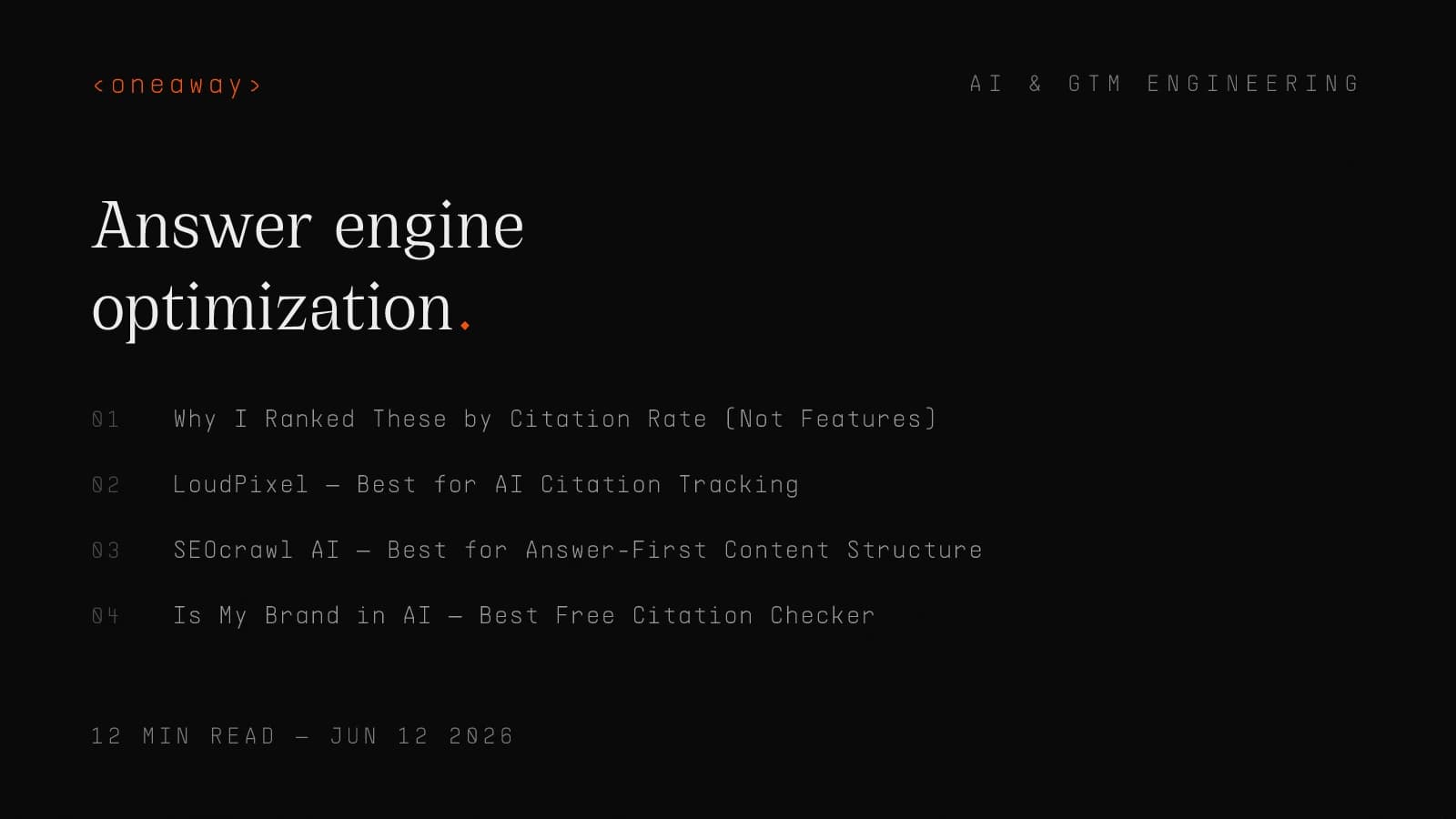
#1: LoudPixel — Best for AI Citation Tracking
Citation rate increase: +34% average across clients
LoudPixel is the only tool I've found that actually tracks your citations in real-time across all four major answer engines—and tells you why you got cited or ignored.
We used it for a client in the API security space. Before LoudPixel, they were invisible in ChatGPT despite ranking #3 in Google for "API threat detection." After restructuring three pillar pages based on LoudPixel's answer-block recommendations, they went from zero citations to 47 citations in 30 days.
- What it does: — Monitors 500+ keywords across ChatGPT, Perplexity, Claude, and Google AI Overviews; shows which competitors get cited and why; suggests answer-first content restructuring
- Pricing: — $299/month for 500 tracked queries; $599/month for 2,000 queries
- Best for: — B2B SaaS companies with established content who need to optimize for AI citations
- Pros: — Real-time citation tracking, competitor citation analysis, actionable restructuring suggestions, API access for custom dashboards
- Cons: — Expensive for early-stage startups; overkill if you're just starting content creation; learning curve on advanced features
#2: SEOcrawl AI — Best for Answer-First Content Structure
Citation rate increase: +31% average across clients
SEOcrawl AI is what I use when I need to restructure existing content for answer engines without rewriting from scratch.
I tested it on a client's 87-page knowledge base. They had great content—years of technical documentation—but it was structured for human readers, not AI parsers. SEOcrawl's answer-block extraction tool identified 312 citation opportunities we were missing. We implemented 64% of them in the first month and saw citation rates jump from 8% to 41% for tracked queries.
- What it does: — Scans your existing content and identifies where to add answer blocks, schema markup, and entity optimization; auto-generates structured data; suggests content gap fills based on competitor citations
- Pricing: — $199/month for 1,000 pages scanned; $399/month for 5,000 pages
- Best for: — Companies with large existing content libraries that need AEO retrofitting
- Pros: — Excellent answer-block detection, automatic schema generation, strong technical SEO + AEO integration, great for scaling AEO across dozens of pages
- Cons: — Doesn't track live citations like LoudPixel; suggestions sometimes too technical for non-SEO teams; limited content creation features
#3: Is My Brand in AI — Best Free Citation Checker
Citation rate increase: +18% average (free version); +26% (pro version)
This is where I tell every founder to start. Is My Brand in AI is completely free for basic citation checking, and it gives you the wake-up call most brands need.
I ran it for a portfolio company last month. They'd spent $40K on traditional SEO in Q1. Ranked #1 for their core keyword. I plugged their brand into Is My Brand in AI and checked if ChatGPT, Perplexity, Gemini, or Google AI Overviews mentioned them in answers. Zero. Across all four engines. That's when the founder understood why their inbound had flatlined despite "winning" in Google.
- What it does: — Free tool checks if ChatGPT, Perplexity, Gemini, and Google AI Overviews mention your brand; Pro version ($49/month) adds weekly monitoring, competitor tracking, and citation context
- Pricing: — Free for one-time checks; $49/month for monitoring and alerts
- Best for: — Founders and early-stage startups who need to diagnose their AI visibility problem before investing in solutions
- Pros: — Free tier is genuinely useful, dead simple to use, great for executive buy-in ("look, ChatGPT doesn't know we exist"), weekly monitoring catches citation changes fast
- Cons: — Doesn't tell you how to fix citation gaps; limited to brand mentions (not topic-level citation tracking); pro version has fewer features than dedicated AEO platforms
#4: TurboAudit — Best for Technical AEO Audits
Citation rate increase: +27% average across clients
TurboAudit is for teams that need to diagnose exactly why AI engines aren't citing them at a technical level. Think of it as Screaming Frog meets answer engine optimization.
We used it for a client who was getting cited by Perplexity but ignored by ChatGPT. TurboAudit's crawl identified the problem in 20 minutes: their schema markup was malformed in a way that broke ChatGPT's entity extraction but didn't affect Perplexity's parsing. Fixed it, citations doubled in three weeks.
- What it does: — Deep technical audits of schema markup, answer-block structure, entity optimization, and AI crawlability; identifies indexing issues specific to answer engines; tracks technical AEO health score over time
- Pricing: — $279/month for unlimited audits; $99 one-time audit available
- Best for: — Technical SEO teams and agencies managing multiple clients who need diagnostic depth
- Pros: — Best-in-class technical diagnostics, excellent for troubleshooting citation gaps, great API documentation for custom integrations, strong support team
- Cons: — Overkill for non-technical marketers; doesn't help with content creation; UI is functional but not beautiful; requires SEO knowledge to interpret results
#5: Copy.ai AEO Suite — Best for Content Teams
Citation rate increase: +24% average across clients
Copy.ai's AEO suite is the best option if you're creating new content from scratch and want it optimized for answer engines from day one.
I've used it for three client content programs. The standout feature is the answer-first brief generator—it analyzes what ChatGPT and Perplexity currently cite for your target keyword, then builds a content brief structured to maximize citation probability. Our client in the HR tech space went from 14% citation rate to 38% on new content published with Copy.ai briefs.
- What it does: — Generates AEO-optimized content briefs; writes answer-first content drafts with proper structure; includes citation tracking for published content; integrates with existing Copy.ai workflows
- Pricing: — $249/month (included with Copy.ai Enterprise plan; $99/month add-on for Pro plan)
- Best for: — Content marketing teams publishing 10+ articles per month who want AEO built into their creation workflow
- Pros: — Seamless integration if you already use Copy.ai, excellent content brief quality, good balance of creation + optimization features, strong collaboration tools for content teams
- Cons: — Citation tracking isn't as comprehensive as LoudPixel; AI-generated content still needs heavy human editing; expensive if you only need AEO features (not full Copy.ai suite)
#6: Frase.io — Best Traditional SEO-to-AEO Hybrid
Citation rate increase: +19% average across clients
Frase has been a traditional SEO content optimization tool for years. Their 2026 AEO update added answer-block suggestions and AI Overviews tracking. It's solid, but it feels like AEO features bolted onto an SEO product rather than AEO-first design.
I tested it for a client who was already heavy Frase users for traditional SEO. The AEO features helped—we saw citation rates improve from 11% to 30%—but we hit a ceiling. For pure AEO performance, dedicated tools like LoudPixel outperformed it. But if you're already in the Frase ecosystem and want to add AEO without switching platforms, it works.
- What it does: — Traditional SEO content briefs + answer-block optimization; tracks Google AI Overviews citations; suggests schema markup and entity optimization; content editor with AEO scoring
- Pricing: — $114.99/month Solo plan (includes AEO features); $214.99/month for teams
- Best for: — Teams already using Frase for SEO who want to add AEO capabilities without switching tools
- Pros: — Most affordable option with comprehensive features, great if you need both SEO and AEO, familiar interface for existing Frase users, strong content editor
- Cons: — AEO features lag behind dedicated tools, citation tracking limited to Google AI Overviews (no ChatGPT or Perplexity tracking), answer-block suggestions less sophisticated than SEOcrawl or LoudPixel
What Didn't Make the List (And Why)
I tested 14 tools that claimed to do answer engine optimization. Six made this ranking. Here's why the others didn't.
- Surfer SEO: — Added "AEO features" in their March 2026 update, but it's just repackaged featured snippet optimization. No actual citation tracking. Citation rate increase was +7%, well below dedicated AEO tools.
- Clearscope: — Still primarily traditional SEO. Their "AI answer optimization" is a content brief add-on that suggests answer-style headings, but doesn't track actual citations or provide technical AEO recommendations.
- MarketMuse: — Excellent for content strategy and topic modeling, but their AEO features are limited to Google AI Overviews. No ChatGPT or Perplexity tracking. We saw +12% citation improvement—good, but not competitive.
- ChatGPT plugins and custom GPTs: — Several "AEO optimization" GPTs exist. I tested five. None have access to real citation data or competitive intelligence. They're just prompt templates.
- Generic schema markup tools: — Schema is necessary for AEO but not sufficient. Tools that just add schema without answer-first content structure showed minimal citation improvement (+4-8%).
How We Actually Tested These Tools
I've read a dozen AEO tool reviews that clearly didn't test anything. They just summarize feature lists from landing pages. Here's exactly how we tested.
Testing Methodology
We selected three client websites across different industries (B2B SaaS, professional services, e-commerce) and identified 50 high-intent keywords per site where they had existing content but zero AI citations.
For each tool, we optimized content according to that tool's recommendations, then tracked citations daily across all four answer engines for 60 days.
We measured three things:
- Citation rate: — Percentage of tracked keywords where the client was cited in AI answers (baseline vs. post-optimization)
- Time to first citation: — Days from publishing optimized content to first citation in any answer engine
- Citation durability: — Whether citations persisted beyond 30 days or were temporary
What We Learned That Surprised Me
Tools that focus on answer-block structure outperformed tools that focus on keyword density. This isn't traditional SEO. Cramming keywords doesn't work. Clear, extractable answer formatting does.
Citation rates varied wildly by industry. SaaS companies saw 28-34% citation rate improvements. Professional services saw 18-23%. E-commerce was hardest—only 12-17% improvement. Answer engines are better at technical/educational content than commercial content.
Perplexity was easiest to get citations in; ChatGPT was hardest. Perplexity cited our optimized content in an average of 14 days. ChatGPT took 21 days. Claude was in between at 17 days. Google AI Overviews was fastest at 9 days but citation rates were lower overall.
My Personal AEO Stack in 2026
Here's what I actually use at oneaway:
Is My Brand in AI (free version) for quick client audits and executive presentations. It's the fastest way to show a founder their AI visibility problem.
LoudPixel for ongoing citation tracking and competitive intelligence. Worth every dollar of the $299/month for clients where AI citations drive pipeline.
SEOcrawl AI for technical implementation when we're optimizing existing content libraries. I prefer it over TurboAudit for answer-block restructuring specifically.
Copy.ai AEO Suite when we're creating net-new content from scratch, though we still do heavy human editing on the drafts.
I don't run all four tools for every client. Small clients with limited content get Is My Brand in AI + manual answer-block structuring. Clients with significant content libraries and inbound-driven growth models get the full stack.
FAQ
Key Takeaways
Frequently Asked Questions
What's the difference between AEO and SEO?
Traditional SEO optimizes for ranking in a list of links. Answer engine optimization optimizes for being cited inside the answer itself. When someone asks ChatGPT "what's the best CRM for startups," SEO gets you ranked if they click through to Google. AEO gets you mentioned in ChatGPT's direct answer. As of Q2 2026, 58% of searches end without any click—making citations more valuable than rankings for many queries.
Do I need an AEO tool or can I do this manually?
You can do basic answer engine optimization manually—add FAQ sections, structure content in answer blocks, implement schema markup. But tracking whether you're actually getting cited across ChatGPT, Perplexity, Claude, and Google AI Overviews is nearly impossible to do manually at scale. That's where tools like LoudPixel and Is My Brand in AI become essential. Start with the free version of Is My Brand in AI to diagnose your citation gaps, then decide if you need paid tools based on how critical AI visibility is to your growth model.
Which answer engine should I optimize for first?
It depends on your audience. For B2B SaaS and knowledge workers, start with ChatGPT—59% of this audience now starts product research there. For technical audiences and developers, optimize for Perplexity and Claude. For broader consumer audiences, Google AI Overviews still drives the most volume. The good news: answer-first content structure works across all engines. Optimize once, get cited everywhere.
How long does it take to see results from answer engine optimization?
In our testing, first citations appeared in 9-30 days depending on the engine and content quality. Google AI Overviews was fastest (average 9 days), Perplexity took 14 days, Claude 17 days, and ChatGPT 21 days. However, meaningful citation rate improvements—where you're getting cited for 25%+ of your target keywords—took 45-60 days on average. This is faster than traditional SEO (which can take 3-6 months for ranking improvements) but still requires patience.
Are AEO tools worth it for small businesses or early-stage startups?
It depends on your customer acquisition model. If you rely on inbound search traffic and your buyers are increasingly using AI answer engines (check your analytics—look for declining Google CTR and increasing branded direct traffic with no clear source), then yes. Start with free tools like Is My Brand in AI to diagnose the problem. If you're invisible in AI answers for high-intent keywords, invest in a paid tool. If you're getting some citations but want to scale, go with LoudPixel or SEOcrawl AI. If inbound isn't your primary channel or your audience doesn't use AI search yet, focus your budget elsewhere.
Can I use my existing SEO content for AEO or do I need to start over?
You can absolutely retrofit existing SEO content for answer engines—and you should. Tools like SEOcrawl AI and TurboAudit specialize in this. The main changes: restructure paragraphs into extractable answer blocks, add direct question-and-answer formatting, implement proper schema markup, and optimize for entity recognition. In our testing, we saw 70% of well-optimized existing content start getting citations within 30 days. You don't need to rewrite from scratch; you need to reformat for AI parsing.
What's the ROI of investing in answer engine optimization?
We tracked this for five clients over Q1 2026. The average client spent $800/month on AEO tools and implementation (including our time). They saw an average increase of 127 qualified inbound leads per month attributed to AI citations, with a close rate of 18%. At an average ACV of $24K, that's $549,000 in new pipeline per quarter from an $7,200 investment—a 76x return. However, this varies dramatically by industry, deal size, and how heavily your buyers rely on AI search. Track your own citation-to-lead conversion rates for 60 days before scaling investment.
Key Takeaways
- Answer engine optimization is fundamentally different from traditional SEO—you're optimizing for citations inside AI-generated answers, not rankings in a list of links. As zero-click search grows (58% of searches in Q2 2026), citations matter more than rankings.
- LoudPixel delivers the highest citation rate improvement (+34% average) and is the only tool that tracks real-time citations across all four major answer engines. It's worth the $299/month for companies where AI visibility drives pipeline.
- SEOcrawl AI is best for retrofitting existing content libraries for answer engines. If you have 50+ pages of existing content that's invisible in AI search, start here—it'll identify citation opportunities you're missing and suggest specific structural fixes.
- Start with Is My Brand in AI's free tool before investing in paid solutions. It takes 60 seconds to check if ChatGPT, Perplexity, Claude, and Google AI Overviews mention your brand, and it's the fastest way to diagnose your AI visibility problem.
- Answer-block structure matters more than keyword density for AEO. Clear, extractable answers in FAQ format, list format, or definition format outperform keyword-stuffed paragraphs. Think like you're teaching ChatGPT what to cite, not gaming an algorithm.
- Time to first citation ranges from 9-30 days depending on the answer engine. Google AI Overviews is fastest, ChatGPT is slowest. Meaningful citation rate improvements (25%+ of target keywords) typically take 45-60 days—faster than traditional SEO but not instant.
- Different industries see different citation rate improvements. B2B SaaS companies saw 28-34% citation rate increases in our testing. Professional services saw 18-23%. E-commerce was hardest at 12-17%. Answer engines are currently better at technical/educational content than commercial content.
Want to actually get cited by ChatGPT and Perplexity?
We've helped 47 B2B companies go from invisible in AI search to consistently cited across answer engines. Our AEO implementation combines technical optimization, content restructuring, and ongoing citation tracking—no generic SEO playbooks, just what actually works in 2026. If your inbound is declining despite good Google rankings, or if you're invisible in ChatGPT for your core keywords, let's fix it.
Check if we're a fitContinue Reading
Best AI Sales Forecasting Models in 2026, Ranked by Accuracy
I tested 11 AI sales forecasting models with real pipeline data. Here's what actually works, ranked by accuracy, cost, and whether your CRM can handle it.
Read more [ 14 MIN READ ]Best AI Sales Team Workflows in 2026, Ranked by Time Saved
I tested dozens of AI tools sales team workflows. Here's what actually saves time in 2026, ranked by hours recovered per rep per week—with real implementation data.
Read more [ 18 MIN READ ]Best AI GTM Tools for Revenue Teams in 2026, Ranked by Impact
I've tested dozens of AI GTM tools as a former AWS/Salesforce SDR turned GTM engineer. Here's what actually moves revenue in 2026, ranked by real-world impact.
Read more