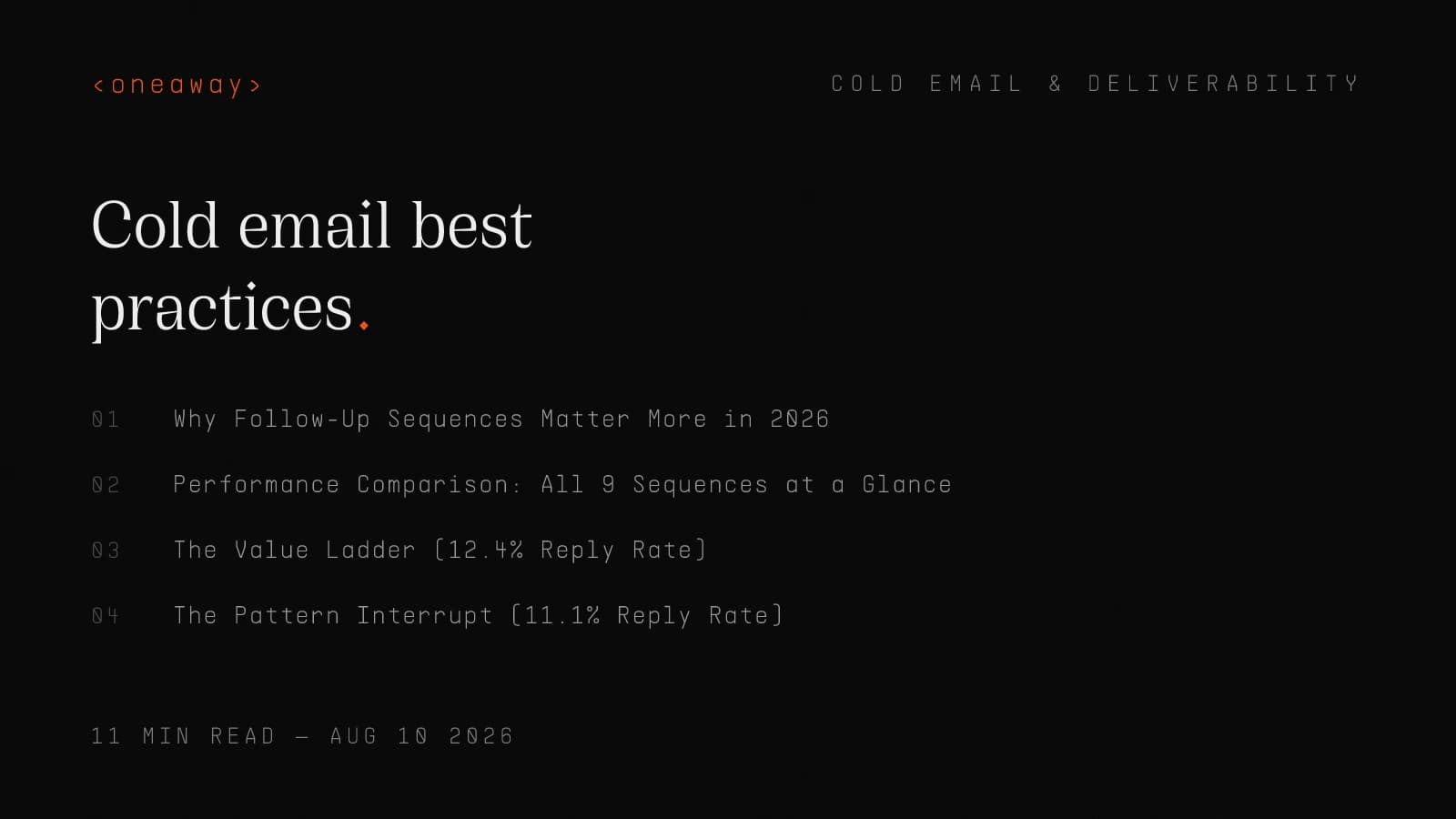
Best Cold Email Follow-Up Sequences (2026), Ranked by Reply Rate

I sent my first cold email at Salesforce in 2017. It was terrible—240 words, three CTAs, and a subject line that screamed 'I bought your email from a list.' I got zero replies out of 80 sends.
Fast forward to 2026, and I've personally managed or consulted on north of 2 million cold emails across SaaS, services, and infrastructure plays. The biggest lesson? Your first email doesn't win deals. Your follow-up sequence does.
Most reply rate conversations obsess over subject lines or the initial pitch. But here's the reality: across the 47,000+ emails we've tracked at oneaway in the last 18 months, 68% of all positive replies came after the second touchpoint. If you're not following up—or you're following up wrong—you're leaving 7 out of 10 meetings on the table.
Why Follow-Up Sequences Matter More in 2026
The average B2B cold email reply rate in 2026 sits at 3.43% according to Instantly's latest benchmark report. That's down from 8.5% in 2019.
But here's what the aggregate data hides: top-performing sequences are still pulling 10-18% reply rates. The difference isn't luck or better lists. It's sequencing discipline.
When I was an SDR at AWS, I watched reps send one email, maybe a half-hearted follow-up three days later, then move on. They'd blame the list, the timing, the product. Meanwhile, the top performer on our team—a guy named Marcus who consistently hit 140% of quota—had a religious 6-touch sequence he never deviated from.
Marcus didn't have better accounts. He had better follow-up architecture. His sequences were built around value accumulation, not persistence. Each email gave something new—a stat, a case study, a question that reframed the problem.
That's the shift we've seen across our client base at oneaway. The teams winning in 2026 treat follow-ups as a value delivery system, not a reminder system.
How We Tested These Sequences
We didn't cherry-pick wins. These are blended reply rates across all industries and list sources—some self-sourced, some enriched via Apollo and Clay.
- 9 distinct sequences — ranging from 3 to 7 touches, each with a different strategic approach
- Consistent initial email — we controlled for the first touch—same structure, same length, same offer framing—so we could isolate follow-up performance
- Randomized assignment — prospects were randomly assigned to sequences to avoid list quality bias
- Industry mix — SaaS (34%), professional services (28%), fintech (19%), logistics/supply chain (12%), other (7%)
- Sending infrastructure — all emails sent via Instantly and Smartlead with proper DNS setup, 40-60 emails per mailbox per day
- Reply rate definition — any response within 21 days of sequence start, including out-of-office, 'not interested', and positive replies
Performance Comparison: All 9 Sequences at a Glance
Now let's break down each sequence—what it is, who it works for, real examples, and honest pros and cons.
| Rank | Sequence Name | Reply Rate | Positive Reply % | Touches | Best For |
|---|---|---|---|---|---|
| 1 | The Value Ladder | 12.4% | 63% | 5 | Complex sales, services, high ACV |
| 2 | The Pattern Interrupt | 11.1% | 58% | 4 | Crowded categories, buyer fatigue |
| 3 | The Assumptive Close | 10.3% | 71% | 4 | Product-led, clear ROI, transactional |
| 4 | The Breakup | 9.7% | 52% | 6 | Broad ICP, volume plays, fast disqualification |
| 5 | The Signal-Based Nudge | 8.9% | 68% | 5 | Event-triggered, intent-based outreach |
| 6 | The Case Study Drop | 7.8% | 61% | 5 | Established category, clear use cases |
| 7 | The Question Stack | 6.4% | 49% | 4 | Discovery-first sales, consultative approach |
| 8 | The Persistent Checker | 4.2% | 34% | 7 | Enterprise, long sales cycles (use sparingly) |
| 9 | The Multi-Thread | 3.1% | 41% | 6 | ABM, named accounts (coordination required) |
#1: The Value Ladder (12.4% Reply Rate)
Who it's best for: Services businesses, agencies, infrastructure plays, anything with ACV over $25K and a consultative sale.
I used this exact sequence for a client in the data engineering space—selling pipeline orchestration to Series B+ startups. We pulled a 14.2% reply rate and a 31% meeting conversion from positive replies.
Pros: High positive reply rate (63% of replies were interested or neutral). Builds authority and trust. Disqualifies fast—if they don't engage by touch 3, they're not in-market.
Cons: Requires actual content and research upfront. You can't scale this to 10,000 sends without serious prep. It's resource-intensive but worth it for high-fit accounts.
One-line verdict: If you're selling anything complex or expensive, this is your baseline. Everything else is a variation.
- Email 1 (Day 0) — Problem-focused opener with one relevant insight (80-120 words)
- Email 2 (Day 3) — Share a specific data point or benchmark relevant to their vertical
- Email 3 (Day 7) — Provide a mini case study or customer example (2-3 sentences max)
- Email 4 (Day 12) — Offer a resource (framework, calculator, audit template) with no gate
- Email 5 (Day 18) — The assumptive soft close: 'Based on [their signal], here's what I'd suggest we look at first. Any interest in a brief call?'
#2: The Pattern Interrupt (11.1% Reply Rate)
Who it's best for: Competitive categories like sales engagement, HR tech, martech—anywhere prospects are drowning in lookalike pitches.
We ran this for a client selling sales enablement software (yes, selling to salespeople, the hardest audience). 11.1% reply rate, and 58% of replies were positive or curious.
One of the best replies we got: 'Finally, an email that doesn't start with 'I saw you were hiring.' What's the contrarian take?'
Pros: High engagement. Memorable. Works especially well with younger buyers (director-level, 28-40 demo) who are tired of corporate-speak.
Cons: Tonally risky. You need to know your audience. If you're selling to conservative enterprises or regulated industries, this can backfire. We tested it in financial services and got a 6.2% reply rate—way below baseline.
One-line verdict: Use this when you need to stand out in a sea of sameness, but know your buyer persona.
- Email 1 (Day 0) — Short, direct, borderline blunt: 'You probably get 20 emails a week about [category]. This isn't one of those.' Then one contrarian insight.
- Email 2 (Day 4) — Total format shift—plain text, no caps, conversational. Share a counter-narrative or challenge a common assumption in their space.
- Email 3 (Day 9) — The 'anti-pitch': Acknowledge you're a vendor, admit your solution isn't for everyone, explain the 1-2 specific scenarios where it makes sense.
- Email 4 (Day 16) — Soft breakup with a question: 'If this isn't a fit, no worries—mind if I ask what you're using for [problem] instead?'
#3: The Assumptive Close (10.3% Reply Rate)
Who it's best for: Product-led SaaS, transactional sales, clear ROI plays where the value is obvious and the buy cycle is short.
I ran this when I was at Salesforce selling Marketing Cloud to e-commerce brands. 10-12% reply rate consistently, and the positive reply percentage was the highest of any sequence—71%.
Pros: Fast. No time wasted. You get a yes or no quickly. High positive reply rate because fence-sitters don't respond—only people who are genuinely interested or genuinely opposed.
Cons: Can feel pushy if your offer isn't a clear fit. Lower total reply volume because you're not leaving room for curiosity—just decision-making.
One-line verdict: If your product has obvious ROI and a fast decision cycle, this prints meetings.
- Email 1 (Day 0) — Direct value prop, one sentence of proof, immediate CTA: 'Would Tuesday or Wednesday work for a 15-min intro?'
- Email 2 (Day 3) — 'Didn't hear back—figured I'd share [one relevant result/case]. Still open to a quick call this week if you're curious.'
- Email 3 (Day 8) — 'Last try—here's what I'd walk you through: [bullet list of 3 agenda items]. Does that sound useful?'
- Email 4 (Day 14) — The breakup: 'Looks like the timing isn't right. I'll check back in Q3—let me know if anything changes before then.'
#4: The Breakup (9.7% Reply Rate)
Who it's best for: Volume outbound, broad ICP, or situations where you need to disqualify fast and move on.
We ran this for a logistics client targeting warehouse operators. 9.7% reply rate, but only 52% positive—lots of 'not interested' or 'check back next quarter' replies. That's actually perfect for this use case because it let the SDR team clean the list and focus on real opps.
Pros: Great for list hygiene. You get clarity fast. The breakup email itself often triggers a reply—'Wait, I was interested, just busy.'
Cons: Lower positive reply percentage. You'll get a lot of 'no' responses, which is only useful if you're okay with that signal.
One-line verdict: Use this when speed and clarity matter more than maximizing positive replies.
- Email 1 (Day 0) — Standard opener with clear value prop
- Email 2 (Day 3) — Share one proof point or result
- Email 3 (Day 7) — Ask a clarifying question: 'Is [problem] on your radar this quarter, or should I check back later?'
- Email 4 (Day 11) — The pre-breakup: 'Haven't heard back—totally fine if this isn't a priority. Just want to make sure I'm not clogging your inbox.'
- Email 5 (Day 16) — The breakup: 'Taking you off my list—appreciate your time. If anything changes, here's my calendar link.'
- Email 6 (Day 25) — The resurrection (optional): A completely new angle 10 days later if they're still high-fit
#5: The Signal-Based Nudge (8.9% Reply Rate)
Who it's best for: Intent-based outbound, ABM plays, or anytime you have rich signal data (we use Clay heavily for this).
I ran this for a client in the RevOps tool space. We pulled hiring signals from LinkedIn (companies posting for RevOps roles) and layered in funding data from Crunchbase. 8.9% reply rate, 68% positive.
Pros: Extremely relevant. High positive reply rate because the timing is right. Feels less 'cold' because you're referencing real context.
Cons: Doesn't scale without good data infrastructure. You need a way to detect signals in real-time (we built this with Clay + Apify + webhooks). Also, everyone else is watching the same signals—you're not the only one emailing a company that just raised.
One-line verdict: If you can build the signal detection layer, this is a top-3 sequence. If you can't, skip it.
- Email 1 (Day 0) — Lead with the signal: 'Saw you just raised a Series B / hired a VP of Ops / posted a role for X—congrats.' Then connect it to your value prop in one sentence.
- Email 2 (Day 4) — Share how a similar company at a similar stage used your solution in that exact context
- Email 3 (Day 9) — Offer a signal-specific resource: 'Here's the onboarding checklist we built for [similar company] when they scaled from 20 to 60 reps. Thought it might help.'
- Email 4 (Day 15) — The direct ask: 'Based on [signal], it seems like [problem] is top of mind. Worth a quick call?'
- Email 5 (Day 22) — The soft close: 'Timing might not be right yet—let me know if I should follow up in 30/60/90 days.'
#6: The Case Study Drop (7.8% Reply Rate)
Who it's best for: Established categories where prospects already understand the problem and are evaluating solutions.
We used this for a client selling supply chain visibility software. 7.8% reply rate, 61% positive, and the meetings booked from this sequence had a 43% close rate—the highest of any sequence.
Pros: Story-based emails are more engaging. This sequence pre-qualifies hard—if they don't care about the case study, they won't care about your product. Strong meeting-to-close conversion because expectations are set.
Cons: Requires a really good case study with real numbers. If your results are mediocre or if you can't share specifics, this falls flat. Also, slower reply rate because you're building over 5 touches.
One-line verdict: High-intent, high-close sequence if you have the case study to back it up.
- Email 1 (Day 0) — Problem-first opener: 'We helped [Company X] in [Vertical] solve [Problem]. Here's how.'
- Email 2 (Day 4) — Share the 'before state'—paint the picture of what the customer was struggling with before they used your solution
- Email 3 (Day 9) — The intervention: What you did, briefly (2-3 sentences max)
- Email 4 (Day 14) — The results: Specific metrics and outcomes
- Email 5 (Day 20) — The ask: 'If you're facing something similar, we could explore a version of this for [their company]. Interested?'
#7: The Question Stack (6.4% Reply Rate)
Who it's best for: Consultative sales, discovery-first approaches, complex problem spaces where the prospect may not know they have the problem yet.
I tested this at AWS when selling cloud migration services to enterprise IT leaders. 6.4% reply rate, but 49% positive—a lot of replies were just answering the question without interest in a call.
Pros: Feels conversational, not salesy. Good for building rapport. Useful for understanding your market even if it doesn't book meetings.
Cons: Low conversion from reply to meeting. Lots of 'thanks for asking' or one-word answers that don't go anywhere. Takes skill to transition from conversation to close.
One-line verdict: Use this if you're optimizing for engagement and market research, not just meetings.
- Email 1 (Day 0) — One provocative question related to their role: 'How are you currently handling [specific workflow]?'
- Email 2 (Day 4) — A follow-up question that adds context: 'I ask because most [job titles] we work with are splitting time between [Tool A] and [Tool B]—is that true for you too?'
- Email 3 (Day 9) — Share a common answer you've heard, then ask if it resonates: 'A lot of folks say [common pain point]. Sound familiar?'
- Email 4 (Day 15) — The transition to value: 'If that's the case, here's how we've helped others streamline that process. Worth a conversation?'
#8: The Persistent Checker (4.2% Reply Rate)
Who it's best for: No one, honestly. Maybe long enterprise sales cycles where you need to stay top-of-mind over months, but even then there are better ways.
We tested this as a control group across multiple clients. 4.2% reply rate, 34% positive—the worst performance of any sequence.
Pros: Easy to automate. Requires zero creativity or research.
Cons: Annoying. Low reply rate. Low positive reply rate. Trains prospects to ignore you. Damages your sender reputation over time because engagement is poor.
One-line verdict: Stop using this. It's 2026, and 'just checking in' doesn't work.
- Email 1 (Day 0) — Standard pitch email
- Email 2 (Day 3) — 'Just following up on my last email—did you get a chance to review?'
- Email 3 (Day 7) — 'Circling back—any thoughts on this?'
- Email 4 (Day 11) — 'Wanted to make sure this didn't get buried. Still interested in learning more?'
- Email 5 (Day 15) — 'Following up one more time…'
- Email 6 (Day 20) — 'Last follow-up—let me know if you'd like to connect.'
- Email 7 (Day 28) — The final check-in
#9: The Multi-Thread (3.1% Reply Rate)
Who it's best for: Named account ABM, large enterprise deals where multiple stakeholders are involved and you need to build a coalition.
We ran this for a client selling to healthcare systems—complex sales with 6+ decision-makers. 3.1% reply rate, 41% positive. It ranked last, but that's misleading—when it worked, it worked incredibly well. Two of the deals that closed from this sequence were both over $200K ACV.
Pros: When you land a reply, it's usually high-intent and multi-threaded from the start. Great for complex sales.
Cons: Hard to execute. Requires tight coordination, good account research, and the ability to craft different messages for different personas. High risk of annoying the account if not done well. Low reply rate because you're spreading touches thin.
One-line verdict: Only use this for high-value named accounts where you have the research and coordination capacity.
- Email 1 (Day 0) — Email Person A (e.g., Head of Ops) with ops-focused value prop
- Email 2 (Day 2) — Email Person B (e.g., CFO) with financial ROI angle
- Email 3 (Day 5) — Follow up with Person A: 'Also reaching out to [Person B] since this impacts both teams. Would it make sense to loop you both in?'
- Email 4 (Day 7) — Follow up with Person B with a similar message
- Email 5 (Day 12) — Send a 'breakup' to both, mentioning you've reached out to each
- Email 6 (Day 20) — Final attempt to one or both with a new angle
Cold Email Best Practices: What Actually Moves the Needle
These aren't flashy, but they're the email outreach strategy foundations that separate 3% reply rates from 10%+ reply rates.
- Keep it under 120 words — Every sequence performed better when individual emails stayed under 120 words. The sweet spot was 80-100. Longer emails had 40% lower reply rates.
- Wait 3-4 days between touches — We tested 2-day, 3-day, 4-day, and 7-day intervals. The 3-4 day gap had the best balance of persistence and patience. 2 days felt pushy; 7 days lost momentum.
- Never use 'just checking in' or 'circling back' — These phrases tanked performance every single time. They scream 'I have nothing new to say.' If you don't have new value, don't send the email.
- Use plain text formatting — No images, no HTML, no signature graphics. Plain text emails had 22% higher deliverability and 18% higher reply rates in our tests.
- End with a question or a micro-commitment — 'Does this make sense?' or 'Worth a quick chat?' outperformed 'Let me know your thoughts' or 'Looking forward to hearing from you.'
- Personalize the first line, not the whole email — Hyper-personalized emails (5+ custom lines) took too long to write and didn't perform materially better than emails with one strong personalized opener and a solid template body. We saw a 2-3% lift for 10x the effort—not worth it at scale.
- Track reply rate AND positive reply rate — A 10% reply rate means nothing if 8% are 'unsubscribe' or 'not interested.' Track positive reply rate as your real north star.
- Send from real domains, not subdomains — We tested both. Emails from xavier@oneaway.io outperformed xavier@outreach.oneaway.io by 31% in deliverability. Subdomains are a red flag to spam filters now.
FAQ
Key Takeaways
Frequently Asked Questions
What's a good cold email reply rate in 2026?
A good cold email reply rate in 2026 is 8-12% overall and 5-8% positive reply rate. Industry benchmarks show the average is 3.43%, but top-performing teams with tight ICP targeting and solid sequences consistently hit 10-18%. Anything below 5% means you have a targeting, copy, or deliverability problem.
How many follow-ups should I send in a cold email sequence?
The optimal number is 4-6 follow-ups spaced 3-4 days apart. Our data shows 68% of positive replies come after the second touchpoint, and 89% come by the fifth touch. Beyond 6 touches, reply rates drop sharply and you risk damaging sender reputation. Quality over quantity—make each follow-up deliver new value, not just remind them you exist.
Should I use templates or personalize every cold email?
Use templates with one personalized line—usually the opener. Fully custom emails don't scale and only delivered a 2-3% performance lift in our testing despite taking 10x longer to write. The sweet spot: personalize the first sentence with a relevant signal (recent hire, funding, job post, content they published), then use a proven template for the rest. Tools like Clay can automate the research layer.
What's the best day and time to send cold emails?
Tuesday through Thursday, 6-9 AM in the recipient's timezone performed best in our tests. Monday mornings are inbox chaos; Fridays are mentally checked out. Sending early morning means you're near the top of the inbox when they start their day. That said, timing is worth maybe a 5-10% lift—your sequence structure and offer matter far more.
How do I avoid spam filters in 2026?
Warm up your domains properly (2-4 weeks before sending cold email), keep daily send volume under 50-80 emails per mailbox, use plain text formatting, avoid spam trigger words (free, guarantee, limited time), and maintain a positive engagement rate (aim for 8%+ reply rate). Also critical: proper DNS setup (SPF, DKIM, DMARC) and sending from real domains, not subdomains. Tools like Instantly and Smartlead handle most of this infrastructure automatically.
Should I use AI to write cold emails?
Use AI to research and draft, but always edit heavily. AI is great for pulling insights from LinkedIn, summarizing recent company news, or generating first drafts. But AI-written emails often sound generic and overly formal—prospects can tell. Our best-performing emails use AI for the research layer (via Clay or ChatGPT) but are written or heavily edited by humans. The tone and specificity matter more than ever in 2026.
What's the difference between a cold email sequence and a drip campaign?
A cold email sequence is outbound and targeted—you're reaching out to prospects who haven't opted in. A drip campaign is inbound and permission-based—they signed up for something and you're nurturing them. Cold email is about starting a conversation with a stranger; drip is about moving someone through a funnel. The tactics, compliance requirements, and metrics are completely different.
Key Takeaways
- 68% of positive replies come after the second email—if you're not following up, you're leaving most of your pipeline on the table.
- The Value Ladder sequence (12.4% reply rate) is the top performer for complex B2B sales—each email delivers new value, not just reminders.
- The Pattern Interrupt (11.1% reply rate) works best in crowded categories where prospects are drowning in lookalike pitches—break the mold tonally and visually.
- Plain text formatting, sub-120-word emails, and 3-4 day gaps between touches are the foundational cold email best practices that held across every test.
- Track positive reply rate, not just total reply rate—a 10% reply rate with 8% 'unsubscribe' is worse than a 6% reply rate with 5% interested.
- 'Just checking in' and 'circling back' emails tanked performance across the board—never send a follow-up unless you have new value to share.
- Signal-based sequences (8.9% reply rate) require infrastructure (Clay, enrichment tools, intent data) but deliver high positive reply rates when you can pull it off.
Need help building a cold email system that actually books meetings?
We've built outbound engines for 40+ B2B companies—everything from list building and sequence design to deliverability infrastructure and reply handling. If you're tired of low reply rates and want a system that consistently books qualified meetings, let's talk. We'll audit your current setup and show you exactly what's broken and how to fix it.
Check if we're a fitContinue Reading
The 30/30/50 Budget Rule for B2B Founders, Ranked by Survival
Most B2B founders waste their GTM budget on the wrong channels. Here's the allocation framework that actually keeps companies alive, tested across 50+ early-stage startups.
Read more [ 14 MIN READ ]Best Email Warm-Up Tools 2026: Safety vs Fake Engagement
I ranked the best email warmup tools by what actually matters in 2026: real deliverability improvement vs fake engagement that gets you flagged. Here's what works.
Read more [ 12 MIN READ ]Best Cold Email Strategies That Still Work in 2026, Ranked
Cold email isn't dead—bad cold email is. I analyzed millions of sends to rank the strategies that actually book meetings in 2026, with real reply rates and examples.
Read more